Solution:
Concept: A lever is a rigid bar that turns about a fixed point, the fulcrum F. Its class depends on what lies in the middle: the fulcrum (class I), the load (class II) or the effort (class III). When it balances, effort × effort arm = load × load arm, so M.A. = effort arm ÷ load arm.
Step 1 — Part (i): find the fulcrum, load and effort.
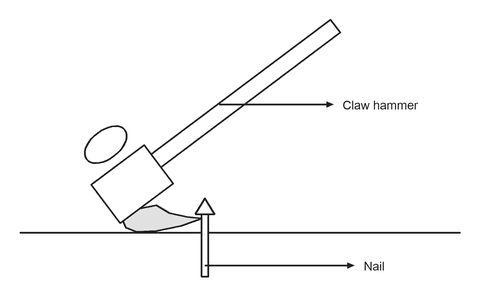
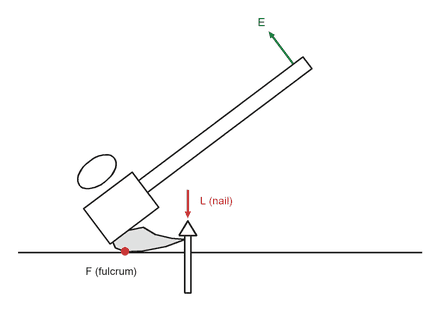
The head of the hammer rests on the surface, and the hammer turns about this point: it is the fulcrum F. The nail's resistance acts at the claw: it is the load L. The hand pulls at the far end of the handle: it is the effort E.
Step 2 — Part (i): name the class.
Along the hammer, the head (the fulcrum) lies between the claw (the load) and the handle (the effort). A lever with the fulcrum in the middle is a class I lever. The handle is much longer than the claw, so the effort arm is longer than the load arm and a small effort pulls out a firmly fixed nail.
Step 3 — Part (ii): another class I lever with M.A. > 1.
We need a class I lever whose effort arm is longer than its load arm. A crowbar is one: the fulcrum is near the load at the short end, and the effort is applied at the long end. A pair of pliers, or shears for cutting metal sheets (long handles, short blades), are other examples.
Watch out: A class I lever does not always have M.A. > 1; scissors with long blades have M.A. < 1, so they are not a correct example here.
Therefore, (i) the claw hammer is a class I lever; (ii) a crowbar (or a pair of pliers) is a class I lever with M.A. > 1.