
Question 112 marksAsked 2020Easy
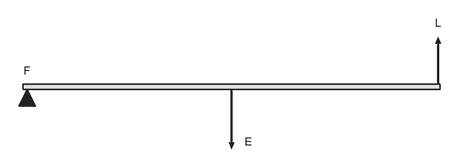
(i) Identify the class of the lever shown in the diagram below:
(ii) How is it possible to increase the M.A. of the above lever without increasing its length?
Confirming your payment
Sign up now and get 250 free tokens.
Previous Year Questions · Question 11 of 31
(i) Identify the class of the lever shown in the diagram below:
(ii) How is it possible to increase the M.A. of the above lever without increasing its length?
Solution:
Concept: A lever is a rigid bar that turns about a fixed point, the fulcrum F. Its class depends on what lies in the middle: the fulcrum (class I), the load (class II) or the effort (class III). When it balances, effort × effort arm = load × load arm, so M.A. = effort arm ÷ load arm.
Step 1 — Part (i): see what lies in the middle.
In the figure the fulcrum F is at one end and the load L at the other end, with the effort E between them. A lever with the effort in the middle is a class III lever. Its effort arm is shorter than its load arm, so its M.A. is less than 1.
Step 2 — Part (ii): lengthen the effort arm.
The length of the lever stays the same, so the load arm (F to L) cannot change. To raise the M.A. we apply the effort farther from the fulcrum, that is, we shift the point of effort towards the load. The effort arm becomes longer, so
increases.
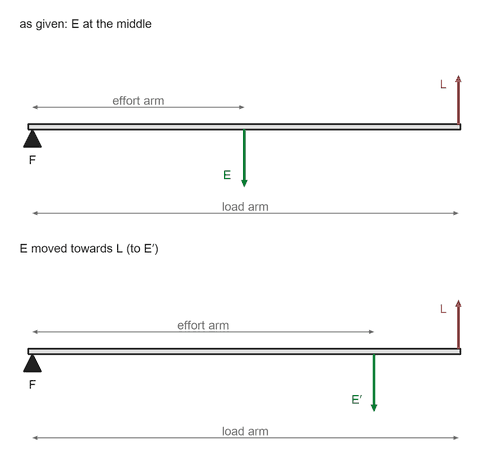
Watch out: Moving the effort towards the load raises the M.A., but it stays less than 1 while the effort is still between F and L.
Therefore, (i) it is a class III lever; (ii) its M.A. can be increased by applying the effort farther from the fulcrum (closer to the load), which lengthens the effort arm.