Solution:
Concept: Mechanical advantage (M.A.) is load ÷ effort. Velocity ratio (V.R.) is the velocity of the effort ÷ the velocity of the load, which is the distance moved by the effort ÷ the distance moved by the load in the same time. Efficiency η is work output ÷ work input, and it works out to M.A. ÷ V.R. Work = force × distance moved in the direction of the force.
Given: V.R. = 4; load L = 175 kgf; height through which the load is lifted, dL = 15 m; effort E = 50 kgf downward; g = 10 N kg⁻¹.
Step 1 — Part (i): distance moved by the effort.
The effort moves V.R. times as far as the load:
dE=V.R.×dL=4×15 m=60 m
Step 2 — Part (ii): change the effort into newtons.
Work in joule needs the force in newton, and 1 kgf = 10 N here:
E=50×10 N=500 N
Step 3 — Part (ii): work done by the effort.
Work is force times the distance moved in its direction:
W=E×dE=500 N×60 m=30,000 J
Step 4 — Part (iii): mechanical advantage.
The M.A. is the load divided by the effort, both in kgf:
M.A.=50 kgf175 kgf=3.5
Step 5 — Part (iv): efficiency.
The efficiency is the M.A. divided by the V.R.:
η=43.5×100%=87.5%
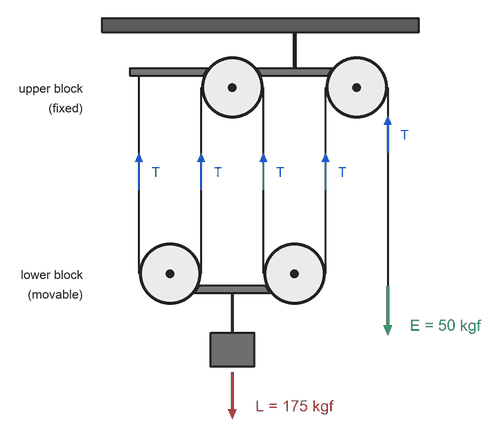
Step 6 — Check with the work.
The useful work lifts 1750 N through 15 m:
work output=1750 N×15 m=26,250 J
30,00026,250×100%=87.5%
The remaining 3,750 J is spent against friction and in lifting the lower block.
Watch out: Change kgf into newton before working out the work in joule; the M.A. needs no change, as both forces are in kgf.
Therefore, (i) the effort moves 60 m; (ii) the work done by the effort is 30,000 J; (iii) M.A. = 3.5; (iv) efficiency = 87.5%.
