Solution:
Concept: (i) In an ideal pulley system the string is light and slides without friction, so the tension T is the same all along one string. Every strand that holds up a movable pulley pulls it up with T, and the effort pulls the free end with E = T. A fixed pulley only changes the direction of the force; a movable pulley hangs in two strands, so they share its load. (ii) 'Uniform' means constant speed; the direction may or may not change. (iii) A heavy nucleus releases energy when it splits.
Given: Load 50 kgf lifted to the same height by both boys.
Step 1 — Part (i): fixed pulley.
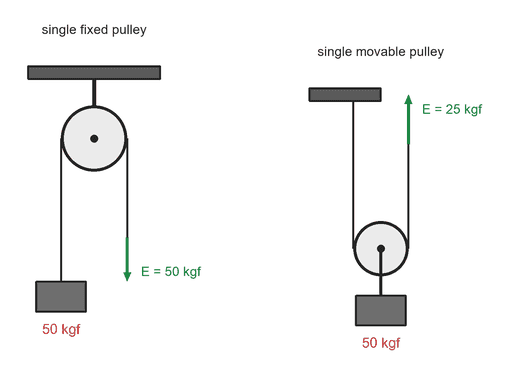
With a single fixed pulley the load hangs on one strand and the effort pulls the other strand of the same string, so (ideally) the effort equals the load: 50 kgf.
Step 2 — Part (i): movable pulley.
A single movable pulley hangs in two strands, each with tension T, which share the load. The effort pulls one strand, so it equals T:
2T=50 kgf
E=T=250 kgf=25 kgf
Step 3 — Part (i): compare.
We divide the two efforts:
EmovableEfixed=25 kgf50 kgf=12
The ideal M.A. of a single fixed pulley is 1, and that of a single movable pulley is 2, because two strands share the load. (In practice the second boy needs a little more than 25 kgf, as he also lifts the pulley and works against friction.)
Step 4 — Part (ii): compare the two motions.
In uniform linear motion a body moves in a straight line with constant speed, so its velocity is constant and it has no acceleration. In uniform circular motion the speed is constant, but the direction of motion (along the tangent) changes at every point. So the velocity changes all the time and the motion is accelerated, which needs a force towards the centre (the centripetal force).
Step 5 — Part (iii): the nuclear process.
Electricity is produced from nuclear energy by nuclear fission. A heavy nucleus such as uranium-235 absorbs a slow neutron and splits into two lighter nuclei, releasing a large amount of energy and more neutrons. In a nuclear power station a controlled chain reaction of fission heats water into steam, and the steam turns the turbines of the generators.
Watch out: The fixed pulley does not reduce the effort; it only lets the boy pull downward.
Therefore, (i) the boy with the fixed pulley applies 50 kgf and the other 25 kgf, a ratio of 2 : 1, because a movable pulley's two strands share the load (ideal M.A. 2, not 1); (ii) uniform linear motion has constant velocity and no acceleration, while uniform circular motion has a continuously changing direction, so it is accelerated; (iii) nuclear fission.
