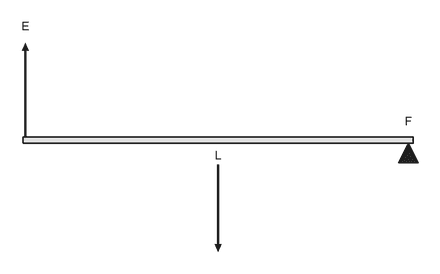
Solution:
Concept: A lever is a rigid bar that turns about a fixed point, the fulcrum F. Its class depends on what lies in the middle: the fulcrum (class I), the load (class II) or the effort (class III). When it balances, effort × effort arm = load × load arm, so M.A. = effort arm ÷ load arm.
Step 1 — Part (i): see what lies in the middle.
In the figure the effort E acts at one end and the fulcrum F is at the other end, with the load L between them. A lever with the load in the middle is a class II lever.
Step 2 — Part (ii): what stays the same.
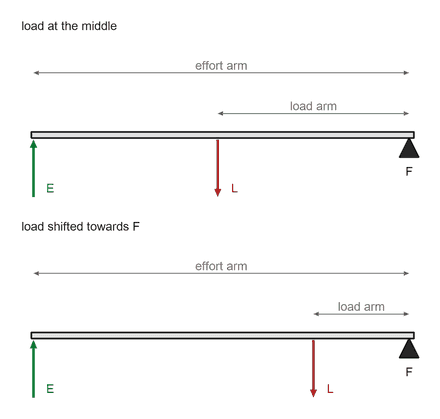
The effort still acts at the same point, so the effort arm (F to E) does not change.
Step 3 — Part (ii): what changes.
Moving the load towards the fulcrum makes the load arm (F to L) shorter. Since
M.A.=load armeffort arm
a smaller load arm gives a larger M.A.: a smaller effort now balances the same load.
Step 4 — Use the figure's numbers.
In the figure the load is at the middle, so the effort arm is about twice the load arm (M.A. about 2). Halving the load arm would make the M.A. about 4.
Watch out: The length of the lever is fixed; only the load arm changes here.
Therefore, (i) it is a class II lever; (ii) the mechanical advantage increases, because the load arm becomes shorter while the effort arm stays the same.