
Opening your dashboard
Class 10 Maths Chapter 4 Linear Inequations: Previous Year Questions
16 questions on Chapter 4, each solved step by step. Class 10 Maths, ICSE 2026-27.
16 questions with solutions
1–3 marks · Mixed difficulty
The first 11 solutions are on this page. This chapter is a long one, so the rest open on their own page to keep this one quick to load.
- 13 marks
Question 1
Solve the following inequation, write the solution set and represent it on the number line.
Solve with AIWritten solution
Solution:
Concept: A double inequation such as is two inequations joined by and. If is only in the middle part, the same operation is done on all three parts at once; if is in more than one part, it is split into two inequations, each is solved, and only the values that satisfy both are kept.
An inequation is solved like an equation, with one extra rule. Adding or subtracting the same number on both sides, or multiplying or dividing both sides by the same positive number, keeps the sign of inequality. Multiplying or dividing both sides by a negative number reverses the sign (< becomes >, ≤ becomes ≥).
Step 1 — Solve the first inequation.
appears in all three parts, so we split the double inequation into two inequations joined by and. The first inequation is:
Multiplying out the bracket:
Adding to both sides (this keeps the term positive):
Subtracting 21 from both sides:
Dividing both sides by 4 (positive, so the sign stays the same):
Step 2 — Solve the second inequation.
The second inequation is:
Multiplying both sides by 3 to clear the fraction (3 is positive, so the sign stays the same):
Adding to both sides:
Subtracting 1 from both sides:
Dividing both sides by 22:
Reading it from the other side:
Step 3 — Combine the two results.
must be at least and less than 2. The two number lines below show each result; the solution is the part where they overlap.

Step 4 — Write the solution set and represent it.
Since , the solution set is . Here , halfway between −2 and −1.

The number line shows a filled circle at ( is included), a hollow circle at 2 (2 is not included) and a thick line between them.
Check: gives , which is true; gives , which is true; gives , which is false.
Watch out: Decide each end point separately: ≤ or ≥ gives a filled circle, < or > gives a hollow circle.
Therefore, the solution set is , as shown on the number line.
- 23 marks
Question 2
Solve the following inequation and represent the solution set on a number line.
Solve with AIWritten solution
Solution:
Concept: A double inequation such as is two inequations joined by and. If is only in the middle part, the same operation is done on all three parts at once; if is in more than one part, it is split into two inequations, each is solved, and only the values that satisfy both are kept. Dividing all three parts by a negative number reverses both signs.
The replacement set is the set the values of are taken from: = {1, 2, 3, …} (natural numbers), = {0, 1, 2, 3, …} (whole numbers), or = {…, −2, −1, 0, 1, 2, …} (integers) and (all real numbers). The solution set is made of those members of the replacement set that satisfy the inequation.
Step 1 — Write the mixed numbers as fractions.
We change into and into .
The given inequation is:
Writing the mixed numbers as fractions:
Step 2 — Add 1/2 to all three parts.
is only in the middle part, so we add to all three parts to leave only the term in the middle.
Adding to all three parts:
Step 3 — Divide all three parts by −4.
Since −4 is negative, both signs reverse.
Dividing by −4 and reversing both signs:
Writing it with the smaller number first:
On the real number line this is every number from −2 (included) up to 2 (not included):

Step 4 — Pick the integers.
, the integers. −2 is included (≤) and 2 is not included (<), so the integers in the range are −2, −1, 0 and 1.

The number line shows separate dots at −2, −1, 0, 1; no thick line, because can only be an integer.
Check: gives , which is true; gives , which is false.
Watch out: After dividing by −4, the end that was “≤ 8” becomes “≥ −2”, so −2 (not 2) is the included end point.
Therefore, the solution set is , shown as dots on the number line.
- 33 marks
Question 3
Solve the following inequation, write down the solution set and represent it on the real number line :
Solve with AIWritten solution
Solution:
Concept: A double inequation such as is two inequations joined by and. If is only in the middle part, the same operation is done on all three parts at once; if is in more than one part, it is split into two inequations, each is solved, and only the values that satisfy both are kept.
The replacement set is the set the values of are taken from: = {1, 2, 3, …} (natural numbers), = {0, 1, 2, 3, …} (whole numbers), or = {…, −2, −1, 0, 1, 2, …} (integers) and (all real numbers). The solution set is made of those members of the replacement set that satisfy the inequation.
Step 1 — Solve the first inequation.
appears in all three parts, so we split the double inequation into two inequations joined by and. The first inequation is:
Subtracting from both sides (this keeps the term positive):
Subtracting 10 from both sides:
Dividing both sides by 3 (positive, so the sign stays the same):
Reading it from the other side:
Step 2 — Solve the second inequation.
The second inequation is:
Subtracting from both sides:
Subtracting 10 from both sides:
Dividing both sides by 3:
Step 3 — Combine the two results.
must be at least −4 and less than . The two number lines show each result; the solution is where they overlap.
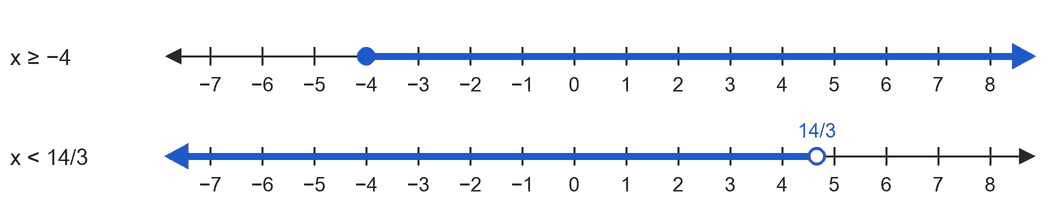
Step 4 — Pick the integers.
, the integers. −4 is included, and the largest integer below is 4, so the solution set is {−4, −3, −2, −1, 0, 1, 2, 3, 4}.

The number line shows separate dots at −4, −3, −2, −1, 0, 1, 2, 3, 4; no thick line, because can only be an integer.
Check: gives , which is true; gives , which is true; gives , which is false.
Watch out: is not an integer. The largest integer less than is 4, not 5.
Therefore, the solution set is , shown as dots on the number line.
- 43 marks
Question 4
Solve the following inequation and write down the solution set:
Represent the solution on a real number line.
Solve with AIWritten solution
Solution:
Concept: A double inequation such as is two inequations joined by and. If is only in the middle part, the same operation is done on all three parts at once; if is in more than one part, it is split into two inequations, each is solved, and only the values that satisfy both are kept.
The replacement set is the set the values of are taken from: = {1, 2, 3, …} (natural numbers), = {0, 1, 2, 3, …} (whole numbers), or = {…, −2, −1, 0, 1, 2, …} (integers) and (all real numbers). The solution set is made of those members of the replacement set that satisfy the inequation.
Step 1 — Solve the first inequation.
appears in all three parts, so we split the double inequation into two inequations joined by and. The first inequation is:
Subtracting from both sides (this keeps the term positive):
Subtracting 4 from both sides:
Dividing both sides by 4 (positive, so the sign stays the same):
Reading it from the other side:
Step 2 — Solve the second inequation.
The second inequation is:
Subtracting from both sides:
Subtracting 4 from both sides:
Dividing both sides by 2:
Step 3 — Combine the two results.
must be greater than −2 and at most 5. The two number lines show each result; the solution is where they overlap.

Step 4 — Pick the whole numbers.
, the whole numbers, which start at 0. So −1 is left out even though it is greater than −2, and 5 is included (≤). The solution set is {0, 1, 2, 3, 4, 5}.

The number line shows separate dots at 0, 1, 2, 3, 4, 5; no thick line, because can only be a whole number.
Check: gives , which is true; gives , which is true; gives , which is false.
Watch out: Whole numbers start at 0, so −1 is not in the solution set although it satisfies the inequation.
Therefore, the solution set is , shown as dots on the number line.
- 53 marks
Question 5
Solve the following inequation and represent the solution set on the number line.
Solve with AIWritten solution
Solution:
Concept: A double inequation such as is two inequations joined by and. If is only in the middle part, the same operation is done on all three parts at once; if is in more than one part, it is split into two inequations, each is solved, and only the values that satisfy both are kept.
An inequation is solved like an equation, with one extra rule. Adding or subtracting the same number on both sides, or multiplying or dividing both sides by the same positive number, keeps the sign of inequality. Multiplying or dividing both sides by a negative number reverses the sign (< becomes >, ≤ becomes ≥).
Step 1 — Solve the first inequation.
appears in all three parts, so we split the double inequation into two inequations joined by and. The first inequation is:
Multiplying both sides by 5 to clear the fraction (5 is positive, so the sign stays the same):
Subtracting from both sides:
Subtracting 20 from both sides:
Dividing both sides by 2:
Reading it from the other side:
Step 2 — Solve the second inequation.
The second inequation is:
Multiplying both sides by 2 to clear the fraction:
Subtracting from both sides:
Subtracting 8 from both sides:
Step 3 — Combine the two results.
must be greater than −5 and at most 2. The two number lines show each result; the solution is where they overlap.

Step 4 — Write the solution set and represent it.
Since , the solution set is .

The number line shows a hollow circle at −5 (−5 is not included), a filled circle at 2 (2 is included) and a thick line between them.
Check: gives , which is false; gives , which is true; gives , which is true.
Watch out: When you multiply a side by 5 or 2 to clear a fraction, multiply every term on that side, including the whole numbers.
Therefore, the solution set is , as shown on the number line.
- 61 mark
Question 6
The solution set of the inequation is
Solve with AIAnswer
(A)
(B)
- Correct
(C)
(D)
Answer: (C)
Concept: An inequation is solved like an equation, with one extra rule. Adding or subtracting the same number on both sides, or multiplying or dividing both sides by the same positive number, keeps the sign of inequality. Multiplying or dividing both sides by a negative number reverses the sign (< becomes >, ≤ becomes ≥). Because , the solution set is every real number in the range, not just the integers.
Step 1 — Add 3 to both sides.
We add 3 to both sides so that stands alone. Adding a number keeps the sign.
Adding 3 to both sides:
Step 2 — Write the solution set.
Since , every real number that is −2 or more is a solution.

The number line shows a filled circle at −2 (−2 is included) and a thick line with an arrow to the right of it.
Check: gives , which is true; gives , which is false.
Watch out: ≥ includes the end point, so −2 itself belongs to the solution set.
Why the other options are wrong:
- (A) : it uses > and so leaves out −2 itself. But gives , which is true, so −2 is a solution.
- (B) : the sign is the wrong way round. gives , which is false.
- (D) : it lists only five integers. , so numbers such as and 3 are solutions too: gives , which is true.
Therefore, the solution set is , option (C).
- 72 marks
Question 7
The solution set on the number line of the linear inequation is
Solve with AIAnswer
(A)

- Correct
(B)

(C)

(D)

Answer: (B)
Concept: A double inequation such as is two inequations joined by and. If the variable is only in the middle part, the same operation is done on all three parts at once; if the variable is in more than one part, it is split into two inequations, each is solved, and only the values that satisfy both are kept.
On a number line a filled circle ● means the end point is included (≤ or ≥) and a hollow circle ○ means it is not included (< or >). A thick line means every real number in that part is a solution, and an arrow means the solutions go on without end. Separate dots mean only those numbers (natural numbers, whole numbers or integers) are solutions.
Step 1 — Solve the first inequation.
appears in all three parts, so we split the double inequation. The first inequation is:
Subtracting from both sides:
Adding 6 to both sides:
Step 2 — Solve the second inequation.
The second inequation is:
Subtracting from both sides:
Reading it from the other side:
Step 3 — Combine and pick the natural numbers.
must be at least 2 and less than 8, so . Since , the solution set is {2, 3, 4, 5, 6, 7}: separate dots, with no thick line.
Check: gives , which is true; gives , which is true; gives , which is false.
Watch out: 8 is not a solution because the first sign is strict (<), but 2 is a solution because the second sign is ≤.
Why the other options are wrong:
- (A): its dots start at 1, but 1 is not a solution. gives , which is false.
- (C): its dots go up to 8, but 8 is not a solution. gives , which is false.
- (D): its dots run from 1 to 8, so it includes both 1 and 8, and neither is a solution.
Therefore, the number line with separate dots at 2, 3, 4, 5, 6 and 7 is the solution set, option (B).
- 81 mark
Question 8
The solution set for the inequation , is :
Solve with AIAnswer
(A)
- Correct
(B)
(C)
(D)
Answer: (B)
Concept: An inequation is solved like an equation, with one extra rule. Adding or subtracting the same number on both sides, or multiplying or dividing both sides by the same positive number, keeps the sign of inequality. Multiplying or dividing both sides by a negative number reverses the sign (< becomes >, ≤ becomes ≥).
The replacement set is the set the values of are taken from: = {1, 2, 3, …} (natural numbers), = {0, 1, 2, 3, …} (whole numbers), or = {…, −2, −1, 0, 1, 2, …} (integers) and (all real numbers). The solution set is made of those members of the replacement set that satisfy the inequation.
Step 1 — Subtract 4 from both sides.
We subtract 4 from both sides so that only the term is left on the left.
Subtracting 4:
Step 2 — Divide by 2.
We divide both sides by 2. Since 2 is positive, the sign stays the same.
Dividing by 2:
Step 3 — Pick the whole numbers.
, and the whole numbers start at 0. So the whole numbers up to and including 5 are 0, 1, 2, 3, 4 and 5.

The number line shows separate dots at 0, 1, 2, 3, 4, 5; no thick line, because can only be a whole number.
Check: gives , which is true; gives , which is true; gives , which is false.
Watch out: Whole numbers include 0, and the sign ≤ includes 5.
Why the other options are wrong:
- (A) : it leaves out 0, which is a whole number and a solution ( gives , which is true).
- (C) : it leaves out both 0 and 5, and each of them satisfies the inequation.
- (D) : it leaves out 5, but the sign ≤ includes 5 ( gives , which is true).
Therefore, the solution set is , option (B).
- 93 marks
Question 9
Solve the following inequation. Write down the solution set and represent it on the real number line.
, .
Solve with AIWritten solution
Solution:
Concept: A double inequation such as is two inequations joined by and. If is only in the middle part, the same operation is done on all three parts at once; if is in more than one part, it is split into two inequations, each is solved, and only the values that satisfy both are kept.
An inequation is solved like an equation, with one extra rule. Adding or subtracting the same number on both sides, or multiplying or dividing both sides by the same positive number, keeps the sign of inequality. Multiplying or dividing both sides by a negative number reverses the sign (< becomes >, ≤ becomes ≥).
Step 1 — Solve the first inequation.
appears in all three parts, so we split the double inequation into two inequations joined by and. The first inequation is:
Multiplying out the bracket:
Adding to both sides (this keeps the term positive):
Subtracting 45 from both sides:
Dividing both sides by 4 (positive, so the sign stays the same):
Step 2 — Solve the second inequation.
The second inequation is:
Adding to both sides:
Subtracting 2 from both sides:
Dividing both sides by 10:
Reading it from the other side:
Step 3 — Combine the two results.
must be at least −7 and less than . The two number lines show each result; the solution is where they overlap.
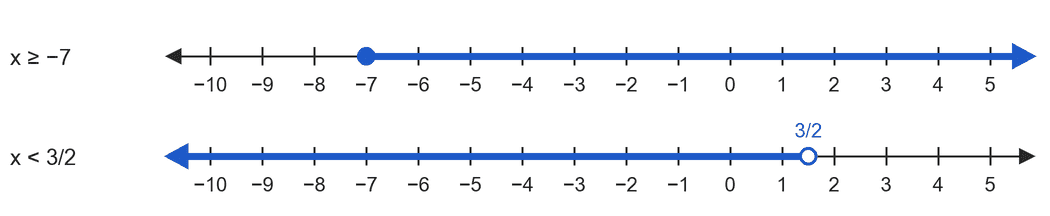
Step 4 — Write the solution set and represent it.
Since , the solution set is . Here , halfway between 1 and 2.

The number line shows a filled circle at −7 (−7 is included), a hollow circle at ( is not included) and a thick line between them.
Check: gives , which is true; gives , which is true; gives , which is false.
Watch out: opens to : the minus sign multiplies the −9 as well.
Therefore, the solution set is , as shown on the number line.
- 103 marks
Question 10
Solve the following inequation, write down the solution set and represent it on the real number line.
, .
Solve with AIWritten solution
Solution:
Concept: A double inequation such as is two inequations joined by and. If is only in the middle part, the same operation is done on all three parts at once; if is in more than one part, it is split into two inequations, each is solved, and only the values that satisfy both are kept.
The replacement set is the set the values of are taken from: = {1, 2, 3, …} (natural numbers), = {0, 1, 2, 3, …} (whole numbers), or = {…, −2, −1, 0, 1, 2, …} (integers) and (all real numbers). The solution set is made of those members of the replacement set that satisfy the inequation.
Step 1 — Solve the first inequation.
appears in all three parts, so we split the double inequation into two inequations joined by and. The first inequation is:
Multiplying both sides by 2 to clear the fraction (2 is positive, so the sign stays the same):
Subtracting from both sides (this keeps the term positive):
Subtracting 4 from both sides:
Dividing both sides by 5:
Reading it from the other side:
Step 2 — Solve the second inequation.
The second inequation is:
Multiplying both sides by 2:
Subtracting from both sides:
Subtracting 4 from both sides:
Dividing both sides by 3:
Step 3 — Combine the two results.
must be at least −2 and less than 4. The two number lines show each result; the solution is where they overlap.

Step 4 — Pick the integers.
, the integers. −2 is included (≤) and 4 is not (<), so the solution set is {−2, −1, 0, 1, 2, 3}.

The number line shows separate dots at −2, −1, 0, 1, 2, 3; no thick line, because can only be an integer.
Check: gives , which is true; gives , which is true; gives , which is false.
Watch out: 4 is not a solution: the second sign is strict (<).
Therefore, the solution set is , shown as dots on the number line.
- 111 mark
Question 11
The solution set for , is;
Solve with AIAnswer
- Correct
(A)
(B)
(C)
(D)
Answer: (A)
Concept: A double inequation such as is two inequations joined by and. If is only in the middle part, the same operation is done on all three parts at once; if is in more than one part, it is split into two inequations, each is solved, and only the values that satisfy both are kept. Multiplying all three parts by a negative number reverses both signs.
Step 1 — Multiply all three parts by −3.
is only in the middle part, so we multiply all three parts by −3 to leave alone. Since −3 is negative, both signs reverse.
Multiplying by −3 and reversing both signs:
Writing it with the smaller number first:
Step 2 — Pick the integers.
. Both signs are strict, so neither −6 nor 0 is included. The integers between them are −5, −4, −3, −2 and −1.

The number line shows separate dots at −5, −4, −3, −2, −1; no thick line, because can only be an integer.
Check: gives , which is true; gives , which is false; gives , which is false.
Watch out: Multiplying by −3 reverses both signs; both end points stay excluded because both signs are strict.
Why the other options are wrong:
- (B) : it includes −6. gives , which is false, because 2 is not less than 2.
- (C) : it includes 0. gives , which is false, because 0 is not greater than 0.
- (D) : it includes both end points, −6 and 0, and neither satisfies the inequation.
Therefore, the solution set is , option (A).
- 123 marks
Question 12
Solve the following inequation, write the solution set and represent it on the real number line.
- 131 mark
Question 13
If , then:
- 143 marks
Question 14
Solve the inequation, write down the solution set and represent it on a real number line:
;
- 153 marks
Question 15
Solve the following inequation, write the solution set and represent it on the real number line.
- 163 marks
Question 16
Solve the following inequation, write the solution set and represent it on the real number line.