
Question 123 marksAsked 2025Medium
Solve the following inequation, write the solution set and represent it on the real number line.
Confirming your payment
Sign up now and get 250 free tokens.
Previous Year Questions · Question 12 of 16
Solve the following inequation, write the solution set and represent it on the real number line.
Solution:
Concept: A double inequation such as is two inequations joined by and. If is only in the middle part, the same operation is done on all three parts at once; if is in more than one part, it is split into two inequations, each is solved, and only the values that satisfy both are kept.
An inequation is solved like an equation, with one extra rule. Adding or subtracting the same number on both sides, or multiplying or dividing both sides by the same positive number, keeps the sign of inequality. Multiplying or dividing both sides by a negative number reverses the sign (< becomes >, ≤ becomes ≥).
Step 1 — Solve the first inequation.
appears in all three parts, so we split the double inequation into two inequations joined by and. The first inequation is:
Multiplying both sides by 15, the L.C.M. of 3 and 5, to clear the fractions (15 is positive, so the sign stays the same):
Subtracting from both sides:
Adding 25 to both sides:
Dividing both sides by 21:
Cancelling the common factor 7:
Step 2 — Solve the second inequation.
The second inequation is:
Multiplying both sides by 5 to clear the fractions:
Subtracting from both sides (this keeps the term positive):
Subtracting 55 from both sides:
Reading it from the other side:
Step 3 — Combine the two results.
must be less than and at least −5. The two number lines show each result; the solution is where they overlap.
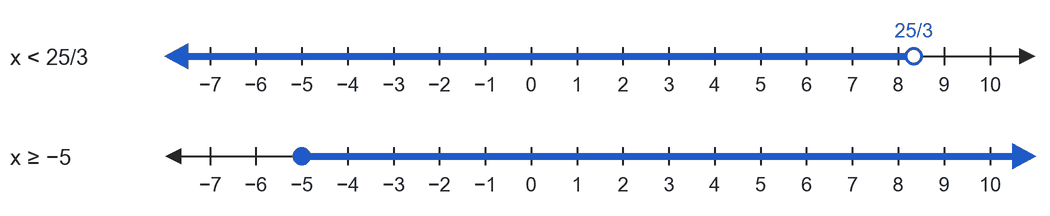
Step 4 — Write the solution set and represent it.
Since , the solution set is . Here , a third of the way from 8 to 9.

The number line shows a filled circle at −5 (−5 is included), a hollow circle at ( is not included) and a thick line between them.
Check: gives , which is true; gives , which is true; gives , which is false.
Watch out: Multiply every term by 15, including 10 on the right: .
Therefore, the solution set is , as shown on the number line.