
Question 163 marksAsked 2026Medium
Solve the following inequation, write the solution set and represent it on the real number line.
Confirming your payment
Sign up now and get 250 free tokens.
Previous Year Questions · Question 16 of 16
Solve the following inequation, write the solution set and represent it on the real number line.
Solution:
Concept: A double inequation such as is two inequations joined by and. If is only in the middle part, the same operation is done on all three parts at once; if is in more than one part, it is split into two inequations, each is solved, and only the values that satisfy both are kept.
An inequation is solved like an equation, with one extra rule. Adding or subtracting the same number on both sides, or multiplying or dividing both sides by the same positive number, keeps the sign of inequality. Multiplying or dividing both sides by a negative number reverses the sign (< becomes >, ≤ becomes ≥).
Step 1 — Solve the first inequation.
appears in all three parts, so we split the double inequation into two inequations joined by and. The first inequation is:
Multiplying both sides by 3 to clear the fractions (3 is positive, so the sign stays the same):
Subtracting from both sides:
Subtracting 14 from both sides:
Dividing both sides by 5:
Step 2 — Solve the second inequation.
The second inequation is:
Multiplying both sides by 3:
Subtracting from both sides (this keeps the term positive):
Adding 12 to both sides:
Dividing both sides by 5:
Reading it from the other side:
Step 3 — Combine the two results.
must be greater than −4 and at most . The two number lines show each result; the solution is where they overlap.
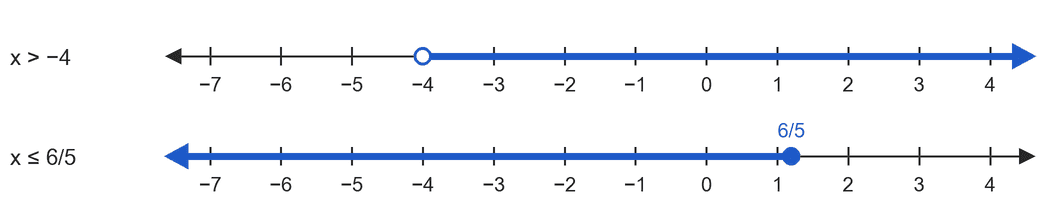
Step 4 — Write the solution set and represent it.
Since , the solution set is . Here , just past 1.

The number line shows a hollow circle at −4 (−4 is not included), a filled circle at ( is included) and a thick line between them.
Check: gives , which is false; gives , which is true; gives , which is true.
Watch out: Read “” from the right as “”: the sign turns round with it.
Therefore, the solution set is , as shown on the number line.