
Opening your dashboard
Class 9 Maths Chapter 24: Solution of Right Triangles Solutions
26 textbook questions with step-by-step answers, free to read, for ICSE 2026-27.
Get talked through Ch 24, not just shown the answer
Reading a finished solution is not the same as being able to do it. The AI tutor takes one question at a time and works it with you, in your own words, until you can.
- Ask it out loud, in your own words
- It gives you the next step, not the answer
- Stuck on part (ii)? Start there
26 questions with solutions
1–3 marks · Mixed difficulty
The first 21 solutions are on this page. This chapter is a long one, so the rest open on their own page to keep this one quick to load.
- 11 mark
Question 1
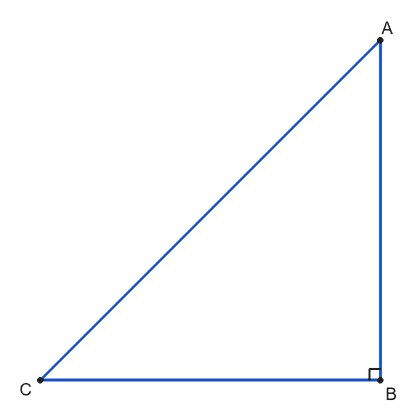
The given figure, shows an isosceles triangle with angle ABC = 90°, the measure of angle BAC is :
 Solve with AI
Answer
(A) 30°
- Correct
(B) 45°
(C) 60°
(D) 40°
Answer: (B) 45°
Concept: In an isosceles triangle the angles opposite the equal sides are equal, and the angles of any triangle add up to 180°.
Step 1 — Use the equal sides.
The triangle is isosceles with the right angle at B, so the two equal sides are AB and BC (the hypotenuse is the longest side). The angles opposite equal sides are equal, so ∠BAC equals ∠BCA.
Step 2 — Use the angle sum.
The angles of a triangle add up to 180°, so the two equal angles share 180° − 90°.
So ∠BAC is 45°.
Watch out: The right angle cannot be one of the two equal angles, because two right angles would already make 180°.
Why the other options are wrong:
- (A) 30°: 30° + 30° + 90° is 150°, not 180°, and the two base angles must be equal.
- (C) 60°: 60° + 60° + 90° is 210°, more than 180°.
- (D) 40°: 40° + 40° + 90° is 170°, not 180°.
Therefore, ∠BAC = 45°, option (B).
- 21 mark
Question 2
In the given triangle, ∠ACB = 90° and angle CAB = 60°, the value of cot ∠ABC is :
 Solve with AI
Answer
(A) 2
(B) 1
- Correct
(C)
(D)
Answer: (C)
Concept: The angles of a triangle add up to 180°, and .
Standard values: , , ; , , ; , , .
Step 1 — Find angle ABC.
The angles of triangle ABC add up to 180°.
So ∠ABC is 30°.
Step 2 — Find its cotangent.
We use the standard value of , the reciprocal of .
Watch out: The question asks for ∠ABC (at B), not the given ∠CAB.
Why the other options are wrong:
- (A) 2: 2 is , not .
- (B) 1: 1 is , but ∠ABC is 30°.
- (D) : is , the cotangent of ∠CAB, not of ∠ABC.
Therefore, , option (C).
- 31 mark
Question 3
In the given triangle, the length of AB is :
 Solve with AI
Answer
(A) m
(B) 4 m
- Correct
(C) 8 m
(D) 6 m
Answer: (C) 8 m
Concept: To find a side of a right triangle, choose the ratio that links the given angle, the side you know and the side you want: tan when both sides are the legs, sin or cos when one of them is the hypotenuse. Standard values: , , ; , , ; , , .
Step 1 — Choose the ratio.
At C, AB is opposite the 45° angle and BC = 8 m is next to it; both are legs, so we use tan.
Step 2 — Solve for AB.
We multiply both sides by BC.
So AB is 8 m.
Watch out: A right triangle with a 45° angle has its two legs equal.
Why the other options are wrong:
- (A) m: is ; sin would need BC to be the hypotenuse, but BC is a leg.
- (B) 4 m: 4 m is half of BC; no ratio of the 45° angle halves a side.
- (D) 6 m: 6 m is not equal to BC, but the legs of a 45° right triangle are equal.
Therefore, AB = 8 m, option (C).
- 41 mark
Question 4
From the information given in the triangle shown below, the length of CD is : (take = 1·732)
 Solve with AI
Answer
- Correct
(A) 7·32 m
(B) 27·32 m
(C) 10 m
(D) 17·32 m
Answer: (A) 7·32 m
Concept: When a figure has two right triangles that share a side, find the shared side from the triangle where enough is known, then use it in the other triangle. Standard values: , , ; , , ; , , .
Step 1 — Find CB.
In right triangle ABC, AB = 10 m is opposite the 30° angle at C and CB is next to it.
Step 2 — Find DB.
In right triangle ABD, AB is opposite the 45° angle at D.
Step 3 — Subtract.
D lies between C and B, so CD is CB − DB.
Watch out: D is between C and B, so subtract DB from CB.
Why the other options are wrong:
- (B) 27·32 m: 27.32 m is CB + DB; it adds the two pieces instead of subtracting.
- (C) 10 m: 10 m is DB, not CD.
- (D) 17·32 m: 17.32 m is the whole of CB, not CD.
Therefore, CD = 7.32 m, option (A).
- 51 mark
Question 5
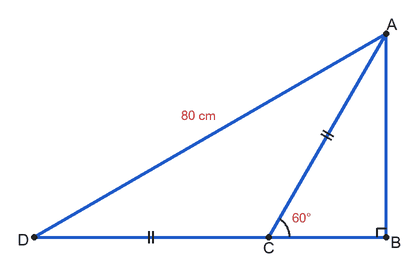
In the given triangle , the length of AB is :
 Solve with AI
Answer
(A) 160 cm
(B) 120 cm
(C) 60 cm
- Correct
(D) 40 cm
Answer: (D) 40 cm
Concept: An exterior angle of a triangle equals the sum of the two interior opposite angles. Standard values: , , ; , , ; , , .
Step 1 — Find angle D.
DC = CA makes triangle DCA isosceles, so ∠D equals ∠CAD. The exterior angle ACB of triangle DCA equals the sum of these two interior opposite angles. Let ∠D = x°; then ∠CAD is also x°.
So ∠D is 30°.
Step 2 — Find AB.
In right triangle ABD, DA = 80 cm is the hypotenuse and AB is opposite angle D.
Watch out: ∠D is half of 60°, not 60°: the 60° angle is the exterior angle at C.
Why the other options are wrong:
- (A) 160 cm: 160 cm is 2 × DA; AB is a leg, so it must be shorter than the hypotenuse DA = 80 cm.
- (B) 120 cm: 120 cm is longer than the hypotenuse DA = 80 cm, which is impossible for a leg.
- (C) 60 cm: 60 cm would need to be , or , but ∠D = 30° gives .
Therefore, AB = 40 cm, option (D).
- 63 marks
Question 6
Find 'x', if :
(i)

(ii)
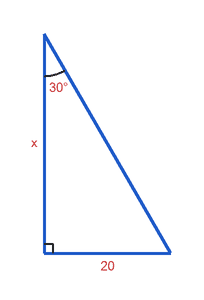
(iii)
 Solve with AI
Written solution
Solution:
Concept: To find a side of a right triangle, choose the ratio that links the given angle, the side you know and the side you want: tan when both sides are the legs, sin or cos when one of them is the hypotenuse. Standard values: , , ; , , ; , , .
Given: Take and for the decimals.
Step 1 — Part (i).
Here x is the hypotenuse and the side 20 is opposite the 60° angle, so we use sin.
Step 2 — Part (ii).
Here 20 is opposite the 30° angle and x is next to it; both are legs, so we use tan.
Step 3 — Part (iii).
Here 20 is opposite the 45° angle and x is the hypotenuse, so we use sin.
Watch out: Decide first whether x is a leg or the hypotenuse; that decides between tan and sin.
Therefore, (i) , (ii) , (iii) .
- 73 marks
Question 7
Find angle 'A' if :
(i)

(ii)
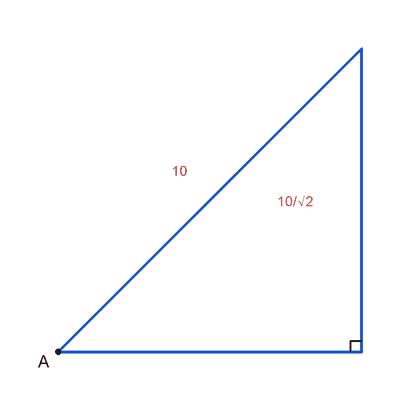
(iii)
 Solve with AI
Written solution
Solution:
Concept: To find an angle, form the ratio of the two sides you know and match it with a standard value. Standard values: , , ; , , ; , , .
Step 1 — Part (i).
The side 10 is next to angle A and 20 is the hypotenuse, so we use cos.
Since , A is 60°.
Step 2 — Part (ii).
The side is opposite angle A and 10 is the hypotenuse, so we use sin.
Since , A is 45°.
Step 3 — Part (iii).
The side is opposite angle A and 10 is next to it, so we use tan.
Since , A is 60°.
Watch out: Check which side is opposite A and which is next to it before writing the ratio.
Therefore, (i) A = 60°, (ii) A = 45°, (iii) A = 60°.
- 83 marks
Question 8
Find angle 'x' if :
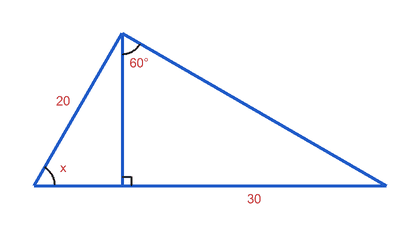 Solve with AI
Written solution
Solution:
Concept: When a figure has two right triangles that share a side, find the shared side from the triangle where enough is known, then use it in the other triangle. Standard values: , , ; , , ; , , .
Step 1 — Find the altitude.
In the right-hand triangle, the 60° angle is at the top, the base piece 30 is opposite it and the altitude is next to it.
Here h stands for the altitude.
Step 2 — Find x.
In the left-hand triangle, the altitude is opposite x and the side 20 is the hypotenuse.
Since , x is 60°.
Watch out: The altitude is next to the 60° angle at the top, so it goes in the denominator of tan 60°.
Therefore, x = 60°.
- 93 marks
Question 9
Find AD, if :
(i)

(ii)
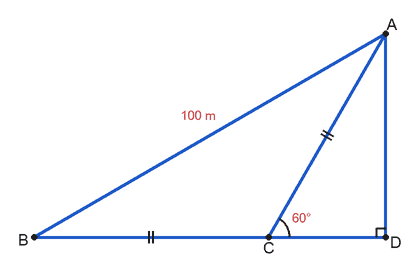 Solve with AI
Written solution
Solution:
Concept: To find a side of a right triangle, choose the ratio that links the given angle, the side you know and the side you want: tan when both sides are the legs, sin or cos when one of them is the hypotenuse. Standard values: , , ; , , ; , , . An exterior angle of a triangle equals the sum of the two interior opposite angles.
Step 1 — Part (i): use the rectangle.
BCDE is a rectangle, so BE equals CD (50 m) and ED equals BC (10 m). Triangle ABE is right-angled at E.
Step 2 — Part (i): find AE.
AE is opposite the 45° angle at B and BE is next to it.
Step 3 — Part (i): find AD.
AD is AE + ED.
Step 4 — Part (ii): find angle B.
BC = CA makes ∠B equal to ∠CAB. The exterior angle ACD, which is 60°, is the sum of these two equal angles, so if ∠B = x°, then 2x = 60.
So ∠B is 30°.
Step 5 — Part (ii): find AD.
In right triangle ABD, AB = 100 m is the hypotenuse and AD is opposite angle B.
Watch out: In part (i), AD is not only AE: add the height ED of the rectangle.
Note: The answer printed in the book for part (ii) is 50 cm; the figure is in metres, so it is 50 m.
Therefore, (i) AD = 60 m, (ii) AD = 50 m.
- 103 marks
Question 10
Find the length of AD.
Given : ∠ABC = 60°, ∠DBC = 45° and BC = 40 cm.
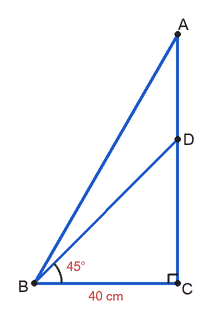 Solve with AI
Written solution
Solution:
Concept: When a figure has two right triangles that share a side, find the shared side from the triangle where enough is known, then use it in the other triangle. Standard values: , , ; , , ; , , .
Given: ∠ABC = 60°, ∠DBC = 45°, BC = 40 cm; take .
Step 1 — Find AC.
In right triangle ABC, AC is opposite ∠ABC = 60° and BC = 40 cm is next to it.
Step 2 — Find DC.
In right triangle DBC, DC is opposite ∠DBC = 45°.
Step 3 — Find AD.
D lies on AC, so AD is AC − DC.
Watch out: Keep the exact surd until the last line, then use ; rounding early changes the last digit.
Therefore, AD cm ≈ 29.28 cm.
- 113 marks
Question 11
Find lengths of diagonals AC and BD. Given AB = 60 cm and ∠BAD = 60°.
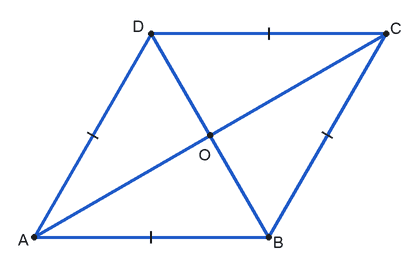 Solve with AI
Written solution
Solution:
Concept: The diagonals of a rhombus bisect each other at right angles, and each diagonal bisects the angles at its ends. So each quarter of the rhombus is a right triangle with the side as its hypotenuse. Standard values: , , ; , , ; , , .
Given: AB = 60 cm and ∠BAD = 60°; take .
Step 1 — Find the angle at A in triangle AOB.
Let the diagonals meet at O. The diagonal AC bisects ∠BAD, so ∠OAB is 30°, and ∠AOB is 90°.
Step 2 — Find BD.
In right triangle AOB, AB = 60 cm is the hypotenuse and OB is opposite the 30° angle.
BD is twice OB, so BD = 60 cm.
Step 3 — Find AC.
OA is next to the 30° angle.
Watch out: OB and OA are only half of the diagonals; double them at the end.
Therefore, AC cm ≈ 103.92 cm and BD = 60 cm.
- 123 marks
Question 12
Find AB.
 Solve with AI
Written solution
Solution:
Concept: When a figure has two right triangles that share a side, find the shared side from the triangle where enough is known, then use it in the other triangle. Standard values: , , ; , , ; , , .
Given: Take .
Step 1 — Find AC.
In right triangle ACF, FC = 20 is opposite the 45° angle at A.
Step 2 — Find CD.
Let the dashed line from F meet ED at G. FGDC is a rectangle, so GD equals FC (20) and CD equals FG. In right triangle FGE, EG is ED − GD and ∠FEG is 60°.
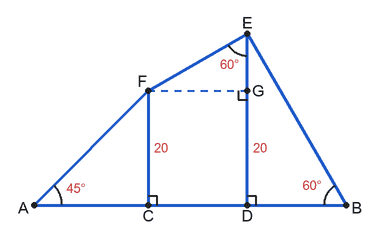
FG is opposite the 60° angle at E and EG is next to it.
So CD .
Step 3 — Find DB.
In right triangle EDB, ED = 30 is opposite the 60° angle at B.
Step 4 — Add the three pieces.
AB is AC + CD + DB.
Watch out: The 60° angle at E is between EF and the vertical ED, so EG (not FG) is next to it.
Therefore, AB ≈ 54.64 (in the units of the figure).
- 133 marks
Question 13
In trapezium ABCD, as shown, AB // DC, AD = DC = BC = 20 cm and ∠A = 60°.
Find :
(i) length of AB
(ii) distance between AB and DC.
 Solve with AI
Written solution
Solution:
Concept: To find a side of a right triangle, choose the ratio that links the given angle, the side you know and the side you want: tan when both sides are the legs, sin or cos when one of them is the hypotenuse. Standard values: , , ; , , ; , , .
Given: AB ∥ DC, AD, DC and BC are each 20 cm, ∠A = 60°; take .
Step 1 — Draw the heights.
Drop perpendiculars DP and CQ to AB. Since AD = BC, the trapezium is symmetric, so AP equals QB, and PQ equals DC (20 cm).
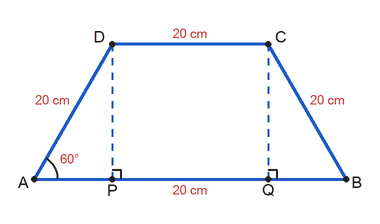
Step 2 — Solve triangle APD.
In right triangle APD, AD = 20 cm is the hypotenuse and ∠A = 60°.
Step 3 — Part (i).
AB is made of AP, PQ and QB.
Step 4 — Part (ii).
The distance between the parallel sides is the height DP.
Watch out: The middle piece PQ equals DC; only the two end pieces come from the 60° triangles.
Therefore, (i) AB = 40 cm, (ii) the distance is cm ≈ 17.32 cm.
- 143 marks
Question 14
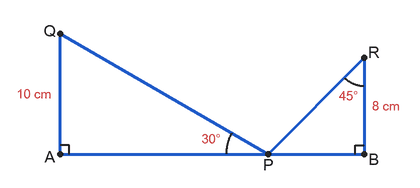
Use the information given to find the length of AB.
 Solve with AI
Written solution
Solution:
Concept: When a figure has two right triangles that share a side, find the shared side from the triangle where enough is known, then use it in the other triangle. Standard values: , , ; , , ; , , .
Given: Take .
Step 1 — Find AP.
In right triangle QAP, QA = 10 cm is opposite the 30° angle at P and AP is next to it.
Step 2 — Find PB.
In right triangle PBR, ∠PRB = 45°, so ∠RPB is also 45° and the two legs are equal. So PB equals BR, which is 8 cm.
Step 3 — Add.
P lies between A and B, so AB is AP + PB.
Watch out: The 45° angle is at R, so PB is opposite it and BR is next to it.
Therefore, AB ≈ 25.32 cm.
- 153 marks
Question 15
Find the value of cot x.
 Solve with AI
Written solution
Solution:
Concept: Standard values, used for the check: , , ; , , ; , , . Pythagoras' theorem gives the missing side first.
Step 1 — Find AB.
Triangle ABC is right-angled at B, with hypotenuse AC = 2 and BC = √3.
Step 2 — Find cot x.
Angle x is at A, so AB is next to it and BC is opposite it.
Watch out: The cotangent is base ÷ perpendicular, the reciprocal of the tangent.
Check: , so x is 60°, as the figure suggests.
Therefore, .
- 163 marks
Question 16
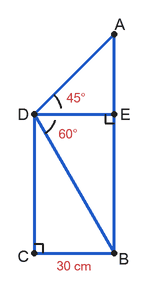
Find the length of AB.
 Solve with AI
Written solution
Solution:
Concept: When a figure has two right triangles that share a side, find the shared side from the triangle where enough is known, then use it in the other triangle. Standard values: , , ; , , ; , , .
Given: Take .
Step 1 — Use the rectangle.
DCBE is a rectangle, so DE equals CB (30 cm), and DE ⊥ AB at E.
Step 2 — Find AE.
In right triangle ADE, AE is opposite the 45° angle at D.
Step 3 — Find EB.
In right triangle DEB, EB is opposite the 60° angle at D.
Step 4 — Add.
E lies on AB, so AB is AE + EB.
Watch out: Both angles are measured from DE, so DE = 30 cm is the base in both triangles.
Therefore, AB cm ≈ 81.96 cm.
- 173 marks
Question 17
In the given figure, AB and EC are parallel to each other. Sides AD and BC are 2 cm each and are perpendicular to AB.

Given that ∠AED = 60° and ∠ACD = 45°; calculate :
(i) AB (ii) AC (iii) AE
Solve with AIWritten solution
Solution:
Concept: To find a side of a right triangle, choose the ratio that links the given angle, the side you know and the side you want: tan when both sides are the legs, sin or cos when one of them is the hypotenuse. Standard values: , , ; , , ; , , .
Given: AB ∥ EC, AD ⊥ AB, BC ⊥ AB, AD = 2 cm, ∠AED = 60°, ∠ACD = 45°.
Step 1 — See the rectangle.
AD and BC are both perpendicular to AB, and AB ∥ DC, so ABCD is a rectangle and AB equals DC.
Step 2 — Part (i).
In right triangle ADC, ∠ACD = 45°, so the legs are equal and DC equals AD (2 cm).
So AB = 2 cm.
Step 3 — Part (ii).
AC is the hypotenuse of triangle ADC, and AD is opposite the 45° angle.
Step 4 — Part (iii).
AE is the hypotenuse of right triangle ADE, and AD is opposite the 60° angle at E.
Watch out: Use sin (not tan) for AC and AE, because they are hypotenuses.
Therefore, (i) AB = 2 cm, (ii) AC cm ≈ 2.83 cm, (iii) AE cm ≈ 2.31 cm.
- 183 marks
Question 18
In the given figure, ∠B = 60°, AB = 16 cm and BC = 23 cm. Calculate :
(i) BE (ii) AC.
 Solve with AI
Written solution
Solution:
Concept: To find a side of a right triangle, choose the ratio that links the given angle, the side you know and the side you want: tan when both sides are the legs, sin or cos when one of them is the hypotenuse. Standard values: , , ; , , ; , , . Then Pythagoras' theorem gives the remaining side.
Given: ∠B = 60°, AB = 16 cm, BC = 23 cm and AE ⊥ BC.
Step 1 — Part (i).
AE ⊥ BC, so triangle ABE is right-angled at E; AB = 16 cm is the hypotenuse and BE is next to the 60° angle.
Step 2 — Find AE and EC.
AE is opposite the 60° angle, and EC is the rest of BC.
Step 3 — Part (ii).
Triangle AEC is right-angled at E, so we use Pythagoras' theorem.
Watch out: , which is 192.
Therefore, (i) BE = 8 cm, (ii) AC cm ≈ 20.42 cm.
- 193 marks
Question 19
Find :
(i) BC
(ii) AD
(iii) AC
 Solve with AI
Written solution
Solution:
Concept: To find a side of a right triangle, choose the ratio that links the given angle, the side you know and the side you want: tan when both sides are the legs, sin or cos when one of them is the hypotenuse. Standard values: , , ; , , ; , , .
Given: ∠ABC = 90°, ∠C = 30°, AB = 12 cm and BD ⊥ AC; take .
Step 1 — Find the angles.
∠ABC = 90° and ∠C = 30°, so ∠A is 60°. BD ⊥ AC, so triangle ADB is right-angled at D.
Step 2 — Part (i).
In right triangle ABC, AB = 12 cm is opposite the 30° angle at C and BC is next to it.
Step 3 — Part (ii).
In right triangle ADB, AB is the hypotenuse and AD is next to the 60° angle at A.
Step 4 — Part (iii).
In right triangle ABC, AC is the hypotenuse and AB is opposite the 30° angle.
Watch out: AD lies in the small triangle ADB, where the angle to use is ∠A = 60°.
Therefore, (i) BC cm ≈ 20.78 cm, (ii) AD = 6 cm, (iii) AC = 24 cm.
- 203 marks
Question 20
In right-angled triangle ABC; ∠B = 90°. Find the magnitude of angle A, if :
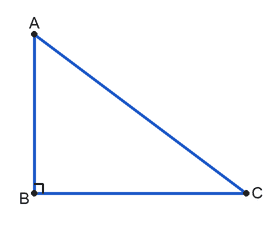
(i) AB is times of BC.
(ii) BC is times of AB.
Solve with AIWritten solution
Solution:
Concept: To find an angle, form the ratio of the two sides you know and match it with a standard value. Standard values: , , ; , , ; , , .
Given: ∠B = 90°.
Step 1 — Part (i).
For angle A, BC is opposite and AB is next to it. AB is times BC, so we write AB as .
Since , A is 30°.
Step 2 — Part (ii).
Now BC is times AB.
Since , A is 60°.
Watch out: BC is opposite A, so it is the numerator of tan A.
Therefore, (i) A = 30°, (ii) A = 60°.
- 213 marks
Question 21
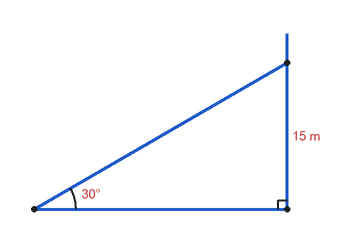
A ladder is placed against a vertical tower. If the ladder makes an angle of 30° with the ground and reaches upto a height of 15 m of the tower; find the length of the ladder.
 Solve with AI
Written solution
Solution:
Concept: To find a side of a right triangle, choose the ratio that links the given angle, the side you know and the side you want: tan when both sides are the legs, sin or cos when one of them is the hypotenuse. Standard values: , , ; , , ; , , .
Given: The ladder makes 30° with the ground and reaches 15 m up the tower.
Step 1 — Choose the ratio.
The ladder is the hypotenuse, and the height 15 m on the tower is opposite the 30° angle at the ground, so we use sin. Let the ladder be l m.
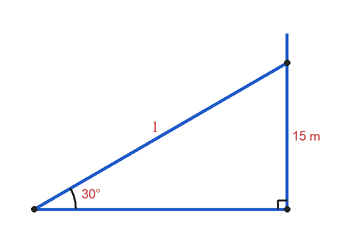
Step 2 — Solve.
We multiply both sides by l and divide by sin 30°.
Watch out: The 15 m height is opposite the angle at the ground, so it is sin, not tan.
Therefore, the ladder is 30 m long.
- 223 marks
Question 22
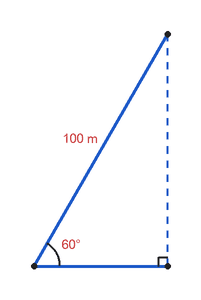
A kite is attached to a 100 m long string. Find the greatest height reached by the kite when its string makes an angle of 60° with the level ground.
- 233 marks
Question 23
Find AB and BC, if :
(i)
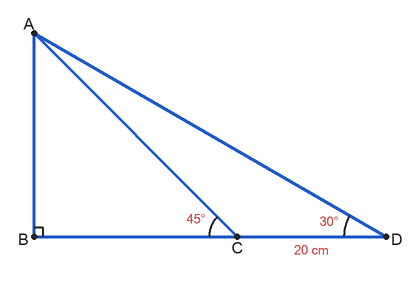
(ii)
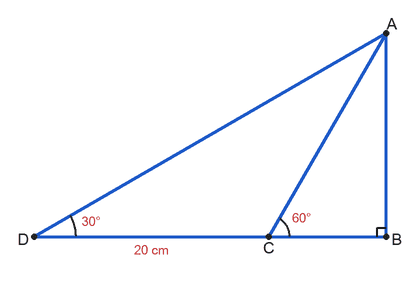
(iii)
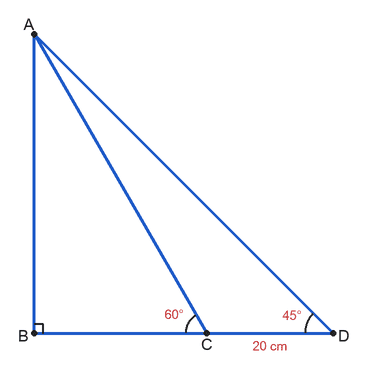
- 243 marks
Question 24
Find PQ, if AB = 150 m, ∠P = 30° and ∠Q = 45°
(i)
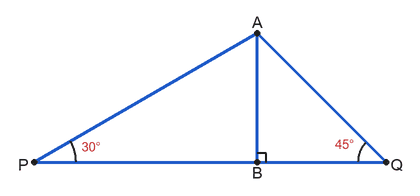
(ii)
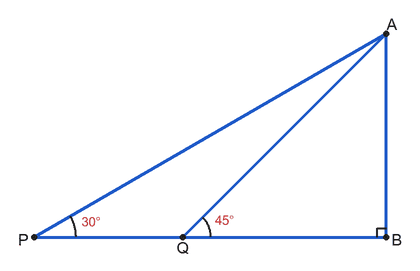
- 253 marks
Question 25
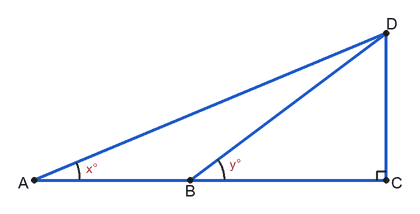
If , and AB = 48 m; find the length of CD.
- 263 marks
Question 26
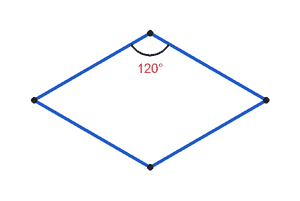
The perimeter of a rhombus is 96 cm and obtuse angle of it is 120°. Find the lengths of its diagonals.
What Class 9 Maths Ch 24 covers
The sections of the chapter, in the order the book takes them. Every question above comes from one of these.
- 01One Side and One Acute Angle Given
- 02Two Sides Given
More ways to study this chapter
The same chapter asked three other ways. Practise it, revise it, and see what the board has set on Ch 24 before.
Class 9 Maths Ch 24 questions students ask
How many questions are there in Class 9 Maths Ch 24?
26 questions. Every one is solved step by step on this page.
Are these Class 9 Maths solutions free?
Yes. Every question and its full working is free to read, with no account needed.
Can I download the Class 9 Maths Ch 24 solutions as a PDF?
There is no PDF to download. Every solution is on this page instead, which means it is searchable, always the current syllabus, and readable on a phone. Use your browser's print option if you want it on paper.