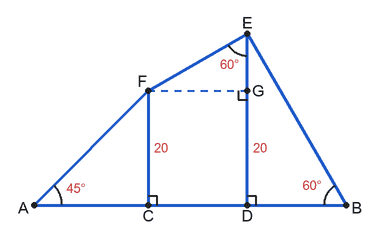
Concept: When a figure has two right triangles that share a side, find the shared side from the triangle where enough is known, then use it in the other triangle. Standard values: sin30∘=21, cos30∘=23, tan30∘=31; sin45∘=21, cos45∘=21, tan45∘=1; sin60∘=23, cos60∘=21, tan60∘=3.
Given: Take 3=1.732.
Step 1 — Find AC.
In right triangle ACF, FC = 20 is opposite the 45° angle at A.
AC=tan45∘20=20
Step 2 — Find CD.
Let the dashed line from F meet ED at G. FGDC is a rectangle, so GD equals FC (20) and CD equals FG. In right triangle FGE, EG is ED − GD and ∠FEG is 60°.
EG=30−20=10
FG is opposite the 60° angle at E and EG is next to it.
FG=10tan60∘=103
So CD =103.
Step 3 — Find DB.
In right triangle EDB, ED = 30 is opposite the 60° angle at B.
DB=tan60∘30=330=103
Step 4 — Add the three pieces.
AB is AC + CD + DB.
AB=20+103+103=20+203≈54.64
Watch out: The 60° angle at E is between EF and the vertical ED, so EG (not FG) is next to it.
Therefore, AB =20+203 ≈ 54.64 (in the units of the figure).