
Opening your dashboard
Class 9 Maths Chapter 24 Solution of Right Triangles: Competency-Based Questions (CBQ)
40 questions on Chapter 24, each worked through on its own page with the AI tutor. Class 9 Maths, ICSE 2026-27.
40 questions
1–5 marks · Mixed difficulty
- 11 mark
Question 1
Competency: Understanding
A conveyor belt carries sacks up a straight slope that makes an angle with the level floor. The belt covers 10 m of floor. Its length is not known.
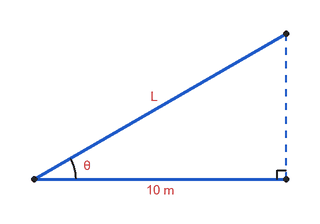
Which equation gives ?
- 21 mark
Question 2
Competency: Application
A boat leaves a straight coast and sails 10 km in a straight line that makes with the coast. (Take .)

How far is the boat from the coast now?
- 31 mark
Question 3
Competency: Application
A straight water slide starts from a platform 9 m above the pool. It ends at the water level, m away from the foot of the platform, measured along the level ground.

The angle that the slide makes with the ground is
- 41 mark
Question 4
Competency: Analysis
The cross-section of a canal is a trapezium. The bed of the canal is 3 m wide and horizontal, the canal is 1.5 m deep, and each bank slopes at to the horizontal.
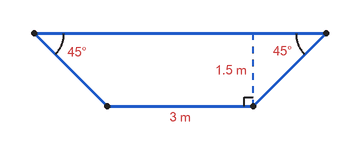
The width of the canal at the top is
- 51 mark
Question 5
Competency: Evaluation
A sail has the shape of a triangle with one right angle, and its longest edge is 8 m. Sana works out the lengths of its edges and gets m for one of the two shorter edges.
Before doing the sum again, what can we say about her answer?
- 61 mark
Question 6
Competency: Analysis
Assertion (A): A ladder makes with level ground and its foot is 2 m from a vertical wall. The ladder is 4 m long.
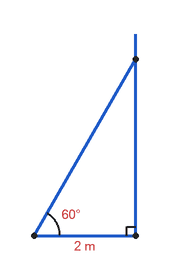
Reason (R):
- 72 marks
Question 7
Competency: Application
A cable car moves along a straight cable that makes with the horizontal. The upper station is 600 m higher than the lower station.
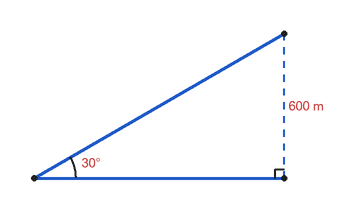
Find the length of the cable between the stations and the horizontal distance between them. (Take .)
- 82 marks
Question 8
Competency: Evaluation
A flagpole is 10 m high. A rope is stretched tight from its top to a peg on level ground, 10 m from the foot of the pole.
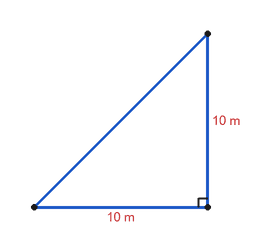
Dev says, "The rope makes with the ground, and it is 20 m long." Check both parts of Dev's statement. (Take .)
- 92 marks
Question 9
Competency: Analysis
The figure shows a door from above. H is the hinge and HW is the line of the wall. The door HE is 90 cm wide. It has been opened until its free edge E is 45 cm from the wall, measured along the perpendicular EF.

Find the angle through which the door has been opened, and the length HF. (Take .)
- 102 marks
Question 10
Competency: Application
A drone takes off from level ground and flies in a straight line that makes with the ground. After flying 200 m along this line, it is exactly above a tree.
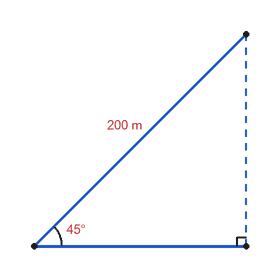
Find the height of the drone above the tree's foot and the distance of the tree from the take-off point. (Take .)
- 113 marks
Question 11
Competency: Analysis & Evaluation
Two straight paths lead from a village to a temple on a hill. The temple is 300 m higher than the village.
- Path A makes with the horizontal. Rahul can walk up it at 1.2 km/h.
- Path B makes with the horizontal. It is steeper, so Rahul can walk up it at only 0.8 km/h.

Rahul says, "Path B is shorter, so it will take me less time."
(a) Find the length of each path. (Take .)
(b) Find the time Rahul takes on each path, in minutes.
(c) Is Rahul right? Justify.
- 123 marks
Question 12
Competency: Creativity
A boat T is anchored in the sea, some distance from a long straight beach. Asha wants to find how far the boat is from the beach, without leaving the beach. She has only a long measuring tape and a card cut in the shape of a set-square with angles , and .
Plan a method for Asha. Say what she should do and measure, explain with a trigonometrical ratio why the method works, and work out one example with numbers of your own.
- 133 marks
Question 13
Competency: Application & Analysis
A street lamp has a vertical pole PQ, 6 m high. A straight arm QR, 2 m long, is fixed to the top of the pole and makes with the vertical, as shown. The lamp is at R. (The figure is not drawn to scale.)
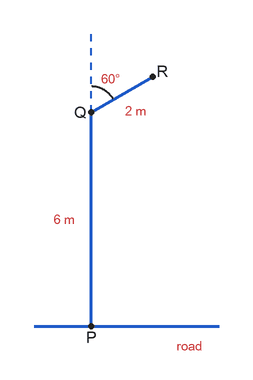
(a) Find the height of the lamp R above the road.
(b) Find how far the lamp is, measured along the road, from the foot P of the pole. (Take .)
(c) The lamp is meant to hang exactly above a line painted on the road 1.5 m from P. Does it? If not, by how much does it miss the line?
- 145 marks
Question 14
Competency: Analysis & Evaluation
Case study — Guy wires of three masts
A telecom company holds up three tall masts, each standing upright on level ground, with straight steel guy wires. Each wire runs from a point on its mast down to a peg in the ground. The table shows the length of each wire and the angle it makes with the ground.
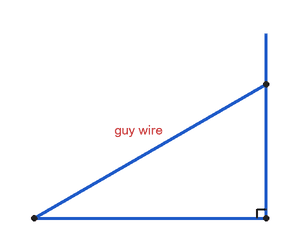
Mast Length of guy wire Angle with the ground P 80 m Q 60 m R 50 m Take and .
(a) Find the height at which each wire is tied to its mast.
(b) Find the distance of each peg from the foot of its mast.
(c) The engineer says, "The longest wire is tied highest up its mast." Is this true? Justify. She also plans a wire S for a new mast, tied 45 m up the mast to a peg m from its foot. Find the angle the wire will make with the ground and the length of the wire.
- 154 marks
Question 15
Competency: Application & Analysis
Case study — Cables of a bridge
The figure shows a tower AD of a bridge, standing upright on the level deck. Two straight cables run from the top A to the points C and B on the deck, on the same side of the tower. Cable AC makes with the deck and cable AB makes with it. The points B and C are 40 m apart.

Take .
(a) Find . Hence explain why AC = 40 m.
(b) Find the height AD of the tower and the distance DC.
(c) Find the length of the cable AB, and the total length of the two cables.
- 161 mark
Question 16
Competency: Analysis
A hexagonal nut is a regular hexagon of side 10 mm. A spanner fits across two opposite sides of the nut. (Take .)
The distance between the two opposite sides, which the spanner must fit, is
- 171 mark
Question 17
Competency: Analysis
In a right-angled triangle, one of the acute angles is and the longest side is 18 cm long. (Take .)
By how much is the longer of the other two sides greater than the shorter one?
- 181 mark
Question 18
Competency: Analysis
A rectangular gate is 2 m high and m wide. It is braced with two straight steel bars, one along each diagonal of the gate.
What is the acute angle between the two bars where they cross?
- 191 mark
Question 19
Competency: Evaluation
In a right-angled triangle, one acute angle is and the hypotenuse is 10 cm. Priya says, "Each of the two shorter sides is 5 cm." Jay says, "Each of the two shorter sides is cm." (Take .)
Who is right, and why?
- 201 mark
Question 20
Competency: Application
A square park has each side 100 m long. Ravi cycles from one corner to the opposite corner along two sides of the park. Sita walks straight across the park along the diagonal. (Take .)
How much shorter is Sita's route than Ravi's?
- 211 mark
Question 21
Competency: Analysis
A pair of compasses has two legs, each 14 cm long, joined at the top. The legs are opened until the angle between them is . (Take .)
The distance between the needle point and the pencil point is
- 221 mark
Question 22
Competency: Analysis
Assertion (A): In a right-angled triangle whose hypotenuse is 20 cm and one acute angle is , the area is cm.
Reason (R): The area of a right-angled triangle is half the product of the two sides that contain the right angle.
- 231 mark
Question 23
Competency: Evaluation
Assertion (A): In a right-angled triangle ABC with and , the side BC is shorter than the side AB.
Reason (R): In a triangle, the side opposite to the larger angle is the longer side.
- 241 mark
Question 24
Competency: Understanding
In a right-angled triangle the hypotenuse is and one acute angle is .
The perimeter of the triangle is
- 251 mark
Question 25
Competency: Analysis
A 6 m ladder rests against a vertical wall. In the first position the foot of the ladder is at P and its top at A, and the ladder makes with the level ground. The foot is then pulled away from the wall, and the top slides down the wall, until the ladder makes with the ground. In the second position the foot is at Q and the top at B. The wall meets the ground at O. (Take .)
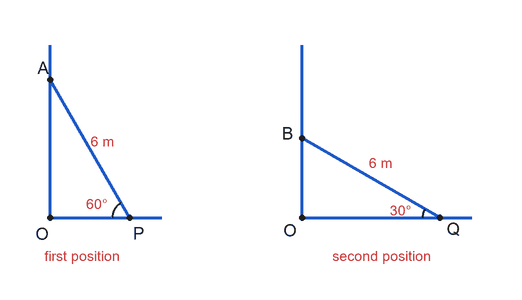
How far has the foot of the ladder moved, that is, what is the distance PQ?
- 262 marks
Question 26
Competency: Application
The figure shows a clock face with centre O. The minute hand OT is 14 cm long. The minute hand turns through every minute, starting from the mark 12. (Take .)
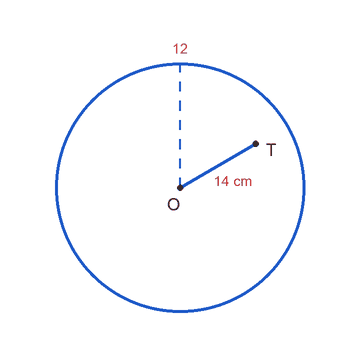
At 10 minutes past an hour, find how high the tip T is above the level of the centre O, and how far T is to the right of the vertical line through O and 12.
- 272 marks
Question 27
Competency: Evaluation
A shopping mall has a safety rule for escalators: an escalator must not make an angle of more than with the floor. (Hypothetical data.) The planner checks two escalator designs.
- Escalator P is 9.6 m long along its slope and rises to a height of 4.8 m.
- Escalator Q rises to a height of 4.5 m over a horizontal distance of 4.5 m.
Which of the two designs follow the rule? Show your working.
- 282 marks
Question 28
Competency: Analysis
A triangular tile has a right angle. The area of the tile is cm and one of the two sides that contain the right angle is 4 cm.
Find the angle that the hypotenuse makes with this 4 cm side.
- 292 marks
Question 29
Competency: Evaluation
A water pipe 20 m long is laid in a straight line down a hillside that makes an angle of with the horizontal. Meena wants to know how much level ground the pipe covers, measured horizontally. She writes:
"Horizontal length m."
Is Meena right? Find the correct horizontal length, and say what her 10 m actually measures. (Take .)
- 302 marks
Question 30
Competency: Evaluation
A shelf bracket is made of a vertical arm fixed to the wall, a horizontal arm under the shelf and a straight brace joining the free ends of the two arms. Rahul wants the brace to make exactly with the horizontal arm. The shop has three brackets. (Hypothetical data.)
Bracket Vertical arm Horizontal arm A 20 cm cm B 25 cm 25 cm C cm 15 cm Which bracket should Rahul buy, and how long is its brace?
- 312 marks
Question 31
Competency: Application
A spotlight L is fixed in the ceiling of a hall, 3 m above the floor. It lights a circular patch on the floor. The figure shows the cross-section through the centre F of the patch. The edges LP and LQ of the beam each make with the vertical LF. (Take and .)
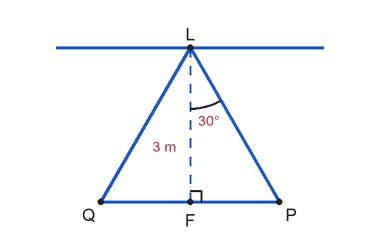
Find the radius of the lit circular patch and its area.
- 323 marks
Question 32
Competency: Application & Analysis
A footbridge over a stream is supported by a steel truss in the shape of an isosceles triangle ABC. The base BC is 12 m long, and each of the two equal sides AB and AC makes with the base. A vertical steel post AD joins the top A to the middle point D of the base. (Take .)
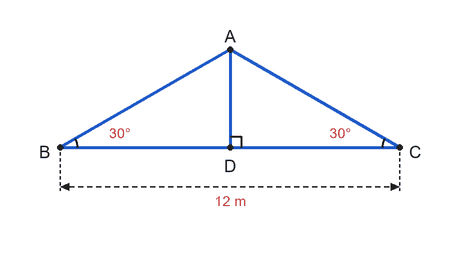
(a) Find the length of the post AD.
(b) Find the length of each sloping side.
(c) Find the total length of steel needed for the truss, counting the base, the two sloping sides and the post.
- 333 marks
Question 33
Competency: Analysis & Evaluation
A vertical pole 12 m high is to be held by one straight wire from its top to a peg in the level ground. There is free ground for the peg only up to 8 m from the foot of the pole. The wire can be fixed at or at to the ground. (Take .)
(a) Find the distance of the peg from the foot of the pole in each case.
(b) Which angle can be used? Find the length of the wire in that case.
- 343 marks
Question 34
Competency: Creativity
A godown has a loading platform 0.9 m above the ground. For safety, a straight ramp to the platform must not make more than with the ground. (Hypothetical rule. Take .)
Design a ramp for the godown. Say how long the sloping plank will be and how far from the platform its lower end will rest, and show by calculation that your ramp follows the rule.
- 353 marks
Question 35
Competency: Application & Analysis
A triangular plot ABC is right-angled at C. The side AC is 24 m long and . A straight path CD is laid from C to meet the side AB at D, at right angles to AB. (Take .)
Find (i) the length of the path CD, (ii) the length AD, (iii) the length BD.
- 363 marks
Question 36
Competency: Analysis
A student fixes a vertical stick 2 m long on level ground and measures the length of its shadow at three times of the day. (Hypothetical data.)
Time 8:30 am 9:30 am 10:45 am Length of the shadow m 2 m m Find the angle that the Sun's rays make with the ground at each time. What do you notice about this angle as the shadow gets shorter?
- 375 marks
Question 37
Competency: Analysis & Evaluation
Case study: The children's playground of a park has a slide and a swing. (Hypothetical data. Take .)
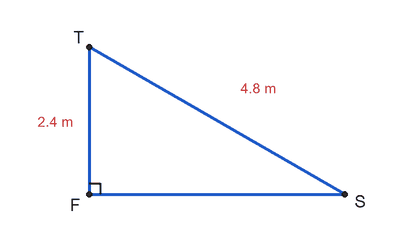
- Slide: the top T of the platform is 2.4 m above the ground, and the slide TS is 4.8 m long. F is the foot of the platform.
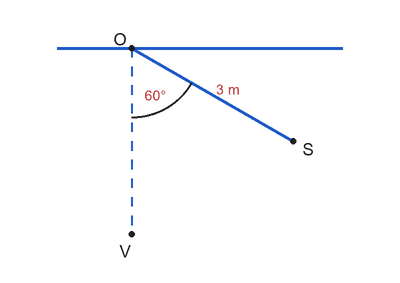
- Swing: each chain OS is 3 m long. A child pulls the seat back until the chain makes with the vertical OV, where V is the lowest position of the seat.
- Rule of the park: a slide must not make more than with the ground.
(a) Find the angle that the slide makes with the ground, and the horizontal distance FS.
(b) Find how high the seat S is above its lowest position V, and how far S is, measured horizontally, from the vertical line OV.
(c) The park plans a second slide from the same platform, m long. Does it follow the rule? Give a reason.
- 385 marks
Question 38
Competency: Analysis & Evaluation
Case study: A school architect compares three designs for one flight of stairs, from the ground floor up to a landing. In a staircase, the rise of a step is its vertical height and the tread is its horizontal depth. The slope of the staircase is the angle between the horizontal and the line joining the front edges of two successive steps. (Hypothetical data. Take .)
Staircase Information about one step Number of steps S1 rise 15 cm, tread cm 12 S2 rise 20 cm, tread 20 cm 9 S3 the line joining the front edges of two successive steps is 30 cm long and makes with the horizontal 7 (a) Find the slope of S1 and of S2.
(b) Find the rise and the tread of one step of S3.
(c) For each staircase, find the height it climbs and the floor length it takes up. Staircases for everyday use should have a slope between and . Which staircase should the architect choose?
- 394 marks
Question 39
Competency: Application & Analysis
Case study: A geometry box has two set-squares. One has angles , and , and the other has angles , and . The longest side of each set-square is 20 cm. Neeta places them on opposite sides of the common longest side PQ to form a four-sided figure PRQS, as shown. The right angles are at R and S. (Take and .)
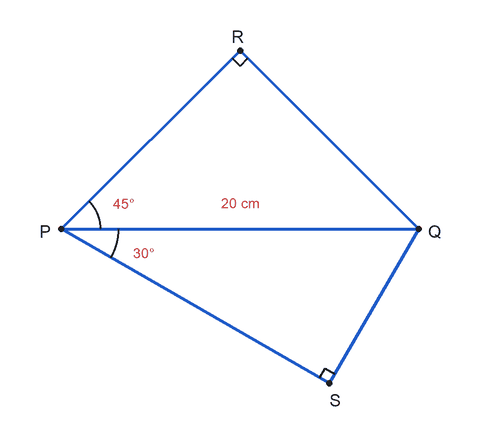
(a) Find the lengths PR and RQ.
(b) Find the lengths PS and SQ.
(c) Find the perimeter of PRQS. Which of the two set-squares has the larger area, and by how much?
- 404 marks
Question 40
Competency: Analysis & Evaluation
Case study: A triangular flower bed ABC is in the shape of an equilateral triangle of side 12 m. A straight path AD is laid from A to meet the side BC at D, at right angles to BC. (Take .)
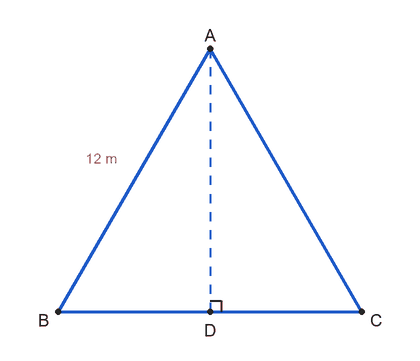
(a) Find the length of the path AD.
(b) Find the area of the flower bed.
(c) The gardener says, "If I make each side 24 m, then both the path AD and the area of the bed will become twice as large." Is he right? Justify your answer.