
Opening your dashboard
Class 9 Chemistry Chapter 8: Atmospheric Pollution Solutions
53 textbook questions with step-by-step answers, free to read, for ICSE 2026-27.
Get talked through Ch 8, not just shown the answer
Reading a finished solution is not the same as being able to do it. The AI tutor takes one question at a time and works it with you, in your own words, until you can.
- Ask it out loud, in your own words
- It gives you the next step, not the answer
- Stuck on part (ii)? Start there
53 questions with solutions
1–5 marks · Mixed difficulty
- 15 marks
Question 1
Define the following terms :
(i) pollution
(ii) pollutant
(iii) air pollution.
Solve with AIWritten solution
Solution:
Concept: Pollution is a harmful change in our surroundings; a pollutant is the substance that causes it; air pollution is that change happening in the air.
Step 1 — Define pollution.
Pollution is the contamination of air, water or soil by undesirable amounts of materials or heat. These substances build up to levels that have harmful effects on plants, animals and human beings.
Step 2 — Define pollutant.
A pollutant is a toxic or otherwise harmful substance that has an undesirable effect on the parts of the environment and on living things. Examples are sulphur dioxide and carbon monoxide.
Step 3 — Define air pollution.
Air pollution is the lowering of the quality of air by harmful substances (gases, smoke, dust) collecting in it, so that it harms the lives of humans, plants and animals.
Watch out: A pollutant is the substance, while pollution is the harmful condition it produces; do not use the two words for each other.
Therefore, pollution is harmful contamination of the environment, a pollutant is the harmful substance that causes it, and air pollution is the lowering of air quality by such substances.
- 22 marks
Question 2
Name any four gaseous pollutants.
Solve with AIWritten solution
Solution:
Concept: Gaseous pollutants are harmful gases released into the air, mostly when fuels burn or organic matter decays.
Step 1 — Recall where gaseous pollutants come from.
Burning coal, petrol and diesel gives oxides of sulphur, nitrogen and carbon, and decaying matter gives hydrogen sulphide and methane.
Step 2 — Name four of them.
Any four of the following are correct:
- Sulphur dioxide,
- Carbon monoxide,
- Nitrogen dioxide,
- Hydrogen sulphide,
- Nitric oxide , sulphur trioxide or methane
Therefore, four gaseous pollutants are sulphur dioxide, carbon monoxide, nitrogen dioxide and hydrogen sulphide.
- 34 marks
Question 3
Name the compounds of sulphur that cause air pollution. Also state their harmful effects.
Solve with AIWritten solution
Solution:
Concept: Sulphur pollutants come from burning fuels that contain sulphur (oxides of sulphur) and from decaying organic matter (hydrogen sulphide).
Step 1 — Name the compounds.
The sulphur compounds that pollute air are sulphur dioxide , sulphur trioxide and hydrogen sulphide .
Step 2 — Effects of the oxides of sulphur on living things.
Breathing them causes headache and vomiting, irritates the nose and throat and damages the lungs; in high amounts they can cause death by respiratory failure. They also damage plants and lower crop yields.
Step 3 — Effects on buildings and the air.
They mix with smoke and fog to form smog, and they form sulphuric acid in rain water (acid rain), which weakens buildings of marble, limestone and metal:
Step 4 — Effects of hydrogen sulphide.
Hydrogen sulphide is a poisonous gas with a rotten-egg smell. It causes nausea, irritates the eyes and throat, and also harms plants and lowers crop growth.
Watch out: Sulphur trioxide is formed from sulphur dioxide in the air, so both oxides end up as sulphuric acid in rain.
Therefore, the sulphur pollutants are sulphur dioxide, sulphur trioxide and hydrogen sulphide; they harm the lungs, eyes and plants, form smog and acid rain, and damage buildings.
- 44 marks
Question 4
State :
(i) natural sources of air pollution.
(ii) man-made sources of air pollution.
Solve with AIWritten solution
Solution:
Concept: A source of air pollution is natural if nature itself releases the pollutant, and man-made if human activity releases it.
Step 1 — Natural sources.
Nature releases pollutants in the following ways:
- Volcanoes give out carbon monoxide, sulphur dioxide, hydrogen sulphide, hydrogen chloride and ash.
- Decaying vegetation: bacteria acting on organic matter in soil release nitrous oxide and methane.
- Forest fires release carbon monoxide, smoke and soot.
- Winds and dust storms carry sand, dust and pollen into the air.
Step 2 — Man-made sources.
Human activities release pollutants in the following ways:
- Automobiles: burning petrol and diesel gives carbon monoxide, oxides of nitrogen, unburnt hydrocarbons and fine particles.
- Factories and thermal power plants: burning coal gives carbon dioxide, sulphur dioxide, oxides of nitrogen, ash and smoke.
- Industrial processes, e.g. fertilizer plants (oxides of nitrogen, ammonia) and smelters (sulphur dioxide).
- Burning crop residue, garbage and plastics gives carbon monoxide, smoke and harmful gases.
Therefore, the natural sources are volcanoes, decaying vegetation, forest fires and dust storms, and the man-made sources are automobiles, factories, power plants, industrial processes and open burning.
- 54 marks
Question 5
(a) How do oxides of nitrogen enter the atmosphere ?
(b) What are their harmful effects ?
Solve with AIWritten solution
Solution:
Concept: Nitrogen and oxygen of the air combine only at very high temperatures, as in furnaces, engines and lightning. The nitric oxide formed is then oxidised to nitrogen dioxide.
Step 1 — (a) Where the high temperature comes from.
Oxides of nitrogen form when air is heated strongly:
- in furnaces of factories and power plants, where fuels burn;
- in internal combustion engines of vehicles, from where they leave with the exhaust gases;
- during thunderstorms, in the electric discharge of lightning.
Step 2 — (a) The reactions.
At such temperatures nitrogen and oxygen combine to give nitric oxide, which the oxygen of the air then oxidises to nitrogen dioxide:
Step 3 — (b) Harmful effects.
The oxides of nitrogen harm living things and the environment:
- They irritate the mucous membranes of the eyes, nose and lungs; large amounts of cause serious lung diseases.
- They damage the leaves of plants.
- In sunlight, and unburnt hydrocarbons react to form ozone and other irritating chemicals: this is photochemical smog, which causes eye irritation and asthma attacks.
- dissolves in rain water to form nitric acid, a cause of acid rain:
Watch out: Nitrogen does not burn in ordinary air; it combines with oxygen only at very high temperatures.
Therefore, oxides of nitrogen enter the air from furnaces, vehicle engines and lightning, and they irritate the lungs, damage plants, form photochemical smog and cause acid rain.
- 62 marks
Question 6
State the origin and health impact of smog.
Solve with AIWritten solution
Solution:
Concept: The word smog is made from smoke + fog: it is fog loaded with smoke and polluting gases.
Step 1 — State its origin.
Industries and automobiles release smoke, soot, oxides of sulphur and nitrogen and partly burnt hydrocarbons. These mix with fog to form a dark, thick fog laden with dust and soot, called smog.
Step 2 — Name the two kinds.
Smoke, fog and sulphur dioxide give the classical (sulphurous) smog of cold, damp places. In strong sunlight, nitrogen dioxide and hydrocarbons from vehicles react to form ozone and other irritants, giving photochemical smog.
Step 3 — State its health impact.
Smog harms health in these ways:
- it reduces visibility and is noxious and irritating;
- it causes breathing troubles such as asthma and throat and nose infections, and eye irritation; children and old people are affected most;
- very heavy smog can cause death by suffocation.
Therefore, smog forms when smoke and polluting gases from industries and vehicles mix with fog (or react in sunlight), and it reduces visibility and causes breathing troubles, eye irritation and even death.
- 72 marks
Question 7
What are the harmful effects of oxides of sulphur?
Solve with AIWritten solution
Solution:
Concept: Sulphur dioxide and sulphur trioxide harm living things directly and also produce acid rain and smog.
Step 1 — Effects on human health.
Breathing oxides of sulphur causes headache and vomiting; sulphur dioxide irritates the upper respiratory tract and damages the lungs, and in high amounts it can cause death by respiratory failure.
Step 2 — Effects on plants and buildings.
They destroy vegetation, lower the yield of crops and weaken building materials.
Step 3 — Formation of smog and acid rain.
They mix with smoke and fog to form smog. Sulphur dioxide is also oxidised in the air and the sulphur trioxide dissolves in rain water to form sulphuric acid, the main cause of acid rain:
Therefore, oxides of sulphur cause headache, vomiting and lung damage, destroy crops, weaken buildings, and form smog and acid rain.
- 82 marks
Question 8
State the main sources and effects of carbon monoxide.
Solve with AIWritten solution
Solution:
Concept: Carbon monoxide forms when carbon fuels burn in too little oxygen, and it is poisonous because it combines with haemoglobin of the blood.
Step 1 — Main sources.
Carbon monoxide is released by the incomplete burning of fuels such as petrol, diesel, wood and coal in vehicles, homes and factories. Tobacco smoke, forest fires, volcanoes and the burning of crop residue and plastics also release it.
Step 2 — Effects.
Carbon monoxide combines with haemoglobin to form carboxyhaemoglobin, so the blood carries less oxygen. This causes headache, dizziness and slowed reactions; the heart and brain suffer most. In high amounts it causes unconsciousness and death.
Watch out: Carbon monoxide has no colour or smell, so a person cannot tell that it is present.
Therefore, carbon monoxide comes mainly from incomplete burning of fuels in vehicles, homes and factories, and it reduces the oxygen-carrying capacity of blood, which can kill.
- 92 marks
Question 9
Give the mechanism of the action of carbon monoxide.
Solve with AIWritten solution
Solution:
Concept: Haemoglobin in red blood cells normally carries oxygen to the body. Carbon monoxide takes the place of oxygen on haemoglobin and holds on far more strongly.
Step 1 — Carbon monoxide enters the blood.
When air containing carbon monoxide is inhaled, the gas passes through the lungs directly into the blood stream.
Step 2 — It combines with haemoglobin.
In the blood it combines with haemoglobin to form carboxyhaemoglobin:
Step 3 — Why small amounts are dangerous.
Haemoglobin binds carbon monoxide about 200 to 250 times more strongly than oxygen, so even a low concentration of the gas ties up a large part of the haemoglobin.
Step 4 — The result.
The haemoglobin turned into carboxyhaemoglobin can no longer carry oxygen, so the oxygen-carrying capacity of blood falls. The heart and brain, which need the most oxygen, are affected first; in high concentration carbon monoxide causes unconsciousness and death.
Watch out: Carbon monoxide does not react with the oxygen in blood; it blocks the haemoglobin that should carry the oxygen.
Therefore, carbon monoxide acts by combining with haemoglobin to form carboxyhaemoglobin, which reduces the oxygen supply to the body.
- 102 marks
Question 10
How can we control carbon monoxide poisoning?
Solve with AIWritten solution
Solution:
Concept: Carbon monoxide comes from the incomplete burning of fuels, so poisoning is controlled by burning fuels completely, removing CO from exhaust gases, and keeping people away from it.
Step 1 — Use cleaner vehicles and fuels.
Electrically powered vehicles give no exhaust gas on the road, and fuels such as CNG, LNG or alcohols burn more completely than petrol or diesel.
Step 2 — Fit catalytic converters.
A catalytic converter in the exhaust pipe changes the leftover carbon monoxide into carbon dioxide before the gases leave the vehicle:
Step 3 — Burn fuel with enough air.
When there is enough oxygen, a fuel such as octane (in petrol) burns completely to carbon dioxide and water, with no carbon monoxide:
Step 4 — Protect people.
Stoves, heaters and engines should never be run in closed rooms or garages. A person affected by carbon monoxide must be moved to fresh air at once and given medical help (oxygen).
Watch out: A catalytic converter does not make the engine burn fuel better; it treats the exhaust gas after burning.
Therefore, carbon monoxide poisoning is controlled by using cleaner fuels and vehicles, fitting catalytic converters, burning fuels in enough air and never burning fuels in closed spaces.
- 112 marks
Question 11
Why does rain water have pH less than 7 ?
Solve with AIWritten solution
Solution:
Concept: A solution with pH below 7 is acidic. Even unpolluted air contains carbon dioxide, which is an acidic oxide.
Step 1 — Carbon dioxide dissolves in rain.
As rain falls through the air, it dissolves some carbon dioxide and forms the weak acid carbonic acid:
Step 2 — Find the pH.
Carbonic acid is a weak acid, so it makes rain water only slightly acidic, with a pH of about 5.6.
Watch out: This pH of about 5.6 is normal; rain is called acid rain only when its pH falls below 5.6.
Therefore, rain water has a pH less than 7 because it dissolves carbon dioxide of the air and forms weak carbonic acid.
- 122 marks
Question 12
pH of acid rain is sometimes as low as 2. Explain.
Solve with AIWritten solution
Solution:
Concept: The lower the pH, the more acidic the solution. Weak carbonic acid alone gives rain a pH of about 5.6; a much lower pH needs strong acids.
Step 1 — Strong-acid gases enter the air.
Burning fossil fuels in power plants, factories and vehicles releases large amounts of sulphur dioxide and oxides of nitrogen.
Step 2 — They form strong acids in rain.
These gases are oxidised in the air and dissolve in rain water to form sulphuric acid and nitric acid:
Step 3 — Explain the very low pH.
Sulphuric and nitric acids are strong acids that ionise almost completely, so they give far more ions than carbonic acid. Acid rain usually has a pH of about 4 to 5, but where pollution is very heavy its pH can fall to about 2.
Therefore, the pH of acid rain can be as low as 2 because heavy pollution adds strong sulphuric and nitric acids, not just weak carbonic acid, to the rain water.
- 134 marks
Question 13
Explain the formation of acid rain due to :
(i) oxides of sulphur
(ii) oxides of nitrogen
Solve with AIWritten solution
Solution:
Concept: Acidic oxides of sulphur and nitrogen are oxidised in the air and then dissolve in rain water to give sulphuric acid and nitric acid.
Step 1 — (i) Sulphur dioxide forms from fuels.
Coal and petroleum contain sulphur, which burns to sulphur dioxide:
Step 2 — (i) Sulphuric acid forms in the air.
Sulphur dioxide is oxidised by the oxygen of the air to sulphur trioxide, which combines with rain water to form sulphuric acid:
Step 3 — (ii) Oxides of nitrogen form.
At the high temperature of furnaces, engines and lightning, nitrogen and oxygen of the air combine to give nitric oxide, which is oxidised to nitrogen dioxide:
Step 4 — (ii) Nitric acid forms in the air.
Nitrogen dioxide dissolves in rain water to form a mixture of nitrous acid and nitric acid; in the presence of oxygen it gives nitric acid only:
Step 5 — Acid rain falls.
These acids come down to the earth with the rain as acid rain.
Therefore, oxides of sulphur form sulphuric acid and oxides of nitrogen form nitric acid in rain water, and these acids fall as acid rain.
- 142 marks
Question 14
What are the causes of acid rain ?
Solve with AIWritten solution
Solution:
Concept: Acid rain is caused by acidic oxides released into the air, mainly by burning fossil fuels.
Step 1 — Burning fossil fuels.
Coal and oil contain compounds of sulphur and nitrogen. Burning them in power plants, factories and vehicles releases large amounts of sulphur dioxide and oxides of nitrogen.
Step 2 — Industries.
Chemical plants and the smelting of copper, lead and zinc sulphide ores also release sulphur dioxide.
Step 3 — High temperatures.
Lightning and the hot interiors of internal combustion engines make nitrogen and oxygen of the air combine to form oxides of nitrogen.
Step 4 — Formation of acids.
These oxides dissolve in rain water to form sulphuric acid and nitric acid (carbonic acid adds a little), which come down as acid rain.
Watch out: Carbon dioxide alone does not make acid rain; normal rain already contains it (pH about 5.6).
Therefore, acid rain is caused by sulphur dioxide and oxides of nitrogen from burning fuels, smelting and lightning, which form sulphuric and nitric acids in rain water.
- 155 marks
Question 15
Give the impact of acid rain :
(i) on plants
(ii) on soil
(iii) on water bodies.
Solve with AIWritten solution
Solution:
Concept: The acids in acid rain wash nutrients out of soil and make soil and water too acidic for living things.
Step 1 — (i) On plants.
Acid rain damages leaves and makes plants lose nutrients; large areas of forests are damaged and crops grow poorly.
Step 2 — (ii) On soil.
Acid rain washes out calcium, magnesium and potassium, the basic nutrients of soil, so the soil loses its fertility. It also releases aluminium from soil minerals, which harms plant roots.
Step 3 — (iii) On water bodies.
The water of lakes and rivers becomes acidic, and aluminium washed in from the soil adds to the harm, so fish and other aquatic organisms die.
Therefore, acid rain damages plant leaves and forests, makes soil infertile by washing out calcium and potassium, and makes lakes and rivers acidic so that aquatic life dies.
- 162 marks
Question 16
How does a scrubber help in reducing the formation of acid rain ?
Solve with AIWritten solution
Solution:
Concept: A scrubber is a device that removes gaseous pollutants from waste gases before they leave a chimney.
Step 1 — How the scrubber works.
The gas rising from the smoke stack is passed through a fine spray of water inside the scrubber. The water absorbs sulphur dioxide, forming sulphurous acid:
Step 2 — What leaves the scrubber.
The cleaned gas goes out at the top and the water is drained off, so much less sulphur dioxide reaches the air.
Step 3 — How this reduces acid rain.
Sulphur dioxide is the gas that forms sulphuric acid, the main acid of acid rain. Removing it at the chimney means less sulphuric acid forms in rain.
Note: Modern power-plant scrubbers spray a slurry of lime or limestone, which removes sulphur dioxide much better than water alone:
Therefore, a scrubber reduces acid rain by absorbing sulphur dioxide from waste gases before they reach the air.
- 172 marks
Question 17
What do you understand by 'greenhouse effect' ?
Solve with AIWritten solution
Solution:
Concept: Greenhouse gases (carbon dioxide, water vapour, methane, nitrous oxide, ozone and CFCs) let sunlight pass but absorb the infra-red radiation (heat) given out by the warm earth, just as the glass of a greenhouse keeps heat in.
Step 1 — Sunlight warms the earth.
Sunlight passes through the atmosphere and heats the earth's surface.
Step 2 — The earth gives out heat.
The warm earth gives out the heat as infra-red radiation, which has a longer wavelength than sunlight.
Step 3 — Greenhouse gases trap the heat.
Part of this infra-red radiation is absorbed by carbon dioxide, water vapour and other greenhouse gases and is sent back towards the earth instead of escaping to space. This keeps the earth's surface and the lower atmosphere warm.
Step 4 — State the meaning.
This warming of the earth by heat trapped in the atmosphere is called the greenhouse effect, because the gases act like the glass of a greenhouse, which lets sunlight in but keeps the heat inside.
Watch out: The gases trap the heat given out by the earth, not the incoming sunlight itself.
Therefore, the greenhouse effect is the warming of the earth and its lower atmosphere because greenhouse gases trap the infra-red radiation given out by the earth.
- 182 marks
Question 18
What are greenhouse gases. How are they responsible for global warming ?
Solve with AIWritten solution
Solution:
Concept: Greenhouse gases (carbon dioxide, water vapour, methane, nitrous oxide, ozone and CFCs) let sunlight pass but absorb the infra-red radiation (heat) given out by the warm earth, just as the glass of a greenhouse keeps heat in.
Step 1 — Define greenhouse gases.
Greenhouse gases are the gases of the atmosphere that cause the greenhouse effect: carbon dioxide, water vapour, methane, nitrous oxide, ozone and chlorofluorocarbons (CFCs).
Step 2 — How they trap heat.
They allow sunlight to reach the earth but absorb the infra-red radiation given out by the heated earth, so the heat stays in the atmosphere.
Step 3 — How they cause global warming.
Burning fossil fuels and cutting forests increase the amount of these gases. More gas traps more heat, so the average temperature of the earth's surface rises. This rise is called global warming.
Therefore, greenhouse gases are gases such as carbon dioxide and methane that absorb the earth's infra-red radiation, and their increase traps more heat and causes global warming.
- 195 marks
Question 19
State the sources and effects of the following gases:
(i) Carbon dioxide
(ii) Methane
(iii) Water vapour
Solve with AIWritten solution
Solution:
Concept: Carbon dioxide, methane and water vapour are all greenhouse gases: each absorbs the infra-red radiation given out by the earth, so their main effect is to trap heat.
Step 1 — (i) Sources of carbon dioxide.
Carbon dioxide comes from burning fossil fuels (coal, natural gas, petroleum), industrial processes such as making lime and fermentation, the decay of plants, and the respiration of plants and animals. For example, heating limestone to make lime gives:
Step 2 — (i) Effects of carbon dioxide.
It is the main gas behind global warming. Its increase traps more heat, which melts glaciers and raises the sea level. Dissolved in sea water it also makes the oceans more acidic.
Step 3 — (ii) Sources of methane.
Methane comes from the decay of organic matter without air (marshes, paddy fields, cattle, landfills) and from leaks and incomplete burning of fossil fuels.
Step 4 — (ii) Effects of methane.
Methane is a powerful greenhouse gas; molecule for molecule it traps far more heat than carbon dioxide, so it adds to global warming.
Step 5 — (iii) Sources of water vapour.
Most water vapour comes from evaporation from seas, lakes and plants; burning hydrocarbons also gives water vapour:
Step 6 — (iii) Effects of water vapour.
Water vapour absorbs infra-red radiation and is the largest contributor to the natural greenhouse effect. As the earth warms, more water evaporates, which adds to the warming. It is also needed for clouds and rain.
Note: Older books give carbon dioxide's share as about 50 % and methane's as about 19 %. Current figures (NOAA, 2023) for the extra warming caused by long-lived greenhouse gases are about two-thirds for carbon dioxide and about 16 % for methane.
Therefore, carbon dioxide (from burning fuels and respiration), methane (from decay without air) and water vapour (from evaporation and burning) all trap the earth's heat and add to the greenhouse effect and global warming.
- 202 marks
Question 20
State the ways of reducing the presence of greenhouse gases.
Solve with AIWritten solution
Solution:
Concept: Greenhouse gases are reduced by releasing less of them (burning less fuel) and removing more of them (plants take in carbon dioxide).
Step 1 — Burn less fuel.
Using vehicles less (cycling, public transport, car pools) and using solar, wind and other non-conventional energy in place of coal and oil reduce the carbon dioxide released.
Step 2 — Grow more plants.
Planting trees increases the green cover, and plants use up carbon dioxide in photosynthesis.
Step 3 — Avoid open burning.
Not burning dry leaves, wood, crop residue and garbage, and avoiding smoking, stop extra carbon dioxide and smoke from entering the air.
Step 4 — Spread awareness.
Making people aware of global warming helps them adopt these habits; avoiding CFCs also helps, as they are greenhouse gases too.
Therefore, the presence of greenhouse gases is reduced by using vehicles and fossil fuels less, using clean energy, planting trees, avoiding burning and smoking, and making people aware.
- 212 marks
Question 21
State the effects of greenhouse gases on the atmosphere.
Solve with AIWritten solution
Solution:
Concept: Greenhouse gases (carbon dioxide, water vapour, methane, nitrous oxide, ozone and CFCs) let sunlight pass but absorb the infra-red radiation (heat) given out by the warm earth, just as the glass of a greenhouse keeps heat in.
Step 1 — They keep the earth warm.
By trapping infra-red radiation they warm the earth's surface and the lower atmosphere. Without them the average surface temperature would be about −18 °C instead of about 15 °C, too cold for most life.
Step 2 — They help the water cycle.
The warmth helps the evaporation of water and the formation of clouds, which bring rain.
Step 3 — In excess they cause global warming.
When their amount increases, the average temperature rises (global warming). Glaciers and polar ice melt, the sea level rises, and rainfall patterns change.
Step 4 — Some also harm the ozone layer.
CFCs and oxides of nitrogen, besides trapping heat, also destroy ozone in the upper atmosphere.
Therefore, greenhouse gases keep the atmosphere warm enough for life and help form clouds, but in excess they cause global warming, a rising sea level and changed rainfall, and some deplete the ozone layer.
- 222 marks
Question 22
State the role of a greenhouse in growing plants.
Solve with AIWritten solution
Solution:
Concept: A greenhouse is a glass (or clear plastic) house used to grow plants in cold regions or cold seasons.
Step 1 — Sunlight enters.
The glass lets sunlight in, and it warms the soil, plants and air inside.
Step 2 — Heat stays in.
The warm soil and plants give out heat (infra-red radiation), but the glass does not let this heat escape easily, and the warm air cannot blow away.
Step 3 — Plants grow in the cold.
So the inside of the greenhouse stays warmer than the outside, and plants can grow even when it is very cold outdoors.
Therefore, a greenhouse lets sunlight in and keeps the heat inside, so plants can be grown in cold places.
- 232 marks
Question 23
Our atmosphere acts as a greenhouse. Explain.
Solve with AIWritten solution
Solution:
Concept: In a greenhouse the glass lets sunlight in but keeps heat inside. In the atmosphere, greenhouse gases play the part of the glass.
Step 1 — Sunlight reaches the earth.
Sunlight passes through the atmosphere (most of its ultraviolet rays are absorbed by ozone) and heats the earth's surface.
Step 2 — The earth radiates heat.
The heated earth gives out infra-red radiation, of lower energy and longer wavelength than sunlight.
Step 3 — The gases trap it.
Part of this radiation is absorbed by carbon dioxide, water vapour and other greenhouse gases and is not allowed to escape into space, so the earth stays warm.
Therefore, our atmosphere acts as a greenhouse because, like the glass, it lets sunlight in but traps the heat given out by the earth.
- 242 marks
Question 24
How can we reduce global warming ?
Solve with AIWritten solution
Solution:
Concept: Global warming is caused by extra greenhouse gases, so it is reduced by releasing less of them and removing more of them.
Step 1 — Burn less fossil fuel.
Minimise the use of automobiles by cycling, using public transport or car pools, and use renewable energy (solar, wind) in place of coal and oil.
Step 2 — Plant more trees.
Trees take in carbon dioxide for photosynthesis, so increasing the green cover removes it from the air.
Step 3 — Avoid burning.
Do not burn dry leaves, wood or garbage, and avoid smoking; all of them add carbon dioxide and smoke.
Step 4 — Spread awareness.
Help people understand global warming, since many are unaware of it and of how they can help.
Therefore, global warming can be reduced by using vehicles and fossil fuels less, using renewable energy, planting trees, avoiding burning and smoking, and making people aware.
- 251 mark
Question 25
Excessive release of carbon dioxide in the atmosphere is the cause of :
Solve with AIAnswer
(A) depletion of ozone
(B) formation of polar vortex
- Correct
(C) global warming
(D) formation of smog
Answer: (C) global warming
Concept: Carbon dioxide is a greenhouse gas: it absorbs the infra-red radiation given out by the earth.
Step 1 — Effect of more carbon dioxide.
When much more carbon dioxide is released, more of the earth's heat is trapped in the atmosphere.
Step 2 — Name the result.
The trapped heat raises the average temperature of the earth's surface, which is global warming.
Why the other options are wrong:
- (A) depletion of ozone: This is caused mainly by CFCs and oxides of nitrogen, not by carbon dioxide.
- (B) formation of polar vortex: This is a large mass of cold, swirling air over the poles, a weather pattern that carbon dioxide does not form.
- (D) formation of smog: This is formed from smoke, fog, oxides of sulphur and nitrogen and hydrocarbons, not from carbon dioxide.
Therefore, excessive release of carbon dioxide causes global warming, option (C).
- 261 mark
Question 26
Inhalation of air polluted with carbon monoxide is dangerous because :
Solve with AIAnswer
(A) CO combines with dissolved in blood.
- Correct
(B) CO combines with haemoglobin of blood.
(C) CO removes water from the body and causes dehydration.
(D) CO causes coagulation of proteins in the body.
Answer: (B) CO combines with haemoglobin of blood.
Concept: Haemoglobin of the blood carries oxygen to the body. Carbon monoxide combines with haemoglobin about 200 to 250 times more strongly than oxygen does.
Step 1 — What carbon monoxide does in blood.
Inhaled carbon monoxide combines with haemoglobin to form carboxyhaemoglobin.
Step 2 — Why this is dangerous.
That haemoglobin can no longer carry oxygen, so the body tissues, especially the heart and brain, are starved of oxygen.
Why the other options are wrong:
- (A) CO combines with dissolved in blood: This is wrong: carbon monoxide does not react with the oxygen in blood; it blocks the haemoglobin that carries oxygen.
- (C) CO removes water from the body and causes dehydration: This is wrong: carbon monoxide is not a drying agent and does not remove water from the body.
- (D) CO causes coagulation of proteins in the body: This is wrong: carbon monoxide does not coagulate body proteins; its harm comes from binding to haemoglobin.
Therefore, carbon monoxide is dangerous because it combines with haemoglobin of blood, option (B).
- 271 mark
Question 27
A decrease in the amount of ozone in the stratosphere is called depletion of ozone and it is caused by :
Solve with AIAnswer
(A) UV radiations of the sun.
(B) excessive use of detergents.
(C) burning coal and wood.
- Correct
(D) use of CFC compounds.
Answer: (D) use of CFC compounds.
Concept: Chlorofluorocarbons (CFCs) reach the stratosphere, where ultraviolet rays split them and release chlorine atoms. Each chlorine atom destroys a very large number of ozone molecules in a chain reaction.
Step 1 — Find what removes the ozone.
The chlorine atoms from CFCs react with ozone and are given back again, so they keep destroying it:
Step 2 — Name the cause.
So the depletion of ozone is caused by the use of CFC compounds.
Why the other options are wrong:
- (A) UV radiations of the sun: This radiation both forms and breaks ozone, and on its own the two processes balance; it releases chlorine only from CFCs.
- (B) excessive use of detergents: These pollute water bodies and do not reach the stratosphere.
- (C) burning coal and wood: This gives mainly carbon dioxide, carbon monoxide and smoke, which are not the chemicals that deplete ozone.
Therefore, depletion of ozone is caused by the use of CFC compounds, option (D).
- 281 mark
Question 28
Which is not a greenhouse gas ?
Solve with AIAnswer
- Correct
(A) Carbon monoxide
(B) Methane
(C) Nitrous oxide
(D) Carbon dioxide
Answer: (A) Carbon monoxide
Concept: A greenhouse gas absorbs the infra-red radiation given out by the earth. The greenhouse gases are carbon dioxide, water vapour, methane, nitrous oxide, ozone and CFCs.
Step 1 — Check each gas.
Methane, nitrous oxide and carbon dioxide are all on the list of greenhouse gases.
Step 2 — Pick the odd one.
Carbon monoxide is a poisonous gas, but it is not counted as a greenhouse gas. (It warms the climate only indirectly, by slowing the removal of methane.)
Why the other options are wrong:
- (B) Methane: This is a powerful greenhouse gas, molecule for molecule much stronger than carbon dioxide.
- (C) Nitrous oxide: This is a long-lived greenhouse gas.
- (D) Carbon dioxide: This is the main greenhouse gas behind global warming.
Therefore, carbon monoxide is not a greenhouse gas, option (A).
- 291 mark
Question 29
The acid which is not responsible for acid rain is :
Solve with AIAnswer
- Correct
(A) Formic acid
(B) Carbonic acid
(C) Sulphuric acid
(D) Nitric acid
Answer: (A) Formic acid
Concept: Acid rain gets its acidity from acidic oxides of carbon, sulphur and nitrogen in the air, which dissolve in rain water to form carbonic, sulphuric and nitric acids.
Step 1 — Match the acids to the oxides.
Carbonic acid comes from carbon dioxide, sulphuric acid from oxides of sulphur and nitric acid from oxides of nitrogen.
Step 2 — Pick the odd one.
Formic acid is an organic acid (found, for example, in ant stings); it does not come from these oxides, so it is not responsible for acid rain.
Note: Traces of formic acid are found in rain in some remote areas, but they are not what makes acid rain.
Why the other options are wrong:
- (B) Carbonic acid: This forms when carbon dioxide dissolves in rain water and gives even clean rain its pH of about 5.6.
- (C) Sulphuric acid: This forms from oxides of sulphur and is the main acid of acid rain.
- (D) Nitric acid: This forms from oxides of nitrogen and rain water and is the second main acid of acid rain.
Therefore, formic acid is not responsible for acid rain, option (A).
- 301 mark
Question 30
The branch of chemistry that aims to design products/process which minimize the use and/or generation of pollution is :
Solve with AIAnswer
(A) Industrial chemistry
- Correct
(B) Green chemistry
(C) Analytical chemistry
(D) Biochemistry
Answer: (B) Green chemistry
Concept: Green chemistry is the design of chemical products and processes that reduce or remove the use and production of harmful (polluting) substances.
Step 1 — Match the aim.
The question asks for the branch that designs products and processes so that pollution is minimised.
Step 2 — Name it.
That is exactly the aim of green chemistry, for example by using safer solvents and making less waste.
Why the other options are wrong:
- (A) Industrial chemistry: This branch deals with making chemicals on a large scale; its aim is production, not cutting pollution.
- (C) Analytical chemistry: This branch deals with finding which substances are present in a sample and in what amounts.
- (D) Biochemistry: This branch deals with the chemistry of living things.
Therefore, the branch is green chemistry, option (B).
- 315 marks
Question 31
Fill in the blanks :
(a) The pollutants such as , and dissolved in the moisture of air are the cause of ________
(b) Excessive release of carbon dioxide in the atmosphere is the cause of ________ effect which produces global warming.
(c) Ozone layer prevents the harmful ________ radiation of the sun to reach the earth.
(d) Decrease in the concentration of ozone in the stratosphere is the cause of formation of ________ holes.
(e) Ozone depletion is mainly caused by the active ________ atoms generated from CFC in the presence of UV radiation.
Solve with AIWritten solution
Solution:
Concept: Acidic oxides form acid rain; carbon dioxide causes the greenhouse effect; and chlorine atoms from CFCs destroy the ozone that blocks ultraviolet rays.
Step 1 — (a) Acidic oxides in moist air.
The oxides , and dissolve in moisture to form nitric and sulphuric acids, which come down as acid rain.
Step 2 — (b) Carbon dioxide.
Carbon dioxide traps the earth's heat, which is the greenhouse effect that produces global warming.
Step 3 — (c) What ozone blocks.
The ozone layer absorbs the harmful ultraviolet (UV) radiation of the sun.
Step 4 — (d) Less ozone.
A fall in ozone concentration over a region of the stratosphere is called an ozone hole.
Step 5 — (e) The active atoms.
Ultraviolet rays split CFC molecules and release chlorine atoms, which destroy ozone.
Therefore, the answers are (a) acid rain, (b) greenhouse, (c) ultraviolet (UV), (d) ozone and (e) chlorine.
- 323 marks
Question 32
Name any two :
(a) natural sources of atmospheric pollution.
(b) gases which are responsible for the formation of acid rain.
(c) particulate pollutants.
Solve with AIWritten solution
Solution:
Concept: Air pollutants come from natural sources and human activities, and include gases as well as tiny solid or liquid particles (particulates).
Step 1 — (a) Natural sources.
Two natural sources are volcanoes and forest fires (decaying vegetation and dust storms are also correct).
Step 2 — (b) Gases causing acid rain.
Two such gases are sulphur dioxide and nitrogen dioxide , which form sulphuric and nitric acids in rain water.
Step 3 — (c) Particulate pollutants.
Two particulate pollutants are dust and smoke (soot) (mist, fumes and lead particles are also correct).
Therefore, (a) volcanoes and forest fires, (b) sulphur dioxide and nitrogen dioxide, and (c) dust and smoke.
- 331 mark
Question 33
State two effects of ozone depletion.
Solve with AIWritten solution
Solution:
Concept: The ozone layer absorbs most of the sun's harmful ultraviolet (UV) rays. When it thins, more UV rays reach the earth.
Step 1 — Effect on human beings.
More UV rays cause skin cancer, sunburn and eye damage (cataract), and weaken the body's defence against disease.
Step 2 — Effect on other living things.
UV rays damage plants and kill small aquatic organisms (plankton) on which food chains depend.
Therefore, two effects of ozone depletion are more skin cancer and eye damage in humans, and harm to plants and aquatic organisms.
- 342 marks
Question 34
What is a pollutant ?
Solve with AIWritten solution
Solution:
Concept: Pollution is a harmful change in the environment; the substance that brings about the change is the pollutant.
Step 1 — Define pollutant.
A pollutant is a toxic or otherwise harmful substance that has an undesirable effect on the parts of the environment and on living things.
Step 2 — Give examples.
Sulphur dioxide, carbon monoxide, oxides of nitrogen and dust are common air pollutants.
Therefore, a pollutant is a harmful substance, such as sulphur dioxide or carbon monoxide, that has an undesirable effect on the environment and on living things.
- 352 marks
Question 35
What do you understand by ppm ?
Solve with AIWritten solution
Solution:
Concept: Pollutants and minor gases are present in air in very small amounts, so their concentration is given in parts per million (ppm) instead of per cent.
Step 1 — State the meaning.
ppm stands for parts per million: the number of parts of a substance in one million () parts of the mixture. For gases in air the parts are taken by volume.
Step 2 — Relate ppm to per cent.
One per cent is one part in a hundred, which is ten thousand parts in a million:
Step 3 — Take an example.
Argon is present in dry air as 9300 ppm, which means 9300 volumes of argon in every million volumes of air. Converting to a percentage:
Therefore, ppm (parts per million) gives the number of parts of a substance in one million parts of a mixture; for example, 9300 ppm of argon in air is 0.93 %.
- 362 marks
Question 36
State an advantage of CNG (Compressed Natural Gas).
Solve with AIWritten solution
Solution:
Concept: CNG (compressed natural gas) is mainly methane, a clean-burning fuel.
Step 1 — How it burns.
Methane burns almost completely in air, giving carbon dioxide and water:
Step 2 — Why this is an advantage.
So CNG gives out very little carbon monoxide and unburnt hydrocarbons, and almost no sulphur dioxide, lead or smoke. Vehicles using it cause much less air pollution than those using petrol or diesel.
Therefore, an advantage of CNG is that it burns almost completely and causes much less air pollution than petrol or diesel.
- 372 marks
Question 37
State how CFCs break ozone layer.
Solve with AIWritten solution
Solution:
Concept: Ultraviolet rays release chlorine atoms from CFCs, and each chlorine atom destroys ozone again and again in a chain reaction.
Step 1 — CFCs give chlorine atoms.
CFCs (freons) drift up to the stratosphere, where ultraviolet rays break them and set free highly reactive chlorine atoms:
Step 2 — Chlorine destroys ozone.
A chlorine atom reacts with an ozone molecule to form chlorine monoxide and oxygen:
Step 3 — Chlorine is given back.
Chlorine monoxide reacts with a free oxygen atom and gives back the chlorine atom:
Step 4 — The chain continues.
The freed chlorine atom attacks another ozone molecule, so one chlorine atom can destroy many thousands of ozone molecules. This thins the ozone layer.
Watch out: The chlorine atom is not used up; that is why even small amounts of CFCs do great damage.
Therefore, CFCs break the ozone layer because ultraviolet rays release chlorine atoms from them, and each chlorine atom destroys ozone in a chain reaction.
- 382 marks
Question 38
State the chemicals responsible for ozone layer depletion.
Solve with AIWritten solution
Solution:
Concept: Chemicals that carry chlorine or bromine up to the stratosphere, and the oxides of nitrogen, destroy ozone.
Step 1 — Chlorofluorocarbons.
CFCs (freons), once used in aerosol sprays, refrigerators, air-conditioners, solvents and plastic foams, are the main ozone-depleting chemicals.
Step 2 — Other halogen compounds.
Carbon tetrachloride , methyl chloride , methyl bromide (a pesticide) and halons (used in fire extinguishers) also release chlorine or bromine atoms.
Step 3 — Oxides of nitrogen.
Nitric oxide from the exhaust of high-flying aircraft, and nitrous oxide from fertilizers, also destroy ozone.
Therefore, the chemicals responsible for ozone depletion are CFCs, carbon tetrachloride, methyl chloride, methyl bromide, halons and oxides of nitrogen.
- 392 marks
Question 39
What is the function of ozone in the atmosphere ?
Solve with AIWritten solution
Solution:
Concept: Ozone is concentrated in a layer of the stratosphere, mainly about 15 to 35 km above the earth's surface.
Step 1 — What ozone does.
The ozone layer absorbs most of the harmful ultraviolet (UV) rays coming from the sun and stops them from reaching the earth.
Step 2 — Why this matters.
So it acts as a protective shield for life on earth, guarding against skin cancer, eye damage and harm to plants and small organisms.
Therefore, ozone in the atmosphere absorbs the harmful ultraviolet rays of the sun and so protects life on earth.
- 405 marks
Question 40
What is the effect of the following pollutants on living beings (one in each case) ?
(a) Fluorides
(b) Smoke particles
(c) Lead
(d) Nitrogen oxide
(e) Smog
Solve with AIWritten solution
Solution:
Concept: Each pollutant has a typical harmful effect on living beings.
Step 1 — (a) Fluorides.
Fluorides damage vegetation, and too much fluoride causes mottled teeth and weak bones (fluorosis).
Step 2 — (b) Smoke particles.
Smoke particles settle in the lungs and cause asthma and other lung diseases.
Step 3 — (c) Lead.
Lead damages the nervous system and kidneys and slows the mental development of children.
Step 4 — (d) Nitrogen oxide.
Oxides of nitrogen irritate the mucous membranes of the eyes and lungs and cause lung diseases.
Step 5 — (e) Smog.
Smog reduces visibility and causes breathing troubles and eye irritation.
Therefore, fluorides harm plants, teeth and bones; smoke causes lung diseases; lead damages the nervous system; nitrogen oxide irritates the lungs; and smog causes breathing troubles.
- 412 marks
Question 41
What is smog ? State its damaging effects.
Solve with AIWritten solution
Solution:
Concept: The word smog is made from smoke + fog.
Step 1 — Define smog.
Smog is a dark, thick fog laden with dust and soot, formed when smoke, oxides of nitrogen and sulphur and partly burnt hydrocarbons from industries and vehicles mix with fog. In strong sunlight, nitrogen dioxide and hydrocarbons also react to give ozone and other irritants (photochemical smog).
Step 2 — State its damaging effects.
Smog harms people in these ways:
- it is noxious and irritating and reduces visibility, causing accidents;
- it causes breathing troubles (asthma, throat and nose infections) and eye irritation;
- very heavy smog can cause death by suffocation.
Therefore, smog is fog mixed with smoke and polluting gases, and it reduces visibility and causes breathing troubles, eye irritation and even death.
- 422 marks
Question 42
Explain the effect of sulphur dioxide on the atmosphere.
Solve with AIWritten solution
Solution:
Concept: Sulphur dioxide is an acidic oxide: in the air it is oxidised and dissolves in moisture to form sulphuric acid.
Step 1 — It forms acid rain.
Sulphur dioxide is oxidised by the oxygen of the air to sulphur trioxide, which combines with moisture or rain water to form sulphuric acid, the main cause of acid rain:
Step 2 — It forms smog.
It mixes with smoke and fog to form smog, which reduces visibility.
Step 3 — It harms living things and buildings.
Air containing sulphur dioxide irritates the respiratory tract and damages the lungs, destroys vegetation and lowers crop yields, and weakens building materials.
Therefore, sulphur dioxide in the atmosphere forms sulphuric acid (acid rain) and smog, and harms the lungs, plants and buildings.
- 432 marks
Question 43
Explain the formation of ozone in the atmosphere.
Solve with AIWritten solution
Solution:
Concept: Ozone forms high in the atmosphere (the stratosphere), where the sun's high-energy ultraviolet rays split oxygen molecules.
Step 1 — Oxygen molecules split.
High-energy ultraviolet radiation breaks oxygen molecules into oxygen atoms:
Step 2 — Ozone forms.
Each oxygen atom combines with an oxygen molecule to form ozone:
Step 3 — Write the net reaction.
Adding the two steps (the second taking place twice) gives the overall change:
Step 4 — Ozone stays in balance.
Ozone also absorbs ultraviolet rays of longer wavelength and splits back into oxygen:
Under normal conditions formation and breakdown balance each other, so the ozone concentration stays nearly constant, and in the process the harmful UV rays are absorbed.
Therefore, ozone forms in the stratosphere when ultraviolet rays split oxygen molecules into atoms that combine with more oxygen molecules to give ozone.
- 442 marks
Question 44
Explain the term 'global warming'. State two ways by which global warming can be reduced.
Solve with AIWritten solution
Solution:
Concept: Greenhouse gases absorb the infra-red radiation given out by the earth; more of them means more trapped heat.
Step 1 — Explain global warming.
Global warming is the rise in the average temperature of the earth's surface. It is caused by an increase in greenhouse gases, mainly carbon dioxide from burning fossil fuels, which trap more of the heat given out by the earth.
Step 2 — State two ways to reduce it.
Two ways are:
- plant more trees, since they take in carbon dioxide for photosynthesis;
- use vehicles and fossil fuels less (cycle, use public transport or car pools, and use solar or wind energy).
Therefore, global warming is the rise in the earth's average temperature due to more greenhouse gases, and it can be reduced by planting trees and burning less fossil fuel.
- 452 marks
Question 45
What is the cause of acid rain? Give any two consequences of acid rain.
Solve with AIWritten solution
Solution:
Concept: Acidic oxides from burning fossil fuels dissolve in rain water to form mineral acids.
Step 1 — State the cause.
Burning fossil fuels releases sulphur dioxide and oxides of nitrogen. These are oxidised in the air and dissolve in rain water to form sulphuric acid and nitric acid, which fall as acid rain:
Step 2 — First consequence.
Acid rain washes calcium and potassium out of soil, so the soil loses its fertility, and it damages forests and crops.
Step 3 — Second consequence.
It makes lakes and rivers acidic, so fish and other aquatic life die. It also corrodes buildings of marble and limestone, such as the Taj Mahal:
Therefore, acid rain is caused by sulphur dioxide and oxides of nitrogen from burning fuels, and two consequences are loss of soil fertility and the death of aquatic life in acidic lakes.
- 462 marks
Question 46
Describe the methods of saving ozone layer.
Solve with AIWritten solution
Solution:
Concept: The ozone layer is saved by stopping the release of chemicals (CFCs and other chlorine and bromine compounds) that destroy ozone.
Step 1 — Stop using CFCs.
Replace CFCs in aerosol sprays, refrigerators, air-conditioners, solvents and plastic foams with safer substitutes.
Step 2 — Dispose of old appliances safely.
Old refrigerators and air-conditioners must be disposed of properly, so that the CFCs in them do not leak into the air.
Step 3 — Limit other ozone-destroying chemicals.
Limit the use of methyl bromide, carbon tetrachloride and halons, and reduce the oxides of nitrogen given out by aircraft and vehicles.
Step 4 — Act together.
Spread awareness and follow international agreements. Under the Montreal Protocol (1987) countries have phased out CFCs, and the ozone layer is now slowly recovering.
Therefore, the ozone layer is saved by stopping the use of CFCs and other ozone-destroying chemicals, disposing of old appliances safely, cutting nitrogen oxide emissions and acting together through agreements such as the Montreal Protocol.
- 473 marks
Question 47
Give the composition, causes and affects of acid rain.
Solve with AIWritten solution
Solution:
Concept: Acid rain is rain with a pH below 5.6 because it contains mineral acids formed from acidic oxides in polluted air.
Step 1 — Composition.
Acid rain is rain water containing dissolved sulphuric acid and nitric acid (with some carbonic acid). Its pH is usually about 4 to 5 and, where pollution is heavy, may fall to about 2.
Step 2 — Causes: sulphuric acid.
Coal and oil contain sulphur. Burning them gives sulphur dioxide, which is oxidised in the air and dissolves in rain water:
Step 3 — Causes: nitric acid.
In furnaces, vehicle engines and lightning, nitrogen and oxygen combine; the nitrogen dioxide formed gives nitric acid with rain water:
Step 4 — Effects on soil, plants and water.
Acid rain washes calcium and potassium out of the soil, so soil loses its fertility; leaves and forests are damaged; and lakes and rivers become acidic, killing fish and other aquatic life.
Step 5 — Effects on buildings, metals and people.
Marble and limestone buildings (such as the Taj Mahal) are slowly eaten away, and metals corrode faster; the acidic air also irritates the respiratory tract:
Watch out: Rain is called acid rain only below pH 5.6, because clean rain already has a pH of about 5.6.
Therefore, acid rain is rain containing sulphuric and nitric acids, caused by oxides of sulphur and nitrogen from burning fuels, and it harms soil, plants, water life, buildings, metals and human health.
- 485 marks
Question 48
How do you propose to control :
(a) carbon monoxide emission ?
(b) emission?
Solve with AIWritten solution
Solution:
Concept: Carbon monoxide comes from incomplete burning of fuels; oxides of sulphur come from sulphur in fuels. So we burn fuels completely and remove sulphur before or after burning.
Step 1 — (a) Use cleaner vehicles and fuels.
Switch to electrically powered vehicles, or to fuels such as CNG, LNG and alcohols that burn more completely than petrol or diesel.
Step 2 — (a) Fit catalytic converters.
A catalytic converter in the exhaust pipe oxidises the leftover carbon monoxide to carbon dioxide before the gases leave the vehicle:
Step 3 — (b) Use low-sulphur fuel.
Use coal and oil with a low sulphur content, so that less sulphur dioxide forms when they burn.
Step 4 — (b) Remove SO₂ from waste gases.
Pass the waste gases of factories and power plants through a scrubber, where a fine spray of water absorbs sulphur dioxide (modern scrubbers use a slurry of lime or limestone, which works better):
Watch out: A catalytic converter treats the exhaust gas; it does not change how the fuel burns in the engine.
Therefore, carbon monoxide emission is controlled by cleaner vehicles and fuels and catalytic converters, and SOx emission by low-sulphur fuels and scrubbers.
- 493 marks
Question 49
What are the components of clean, dry air ?
Solve with AIWritten solution
Solution:
Concept: Clean, dry air (with no water vapour and no pollutants) is mostly nitrogen and oxygen, with small amounts of argon and carbon dioxide and traces of other gases. Since is 10,000 ppm, the two columns below agree.
Step 1 — List the components.
The gases of clean, dry air near the ground are:
Component Percentage by volume Concentration (ppm) Nitrogen 78.08 780,800 Oxygen 20.95 209,500 Argon 0.93 9,300 Carbon dioxide 0.042 420 Neon 0.0018 18 Helium 0.0005 5 Methane 0.0002 about 1.9 Krypton 0.0001 1 Hydrogen 0.00005 0.5 Xenon 0.000009 0.09 Step 2 — Summarise.
So clean, dry air is about 78 % nitrogen, 21 % oxygen and nearly 1 % argon, with about 0.04 % carbon dioxide and traces of neon, helium, methane, krypton, hydrogen and xenon.
Note: Older books give carbon dioxide as 0.03 % (315 ppm), a value from the 1950s; by 2023 it had risen to about 420 ppm (0.042 %) because of burning fossil fuels. Xenon is about 0.09 ppm (older tables print 1 ppm).
Therefore, clean, dry air consists of about 78 % nitrogen, 21 % oxygen, 0.93 % argon and 0.04 % carbon dioxide, with traces of other gases.
- 503 marks
Question 50
What is air pollution? How is it caused ?
Solve with AIWritten solution
Solution:
Concept: Air is polluted when harmful substances collect in it in amounts large enough to harm living things.
Step 1 — Define air pollution.
Air pollution is the lowering of the quality of air by harmful substances that affect the lives of humans, plants and animals.
Step 2 — Name the pollutants that cause it.
It is caused by:
- gaseous pollutants such as oxides of sulphur, nitrogen and carbon;
- hydrocarbons such as methane and unburnt fuel;
- particulate pollutants such as dust, smoke, mist, spray and fumes.
Step 3 — Name their sources.
These come from natural sources (volcanoes, forest fires, decaying vegetation, dust storms) and, mainly, from man-made sources: vehicles, factories, power plants, industrial processes, and the burning of crop residue and plastics.
Therefore, air pollution is the lowering of air quality by harmful gases, hydrocarbons and particles released from natural sources and, mainly, from human activities.
- 513 marks
Question 51
Why is cigarette-smoking harmful ?
Solve with AIWritten solution
Solution:
Concept: Tobacco smoke carries poisonous gases and fine particles deep into the lungs.
Step 1 — It causes lung disease.
Tobacco smoke contains tar and many cancer-causing chemicals, so it causes lung cancer, bronchitis and other lung diseases; its particles also cause asthma.
Step 2 — It lowers the oxygen in blood.
The smoke contains carbon monoxide, which combines with haemoglobin and reduces the oxygen-carrying capacity of blood; this strains the heart.
Step 3 — It harms others nearby.
People sitting nearby breathe the same smoke (passive smoking), so smoking harms them too. That is why smoking in public places is banned by law in India.
Therefore, cigarette smoking is harmful because its smoke causes lung cancer and other lung diseases, its carbon monoxide lowers the oxygen in blood, and it harms people nearby as well.
- 523 marks
Question 52
Describe the major air pollutants. How does carbon monoxide pollute our environment?
Solve with AIWritten solution
Solution:
Concept: A few gases and particulates make up most of the air pollution; carbon monoxide is dangerous because it combines with haemoglobin of the blood.
Step 1 — Describe the major air pollutants.
The major air pollutants, their origin and their harmful effects are:
Pollutant Origin Harmful effect Oxides of nitrogen (, , ) burning of petrol, diesel and coal; lightning lung diseases, smog, acid rain Hydrocarbons (mainly methane, ) decay of organic matter; incomplete burning of fuels greenhouse effect, photochemical smog Oxides of sulphur (, ) burning of coal, petrol and diesel breathing problems, smog, acid rain Hydrogen sulphide () decaying organic matter, sewage nausea, eye and throat irritation Carbon monoxide () incomplete burning of fuels reduces oxygen in blood Particulates smoke, dust, soot and fumes lung damage, asthma Step 2 — How carbon monoxide gets into the air.
Carbon monoxide forms by the incomplete burning of fuels such as petrol, diesel, wood and tobacco, in vehicles, homes and factories.
Step 3 — How it harms us.
When inhaled, it passes into the blood and combines with haemoglobin about 200 to 250 times more strongly than oxygen:
This reduces the oxygen-carrying capacity of blood, causing dizziness; the heart and brain suffer most, and in high concentration it can kill.
Watch out: Carbon monoxide has no colour or smell, so it gives no warning.
Therefore, the major air pollutants are oxides of nitrogen and sulphur, hydrocarbons, hydrogen sulphide, carbon monoxide and particulates, and carbon monoxide pollutes by forming from incomplete burning and blocking the oxygen-carrying haemoglobin.
- 535 marks
Question 53
Study the following figure and answer the questions that follow :
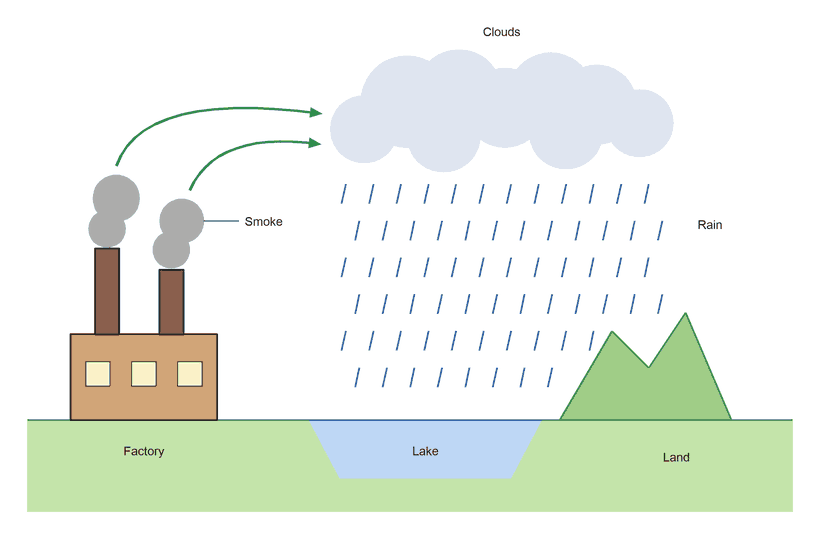
(a) What phenomenon is depicted in this figure ?
(b) Mention the cause of it and give the reaction(s) involved.
(c) State any two consequences of the above phenomenon.
(d) List the ways by which you can reduce and/or prevent it from happening.
Solve with AIWritten solution
Solution:
Concept: Smoke from the factory carries acidic oxides of sulphur and nitrogen up to the clouds. They dissolve in the water of the clouds and come down with the rain on to the lake and the land.
Step 1 — (a) Name the phenomenon.
The figure shows smoke rising to the clouds and rain falling from them on land and water, so it depicts acid rain.
Step 2 — (b) Cause and reactions: sulphuric acid.
Burning fossil fuels in factories, power plants and vehicles releases sulphur dioxide, which is oxidised and dissolves in cloud water to form sulphuric acid:
Step 3 — (b) Cause and reactions: nitric acid.
High temperatures in furnaces, engines and lightning form oxides of nitrogen, which give nitric acid:
Step 4 — (c) Two consequences.
Any two of the following:
- lakes and rivers become acidic, so fish and other aquatic life die;
- soil loses calcium and potassium and its fertility, and forests and crops are damaged;
- marble and limestone buildings are corroded, and metals corrode faster.
Step 5 — (d) Ways to reduce or prevent it.
Acid rain is reduced by releasing less sulphur dioxide and fewer oxides of nitrogen:
- use coal and oil with a low sulphur content;
- fit scrubbers in factory chimneys to absorb sulphur dioxide;
- fit catalytic converters in vehicles and use cleaner fuels such as CNG or electric vehicles;
- use solar, wind and hydro energy in place of burning fossil fuels.
Therefore, the figure depicts acid rain, caused by sulphur dioxide and oxides of nitrogen forming sulphuric and nitric acids; it acidifies lakes and soil and damages buildings, and is reduced by low-sulphur fuels, scrubbers, catalytic converters and clean energy.
What Class 9 Chemistry Ch 8 covers
The sections of the chapter, in the order the book takes them. Every question above comes from one of these.
- 01Air Pollution
- 02Acid Rain
- 03Global Warming
- 04Ozone
More ways to study this chapter
The same chapter asked three other ways. Practise it, revise it, and see what the board has set on Ch 8 before.
Class 9 Chemistry Ch 8 questions students ask
How many questions are there in Class 9 Chemistry Ch 8?
53 questions. Every one is solved step by step on this page.
Are these Class 9 Chemistry solutions free?
Yes. Every question and its full working is free to read, with no account needed.
Can I download the Class 9 Chemistry Ch 8 solutions as a PDF?
There is no PDF to download. Every solution is on this page instead, which means it is searchable, always the current syllabus, and readable on a phone. Use your browser's print option if you want it on paper.