
Opening your dashboard
Class 9 Chemistry Chapter 8 Atmospheric Pollution: Competency-Based Questions (CBQ)
40 questions on Chapter 8, each worked through on its own page with the AI tutor. Class 9 Chemistry, ICSE 2026-27.
40 questions
1–5 marks · Mixed difficulty
- 11 mark
Question 1
Cognitive domain: Application
At a pollution-check centre, a technician tests the exhaust of the same petrol car twice: once with its catalytic converter taken out and once with it fitted. The gas analyser gives the readings below (all in the same units).
Gas in the exhaust Converter taken out Converter fitted Carbon monoxide 40 4 Nitric oxide 25 3 Carbon dioxide 120 156 Nitrogen 700 711 Which statement explains all four changes?
- 21 mark
Question 2
Cognitive domain: Analysis
A sugar mill burns coal in its boiler. An engineer fits a scrubber in the chimney, in which the rising gases pass through a fine spray of water. She tests the gas and the water on both sides of the scrubber.
What is tested Entering the scrubber Leaving the scrubber Sulphur dioxide in the gas (units) 500 60 pH of the water 7.0 3.2 Which conclusion is supported by both rows of the table?
- 31 mark
Question 3
Cognitive domain: Understanding
Ritu marks two lines in her chemistry notes.
Line 1: Without greenhouse gases, the earth would be as cold and barren as the moon.
Line 2: We must reduce the greenhouse gases in the atmosphere.
She feels that the two lines contradict each other. Which statement removes her confusion?
- 41 mark
Question 4
Cognitive domain: Application
Supersonic jet aircraft fly high in the stratosphere. Their burning fuel gives out a large quantity of nitric oxide there. Suppose the number of such flights rises steeply for many years.
Which change is most likely to be reported as a direct result of this nitric oxide high in the atmosphere?
- 51 mark
Question 5
Cognitive domain: Understanding
Assertion (A): Breathing air that contains even a small proportion of carbon monoxide can seriously cut down the supply of oxygen to the tissues of the body.
Reason (R): Haemoglobin binds with carbon monoxide about 200 times more strongly than it binds with oxygen.
- 61 mark
Question 6
Cognitive domain: Analysis
Assertion (A): The radiation given out by the warm surface of the earth has a longer wavelength than the sunlight that heats it.
Reason (R): Carbon dioxide in the atmosphere absorbs some of the infra-red radiation given out by the earth.
- 71 mark
Question 7
Cognitive domain: Understanding
On a May afternoon, the weather app on Farhan's phone shows UV index: very high. His sister tells him that things would be far worse if most of the sun's ultraviolet rays were not stopped high above the ground. Complete her explanation.
In the upper layer of the atmosphere, called the ________, far ultraviolet rays split oxygen molecules into oxygen ________. Each of these combines with an oxygen molecule to form a molecule of ________. This gas absorbs the harmful ultraviolet rays, which could otherwise cause skin ________.
- 81 mark
Question 8
Cognitive domain: Application
Families living beside a fertiliser factory complain of a sharp-smelling gas that makes their eyes water. A student holds a strip of moist red litmus paper in the air near the factory wall, and it slowly turns blue.
Name the gaseous pollutant that the litmus paper has detected, and write its formula.
- 91 mark
Question 9
Cognitive domain: Application
Two identical clean iron nails are left half-dipped in rain water for two weeks. Nail 1 stands in rain water of pH 5.6 collected in a forest. Nail 2 stands in rain water of pH 3.8 collected near an oil refinery.
Predict the difference that will be seen between the two nails, and give the reason.
- 102 marks
Question 10
Cognitive domain: Application
A forest lies downwind of a large coal-fired power station. Over ten years, the forest officers find that the leaves of many trees are damaged, and that the soil contains less and less calcium and potassium. Rain water collected in the forest has a pH of 4.1.
Explain how the power station can be responsible for both findings, and suggest one change at the power station that would reduce the damage.
- 112 marks
Question 11
Cognitive domain: Evaluation
A city replaces 500 diesel buses with electric buses. Its advertisement says: "Our new buses add no pollution to the air, anywhere." The electricity used to charge the buses comes from a coal-fired power plant 80 km away.
Evaluate the advertisement. Is the claim fully correct? Is the change still worth making? Give reasons.
- 122 marks
Question 12
Cognitive domain: Understanding
In a class debate Kabir says: "The ozone hole lets extra heat from the sun reach the earth. That is what causes global warming."
Point out the two mistakes in Kabir's statement and correct them.
- 134 marks
Question 13
Cognitive domain: Analysis
On cold nights some families sleep in a closed room with a coal angithi (a small open stove) burning for warmth, and there have been cases of whole families being found unconscious in the morning. To show the danger, a fire-safety team lights an angithi in an empty test room and records the level of one gas in the air of the room with a meter. They do this first with the door and window shut, and then again with the window open. The gas has no colour and no smell. Their readings are given below.
Time after lighting (minutes) Gas in the air, room shut (ppm) Gas in the air, window open (ppm) 0 0 0 30 60 10 60 150 15 90 280 15 (a) Name the gas. Explain why its level keeps rising when the room is shut but stays low when the window is open.
(b) At 90 minutes in the shut room, the gas makes up only 280 parts in a million parts of the air, while oxygen makes up about 209,400 parts. Explain why so small a proportion can still make a sleeping person unconscious. Name the two organs that are affected most.
(c) A neighbour says: "Coal is the problem. A kerosene stove or a gas heater would be perfectly safe in a shut room." Is he right? Give a reason, and state two precautions that follow from the readings.
- 144 marks
Question 14
Cognitive domain: Evaluation
A zinc smelter was set up in 2006 on a hillside above a lake. The smelter heats zinc sulphide ore in air and also burns coal, and the gases from its chimney drift over the lake. Every five years the fisheries department tests the lake water and counts the fish netted in a survey that is carried out in the same way each time. People of the lakeside village say that their catch has collapsed. The department's records are shown below.
Year pH of the lake water Fish netted in the survey 2005 6.8 420 2010 6.1 310 2015 5.2 120 2020 4.6 15 (a) State what the records show, and name the gas from the smelter that is mainly responsible.
(b) Write balanced equations to show how this gas becomes an acid in rain water.
(c) Two remedies are suggested. Remedy P: make the chimney twice as tall, so that the gases are carried farther away. Remedy Q: spread powdered limestone (calcium carbonate) over the lake every year. Evaluate each remedy, giving an equation where one is needed, and state what would remove the root cause.
- 155 marks
Question 15
Cognitive domain: Creativity
For Science Day, the eco-club of a school wants to show visitors that air containing extra carbon dioxide traps more heat than ordinary air. The club has two identical clear plastic bottles with caps, two thermometers, modelling clay, baking soda, vinegar, water, a measuring cylinder, a stop-clock and a sunny window sill. (Baking soda and vinegar react to give carbon dioxide.)
Design the investigation.
(a) Describe the set-up, and how extra carbon dioxide will be put into one bottle only.
(b) State what must be kept the same for the two bottles so that the test is fair, and what will be measured.
(c) Draw a table for recording the results, and state the result you expect if the club's idea is correct.
(d) State one way in which this model is different from the real greenhouse effect in the atmosphere.
- 161 mark
Question 16
Cognitive domain: Application
A traffic policeman stands at a busy crossing for eight hours every day, with a thick cotton cloth tied over his nose and mouth. At the end of the day the cloth is black with soot and dust. Even so, he often has a headache and feels dizzy by evening.
Which statement best explains why the cloth does not fully protect him?
- 171 mark
Question 17
Cognitive domain: Understanding
Air is about nitrogen and oxygen by volume, and these two gases are present together in every room. Yet the air of a room has no nitric oxide in it, while the air near the exhaust of a running car engine, and the air during a thunderstorm, does contain it.
Which statement explains this?
- 181 mark
Question 18
Cognitive domain: Understanding
A school group visits a hill station in an industrial region. The day is dry but thick fog hangs over the valley, and a pH meter shows that the water collected from the fog droplets has a pH of . A student says, "This cannot be acid rain, because no rain has fallen."
Which statement about the student's claim is correct?
- 191 mark
Question 19
Cognitive domain: Application
Many years ago a small factory cleaned metal parts with carbon tetrachloride, , used as a solvent. After a visit by an environment officer, the owner changed to a water-based cleaning liquid.
Which environmental problem does this change help to reduce most directly?
- 201 mark
Question 20
Cognitive domain: Analysis
Two towns, P and Q, lie at the same height above sea level, have the same kind of soil and receive the same sunshine in May. The air of town P is very dry, and the air of town Q is very humid. The table gives the highest and lowest temperatures of a clear May day in each town. (Hypothetical data.)
Highest temperature (day) Lowest temperature (night) Town P (dry air) Town Q (humid air) Which statement best explains why the night in town Q stays so much warmer?
- 211 mark
Question 21
Cognitive domain: Analysis
On a clear winter day an environment club recorded two things every hour at a busy road junction: the level of nitrogen dioxide in the air, and the number of people reporting burning, watery eyes at a nearby clinic. Each record is shown as a percentage of the highest value of the day in the graph. (Hypothetical data.)
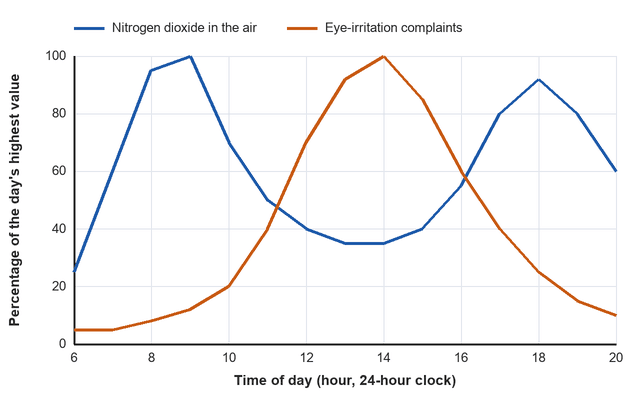
The nitrogen dioxide peaks in the morning and again in the evening, when the traffic is heaviest, but the eye complaints peak at about 2 p.m.
Which statement best explains the graph?
- 221 mark
Question 22
Cognitive domain: Application
A farmer's vegetable plot lies beside an open drain that carries untreated sewage. In the evenings, people passing by notice a smell of rotten eggs, and many say that their eyes sting. The vegetables near the drain grow poorly.
Which gas is mainly responsible, and how is it formed here?
- 231 mark
Question 23
Cognitive domain: Application
Rice is grown in fields that stay flooded with water for weeks. Scientists find that such fields give out methane, which is a greenhouse gas.
Which statement correctly explains where this methane comes from?
- 241 mark
Question 24
Cognitive domain: Analysis
Assertion (A): Rain collected near a coal-fired power station often has a lower pH than rain collected in a clean forest far away from any industry.
Reason (R): Even rain in a clean forest is slightly acidic, because carbon dioxide dissolves in it to form weak carbonic acid.
- 251 mark
Question 25
Cognitive domain: Understanding
Assertion (A): Global warming can flood low-lying coastal areas.
Reason (R): A rise in the average temperature of the earth's surface melts glaciers and the ice caps that lie on land, and this adds water to the sea.
- 262 marks
Question 26
Cognitive domain: Understanding
Workers in the carding section of a cotton textile mill work in air that is full of tiny cotton fibres, which can be seen floating in the beams of light from the windows. After several years many of them develop a long-lasting cough and trouble in breathing.
(a) Is cotton dust a gaseous pollutant or a particulate pollutant? Give a reason.
(b) Name the harmful effect of cotton dust on the lungs, and state one measure that would help to protect the workers.
- 272 marks
Question 27
Cognitive domain: Analysis
A city health department tested the blood of schoolchildren for lead every five years. During this period the city stopped selling petrol that contained tetraethyl lead. (Hypothetical data.)
Year Petrol with tetraethyl lead on sale? Average lead in the blood of the children (micrograms per 100 mL) 1996 Yes 15 2001 No (sale stopped in 1999) 9 2006 No 5 2011 No 4 (a) Describe the trend in the table and give the reason for it, using the chapter.
(b) The blood lead of the children did not fall to zero. Name two other sources of lead in our surroundings.
- 282 marks
Question 28
Cognitive domain: Application
In a kitchen the gas stove usually burns with a steady blue flame. After the air holes at the base of its burner become blocked with dirt, the flame turns yellow and unsteady, the bottom of the cooking vessel is covered with black soot, and the family has a headache while cooking in the closed kitchen.
(a) What has the blocked air supply done to the burning of the fuel? Name the harmful gas that is formed.
(b) What is the black soot, and what should the family do to stop the problem?
- 292 marks
Question 29
Cognitive domain: Evaluation
A shopkeeper in an industrial town says: "Acid rain only spoils buildings and iron gates. It cannot harm people, because nobody drinks rain water and it does not get into the body."
Evaluate the shopkeeper's statement, and give two reasons from the chapter to support your view.
- 302 marks
Question 30
Cognitive domain: Evaluation
A newspaper headline reads: "Global warming only means that every place on the earth will become a little hotter and drier."
Using the chapter, point out what is wrong with the headline, and give two effects of global warming that support your answer.
- 312 marks
Question 31
Cognitive domain: Understanding
Years ago, insect-killer sprays used a CFC as the propellant. A man says: "I only use the spray inside my closed bedroom, so none of it can reach the ozone layer high above."
(a) Explain why he is wrong.
(b) CFCs were chosen for sprays because they are not poisonous, do not catch fire and hardly react with anything. Explain why this same property makes CFCs so harmful to the ozone layer.
- 323 marks
Question 32
Cognitive domain: Application
A school collected the rain water that ran off its roof in one shower in a clean plastic tank. The tank held L of water, and a test showed that it contained mg of nitric acid, . (Hypothetical data.)
Near the school, nitrogen dioxide from vehicles reacts with rain water according to the equation
(a) Find the mass of nitrogen dioxide that must have reacted to form this nitric acid.
(b) Find the mass of nitrous acid, , formed along with it.
(c) Find the mass of water used in the reaction, and show that the masses in (a) and (b) agree with the equation. (H = 1, N = 14, O = 16)
- 333 marks
Question 33
Cognitive domain: Evaluation
An eco-club notes that students of one colony are taken to school every day by separate private cars, one student in each car. The school is km from the colony, so each car runs km a day to go to school and come back. A petrol car gives out about kg of carbon dioxide for every kilometre, and a diesel school bus about kg for every kilometre. (Hypothetical data.)
The club considers two plans. Plan P: car pools, with students in each car ( cars). Plan Q: one school bus, which runs the same km a day and carries all students.
(a) Find the carbon dioxide given out each day at present, under Plan P and under Plan Q.
(b) Recommend a plan, giving a reason from your answers and from the chapter.
(c) A parent objects: "A big diesel bus must pollute the air more than the small cars." Use your answers to judge this.
- 343 marks
Question 34
Cognitive domain: Creativity
Your teacher says that when sulphur burns in air, the gas formed makes water acidic, just as the sulphur in coal makes rain acidic. You are given a small piece of sulphur, a deflagrating spoon (a metal spoon with a long handle), a gas jar with a lid, a burner, a little water, blue litmus paper, and a fume cupboard.
Plan a short demonstration, to be carried out by your teacher, that shows this.
(a) Describe the steps.
(b) State what you expect to observe, and write the equations.
(c) State one safety precaution, with the reason for it.
- 353 marks
Question 35
Cognitive domain: Evaluation
A student prepares a poster for Environment Week. Each of the three statements on it contains one mistake.
Statement 1: "Normal rain has a pH of about 5.6, and acid rain has a pH higher than this, because of the sulphuric and nitric acids in it."
Statement 2: "Global warming is the rise in the average temperature of the earth's surface, and it happens because the proportion of greenhouse gases in the air has fallen below the optimum level."
Statement 3: "The ozone layer in the stratosphere absorbs the infra-red rays of the sun, and the destruction of this layer by CFCs makes skin cancer more common."
Find the mistake in each statement and write the correct statement.
- 363 marks
Question 36
Cognitive domain: Application
The orange trees of an orchard beside a phosphate-fertiliser factory show brown, scorched leaf tips every year, although the soil and the water are good. Children of the nearby village have patchy, brittle teeth, and some adults complain of pain in their bones. The gases from the factory chimney are tested and found to contain compounds of fluorine. (Hypothetical case.)
(a) Which air pollutant, listed in the chapter, is most likely to be responsible?
(b) Match the pollutant with the three observations of the case.
(c) Name one device mentioned in the chapter that can be fitted to the chimney to remove such a gaseous pollutant, and say how it works.
- 375 marks
Question 37
Cognitive domain: Evaluation
Chlorine atoms from CFCs destroy ozone in the stratosphere. An environment agency recorded, for a polar region, the CFCs released into the air each year by all the countries of the world, and the amount of ozone in the stratosphere over that region in October, as an index with the value of 1970 taken as . Both records are shown in the graphs. (Hypothetical data.)

(a) In which year was the release of CFCs the highest, and what was the lowest value of the ozone index?
(b) Find the percentage fall in the ozone index from 1970 to its lowest value. Compare the fall from 1970 to 1980 with the fall from 1980 to 1990, and link the comparison with the CFC records.
(c) A newspaper writes: "By 2020 the CFCs released had fallen to almost nothing, but the ozone index is still well below its 1970 value, so stopping CFCs has failed." Evaluate this claim using the graphs.
- 384 marks
Question 38
Cognitive domain: Analysis
The weather office of a river-delta district recorded the following figures for three years. (Hypothetical data.)
Year Average summer temperature Rainfall in the year Number of rainy days 2000 mm 2010 mm 2020 mm Farmers of the district say that their crops now suffer from long dry spells followed by heavy downpours that flood the fields, and that sea water now reaches fields that were safe twenty years ago.
(a) Find the rise in the average summer temperature from 2000 to 2020, and the average rainfall for each rainy day in 2000 and in 2020.
(b) Name two greenhouse gases, with one source of each, and explain how a rise in greenhouse gases can lead to heavier rain on the rainy days.
(c) Name two effects of global warming from the chapter that the farmers' observations agree with, and state one action by which people can help to slow down global warming.
- 394 marks
Question 39
Cognitive domain: Analysis
An eco-club grew five identical bean seedlings, using the same soil, pots and sunlight, for three weeks. Every day each seedling was sprayed with mL of a different water sample. The samples were made by adding a few drops of dilute sulphuric acid to distilled water. (Hypothetical data.)
Seedling pH of the water sprayed Height after three weeks Condition of the leaves A cm Healthy and green B cm Healthy and green C cm A few pale spots D cm Many brown spots, some leaves fallen E cm Most leaves brown or fallen (a) Which seedling is the control, and which seedling represents normal rain? Give a reason for each answer.
(b) State the pattern that the data show, and find how many times as tall seedling A is as seedling E.
(c) Give two ways in which acid rain damages plants and trees in nature, and state one way in which this experiment differs from a real forest.
- 405 marks
Question 40
Cognitive domain: Creativity
The eco-club of a school wants to compare the amount of solid particles, such as dust and soot, in the air at four places: a classroom, the school playground, the side of a busy road, and the side of a field where crop waste is burnt. The club has white cards of the same size, petroleum jelly, a hand lens, a ruler, a pencil, thread and a clock.
Design the investigation.
(a) Describe how you will prepare the cards and where you will place them.
(b) State what must be kept the same for the four places to make the test fair, and how you will measure the result.
(c) State the result you expect, and say which kind of air pollutant this method cannot detect, with a reason.