
Opening your dashboard
Class 9 Biology Chapter 8: Five Kingdom Classification Solutions
40 textbook questions with step-by-step answers, free to read, for ICSE 2026-27.
Get talked through Ch 8, not just shown the answer
Reading a finished solution is not the same as being able to do it. The AI tutor takes one question at a time and works it with you, in your own words, until you can.
- Ask it out loud, in your own words
- It gives you the next step, not the answer
- Stuck on part (ii)? Start there
40 questions with solutions
1–12 marks · Mixed difficulty
- 11 mark
Question 1
Rearrange the following categories of animal grouping in a sequence starting from the highest downward to the lowest.
Class ..........
Phylum ..........
Species ..........
Genus ..........
Kingdom ..........
Solve with AIWritten solution
Solution:
Concept: The levels of classification, from the largest group to the smallest, are Kingdom → Phylum (Division in plants) → Class → Order → Family → Genus → Species. Each higher level holds more organisms that share fewer features.
Step 1 — Start at the top.
The kingdom is the largest group, so it comes first, followed by the phylum.
Step 2 — Go down the levels.
Below the phylum comes the class. Order and family, which are not in this list, would come next, then the genus.
Step 3 — End with the smallest.
The species is the smallest group, so it comes last.
Watch out: Genus comes just above species; do not reverse these two.
Therefore, the sequence is Kingdom → Phylum → Class → Genus → Species.
- 25 marks
Question 2
Tick-mark the features that characterise vertebrates.
(i) Dorsal nerve cord
(ii) Haemoglobin dissolved
(iii) Three or more pairs of limbs
(iv) A tail behind the level of the anus
(v) Dorsal heart
Solve with AIWritten solution
Solution:
Concept: Vertebrates (backboned animals) have a dorsal, hollow nerve cord, a ventral heart, haemoglobin inside red blood cells, at most two pairs of limbs, and a tail behind the anus at some stage of life.
Step 1 — Feature (i): dorsal nerve cord.
This is a vertebrate feature: the spinal cord runs along the back (dorsal side) and is hollow. Tick it ✓.
Step 2 — Feature (ii): haemoglobin dissolved.
This is not a vertebrate feature: in vertebrates haemoglobin is inside red blood cells; it is dissolved in the plasma only in some invertebrates, such as the earthworm. Do not tick ✗.
Step 3 — Feature (iii): three or more pairs of limbs.
This is not a vertebrate feature: vertebrates have at most two pairs of limbs; three or more pairs are found in arthropods. Do not tick ✗.
Step 4 — Feature (iv): a tail behind the anus.
This is a vertebrate feature: a tail extends beyond the anus, at least in the embryo. Tick it ✓.
Step 5 — Feature (v): dorsal heart.
This is not a vertebrate feature: the vertebrate heart lies on the ventral side; a dorsal heart is found in many invertebrates. Do not tick ✗.
Watch out: Nerve cord and heart are on opposite sides: dorsal nerve cord, ventral heart.
Therefore, tick (i) dorsal nerve cord and (iv) a tail behind the level of the anus.
- 36 marks
Question 3
Mention the name of the phylum against the following characteristics
(i) No single mouth but numerous pores as water inlets ..........
(ii) Jointed appendages ..........
(iii) Unsegmented body with a protective calcareous shell ..........
(iv) Locomotion by tube feet ..........
(v) Long, cylindrical and unsegmented body ..........
(vi) Small flat unsegmented worms ..........
Solve with AIWritten solution
Solution:
Concept: Each invertebrate phylum has one or two features that identify it at once: pores (Porifera), jointed legs (Arthropoda), a shell (Mollusca), tube feet (Echinodermata), a round body (Nematoda) or a flat body (Platyhelminthes).
Step 1 — Feature (i).
Many pores (ostia) for water to enter, and no single mouth, mark the sponges: Porifera.
Step 2 — Feature (ii).
Jointed appendages (legs, antennae) mark Arthropoda (arthro = joint, poda = foot).
Step 3 — Feature (iii).
A soft, unsegmented body usually protected by a calcareous shell marks Mollusca.
Step 4 — Feature (iv).
Locomotion by tube feet marks Echinodermata (starfish, sea urchin).
Step 5 — Feature (v).
A long, cylindrical, unsegmented body tapering at both ends marks Nematoda (roundworms).
Step 6 — Feature (vi).
Small, flat, unsegmented worms belong to Platyhelminthes (flatworms).
Watch out: A long cylindrical body that is segmented would be Annelida; here it is unsegmented, so Nematoda.
Therefore, (i) Porifera; (ii) Arthropoda; (iii) Mollusca; (iv) Echinodermata; (v) Nematoda; (vi) Platyhelminthes.
- 410 marks
Question 4
Name the phylum of each of the following invertebrates.
Animal Phylum (i) Leech .......... (ii) Hydra .......... (iii) Tapeworm .......... (iv) Sea cucumber .......... (v) Sponge .......... (vi) Roundworm .......... (vii) Scorpion .......... (viii) Slug .......... (ix) Centipede .......... (x) Butterfly .......... Solve with AIWritten solution
Solution:
Concept: Place each animal by its main body feature: pores (Porifera), tentacles with stinging cells (Cnidaria), flat body (Platyhelminthes), round body (Nematoda), ringed body (Annelida), jointed legs (Arthropoda), soft body (Mollusca) or spiny skin with tube feet (Echinodermata).
Step 1 — Worms.
The leech has a ringed, segmented body, so it is in Annelida. The tapeworm is a flat worm, so it is in Platyhelminthes. The roundworm has a round, unsegmented body, so it is in Nematoda.
Step 2 — Simple animals.
The sponge has pores all over its body, so it is in Porifera. Hydra has tentacles with stinging cells round its mouth, so it is in Cnidaria (Coelenterata).
Step 3 — Jointed-legged animals.
The scorpion, centipede and butterfly all have jointed legs and an exoskeleton, so all three are in Arthropoda.
Step 4 — Others.
The slug is a soft-bodied animal (a snail without a shell), so it is in Mollusca. The sea cucumber has tube feet and a spiny skin, so it is in Echinodermata.
Animal Phylum (i) Leech Annelida (ii) Hydra Cnidaria (iii) Tapeworm Platyhelminthes (iv) Sea cucumber Echinodermata (v) Sponge Porifera (vi) Roundworm Nematoda (vii) Scorpion Arthropoda (viii) Slug Mollusca (ix) Centipede Arthropoda (x) Butterfly Arthropoda Watch out: The sea cucumber is not a plant or a mollusc; it is an echinoderm, a relative of the starfish.
Therefore, the phyla are as listed in the table above.
- 55 marks
Question 5
Listed below are eleven characteristics (i-xi) in Column I and the five classes (a-e) of Chordata in Column II. Match at least two characteristics with each class.
Column I (Characteristics) Column II (Classes) (i) Three chambered heart (a) Pisces .......... (ii) Feathers (b) Amphibia .......... (iii) Two-chambered heart (c) Reptilia .......... (iv) Eardrum in a pit (d) Aves .......... (v) Scales (e) Mammalia .......... (vi) External ears (vii) Gills (viii) Moist skin (ix) Horny scales on skin (x) Homeothermal (xi) Testes in scrotum Solve with AIWritten solution
Solution:
Concept: Each class of vertebrates has its own set of features: fishes have gills, scales and a two-chambered heart; amphibians a moist skin; reptiles horny scales; birds feathers; mammals external ears, hair and mammary glands.
Step 1 — Pisces.
Fishes breathe by (vii) gills, are covered by (v) scales and have a (iii) two-chambered heart.
Step 2 — Amphibia.
Frogs and toads have a (viii) moist skin and a (i) three-chambered heart.
Step 3 — Reptilia.
Reptiles have (ix) horny scales on the skin and an (iv) eardrum in a pit (a depression at the side of the head). Most reptiles also have a three-chambered heart; crocodiles have four chambers.
Step 4 — Aves.
Birds have (ii) feathers and are (x) homeothermal (warm-blooded).
Step 5 — Mammalia.
Mammals have (vi) external ears and, in most males, (xi) testes in a scrotum; they are homeothermal as well.
Watch out: Homeothermal fits both birds and mammals; scales fit fishes and reptiles. Give each class at least two features that really belong to it.
Therefore, (a) Pisces: iii, v, vii; (b) Amphibia: i, viii; (c) Reptilia: iv, ix; (d) Aves: ii, x; (e) Mammalia: vi, xi (and x).
- 67 marks
Question 6
Mention the class of vertebrates against each.
(i) Crocodile ..........
(ii) Penguin ..........
(iii) Toad ..........
(iv) Shark ..........
(v) Whale ..........
(vi) Bat ..........
(vii) House lizard ..........
Solve with AIWritten solution
Solution:
Concept: Classify by body covering, breathing organ and how the young are born, not by where the animal lives or whether it flies.
Step 1 — Crocodile and house lizard.
Both have dry, horny scales and lay shelled eggs on land, so both are Reptilia.
Step 2 — Penguin.
It has feathers and lays eggs, so it is a bird, Aves, even though it cannot fly.
Step 3 — Toad.
It has a moist skin and lays eggs in water, so it is Amphibia.
Step 4 — Shark.
It lives in water, breathes by gills and has a cartilage skeleton, so it is Pisces (a cartilaginous fish).
Step 5 — Whale and bat.
Both have hair, breathe by lungs, give birth to young ones and feed them on milk, so both are Mammalia. The whale only looks like a fish, and the bat's wings are folds of skin, not feathers.
Watch out: A whale is not a fish and a bat is not a bird.
Therefore, (i) Reptilia; (ii) Aves; (iii) Amphibia; (iv) Pisces; (v) Mammalia; (vi) Mammalia; (vii) Reptilia.
- 71 mark
Question 7
Choose the correct answer from the options given below :
The animals (Kingdom Animalia) are mainly grouped under two categories
Solve with AIAnswer
(A) bilaterally symmetrical and radially symmetrical
(B) coelomate and acoelomate
(C) aquatic and terrestrial
- Correct
(D) vertebrates and invertebrates
Answer: (D) vertebrates and invertebrates
Concept: Kingdom Animalia is mainly divided into two groups by the presence or absence of a backbone: the invertebrates (phyla Porifera to Echinodermata) and the vertebrates (in phylum Chordata).
Step 1 — Recall the main division.
The book first splits animals into those without a backbone and those with one.
Step 2 — Match with the options.
That is option (D).
Why the other options are wrong:
- (A) bilaterally symmetrical and radially symmetrical: This is wrong because symmetry is only one body feature, and some animals, such as most sponges, have no symmetry at all.
- (B) coelomate and acoelomate: This is wrong because the coelom (body cavity) is used for finer grouping, and coelomates include both invertebrates and vertebrates, so it is not the book's main two-way division.
- (C) aquatic and terrestrial: This is wrong because habitat is not a basis of scientific classification; frogs, for example, live both in water and on land.
Therefore, animals are mainly grouped as vertebrates and invertebrates, option (D).
- 81 mark
Question 8
Choose the correct answer from the options given below :
Which one of the following examples does not come under the particular group ?
Solve with AIAnswer
(A) Mushroom, yeast, fern— Fungi
(B) Paramecium, Euglena, sponge — Protista
- Correct
(C) Starfish, Roaches, Dogfish — Pisces
(D) Bat, Parrot, Oyster— Vertebrates
Answer: (C) Starfish, Roaches, Dogfish – Pisces
Concept: A group is named correctly only if its examples belong to it. Check each example against the group named.
Step 1 — Check option (A).
Mushroom and yeast are fungi, but the fern is a plant (a pteridophyte), so one of the three does not fit.
Step 2 — Check option (B).
Paramecium and Euglena are protists, but the sponge is an animal (Porifera), so one of the three does not fit.
Step 3 — Check option (C).
Only the dogfish is a fish. The starfish is an echinoderm and the roach (cockroach) is an insect, so two of the three do not come under Pisces.
Step 4 — Check option (D).
Bat and parrot are vertebrates, but the oyster is a mollusc, so one of the three does not fit.
Step 5 — Choose the printed key.
Every option has a misfit, so the question is best read as 'which set as a whole does not come under the group named'. Only in (C) do most of the examples fall outside the group, so (C) is the key (the printed answer).
Watch out: Read all three examples in every option before choosing; each option contains at least one misfit.
Why the other options are wrong:
- (A) Mushroom, yeast, fern – Fungi: This is not the key because two of its three examples (mushroom, yeast) are fungi; only the fern is out of place.
- (B) Paramecium, Euglena, sponge – Protista: This is not the key because two of its three examples (Paramecium, Euglena) are protists; only the sponge is out of place.
- (D) Bat, Parrot, Oyster – Vertebrates: This is not the key because two of its three examples (bat, parrot) are vertebrates; only the oyster is out of place.
Therefore, the set that does not come under its group is starfish, roaches, dogfish under Pisces, option (C).
- 91 mark
Question 9
Choose the correct answer from the options given below :
Which one of the following is an example of binomial scientific name ?
Solve with AIAnswer
(A) Green alga
(B) Snow leopard
- Correct
(C) Rana tigrina
(D) China-rose
Answer: (C) Rana tigrina
Concept: A binomial (two-name) scientific name has a genus name with a capital first letter and a species name with a small first letter, printed in italics (or underlined separately when handwritten).
Step 1 — Look for the two-part Latin form.
Rana tigrina has a genus (Rana) and a species (tigrina) in italics; it is the Indian bullfrog.
Step 2 — Reject common names.
The other three are everyday English names, which change from place to place.
Note: Today the Indian bullfrog is placed in another genus and named Hoplobatrachus tigerinus; either way its name is binomial.
Why the other options are wrong:
- (A) Green alga: This is wrong because 'green alga' is a common, descriptive name for a whole group.
- (B) Snow leopard: This is wrong because 'snow leopard' is a common English name; its scientific name is Panthera uncia.
- (D) China-rose: This is wrong because 'China-rose' is a common name; its scientific name is Hibiscus rosa-sinensis.
Therefore, Rana tigrina is the binomial scientific name, option (C).
- 101 mark
Question 10
Choose the correct answer from the options given below :
Which one of the following is the correct statement about the respective animal(s) ?
Solve with AIAnswer
(A) Donkey and horse should be considered one single species because they can successfully mate and produce an offspring.
(B) Donkey and horse are two different genera.
(C) Mule is a separate species.
- Correct
(D) Mule is neither a donkey nor a horse.
Answer: (D) Mule is neither a donkey nor a horse.
Concept: A species is a group whose members interbreed to produce fertile young. A mule is the hybrid of a male donkey and a female horse; it is (almost always) sterile.
Step 1 — Test donkey and horse against the definition.
Donkey and horse can mate, but their young, the mule, is sterile, so donkey and horse are two separate species of the same genus Equus.
Step 2 — Place the mule.
A mule cannot breed to form more mules, so it is not a species; it is a hybrid that is neither a donkey nor a horse.
Watch out: Producing young is not enough for one species; the young must themselves be fertile.
Why the other options are wrong:
- (A) Donkey and horse should be considered one single species because they can successfully mate and produce an offspring: This is wrong because a species needs fertile offspring, and the mule is sterile.
- (B) Donkey and horse are two different genera: This is wrong because donkey (Equus asinus) and horse (Equus caballus) belong to the same genus, Equus.
- (C) Mule is a separate species: This is wrong because mules cannot breed among themselves, so they cannot form a species.
Therefore, the correct statement is that the mule is neither a donkey nor a horse, option (D).
- 111 mark
Question 11
Choose the correct answer from the options given below :
Which of the following is the lowest category among the levels of classification ?
Solve with AIAnswer
(A) Class
(B) Family
(C) Order
- Correct
(D) Genus
Answer: (D) Genus
Concept: The levels of classification, from the largest group to the smallest, are Kingdom → Phylum (Division in plants) → Class → Order → Family → Genus → Species. Each higher level holds more organisms that share fewer features.
Step 1 — Place the four options on the ladder.
Class is above order, order is above family, and family is above genus.
Step 2 — Pick the lowest.
Of the four, genus is the lowest (only species lies below it).
Why the other options are wrong:
- (A) Class: This is wrong because class is above order, family and genus.
- (B) Family: This is wrong because family is above genus.
- (C) Order: This is wrong because order is above family and genus.
Therefore, genus is the lowest of these categories, option (D).
- 121 mark
Question 12
Choose the correct answer from the options given below :
Unicellular, prokaryotic organisms belong to :
Solve with AIAnswer
(A) Protista
(B) Fungi
- Correct
(C) Monera
(D) Both (a) and (c)
Answer: (C) Monera
Concept: Prokaryotic cells have no nucleus enclosed by a nuclear membrane and no membrane-bound organelles. In the five kingdom system, all such single-celled organisms (bacteria) are placed in Monera.
Step 1 — Separate prokaryotes from eukaryotes.
Protists and fungi have a true nucleus, so they are eukaryotes; only Monera are prokaryotes.
Step 2 — Match with the options.
Monera is option (C).
Watch out: Being unicellular is not enough; protists are unicellular too, but eukaryotic.
Why the other options are wrong:
- (A) Protista: This is wrong because protists are unicellular but eukaryotic (they have a nucleus with a nuclear membrane).
- (B) Fungi: This is wrong because fungi are eukaryotic, and most are multicellular.
- (D) Both (a) and (c): This is wrong because Protista is not prokaryotic, so 'both' cannot be right.
Therefore, unicellular prokaryotic organisms belong to Monera, option (C).
- 131 mark
Question 13
Choose the correct answer from the options given below :
Which of the following organisms is chlorophyllous ?
Solve with AIAnswer
(A) Penicillium
- Correct
(B) Euglena
(C) Paramecium
(D) Toadstool
Answer: (B) Euglena
Concept: A chlorophyllous organism contains chlorophyll and can make its own food by photosynthesis. Euglena has chloroplasts, although it can also take in food like an animal.
Step 1 — Check each organism for chlorophyll.
Penicillium and the toadstool are fungi, and Paramecium is a non-green protist; none of them has chlorophyll.
Step 2 — Pick the green one.
Only Euglena has chloroplasts with chlorophyll.
Why the other options are wrong:
- (A) Penicillium: This is wrong because Penicillium is a fungus, and fungi have no chlorophyll.
- (C) Paramecium: This is wrong because Paramecium is a non-green protist that feeds on bacteria and other food particles.
- (D) Toadstool: This is wrong because a toadstool (a kind of mushroom) is a fungus without chlorophyll.
Therefore, Euglena is the chlorophyllous organism, option (B).
- 141 mark
Question 14
Choose the correct answer from the options given below :
Cycads and Conifers are two types of :
Solve with AIAnswer
- Correct
(A) Gymnosperms
(B) Pteridophytes
(C) Angiosperms
(D) Bryophytes
Answer: (A) Gymnosperms
Concept: Gymnosperms bear naked seeds, usually in cones. Their two main groups are the cycads (palm-like, e.g. Cycas) and the conifers (pine, fir, deodar); a few others, such as Ginkgo, also exist.
Step 1 — Recall what cycads and conifers have in common.
Both bear seeds that are not enclosed in a fruit.
Step 2 — Match with the options.
Naked-seeded plants are gymnosperms, option (A).
Why the other options are wrong:
- (B) Pteridophytes: This is wrong because pteridophytes (ferns) bear no seeds at all; they reproduce by spores.
- (C) Angiosperms: This is wrong because angiosperms bear seeds enclosed inside fruits.
- (D) Bryophytes: This is wrong because bryophytes (mosses, liverworts) bear no seeds; they reproduce by spores.
Therefore, cycads and conifers are two types of gymnosperms, option (A).
- 151 mark
Question 15
Choose the correct answer from the options given below :
The leaf-like structure of Bryophytes is termed as :
Solve with AIAnswer
(A) Phylloclade
(B) Phyllode
(C) Cladode
- Correct
(D) Phyllids
Answer: (D) Phyllids
Concept: Bryophytes (mosses, liverworts) have no true roots, stems or leaves. Their root-like, stem-like and leaf-like parts are called rhizoids, the caulid and phyllids.
Step 1 — Recall the bryophyte terms.
The leaf-like structures of a moss are its phyllids.
Step 2 — Reject flowering-plant terms.
Phylloclade, phyllode and cladode are modified stems or petioles of flowering plants.
Why the other options are wrong:
- (A) Phylloclade: This is wrong because a phylloclade is a flattened green stem of a flowering plant (e.g. Opuntia).
- (B) Phyllode: This is wrong because a phyllode is a flattened leaf-stalk that works as a leaf (e.g. Australian Acacia).
- (C) Cladode: This is wrong because a cladode is a short, leaf-like green branch of a flowering plant (e.g. Asparagus).
Therefore, the leaf-like structures of bryophytes are phyllids, option (D).
- 161 mark
Question 16
Choose the correct answer from the options given below :
Which of the following belongs to class Pisces ?
Solve with AIAnswer
(A) Jellyfish
- Correct
(B) Dogfish
(C) Silverfish
(D) Cuttlefish
Answer: (B) Dogfish
Concept: Class Pisces holds the true fishes: cold-blooded vertebrates with gills, fins and usually scales. Many animals called 'fish' are not fishes at all.
Step 1 — Check each 'fish'.
The jellyfish is a cnidarian, the silverfish an insect and the cuttlefish a mollusc; none has a backbone.
Step 2 — Pick the true fish.
The dogfish is a small shark, a cartilaginous fish with gills and fins.
Watch out: An animal's common name can mislead; classify by its body features.
Why the other options are wrong:
- (A) Jellyfish: This is wrong because the jellyfish belongs to phylum Cnidaria.
- (C) Silverfish: This is wrong because the silverfish is a wingless insect (phylum Arthropoda).
- (D) Cuttlefish: This is wrong because the cuttlefish (Sepia) is a mollusc.
Therefore, the dogfish belongs to class Pisces, option (B).
- 171 mark
Question 17
Who had introduced the binomial system of naming living beings ?
Solve with AIWritten solution
Solution:
Concept: Binomial nomenclature gives every species a two-part Latin name: the genus followed by the species.
Step 1 — Name the scientist.
The Swedish naturalist Carolus Linnaeus (1707–1778) introduced the binomial system.
Step 2 — When.
He used it throughout his books on plants (1753) and animals (1758), and it is used all over the world today.
Therefore, Carolus Linnaeus introduced the binomial system of naming.
- 181 mark
Question 18
Which two characters out of (a)-(e) given below are common to dog, humans, squirrel, bat, camel and monkey ?
(a) scales on the skin.
(b) wings.
(c) external ears.
(d) give birth to young ones.
(e) a functional tail.
Solve with AIWritten solution
Solution:
Concept: Dog, human, squirrel, bat, camel and monkey are all mammals, so the common characters must be mammal features found in every one of them.
Step 1 — Test each character.
(a) Scales are absent in all of them. (b) Only the bat has wings. (e) Humans (and some others) have no functional tail.
Step 2 — Keep the shared ones.
(c) All six have external ears (pinnae), and (d) all six give birth to young ones.
Therefore, the two common characters are (c) external ears and (d) giving birth to young ones.
- 196 marks
Question 19
Match the items in Column I with as many as possible and even repeatedly from Column II.
Column I Column II 1. Pine (i) Fungi 2. Earthworm (ii) Monera 3. Bread mould (iii) Prokaryote 4. Amoeba (iv) Gymnosperm 5. Moss (v) Plantae 6. Bacteria (vi) Animalia (vii) Protista (viii) Bryophyta Solve with AIWritten solution
Solution:
Concept: An organism can be matched with its kingdom and also with a smaller group (a division) or a cell type, so some items get two matches.
Step 1 — Pine and moss.
Pine is a naked-seeded plant: (iv) Gymnosperm and (v) Plantae. Moss is a simple land plant: (viii) Bryophyta and (v) Plantae.
Step 2 — Earthworm and Amoeba.
The earthworm is a many-celled animal: (vi) Animalia. Amoeba is a single eukaryotic cell: (vii) Protista.
Step 3 — Bread mould and bacteria.
Bread mould (Rhizopus) has no chlorophyll and a body of hyphae: (i) Fungi. Bacteria have no true nucleus: (ii) Monera and (iii) Prokaryote.
Column I Column II 1. Pine (iv) Gymnosperm, (v) Plantae 2. Earthworm (vi) Animalia 3. Bread mould (i) Fungi 4. Amoeba (vii) Protista 5. Moss (viii) Bryophyta, (v) Plantae 6. Bacteria (ii) Monera, (iii) Prokaryote Therefore, the matches are as shown in the table above.
- 204 marks
Question 20
What are the group names for the following categories of animals ?
(a) Animals with a backbone ..........
(b) Animals with a hairy skin ..........
(c) Animals with three pairs of legs ..........
(d) Animals with feathers ..........
Solve with AIWritten solution
Solution:
Concept: Each feature defines a well-known group of animals.
Step 1 — Part (a).
Animals with a backbone are the vertebrates (Vertebrata).
Step 2 — Part (b).
Animals with a hairy skin are the mammals (Mammalia).
Step 3 — Part (c).
Animals with three pairs of legs are the insects (Insecta).
Step 4 — Part (d).
Animals with feathers are the birds (Aves).
Therefore, (a) vertebrates; (b) mammals; (c) insects; (d) birds.
- 211 mark
Question 21
Which ones of the following animals are invertebrates ? Housefly, silverfish, trout, jellyfish, whale, penguin, lizard and sponge.
Solve with AIWritten solution
Solution:
Concept: Invertebrates are animals without a backbone; vertebrates have one.
Step 1 — Pick the animals without a backbone.
The housefly and silverfish are insects, the jellyfish is a cnidarian and the sponge is a poriferan; none has a backbone.
Step 2 — Set aside the vertebrates.
The trout (a fish), whale (a mammal), penguin (a bird) and lizard (a reptile) all have a backbone.
Watch out: Names ending in 'fish' (silverfish, jellyfish) do not make an animal a fish.
Therefore, the invertebrates are the housefly, silverfish, jellyfish and sponge.
- 221 mark
Question 22
Name three animals (belonging to different classes) which breathe by means of lungs but have no external ears (pinnae).
Solve with AIWritten solution
Solution:
Concept: Only mammals have external ears (pinnae). Amphibians, reptiles and birds also breathe by lungs, but they have no pinnae.
Step 1 — An amphibian.
The frog breathes by lungs (and its skin) and has only an eardrum on the surface.
Step 2 — A reptile.
The lizard breathes by lungs and its eardrum lies in a small pit.
Step 3 — A bird.
The pigeon breathes by lungs and its ear opening is hidden under feathers.
Watch out: Fishes have no pinnae either, but they breathe by gills, so they do not fit.
Therefore, three such animals are the frog (Amphibia), the lizard (Reptilia) and the pigeon (Aves).
- 2310 marks
Question 23
Given below is a list of ten animals each followed by three terms or features. Underline the term which does not match with the animal.
(i) Amoeba — Nucleus, tentacle, food vacuole.
(ii) Hydra — Invertebrata, Cnidaria, Crustacea.
(iii) Fish — Gills, paired fins, ear drum
(iv) Earthworm — Invertebrata, Annelida, Insecta.
(v) Grasshopper — Wings, trachea, proboscis.
(vi) Butterfly — Insecta, Invertebrata, Mollusca.
(vii) Whale — Gills, mammary glands, fat under the skin.
(viii) Pigeon — Feathers, wings, hair.
(ix) Monkey — External ear, sweat glands, lateral line.
(x) Bat — Aves, Mammalia, Chordata.
Solve with AIWritten solution
Solution:
Concept: For each animal, two of the three terms fit its group or body; find the one that belongs to a different kind of animal.
Step 1 — Amoeba, Hydra, fish.
(i) Amoeba has no tentacle; it moves and feeds by pseudopodia. (ii) Hydra is a cnidarian, not one of the Crustacea (crabs, prawns). (iii) Fishes have no ear drum.
Step 2 — Earthworm, grasshopper, butterfly.
(iv) The earthworm is an annelid, not one of the Insecta. (v) The grasshopper has biting and chewing mouth-parts, not a proboscis. (vi) The butterfly is an insect, not one of the Mollusca.
Step 3 — Whale, pigeon, monkey, bat.
(vii) The whale breathes by lungs, not gills. (viii) The pigeon has feathers, not hair. (ix) The lateral line is a sense organ of fishes, not of monkeys. (x) The bat is a mammal, not one of the Aves.
Therefore, underline (i) tentacle, (ii) Crustacea, (iii) ear drum, (iv) Insecta, (v) proboscis, (vi) Mollusca, (vii) gills, (viii) hair, (ix) lateral line, (x) Aves.
- 245 marks
Question 24
Name these :
(a) Five kingdoms under the recent scheme of classification.
(b) Five divisions of kingdom Plantae.
(c) Eight phyla of Invertebrates.
(d) Five classes of Chordata.
(e) Two types of fishes on the basis of their skeletons.
Solve with AIWritten solution
Solution:
Concept: Recall the main groups at each level of the five kingdom scheme proposed by R. H. Whittaker (1969).
Step 1 — Part (a).
The five kingdoms are Monera, Protista, Fungi, Plantae and Animalia.
Step 2 — Part (b).
The five divisions of kingdom Plantae in the book are Thallophyta (algae), Bryophyta (mosses), Pteridophyta (ferns), Gymnosperms and Angiosperms.
Step 3 — Part (c).
The eight invertebrate phyla are Porifera, Cnidaria (Coelenterata), Platyhelminthes, Nematoda, Annelida, Arthropoda, Mollusca and Echinodermata.
Step 4 — Part (d).
The five classes of Chordata (vertebrates) are Pisces, Amphibia, Reptilia, Aves and Mammalia.
Step 5 — Part (e).
By their skeleton, fishes are cartilaginous fishes (skeleton of cartilage, e.g. shark, dogfish) and bony fishes (skeleton of bone, e.g. rohu).
Watch out: Fungi are no longer placed with the plants as 'Thallophyta'; in this scheme they have their own kingdom.
Therefore, the groups are as named in Steps 1 to 5.
- 2510 marks
Question 25
Define the terms :
(a) Species
(b) Clitellum
(c) Moulting
(d) Diaphragm
(e) Nocturnal animals
Solve with AIWritten solution
Solution:
Concept: A definition states exactly what the term is and, where needed, the animal it belongs to.
Step 1 — Species.
A species is a group of organisms of one kind whose members can interbreed among themselves and produce fertile young ones.
Step 2 — Clitellum.
The clitellum is a thick, glandular band of skin round the body of a mature earthworm (on segments 14–16). It forms the cocoon in which the eggs are laid, so it helps in reproduction.
Step 3 — Moulting.
Moulting is the periodic casting off of the old exoskeleton and growing a new, larger one, which lets an animal such as an insect or crab grow.
Step 4 — Diaphragm.
The diaphragm is a dome-shaped muscular sheet in mammals that separates the thorax from the abdomen; its movement helps in breathing.
Step 5 — Nocturnal animals.
Nocturnal animals are those that are active at night (feeding, hunting, mating) and rest during the day, for example the owl, bat and earthworm.
Therefore, the five terms are defined as in Steps 1 to 5.
- 2610 marks
Question 26
Write the specific location and function of :
(a) Microscopic spicules or elastic spongin fibre.
(b) Tentacles
(c) Parapodium
(d) Fins
(e) Feathers
Solve with AIWritten solution
Solution:
Concept: For each structure, name the animal and the exact place where it lies, then say what it does.
Step 1 — Spicules or spongin fibres.
These lie in the body wall of sponges (Porifera). They form the skeleton, which supports the body and protects it.
Step 2 — Tentacles.
These surround the mouth of cnidarians such as Hydra and the sea anemone. They catch prey with their stinging cells and push it into the mouth; in Hydra they also help in movement.
Step 3 — Parapodium.
Parapodia are paired, flat, fleshy outgrowths on the sides of each body segment of Nereis (Annelida). They help in swimming and crawling and in breathing (gaseous exchange).
Step 4 — Fins.
Fins are found on the body of fishes, paired (pectoral, pelvic) and unpaired (dorsal, anal and tail fin). They help in swimming, steering and balancing in water.
Step 5 — Feathers.
Feathers cover the body, wings and tail of birds. They help in flight and keep the body warm by trapping air.
Therefore, each structure's location and function are as given in Steps 1 to 5.
- 272 marks
Question 27
Rearrange the following categories of classification in their proper sequence starting with the highest.
species, family, genus, class, order, phylum.
Solve with AIWritten solution
Solution:
Concept: The levels of classification, from the largest group to the smallest, are Kingdom → Phylum (Division in plants) → Class → Order → Family → Genus → Species. Each higher level holds more organisms that share fewer features.
Step 1 — Order the given categories.
Of the six given, phylum is the largest, then class, order, family and genus, and species is the smallest.
Therefore, the sequence is Phylum → Class → Order → Family → Genus → Species.
- 282 marks
Question 28
Rewrite the following scientific names correctly.
ficus religiosa (peepal), zea Mays (maize) and Bombyx Mori (silk moth).
Solve with AIWritten solution
Solution:
Concept: In a scientific name the genus begins with a capital letter and the species with a small letter; both words are printed in italics (or underlined separately when handwritten).
Step 1 — Peepal.
The genus needs a capital: Ficus religiosa.
Step 2 — Maize.
The species needs a small letter: Zea mays.
Step 3 — Silk moth.
The species needs a small letter: Bombyx mori.
Watch out: Even when a species name comes from a person's or place's name, it begins with a small letter.
Therefore, the correct names are Ficus religiosa, Zea mays and Bombyx mori.
- 297 marks
Question 29
Match the names of animal groups in Column I with the names of animals in Column II.
Column I (Group) Column II (Animal) Annelida Pigeon Porifera Snake Mollusca Earthworm Reptilia Sponge Amphibia Octopus Pisces Trout Mammal Rabbit Which names are left out that do not match and why ?
Solve with AIWritten solution
Solution:
Concept: Match each group with an animal that belongs to it; the names that find no partner are left out.
Step 1 — Make the matches.
Each animal is placed by its main features.
Column I (Group) Column II (Animal) Annelida Earthworm Porifera Sponge Mollusca Octopus Reptilia Snake Pisces Trout Mammal Rabbit Step 2 — Find the names left out.
Amphibia (Column I) is left out because no amphibian, such as a frog, is given in Column II. Pigeon (Column II) is left out because it is a bird (class Aves), and Aves is not in Column I.
Therefore, Amphibia and pigeon are left out, because no amphibian is listed and Aves is not given as a group.
- 301 mark
Question 30
Give the scientific names of man, domestic cat, and peepal tree.
Solve with AIWritten solution
Solution:
Concept: Every species has a two-part (binomial) scientific name: genus, then species, in italics.
Step 1 — Man.
The scientific name of man is Homo sapiens.
Step 2 — Domestic cat.
The scientific name of the domestic cat is Felis catus.
Step 3 — Peepal tree.
The scientific name of the peepal tree is Ficus religiosa.
Note: Older books write the cat as Felis domestica (or Felis domesticus); the accepted name today is Felis catus.
Therefore, man is Homo sapiens, the domestic cat Felis catus and the peepal tree Ficus religiosa.
- 312 marks
Question 31
Why are scientific names of living beings considered better than their common names?
Solve with AIWritten solution
Solution:
Concept: A common name changes with language and place, but a scientific name is one and the same everywhere.
Step 1 — Common names confuse.
Common names differ with language and locality: the pumpkin is called 'sitaphal', 'kumhra' or 'kaddu' in different places, which causes confusion.
Step 2 — One name for many kinds.
One common name may cover many different species, for example 'frog' or 'crow'.
Step 3 — Scientific names are unique.
A scientific name belongs to only one species and is understood all over the world, so scientists of every country know exactly which organism is meant. It also shows the genus, that is, the organism's close relatives.
Therefore, scientific names are better because each is unique to one species, is the same in every language and country, and shows the organism's relationships.
- 322 marks
Question 32
Mention any two drawbacks in classifying organisms under the old two kingdom classification.
Solve with AIWritten solution
Solution:
Concept: The old two kingdom system put every organism into either Plantae or Animalia, but some organisms fit neither.
Step 1 — Bacteria.
Bacteria were called plants, although they are prokaryotic (no true nucleus) and some move with flagella.
Step 2 — Organisms like Euglena.
Euglena has chloroplasts like a plant but moves and takes in food like an animal, so it cannot be placed in either kingdom.
Step 3 — Fungi.
Fungi were called plants though they have no chlorophyll, cannot make food and have no roots, stems or leaves.
Therefore, any two drawbacks: prokaryotic bacteria were grouped with plants, organisms like Euglena fit neither kingdom, and fungi without chlorophyll were called plants.
- 332 marks
Question 33
All humans on earth today may differ widely in their facial features, colour, height, etc. Yet, they belong to a single species Homo sapiens. Give one reason why they are not considered belonging to different species.
Solve with AIWritten solution
Solution:
Concept: The test of one species is interbreeding, not appearance: members of a species mate and produce fertile offspring.
Step 1 — Apply the test to humans.
People of every country and race can marry and have children with one another.
Step 2 — Check the offspring.
Their children are normal and fertile, so they can have children in turn.
Watch out: Differences in skin colour, height or face are only variations within one species.
Therefore, all humans belong to one species, Homo sapiens, because any two can interbreed and produce fertile children.
- 344 marks
Question 34
Give any one difference between each of the following:
(a) Insecta and Arachnida
(b) Flatworm and Roundworm
Solve with AIWritten solution
Solution:
Concept: Compare one clear feature of the same kind for each pair.
Step 1 — Insecta and Arachnida.
Insects and arachnids differ in body parts and legs.
Insecta Arachnida Body in three parts: head, thorax and abdomen. Body in two parts: cephalothorax (head and thorax fused) and abdomen. Three pairs of jointed legs. Four pairs of jointed legs. Step 2 — Flatworm and roundworm.
Flatworms and roundworms differ in body shape and gut.
Flatworm Roundworm Body flat like a ribbon or leaf. Body round and cylindrical. Gut, when present, has only one opening. Gut has two openings: mouth and anus. Tapeworms, a kind of flatworm, have no gut at all; they absorb digested food from the host.
Therefore, (a) insects have three body parts and three pairs of legs, arachnids two parts and four pairs; (b) flatworms are flat with a one-opening gut, roundworms round with a mouth and an anus.
- 3512 marks
Question 35
Mention any one major similarity and one major difference in the following pairs of animals :
(a) insects and birds
(b) whales and fishes
(c) snakes and earthworms
(d) bat and pigeon
(e) cuttlefish and dogfish
(f) wall lizard and frog
Solve with AIWritten solution
Solution:
Concept: The similarity is usually in outward form or way of life; the difference lies in the group each belongs to.
Step 1 — Insects and birds.
Both have wings and can fly. But insects are invertebrates with an exoskeleton and three pairs of legs, while birds are vertebrates with a backbone, feathers and one pair of legs.
Step 2 — Whales and fishes.
Both live in water and have a streamlined body with flippers or fins. But whales are mammals that breathe by lungs and give birth to young ones, while fishes breathe by gills and most lay eggs.
Step 3 — Snakes and earthworms.
Both have a long, cylindrical, limbless body and crawl. But the snake is a vertebrate (reptile) with dry, scaly skin, while the earthworm is an invertebrate (annelid) with a moist, ringed body.
Step 4 — Bat and pigeon.
Both are warm-blooded and fly with forelimbs changed into wings. But the bat is a mammal with hair that gives birth to young ones, while the pigeon is a bird with feathers that lays eggs.
Step 5 — Cuttlefish and dogfish.
Both are marine animals that swim. But the cuttlefish is an invertebrate (Mollusca) with a soft body, while the dogfish is a vertebrate (a cartilaginous fish, Pisces).
Step 6 — Wall lizard and frog.
Both are cold-blooded vertebrates with two pairs of limbs and a three-chambered heart. But the wall lizard (Reptilia) has dry, scaly skin and lays shelled eggs on land, while the frog (Amphibia) has moist, slimy skin and lays its eggs in water.
Watch out: A 'fish' in a name (cuttlefish) does not make an animal a fish.
Therefore, each pair's similarity and difference are as given in Steps 1 to 6.
- 3610 marks
Question 36
Distinguish between the following pairs :
(a) Invertebrates and vertebrates.
(b) Ectothermal and Homeothermal animals
(c) Monera and Protista.
(d) Bryophytes and Pteridophytes
(e) Roundworms and Ringed worms
Solve with AIWritten solution
Solution:
Concept: To distinguish two groups, compare them side by side on the same features.
Step 1 — Invertebrates and vertebrates.
The key difference is the backbone, which goes with the position of the nerve cord and heart.
Invertebrates Vertebrates No backbone; any skeleton is an exoskeleton or simple internal parts (spicules, ossicles). Backbone (vertebral column) and a bony or cartilage endoskeleton. Nerve cord, where present, ventral and solid. Nerve cord dorsal and hollow. Heart, where present, dorsal; haemoglobin, if any, dissolved in plasma. Heart ventral; haemoglobin in red blood cells. Step 2 — Ectothermal and homeothermal animals.
The difference is whether body temperature is kept steady.
Ectothermal (cold-blooded) Homeothermal (warm-blooded) Body temperature changes with the surroundings. Body temperature stays almost constant, whatever the surroundings. e.g. fishes, frogs, lizards, snakes. e.g. birds and mammals. Step 3 — Monera and Protista.
The difference is the kind of cell.
Monera Protista Prokaryotic: no nucleus enclosed by a nuclear membrane. Eukaryotic: a true nucleus with a nuclear membrane. No membrane-bound organelles such as mitochondria. Membrane-bound organelles present. e.g. bacteria. e.g. Amoeba, Paramecium, Euglena, Plasmodium. Step 4 — Bryophytes and pteridophytes.
The difference is true organs and conducting tissue.
Bryophytes Pteridophytes No true roots, stem or leaves; rhizoids, caulid and phyllids. True roots, stem and leaves. No vascular tissue (xylem, phloem). Vascular tissue present. e.g. mosses, liverworts. e.g. ferns. Step 5 — Roundworms and ringed worms.
The difference is segmentation and body cavity.
Roundworms (Nematoda) Ringed worms (Annelida) Body unsegmented. Body segmented into rings. False body cavity (pseudocoelom). True body cavity (coelom). e.g. Ascaris, hookworm (many others live free in soil and water). e.g. earthworm, Nereis, leech. Watch out: Do not call all roundworms parasites; very many kinds live freely in soil and water.
Therefore, the five pairs differ as set out in the tables of Steps 1 to 5.
- 373 marks
Question 37
Explain the meaning of the terms cold-blooded and warm-blooded (homeothermal).
Solve with AIWritten solution
Solution:
Concept: The two terms describe whether an animal can keep its body temperature steady whatever the temperature outside.
Step 1 — Cold-blooded (poikilothermal).
Cold-blooded animals have a body temperature that changes with the temperature of the surroundings, so they become sluggish in the cold. Examples are fishes, amphibians and reptiles.
Step 2 — Warm-blooded (homeothermal).
Warm-blooded animals keep an almost constant, fairly high body temperature whatever the temperature outside, using the heat of their own respiration. Examples are birds and mammals.
Watch out: The term 'cold-blooded' does not mean the blood is always cold; in hot sun a lizard's blood can be warmer than ours.
Therefore, cold-blooded animals change body temperature with their surroundings, while warm-blooded animals keep it almost constant.
- 384 marks
Question 38
Study the figure given below and answer the following questions.
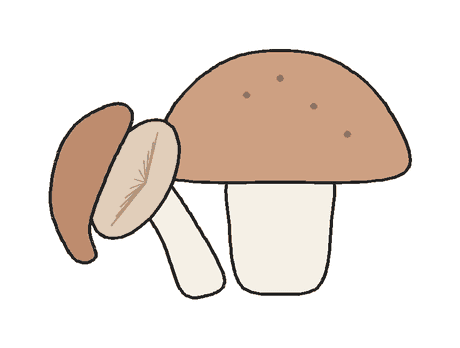
(a) Identify the organism shown in the picture.
(b) To which kingdom does the organism belong ?
(c) Mention two characteristics of the organism that differentiate it from plants.
Solve with AIWritten solution
Solution:
Concept: The figure shows umbrella-shaped bodies with a stalk and a cap, with gills under the cap and no green colour: these are mushrooms.
Step 1 — Part (a).
The organism is a mushroom (an umbrella-shaped fungus; poisonous kinds are called toadstools).
Step 2 — Part (b).
It belongs to kingdom Fungi.
Step 3 — Part (c).
Any two of these features separate it from plants.
- It has no chlorophyll, so it cannot make its own food; it is saprophytic, absorbing food from dead organic matter.
- Its body is made of thread-like hyphae, not of tissues, and is not divided into roots, stem and leaves.
- Its cell wall is made of chitin, not cellulose, and it stores food as glycogen, not starch.
Therefore, (a) mushroom; (b) Fungi; (c) it has no chlorophyll and lives as a saprophyte, and its body of hyphae is not divided into roots, stem and leaves.
- 395 marks
Question 39
Look at the figure given below and answer the question that follow :

(a) Mention the kingdom, phylum and class to which the organism belongs.
(b) Write any two significant characteristics of the organisms belonging to the class mentioned in (i).
(c) Mention two key features of the phylum mentioned in (i) and write the names of the five classes that it has been divided into.
Solve with AIWritten solution
Solution:
Concept: The figure shows a peacock, a bird. In parts (b) and (c), '(i)' refers to part (a) of the question.
Step 1 — Part (a).
The peacock belongs to kingdom Animalia, phylum Chordata and class Aves.
Step 2 — Part (b).
Birds can be recognised by any two of these features.
- The body is covered with feathers, and the forelimbs are changed into wings.
- Birds are warm-blooded (homeothermal) with a four-chambered heart.
- They lay eggs with hard, chalky shells, and the bones are light and hollow, which helps in flight.
Step 3 — Part (c).
All chordates share these key features, and the phylum has five classes.
- A notochord is present at some stage of life (replaced by the backbone in vertebrates).
- The nerve cord is dorsal and hollow, and gill slits are present at some stage of life.
The five classes are Pisces, Amphibia, Reptilia, Aves and Mammalia.
Therefore, (a) Animalia, Chordata, Aves; (b) feathers with wings, and warm blood; (c) notochord and dorsal hollow nerve cord; classes Pisces, Amphibia, Reptilia, Aves and Mammalia.
- 405 marks
Question 40
The figures shown below represent animals of one phylum.
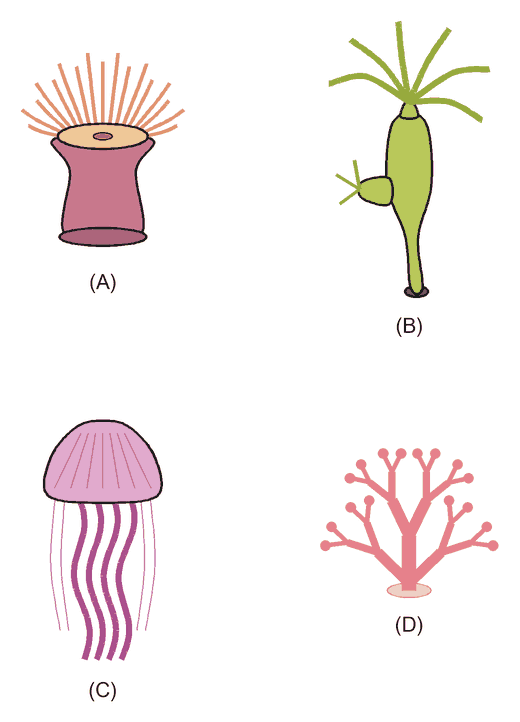
(a) Mention the phylum to which the above animals belong.
(b) Write the habitat of these animals.
(c) Identify the animals (A, B, C and D).
(d) Name the cavity enclosed by the two - layered body wall.
(e) Name the locomotory structure shown in the figures.
Solve with AIWritten solution
Solution:
Concept: All four animals have a soft, sac-like body with a two-layered wall and a ring of tentacles round the mouth, so they are cnidarians.
Step 1 — Part (a).
They belong to phylum Cnidaria (Coelenterata).
Step 2 — Part (b).
They are all aquatic, mostly marine (sea anemone, jellyfish, corals); a few, like Hydra, live in fresh water.
Step 3 — Part (c).
A is the sea anemone, B is Hydra (with a bud), C is a jellyfish and D is a coral.
Step 4 — Part (d).
The cavity enclosed by the two-layered body wall is the coelenteron (gastrovascular cavity), where digestion takes place.
Step 5 — Part (e).
The locomotory structures shown are the tentacles. Hydra moves by looping and somersaulting with its tentacles and basal disc; the jellyfish swims by contracting its bell.
Watch out: The coelenteron is a digestive cavity with one opening, not a true body cavity (coelom).
Therefore, (a) Cnidaria; (b) aquatic, mostly marine; (c) A sea anemone, B Hydra, C jellyfish, D coral; (d) coelenteron; (e) tentacles.
What Class 9 Biology Ch 8 covers
The sections of the chapter, in the order the book takes them. Every question above comes from one of these.
- 01What Is Species
- 02Categories Higher Than Species
- 03Drawbacks of the Old Two Kingdom Classification
- 04Five Kingdom Classification
- 05Naming an Organism
- 06Major Groups of Animals
More ways to study this chapter
The same chapter asked three other ways. Practise it, revise it, and see what the board has set on Ch 8 before.
Class 9 Biology Ch 8 questions students ask
How many questions are there in Class 9 Biology Ch 8?
40 questions. Every one is solved step by step on this page.
Are these Class 9 Biology solutions free?
Yes. Every question and its full working is free to read, with no account needed.
Can I download the Class 9 Biology Ch 8 solutions as a PDF?
There is no PDF to download. Every solution is on this page instead, which means it is searchable, always the current syllabus, and readable on a phone. Use your browser's print option if you want it on paper.