
Opening your dashboard
Class 9 Biology Chapter 8 Five Kingdom Classification: Competency-Based Questions (CBQ)
40 questions on Chapter 8, each worked through on its own page with the AI tutor. Class 9 Biology, ICSE 2026-27.
40 questions
1–5 marks · Mixed difficulty
- 11 mark
Question 1
Cognitive domain: Application
A nursery sells the "pomato", a plant that bears potatoes underground and tomatoes above the ground but produces no seeds. The owner advertises it as "a new species of plant". Going by the meaning of the term species, the pomato is in the same position as which of these organisms ?
- 21 mark
Question 2
Cognitive domain: Analysis
The table shows how four animals are classified.
Animal Class Order Family Genus Modern man Mammalia Primates Hominidae Homo House cat Mammalia Carnivora Felidae Felis Tiger Mammalia Carnivora Felidae Panthera Dog Mammalia Carnivora Canidae Canis Which is the lowest category in which the tiger and the dog are placed together ?
- 31 mark
Question 3
Cognitive domain: Analysis
The figure shows three worms P, Q and R. The arrows point to the openings of the alimentary canal.
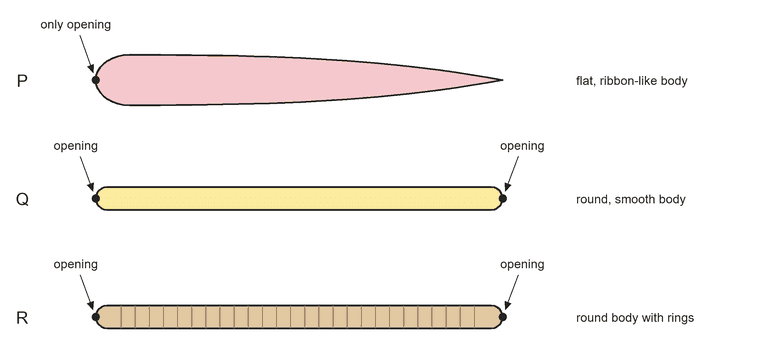
Which is the correct identification of the phyla of P, Q and R, in that order ?
- 41 mark
Question 4
Cognitive domain: Application
A zoo in a hill town has a very cold winter. The keeper is told to pick out the animals whose body temperature will fall as the surroundings get colder. Four of her animals are a gharial (P), a penguin (Q), a salamander (R) and a yak (S). Which animals should she pick ?
- 51 mark
Question 5
Cognitive domain: Understanding
Assertion (A): Euglena could not be placed satisfactorily in either kingdom of the old two kingdom classification.
Reason (R): Euglena has chloroplasts like plants, but it swims with a flagellum and can live on ready-made food in the dark, like animals.
- 61 mark
Question 6
Cognitive domain: Application
Assertion (A): A piece of red coral with its hard skeleton should be displayed in a museum among the vertebrates.
Reason (R): The hard skeleton of corals is made up of calcium carbonate from their secretions.
- 71 mark
Question 7
Cognitive domain: Application
On a damp, shady wall Rina finds a green velvety growth. Under a hand lens, each tiny plant shows root-like, stem-like and leaf-like structures but no true roots, stem or leaves. Beside it grows a plant with true roots, stem and leaves; its leaflets carry rows of brown dots on the underside, and it never bears flowers.
The first plant belongs to the division ______, and the brown dots on the leaflets of the second plant contain ______.
- 81 mark
Question 8
Cognitive domain: Analysis
Over one term, a nature club recorded these seven animals in its diary: sponge, jellyfish, earthworm, snail, starfish, frog and crow.
In all, the seven animals represent ______ different phyla, and ______ of the animals are invertebrates.
- 91 mark
Question 9
Cognitive domain: Understanding
A museum has two preserved hearts without labels. Heart 1 has two chambers. Heart 2 has three chambers, and its ventricle is partially divided.
Heart 1 must have come from an animal of the class ______, and heart 2 from an animal of the class ______.
- 102 marks
Question 10
Cognitive domain: Application
After a night of rain, Ravi saw many earthworms crawling on the wet ground of the school lawn before sunrise. By noon the sun was strong, and he found a few earthworms lying dried up and dead on the hot cement path.
Explain (a) why the earthworms were seen on the surface only before sunrise, and (b) why the worms stranded on the dry path died.
- 112 marks
Question 11
Cognitive domain: Evaluation
Seeing a crab and a tortoise in an aquarium shop, Kunal says: "Both have a hard covering on the outside and both walk on legs, so they should be placed in the same group of animals."
Do you agree with Kunal ? Justify your answer with two points.
- 122 marks
Question 12
Cognitive domain: Understanding
On a trip to Shimla, Asha collects a woody cone from under a pine tree and shakes a few seeds out from between its scales. At home she cuts open a mango and finds its seed deep inside the fruit.
Both pine and mango are seed-bearing trees. Explain why they are still placed in different divisions of Kingdom Plantae, naming the division of each.
- 135 marks
Question 13
Cognitive domain: Analysis
Case: In a wildlife research station, the body temperatures of two vertebrates, X and Y, were recorded while the temperature of the air in their enclosures was slowly changed. Animal X has dry skin with horny scales. Animal Y has a body covered with feathers.
Air temperature Body temperature of X Body temperature of Y 10°C 12°C 40°C 20°C 21°C 40°C 30°C 30°C 41°C 38°C 37°C 41°C (a) By how many degrees did the body temperature of each animal change over the whole experiment ?
(b) Which animal is cold-blooded and which is warm-blooded ? Use the data to explain the meaning of each term.
(c) Name the class of vertebrates to which each animal belongs, and state how the hearts of the two differ.
(d) Name one other class of vertebrates whose members would give readings like those of animal Y, and state two characteristics of that class.
- 145 marks
Question 14
Cognitive domain: Evaluation
Case: A small museum still follows the old scheme of Linnaeus and has only two halls, the "Plant Hall" and the "Animal Hall". An intern has to arrange six new exhibits: a mushroom, a culture of bacteria, a slide of Euglena, a seaweed, a coral and a bath sponge. He places the mushroom in the Plant Hall "because it grows from the ground and does not move". He also places the coral and the sponge in the Plant Hall "because they stay fixed in one place".
(a) Evaluate his decision about the mushroom. In which kingdom is it placed today ? Give two reasons why it is not a plant.
(b) Evaluate his decision about the coral and the sponge. Give two reasons why they belong with the animals even though they are fixed.
(c) Which two exhibits fit neither hall properly ? State the kingdom to which each is assigned in the five kingdom classification, with one reason each.
(d) Is the seaweed rightly placed in the Plant Hall ? Name its division and give a reason.
- 155 marks
Question 15
Cognitive domain: Creativity
Case: The eco-club of a school wants to turn fallen leaves and vegetable peels from the canteen into manure with the help of earthworms (vermiculture). The club has a corner of the garden, a few hundred earthworms, a spade, a watering can and some old jute sacks. The members must plan the pit using what their chapter says about how earthworms live.
(a) Design the pit. State three conditions the club must provide for the earthworms, with the reason for each.
(b) What should the club record over eight weeks to know whether the plan is working ? Draw a table for the record.
(c) Explain two ways in which the school garden will benefit when the manure and the earthworms are added to its beds.
- 161 mark
Question 16
Cognitive domain: Application
The school garden has two plants whose tags read as follows.
Common name Scientific name China rose Hibiscus rosa-sinensis Roselle (gongura) Hibiscus sabdariffa A student who reads only these two tags draws a conclusion about the two plants. Which conclusion is correct ?
- 171 mark
Question 17
Cognitive domain: Analysis
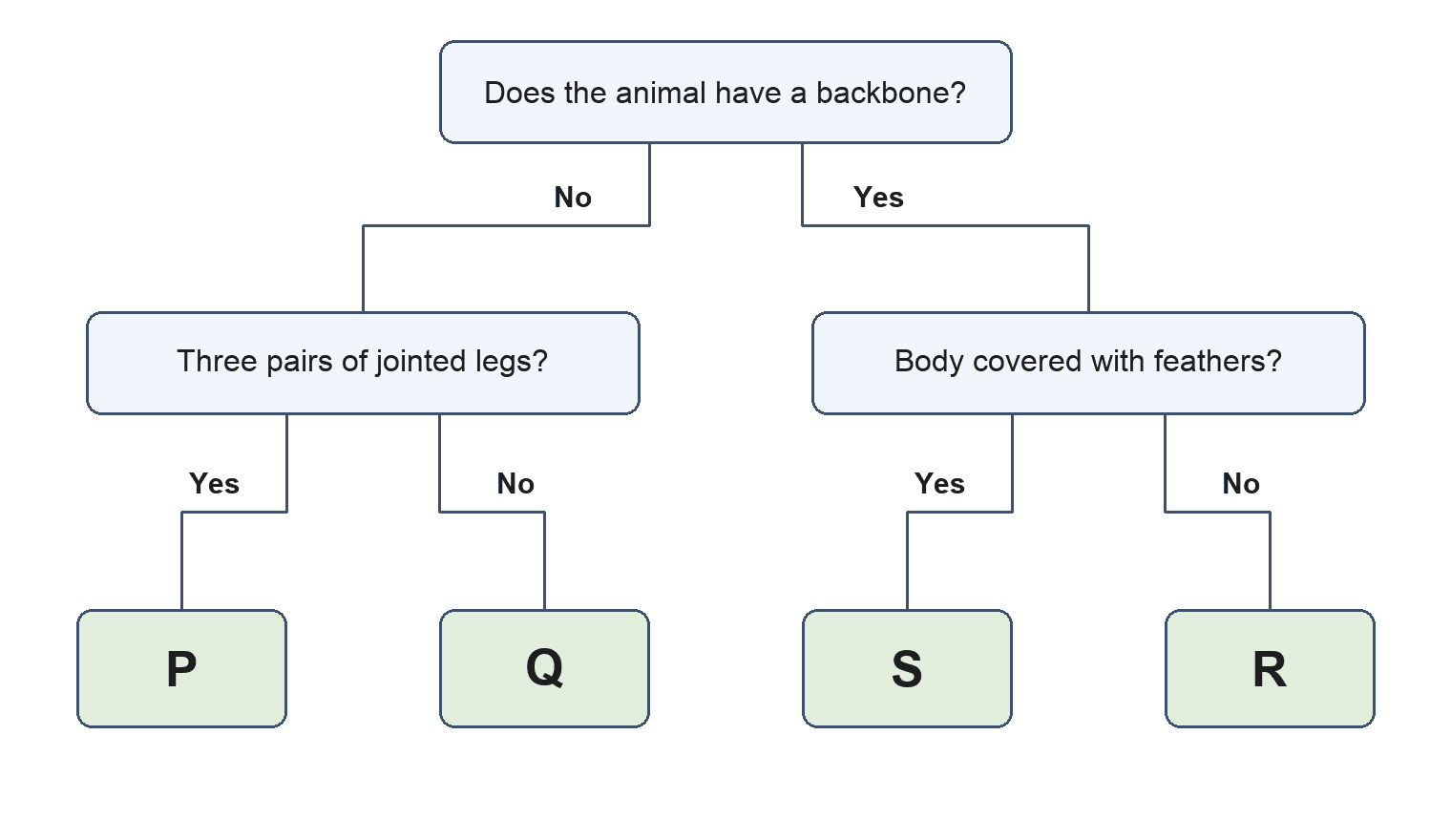
The key above is used to sort four animals: a crow, a frog, a cockroach and a snail. Each animal ends in a different box. Which option gives the animals in boxes P, Q, R and S, in that order ?
- 181 mark
Question 18
Cognitive domain: Application
In a school garden, Tara examines three plants.
- Maize: leaves with parallel veins, fibrous roots, and seeds that have only one cotyledon.
- Pea: leaves with net-like veins, a tap root, and seeds that have two cotyledons.
- Pine: no flowers; its seeds lie bare on the scales of woody cones.
Which option names the group of each plant correctly ?
- 191 mark
Question 19
Cognitive domain: Analysis
Assertion (A): A bat, which flies in the air, is placed in class Mammalia and not in class Aves.
Reason (R): A bat has hair on its skin and feeds its young ones on milk from mammary glands.
- 201 mark
Question 20
Cognitive domain: Analysis
Assertion (A): The alimentary canal of a roundworm and that of an earthworm both open at two ends, a mouth and an anus.
Reason (R): Both these worms have a true body cavity, the coelom.
- 211 mark
Question 21
Cognitive domain: Application
At the seashore, a marine biologist sketches a sea anemone and a sea urchin. In each animal she finds that the body parts are arranged evenly around a central axis, so that the body can be cut into two similar halves along several different planes passing through the centre, not along just one. To which pair of phyla do these two animals belong ?
- 221 mark
Question 22
Cognitive domain: Understanding
A veterinary student examines a standing buffalo. She finds a tick stuck on the underside of the belly, close to the hind legs. Using the terms in your book, where is the tick ?
- 231 mark
Question 23
Cognitive domain: Analysis
A student records the features of four arthropods in a table.
Specimen Pairs of jointed legs Body regions Wings W 3 head, thorax and abdomen 2 pairs X 4 head and thorax fused in one part, abdomen as the other part none Y many; one or two pairs on every segment head and a long trunk that is not divided into thorax and abdomen none Z several head and thorax fused, abdomen separate; lives in water none (Hypothetical data.)
Which specimen could be a scorpion ?
- 241 mark
Question 24
Cognitive domain: Application
In a marine aquarium, a teacher adds a little harmless dye to the sea water close to the sides of a living sponge that is fixed to a rock. The coloured water is slowly drawn into the body of the sponge. Where will the coloured water most probably come out ?
- 251 mark
Question 25
Cognitive domain: Analysis
Rohan marks small ink dots, 1 cm apart, along the stem of a young papaya plant and along the back of his growing puppy. After two months, the dots on the plant have moved apart only near the tip of the stem. The dots on the puppy have moved apart evenly all along its back. (Hypothetical data.)
Which conclusion about growth in plants and animals is supported by these observations ?
- 261 mark
Question 26
Cognitive domain: Understanding
Mehak looks at a drop of idli batter under a microscope. She sees tiny yeast cells, each a single cell with an organised nucleus and a cell wall, and none of them is green. Her friend says that yeast must belong to the kingdom Protista, because it is single-celled.
In the five kingdom classification, yeast is placed in the kingdom ______, together with the bread mould and the mushroom, because, like them, it has no ______ and cannot make its own food.
- 271 mark
Question 27
Cognitive domain: Application
On a rainy evening Dev finds a toad and a garden lizard near the school wall. Behind the eye of the toad he sees a round eardrum lying on the surface of the skin. In the lizard the eardrum lies at the bottom of a tubular depression.
The toad belongs to the class ______ and the lizard to the class ______. Both animals have a ______-chambered heart.
- 282 marks
Question 28
Cognitive domain: Evaluation
Zubin says: “Every organism already has a name, so there is no need to arrange the millions of organisms into groups.”
Do you agree ? Support your answer with two points.
- 292 marks
Question 29
Cognitive domain: Analysis
While turning over a stone in a damp garden, Ishaan finds two long, segmented animals. Animal P has one or two pairs of jointed legs on every segment. Animal Q has no legs at all; its body is divided into ring-like segments and its skin is moist.
Name the phylum of each animal and give one more feature that supports your answer for each.
- 302 marks
Question 30
Cognitive domain: Evaluation
A notice at a zoo says: “The ostrich cannot fly, so it is not a bird.”
Evaluate this statement, using two features of the ostrich that your book gives for its class.
- 312 marks
Question 31
Cognitive domain: Understanding
A banyan tree spreads its roots and branches over a wide area, while a deer has a compact body. Using the comparison of plants and animals in your book, explain (a) why the body of a plant is of the spreading type, and (b) why the body of an animal is compact.
- 323 marks
Question 32
Cognitive domain: Analysis
A fisherman's basket holds a snail and an octopus. The snail has a coiled shell. The octopus has no shell that can be seen from outside. Both animals are placed in the same phylum.
(a) Name the phylum.
(b) State two features of the phylum that the octopus shares with the snail.
(c) Your book describes the molluscs as having a hard calcareous shell that protects the soft body. Explain why the octopus is still placed in this phylum, and what this shows about classifying an animal by a single feature.
- 333 marks
Question 33
Cognitive domain: Evaluation
A student proposes to divide all animals into two groups, water animals and land animals. He puts the crab, the trout and the turtle in the first group, the horse and the lizard in the second, and he is not sure where to put the frog.
(a) Why is the frog a problem for his scheme ?
(b) Show, using the crab, the trout and the turtle, that his first group puts together animals which are very different in classification.
(c) On what basis does your book mainly group the animals instead ?
- 343 marks
Question 34
Cognitive domain: Analysis
A student records the features of five plants A to E.
Plant True roots, stem and leaves Root-like, stem-like and leaf-like structures only Seeds Seeds enclosed in a fruit A No No No No B No Yes No No C Yes No No No D Yes No Yes No E Yes No Yes Yes (Hypothetical data.)
(a) Name the division of each plant.
(b) State the feature that appears for the first time in D, and the feature that appears for the first time in E.
(c) The student says that A may be a mushroom, because it has no roots, stem or leaves. Which feature of the division of A shows that he is wrong ?
- 353 marks
Question 35
Cognitive domain: Creativity
Write a “Who am I ?” riddle for the class Reptilia with exactly three clues. Each clue must use a different feature of the class from your book. Then suppose a student is given only the clue “I have a three-chambered heart.” Name the other class of vertebrates that he could not rule out, and name the clue in your riddle that separates the two classes.
- 363 marks
Question 36
Cognitive domain: Analysis
The table gives the classification of six animals in a zoo. All six belong to the kingdom Animalia and the phylum Chordata.
Animal Class Order Family Genus Species Lion Mammalia Carnivora Felidae Panthera leo Tiger Mammalia Carnivora Felidae Panthera tigris House cat Mammalia Carnivora Felidae Felis catus Dog Mammalia Carnivora Canidae Canis familiaris House crow Aves Passeriformes Corvidae Corvus splendens Jungle crow Aves Passeriformes Corvidae Corvus macrorhynchos (The order Passeriformes and the family Corvidae are given here as data. The house cat is written with its current name, Felis catus; older books write Felis domesticus.)
(a) How many different species, genera, families, orders and classes are listed ?
(b) Which pairs of animals in the table share every category except the species ?
(c) The zoo adds a leopard, Panthera pardus, of the family Felidae, order Carnivora and class Mammalia. Which of your counts in part (a) change, and which stay the same ? Explain why.
- 375 marks
Question 37
Cognitive domain: Analysis
Case: A forest officer lists the species of vertebrates recorded in a national park during one year. The bar chart shows the number of species recorded in each class. The reptiles recorded are lizards, snakes and turtles; no crocodiles were seen. (Hypothetical data.)

(a) Name the class with the most species and the class with the fewest species. How many chambers does the heart of the class with the fewest species have ?
(b) What percentage of the recorded species are warm-blooded ? Show your working.
(c) The officer says: “More than three-quarters of our species keep their body temperature almost constant when the weather changes.” Check this using the chart, and name the term for such animals. How many of the recorded species have a three-chambered heart ?
- 384 marks
Question 38
Cognitive domain: Evaluation
Case: The biology club made a chart for the school corridor. Its entries are given below.
Animal Entry on the chart Spider Class Insecta, because it has jointed legs Starfish Phylum Echinodermata, because it has a spiny skin and moves by tube feet Liver fluke Phylum Nematoda, because it is a worm that lives as a parasite Frog Class Reptilia, because it is cold-blooded Penguin Class Aves, because its body is covered with feathers (a) Which two entries are correct ?
(b) Correct each of the other three entries, giving one feature from your book for each.
(c) The entry for the spider gives “jointed legs” as the reason. For which category does this reason hold good ? Name the category and give one more feature that the spider shares with the crab.
- 394 marks
Question 39
Cognitive domain: Analysis
Case: In a quiz based on the general scheme of five kingdom classification in your book, each player thinks of a living organism and answers four questions about it, asked in the order shown. The questions that were not asked are shown by a dash.
Player Organised nucleus ? Single-celled ? Cell wall ? Makes food by photosynthesis ? 1 No Yes – – 2 Yes Yes – – 3 Yes No Yes No 4 Yes No Yes Yes 5 Yes No No – (a) Name the kingdom of the organism that each player thought of.
(b) Player 6 answered Yes to the first question and No to the second, and then the quiz stopped. Which question on the sheet comes next, and which kingdom or kingdoms would each answer to it leave ?
(c) Aman says: “If an organism has a cell wall, it must be a plant.” Use the answers of players 3 and 4 to judge his statement.
- 405 marks
Question 40
Cognitive domain: Creativity
Case: The eco-club plans to survey the invertebrates of the school garden for one week in the rainy season. The members will lift stones, search the leaf litter and look at the plants, and they will classify each animal on the spot.
(a) Name three phyla of invertebrates that the club is likely to find, and give one feature that students can check on the spot to place an animal in each.
(b) Design a record table with the columns Animal seen, Where found, Feature observed, Phylum and Class (if arthropod), and fill in two imaginary rows.
(c) According to your book, which phylum will most probably have the largest number of species in the survey ? Name one phylum that the club would not expect to find in a school garden, with a reason.