
Opening your dashboard
Class 9 Biology Chapter 8 Five Kingdom Classification: Practice Questions
41 questions on Chapter 8, each worked through on its own page with the AI tutor. Class 9 Biology, ICSE 2026-27.
41 questions
1–5 marks · Mixed difficulty
- 11 mark
Question 1
Bloom's level: Remember
In classification, a group of related families makes up :
- 21 mark
Question 2
Bloom's level: Remember
Organisms whose body is made of thread-like hyphae, with many nuclei spread in a continuous cytoplasm, belong to Kingdom :
- 31 mark
Question 3
Bloom's level: Remember
According to your book, the animal kingdom is divided into how many major phyla ?
- 41 mark
Question 4
Bloom's level: Understand
The lion (Panthera leo) and the tiger (Panthera tigris) are placed in the same genus because :
- 51 mark
Question 5
Bloom's level: Understand
The gill slits of a shark can be seen from outside, but those of a trout cannot. This is because :
- 61 mark
Question 6
Bloom's level: Understand
Under the old two-kingdom scheme, bacteria were placed with plants. This was unsatisfactory mainly because bacteria :
- 71 mark
Question 7
Bloom's level: Apply
A tiny animal found attached to a water plant in a pond has a two-layered body wall, a single body cavity that opens only by a mouth, and tentacles around the mouth to catch food. It belongs to phylum :
- 81 mark
Question 8
Bloom's level: Apply
From this list of organisms — mango tree, bacteria, rabbit, fern, Amoeba, prawn, bread mould, Spirogyra, Paramecium, maize — which pair belongs to the same kingdom ?
- 91 mark
Question 9
Bloom's level: Apply
An animal has dry skin with horny scales, breathes by lungs right from birth, has a three-chambered heart with a partly divided ventricle, and lays eggs with a leathery shell. It is most likely a :
- 101 mark
Question 10
Bloom's level: Analyse
Assertion (A): Fungi are not placed in Kingdom Plantae.
Reason (R): Fungi have no chlorophyll and do not perform photosynthesis.
- 111 mark
Question 11
Bloom's level: Analyse
Assertion (A): The earthworm is an invertebrate.
Reason (R): The earthworm has a true body cavity (coelom).
- 121 mark
Question 12
Bloom's level: Evaluate
Assertion (A): The spiny ant-eater of Australia is a mammal.
Reason (R): All mammals give birth to living young ones.
- 132 marks
Question 13
Bloom's level: Remember
State the two ways in which organisms are arranged when we study the diversity of living things.
- 142 marks
Question 14
Bloom's level: Understand
The house crow and the jungle crow differ in size, colour and beak, and cannot interbreed. Explain why they are two species and yet are placed in the same genus.
- 152 marks
Question 15
Bloom's level: Understand
Explain why the naming system that gives the tiger the name Panthera tigris is called binomial nomenclature, and what each part of the name tells us.
- 162 marks
Question 16
Bloom's level: Understand
Fishes, frogs, snakes, birds and humans look very different, yet all are placed in one phylum. Name the phylum and explain the feature that unites them.
- 172 marks
Question 17
Bloom's level: Apply
A goat and a sheep can mate and produce an animal called a geep, but the geep cannot reproduce. Using the definition of species, decide whether the goat and the sheep belong to the same species. Give a reason.
- 182 marks
Question 18
Bloom's level: Apply
Look at these scientific names: Panthera leo (lion), Panthera tigris (tiger) and Felis catus (house cat).
(a) Which two are most closely related? How do the names show it ?
(b) Name the family to which all three belong.
- 192 marks
Question 19
Bloom's level: Apply
A farmer adds earthworms to his vegetable beds. Explain two ways in which the earthworms will help his crops.
- 202 marks
Question 20
Bloom's level: Apply
Use the five-kingdom scheme to place each organism in its kingdom, giving the deciding features.
(a) A eukaryotic, multicellular organism with cell walls but no chlorophyll.
(b) A eukaryotic, single-celled organism with chloroplasts and a flagellum.
- 212 marks
Question 21
Bloom's level: Analyse
An animal X has a solid, ventral nerve cord, a heart on the dorsal side, no red blood cells in its blood, three pairs of jointed legs and no tail (its anus is at the tip of the body). Analyse these features to decide whether X is a vertebrate or an invertebrate, and name its phylum and class.
- 222 marks
Question 22
Bloom's level: Evaluate
A student says, "All animals that live in water breathe through gills." Judge this statement, giving two examples from your book.
- 233 marks
Question 23
Bloom's level: Understand
Linnaeus divided all living things into only two kingdoms, Plantae and Animalia.
(a) Where would a person following this old scheme be tempted to put Euglena, a mushroom and a bacterium ?
(b) Explain why each of these placements is unsatisfactory.
(c) Name the kingdom in which each is placed today.
- 244 marks
Question 24
Bloom's level: Apply
Read the descriptions of five invertebrates.
Animal Description P Fixed to rocks in the sea; body a hollow tube with many pores in the wall and one large opening on top Q Long, cylindrical, unsegmented; mouth and anus at the two ends; lives in the human intestine R Soft, unsegmented body inside a hard calcareous shell; moves by a muscular foot S Flat, leaf-like, unsegmented; gut with only one opening; lives in the liver of sheep T Jointed legs; exoskeleton of chitin that is cast off during growth (a) Name the phylum of each animal.
(b) Give one more example (not named above) from each phylum.
(c) Which of these five phyla have a true body cavity (coelom)? Use the classification chart in your book.
- 254 marks
Question 25
Bloom's level: Apply
Case: On a school trip to a village pond, Tara listed: tadpoles swimming with gills, adult frogs on the bank, a turtle on a log, ducks on the water, and bats flying at dusk.
(a) Name the vertebrate class of each animal (tadpole and frog together).
(b) The tadpole breathes by gills but the adult frog by lungs. Explain this using a feature of its class.
(c) The turtle also lives in and around the pond. Give two features that make it a reptile and not an amphibian.
- 264 marks
Question 26
Bloom's level: Analyse
Case: In the biology lab, Imran studied three samples under the microscope.
- Sample 1 (from stale bread): fine threads with many nuclei in a continuous cytoplasm; no green colour.
- Sample 2 (from pond water): green single cells, each with a well-defined nucleus and two flagella.
- Sample 3 (from curd): very tiny rod-shaped cells with no nucleus and no chloroplasts.
(a) Name the kingdom of each sample.
(b) Which single feature separates Sample 2 from Sample 3 at the very first branch of the five-kingdom key ?
(c) Sample 1 has a cell wall like plants. Analyse why it is still not placed in Plantae.
- 274 marks
Question 27
Bloom's level: Analyse
Study the results of some crosses.
Cross Offspring Can the offspring reproduce? Labrador dog × Pomeranian dog Puppies Yes Male donkey × female horse Mule No Zebra × donkey Zenkey No Male horse × female donkey Hinny No (a) Which pair(s) of parents belong to the same species ?
(b) What do the last three crosses have in common, and what does this tell us about the parents ?
(c) A student argues, "Since a donkey and a horse can mate, they must be the same species." Using the table, show what is missing from his reasoning.
- 284 marks
Question 28
Bloom's level: Evaluate
Case: A scientist in Delhi wrote to a scientist in Kolkata about a fruit she called "sitaphal". The Kolkata scientist sent back notes on a different fruit, because in his area that name is used for another plant. Later a scientist from Brazil could not understand either set of notes.
(a) What caused the confusion ?
(b) Explain how the scientific naming system would have prevented it, mentioning the two rules for writing such names.
(c) Someone suggests that, instead of scientific names, scientists everywhere should simply use English common names. Evaluate this suggestion.
- 295 marks
Question 29
Bloom's level: Create
Construct a dichotomous key (a key in which each step has two choices) to identify these six animals: sponge, Hydra, earthworm, cockroach, starfish, frog.
(a) Write the key as numbered steps, using only features given in your book.
(b) Name the phylum (and class, where the animal is a vertebrate) reached at the end of each path.
(c) State how your key separates the animal that has a backbone from the animals that lack one.
- 305 marks
Question 30
Bloom's level: Create
Construct a table that compares the five kingdoms under these heads :
(a) cell type (prokaryotic or eukaryotic) and number of cells;
(b) mode of nutrition and presence of a cell wall;
(c) two examples of each kingdom.
Then write one sentence explaining which two features alone are enough to separate Plantae from Animalia.
- 311 mark
Question 31
Under the old scheme of two kingdoms, Euglena could not be called exclusively a plant or an animal, because it :
- 321 mark
Question 32
In which one of the following is the animal correctly matched with its phylum ?
- 331 mark
Question 33
Assertion (A): Birds and mammals are homeothermal animals.
Reason (R): The body temperature of a homeothermal animal rises and falls directly with the temperature of its environment.
- 342 marks
Question 34
Give a reason for each of the following :
(i) House cats differ among themselves in colour, in height and in the length of the tail, yet all the house cats of the world are placed in one species.
(ii) A zebra and a donkey can mate and produce a young one called a zenkey, yet the zebra and the donkey are treated as two different species.
- 352 marks
Question 35
The cat family and the dog family have some features in common, and so the two families are grouped together in a higher category.
(i) Write the names of these two families, and of the order in which both are placed.
(ii) Name the class to which this order belongs. State two features that are common to the animals of this class.
- 362 marks
Question 36
The scientific name of the peacock is Pavo cristatus.
(i) What does each of the two words of this name stand for ? Name this method of naming organisms.
(ii) State how this name must be written by hand, and the rule about the first letter of each of its two words.
- 372 marks
Question 37
State how an invertebrate differs from a vertebrate with respect to each of the following :
(i) the position of the heart and the position of the nerve cord
(ii) the number of pairs of limbs and the place where haemoglobin is found
- 384 marks
Question 38
The figure gives the general scheme by which living organisms are divided into five kingdoms. The names of the kingdoms have been replaced by the numbers 1 to 5.
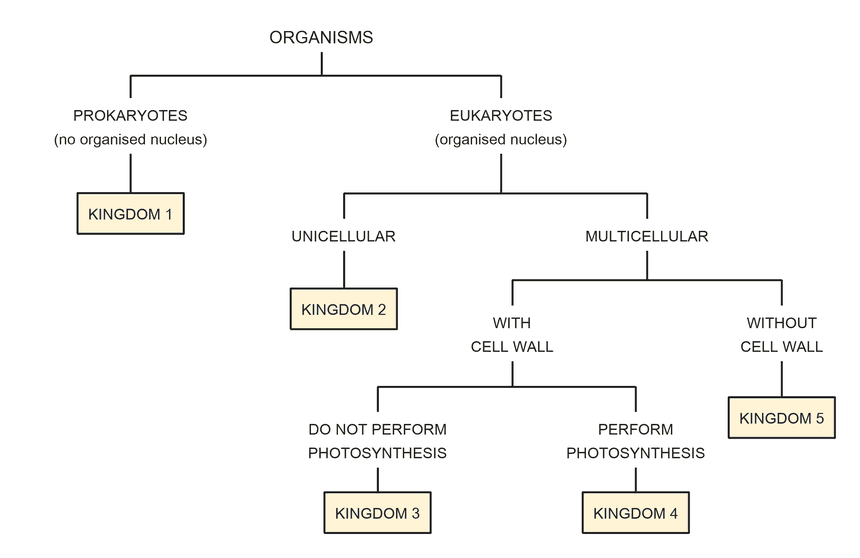
(i) Name the kingdoms 1 to 5.
(ii) Name one organism that belongs to kingdom 2 and one that belongs to kingdom 3.
(iii) How do the organisms of kingdom 4 and those of kingdom 5 differ in the way they obtain their food ? Give the term used for each.
- 393 marks
Question 39
The figure shows an invertebrate animal as seen from the side. Its wings are not drawn, and only the legs of one side are shown.
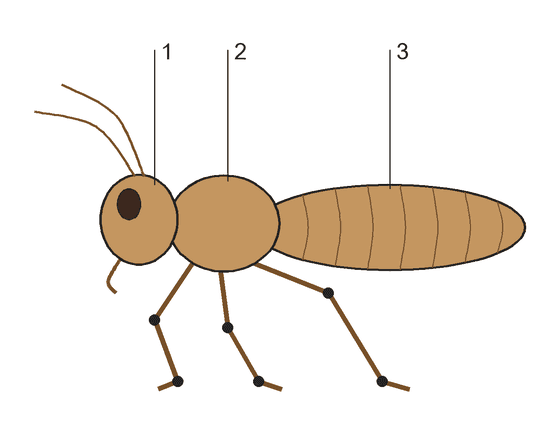
(i) Name the phylum to which this animal belongs. State one feature, seen in the figure, on which you base your answer.
(ii) Name the three divisions of its body numbered 1, 2 and 3.
(iii) What is the exoskeleton of the animals of this phylum made of ? What is meant by moulting ?
- 404 marks
Question 40
A dolphin, a tuna and a turtle swim in the same sea, but they belong to three different classes of vertebrates.
(i) Name the class to which each of these three animals belongs.
(ii) For each animal, state the organ with which it breathes and the number of chambers in its heart.
(iii) Which one of the three is warm-blooded ? How does this animal nourish its young ones ?
- 411 mark
Question 41
Class 9 Sample Paper 1 · Section A
Fill in the blank:
Animals with hairy skin are called ...........