
Opening your dashboard
Class 9 Biology Chapter 17: Aids to Health Solutions
34 textbook questions with step-by-step answers, free to read, for ICSE 2026-27.
Get talked through Ch 17, not just shown the answer
Reading a finished solution is not the same as being able to do it. The AI tutor takes one question at a time and works it with you, in your own words, until you can.
- Ask it out loud, in your own words
- It gives you the next step, not the answer
- Stuck on part (ii)? Start there
34 questions with solutions
1–12 marks · Mixed difficulty
- 13 marks
Question 1
Give one example of each of the following :
(i) Germ-killing body secretion.
(ii) Germ-trapping body secretion.
(iii) Mechanical barrier that prevents the entry of germs into the body.
Solve with AIWritten solution
Solution:
Concept: The local defence system is the body's first line of defence. It keeps germs out with mechanical barriers (such as the skin), traps them in sticky secretions (such as mucus) and kills them with germ-killing secretions (such as tears).
Step 1 — Part (i): a germ-killing secretion.
Tears contain an enzyme (lysozyme) that kills many bacteria, so tears are a germ-killing secretion.
Saliva, sweat, nasal secretion and the hydrochloric acid of the stomach are other examples.
Step 2 — Part (ii): a germ-trapping secretion.
Mucus is a sticky secretion of the lining of the nose and the windpipe; germs and dust stick to it and are then pushed out, so mucus is a germ-trapping secretion.
Step 3 — Part (iii): a mechanical barrier.
The skin is a mechanical barrier: its tough outer layer of dead, keratin-filled cells is almost impossible for germs to pass through unless it is cut.
Watch out: Do not give mucus for part (i); mucus only traps germs, while tears and saliva kill them.
Therefore, (i) tears, (ii) mucus, (iii) skin.
- 26 marks
Question 2
Mention if the following statements are True (T) or False (F)
(i) Immune system deals with the germs after they have entered the body. T/F
(ii) Antibodies eat up the germs. T/F
(iii) Human beings can suffer from all those diseases which attack dogs. T/F
(iv) Anti-venin injection against snake bite is an example of artificially acquired passive immunity. T/F
(v) Mother's antibodies may reach the foetus through placenta. T/F
(vi) A person having once suffered from measles usually gets repeated attacks. T/F
Solve with AIWritten solution
Solution:
Concept: The immune system fights germs that have already entered the body. Antibodies are proteins that bind to germs and their poisons; phagocytes (a kind of white blood cell) swallow germs. Immunity may be active (made by one's own body) or passive (ready-made antibodies received from outside).
Step 1 — Statement (i).
The immune system works inside the body, against germs that have got past the skin and the other outer barriers.
True.
Step 2 — Statement (ii).
Antibodies do not eat germs; they bind to the germs and make them harmless. It is the phagocytes (white blood cells) that engulf and digest germs.
False.
Step 3 — Statement (iii).
Humans have an inborn (innate) immunity against many animal diseases; for example, we do not get canine distemper, a serious disease of dogs.
False.
Step 4 — Statement (iv).
Anti-venin (anti-snake-venom serum) contains ready-made antibodies made in a horse and injected into the patient, so it gives artificially acquired passive immunity.
True.
Step 5 — Statement (v).
Some of the mother's antibodies cross the placenta into the foetus and protect the baby for its first few months; this is naturally acquired passive immunity.
True.
Step 6 — Statement (vi).
One attack of measles makes the body produce antibodies and memory cells, which give long-lasting active immunity, so the person normally does not get measles again.
False.
Watch out: Statement (iii) says 'all' diseases; a few diseases (such as rabies) do pass from dogs to humans, but not all, so the statement is false.
Therefore, (i) T, (ii) F, (iii) F, (iv) T, (v) T, (vi) F.
- 31 mark
Question 3
Define the term prophylaxis.
Solve with AIWritten solution
Solution:
Concept: The word prophylaxis comes from Greek words meaning 'guarding beforehand'; it means prevention of a disease, as opposed to its treatment.
Step 1 — Recall the meaning in this chapter.
In this chapter, prophylaxis means preventing a disease by vaccination, that is, by giving a vaccine before the disease can attack.
Step 2 — Write the definition.
Prophylaxis is the practice of artificially introducing germs or germ substances (a vaccine) into the body so that the body develops resistance against a particular disease.
Step 3 — Note the wider use of the word.
Doctors also use the word for any step taken to prevent a disease, for example taking anti-malaria tablets before visiting a malaria area.
Therefore, prophylaxis is the prevention of a disease by artificially introducing germs or germ substances (a vaccine) into the body to build resistance against that disease.
- 41 mark
Question 4
Name the four categories of materials used for preparing vaccines.
Solve with AIWritten solution
Solution:
Concept: A vaccine contains a disease germ, or a germ product, in a form that cannot cause the disease but still makes the body produce antibodies against it.
Step 1 — Killed germs.
The germs are killed by heat or chemicals, so they cannot multiply, but their antigens still trigger antibodies. Examples are the TAB vaccine (typhoid) and Salk's vaccine (polio).
Step 2 — Living weakened germs.
The germs are alive but so weakened (attenuated) that they cannot cause the disease. Examples are the measles vaccine and BCG (tuberculosis).
Step 3 — Living fully virulent germs.
The textbook calls these 'living fully poisonous germs'. The classic example is the live cowpox virus, used against smallpox. It is a fully active virus, but it causes only a mild illness in humans, and the immunity it gives also protects against the closely related smallpox virus.
Step 4 — Toxoids.
Toxoids are bacterial toxins made harmless by treatment with formalin; they make the body produce antitoxins. Examples are the vaccines against diphtheria and tetanus.
Watch out: Smallpox was wiped out worldwide in 1980, so the cowpox vaccine is no longer given; it is still the textbook's example of the third category.
Therefore, the four categories are killed germs, living weakened germs, living fully virulent germs and toxoids.
- 53 marks
Question 5
Name the diseases prevented by :
(i) Salk's vaccine
(ii) BCG vaccine
(iii) DPT vaccine
Solve with AIWritten solution
Solution:
Concept: Each vaccine is made from one particular germ (or its toxin), so it protects only against the disease that germ causes.
Step 1 — Part (i): Salk's vaccine.
Salk's vaccine contains killed polio viruses and is injected, so it prevents poliomyelitis (polio).
Step 2 — Part (ii): BCG vaccine.
BCG contains weakened tuberculosis bacteria and is given soon after birth, so it prevents tuberculosis (TB).
Step 3 — Part (iii): DPT vaccine.
DPT is a triple vaccine; its three letters stand for the three diseases it prevents: diphtheria, pertussis (whooping cough) and tetanus.
Watch out: The 'P' in DPT is pertussis, not polio; polio has its own vaccines (Salk's injection and the oral drops).
Therefore, (i) polio, (ii) tuberculosis, (iii) diphtheria, pertussis (whooping cough) and tetanus.
- 67 marks
Question 6
Correct the following statements if they are false (without changing the first word).
(i) DDT is an antiseptic.
(ii) Penicillin is a disinfectant.
(iii) Disinfectants are applied on the body.
(iv) Deodorants are both antiseptic as well as disinfectants.
(v) Alexander Fleming discovered the first sulphonamide.
(vi) Antibiotics cannot be made synthetically.
(vii) Sulphonamides are now rarely used.
Solve with AIWritten solution
Solution:
Concept: Antiseptics are mild germ-killing chemicals used on the body; disinfectants are strong ones used on places and things; antibiotics are germ-killing chemicals produced by microorganisms; sulphonamides (sulpha drugs) are germ-killing drugs made in the laboratory. In each statement the first word stays and the rest is corrected.
Step 1 — Statement (i).
DDT is never applied on the body, so it is not an antiseptic. The textbook places it with the disinfectants, chemicals sprayed on places.
Corrected: DDT is a disinfectant (strictly, an insecticide).
Step 2 — Statement (ii).
Penicillin is produced by the mould Penicillium and is taken into the body to kill bacteria, so it is an antibiotic.
Corrected: Penicillin is an antibiotic.
Step 3 — Statement (iii).
Disinfectants are strong enough to harm the skin, so they are used only on spots and places where germs thrive.
Corrected: Disinfectants are applied on spots and places (drains, toilets, floors), not on the body.
Step 4 — Statement (iv).
A deodorant only removes or masks a bad smell; it is not used to kill germs on wounds or places.
Corrected: Deodorants are neither antiseptics nor disinfectants.
Step 5 — Statement (v).
Alexander Fleming discovered penicillin in 1928, the first antibiotic. The first sulpha drug (Prontosil) was found by the German scientist Gerhard Domagk in the 1930s.
Corrected: Alexander Fleming discovered the first antibiotic (penicillin).
Step 6 — Statement (vi).
Many antibiotics are now made in factories by chemical methods; for example, chloromycetin (chloramphenicol) is made wholly synthetically.
Corrected: Antibiotics can be made synthetically.
Step 7 — Statement (vii).
Sulpha drugs have largely been replaced by antibiotics, which work better and have fewer side effects; a few (for example in the medicine co-trimoxazole) are still used.
This statement is true; no correction is needed.
Note: The textbook lists DDT among the disinfectants. Strictly, DDT is an insecticide: it is sprayed on places to kill disease-carrying insects such as mosquitoes, not germs. Its use in India is now limited to mosquito control.
Watch out: Keep the first word of every statement unchanged; only the rest of the sentence is corrected.
Therefore, (i) DDT is a disinfectant; (ii) penicillin is an antibiotic; (iii) disinfectants are applied on spots and places; (iv) deodorants are neither antiseptics nor disinfectants; (v) Fleming discovered the first antibiotic; (vi) antibiotics can be made synthetically; (vii) true.
- 71 mark
Question 7
List any three uses of antibiotics.
Solve with AIWritten solution
Solution:
Concept: Antibiotics are chemical substances produced by microorganisms (bacteria or fungi) that kill other microorganisms or stop their growth. Wherever harmful microbes must be checked, antibiotics can be used.
Step 1 — In medicine.
Doctors give antibiotics to cure bacterial infections such as pneumonia and typhoid, and to prevent infection after surgical operations.
Step 2 — In farming and food.
Antibiotics are used to control plant diseases caused by bacteria (for example, streptomycin sprays on crops). Some are used as food preservatives, and some are added to animal feed to prevent internal infections.
Step 3 — Choose any three.
Any three of these uses answer the question: treating infections, preventing infection after surgery, controlling plant pathogens, preserving food, and treating animal feed.
Note: Today the use of antibiotics in food and in animal feed is strictly limited by law, because their careless use breeds antibiotic-resistant bacteria that medicines can no longer kill.
Therefore, three uses of antibiotics are curing infections (and preventing infection after operations), controlling plant diseases, and preserving food or protecting farm animals through their feed.
- 81 mark
Question 8
Choose the correct answer from the options given below :
Penicillin is :
Solve with AIAnswer
(A) an antiseptic
(B) a disinfectant
- Correct
(C) an antibiotic
(D) an antitoxin
Answer: (C) an antibiotic
Concept: An antibiotic is a chemical produced by a microorganism that kills other microorganisms or stops their growth.
Step 1 — Recall where penicillin comes from.
Penicillin is produced by the mould Penicillium notatum, a microorganism, and it kills many kinds of bacteria.
Step 2 — Match with the options.
A germ-killer made by a microorganism is an antibiotic, which is option (C).
Why the other options are wrong:
- (A) an antiseptic: this is wrong because antiseptics are mild chemicals, such as iodine, applied on the skin; penicillin is made by a mould and is taken into the body.
- (B) a disinfectant: this is wrong because disinfectants are strong chemicals, such as phenol, used on floors and drains, never inside the body.
- (D) an antitoxin: this is wrong because antitoxins are antibodies made by an animal's body against a toxin; penicillin is not an antibody.
Therefore, penicillin is an antibiotic, option (C).
- 91 mark
Question 9
Which of the following immunity is present from our birth ?
Solve with AIAnswer
- Correct
(A) Innate immunity
(B) Active immunity
(C) Passive immunity
(D) Acquired immunity
Answer: (A) Innate immunity
Concept: Innate (inborn) immunity comes with our genetic make-up, so it is present from birth without any infection or vaccination. All other immunity is acquired during life.
Step 1 — Ask when each kind starts.
Active and passive immunity are the two kinds of acquired immunity; both arise only after birth, from an infection, a vaccine or ready-made antibodies.
Step 2 — Pick the inborn kind.
Only innate immunity is there from birth, which is option (A).
Watch out: A baby's antibodies received through the placenta are passive immunity, not innate immunity; they come from the mother, not from the baby's own genes.
Why the other options are wrong:
- (B) Active immunity: this is wrong because active immunity develops only after an infection or a vaccination.
- (C) Passive immunity: this is wrong because passive immunity comes from ready-made antibodies supplied from outside, and it lasts only a short time.
- (D) Acquired immunity: this is wrong because acquired immunity, by its very name, is gained during one's lifetime.
Therefore, the immunity present from birth is innate immunity, option (A).
- 101 mark
Question 10
Naturally acquired active immunity would be most likely acquired through which of the following processes ?
Solve with AIAnswer
(A) vaccination
(B) drinking colostrum
(C) natural birth
- Correct
(D) previous infection with a disease – causing organism
Answer: (D) previous infection with a disease – causing organism
Concept: Active immunity means the body makes its own antibodies; naturally acquired means no vaccine or injection is involved. Both together point to recovering from a real infection.
Step 1 — Decode 'active'.
In active immunity the person's own lymphocytes make the antibodies, after meeting the germ's antigens.
Step 2 — Decode 'naturally acquired'.
The germ must enter in the normal course of life, not through a vaccine given by a doctor.
Step 3 — Combine the two.
A previous infection with a disease-causing organism makes the body produce its own antibodies naturally, which is option (D).
Watch out: Colostrum and the placenta give antibodies naturally, but those antibodies are ready-made, so the immunity is passive, not active.
Why the other options are wrong:
- (A) vaccination: this is wrong because vaccination gives artificially acquired active immunity; the germs are introduced on purpose.
- (B) drinking colostrum: this is wrong because colostrum carries the mother's ready-made antibodies, which give naturally acquired passive immunity.
- (C) natural birth: this is wrong because birth itself makes no antibodies in the baby; antibodies received from the mother give passive immunity.
Therefore, naturally acquired active immunity comes from a previous infection with a disease-causing organism, option (D).
- 111 mark
Question 11
DPT stands for :
Solve with AIAnswer
(A) Diphtheria, Polio and Tetanus
- Correct
(B) Diphtheria, Pertussis and Tetanus
(C) Dysentery, Polio and Typhoid
(D) Diphtheria, Polio and Typhoid
Answer: (B) Diphtheria, Pertussis and Tetanus
Concept: DPT is the triple vaccine given to infants; each letter is the first letter of one disease it prevents.
Step 1 — Expand the letters.
D stands for diphtheria, P for pertussis (whooping cough) and T for tetanus.
Step 2 — Match with the options.
These three diseases are listed together only in option (B).
Watch out: P is pertussis, not polio; polio is prevented by its own vaccines (injected Salk's vaccine and oral drops).
Why the other options are wrong:
- (A) Diphtheria, Polio and Tetanus: this is wrong because polio is not covered by DPT; it has its own polio vaccines.
- (C) Dysentery, Polio and Typhoid: this is wrong because dysentery, polio and typhoid are not prevented by DPT; there is no dysentery vaccine in the infant schedule.
- (D) Diphtheria, Polio and Typhoid: this is wrong because polio and typhoid are prevented by separate vaccines, not by DPT.
Therefore, DPT stands for diphtheria, pertussis and tetanus, option (B).
- 121 mark
Question 12
Vaccines are :
Solve with AIAnswer
(A) An extract of toxins secreted by bacteria.
- Correct
(B) An extract of dead and weakened microbes.
(C) Strong chemicals obtained from fungi.
(D) Chemicals that are applied on the skin to kill bacteria
Answer: (B) An extract of dead and weakened microbes.
Concept: A vaccine is a preparation of dead or weakened germs (or a harmless germ product) that is introduced into the body to make it produce antibodies, without causing the disease.
Step 1 — Recall what vaccines are made from.
Most vaccines contain killed germs (such as TAB and Salk's vaccine) or living weakened germs (such as BCG and the measles vaccine).
Step 2 — Match with the options.
Option (B), an extract of dead and weakened microbes, describes these vaccines.
Watch out: Toxoids are vaccines too, but they are toxins made harmless; a raw toxin, as in option (A), is a poison.
Why the other options are wrong:
- (A) An extract of toxins secreted by bacteria: this is wrong because toxins secreted by bacteria are poisons; only toxins made harmless (toxoids) are used, and they are just one kind of vaccine.
- (C) Strong chemicals obtained from fungi: this is wrong because germ-killing chemicals obtained from fungi are antibiotics, such as penicillin.
- (D) Chemicals that are applied on the skin to kill bacteria: this is wrong because chemicals applied on the skin to kill bacteria are antiseptics.
Therefore, vaccines are an extract of dead and weakened microbes, option (B).
- 131 mark
Question 13
The letter "B" in the name BCG vaccination stands for :
Solve with AIAnswer
(A) Brief
(B) Beri-beri
(C) Bacteria
- Correct
(D) Bacillus
Answer: (D) Bacillus
Concept: BCG stands for Bacillus Calmette–Guérin: a weakened strain of the tuberculosis bacillus developed by two French scientists, Albert Calmette and Camille Guérin.
Step 1 — Expand the name.
The vaccine is named after the germ (a bacillus, that is, a rod-shaped bacterium) and the two scientists who weakened it.
Step 2 — Match with the options.
So the letter B stands for Bacillus, option (D).
Watch out: Option (C) is close in meaning, but the name uses the exact word 'Bacillus', not the general word 'Bacteria'.
Why the other options are wrong:
- (A) Brief: this is wrong because 'Brief' has nothing to do with the name of the vaccine.
- (B) Beri-beri: this is wrong because beri-beri is a disease caused by lack of vitamin B1, and BCG has nothing to do with it.
- (C) Bacteria: this is wrong because the name uses the specific word 'Bacillus', the rod-shaped TB germ, not the general word 'Bacteria'.
Therefore, the B in BCG stands for Bacillus, option (D).
- 141 mark
Question 14
The body's defense against diseases is termed as :
Solve with AIAnswer
(A) Hygiene
- Correct
(B) Immunity
(C) Health
(D) None of these
Answer: (B) Immunity
Concept: Immunity is the body's own ability to resist disease-causing germs and their toxins and to make them harmless.
Step 1 — Read the stem.
The stem asks for the name of the body's own defence against diseases.
Step 2 — Match with the options.
That defence is called immunity, option (B).
Why the other options are wrong:
- (A) Hygiene: this is wrong because hygiene is the science of keeping healthy through cleanliness; it is something we practise, not the body's own defence.
- (C) Health: this is wrong because health is the state of complete physical, mental and social well-being, not the defence itself.
- (D) None of these: this is wrong because a correct term, immunity, is given in option (B).
Therefore, the body's defence against diseases is termed immunity, option (B).
- 151 mark
Question 15
The slimy secretion of the epithelial lining of the various organs is called :
Solve with AIAnswer
(A) Antiseptic
(B) Antibodies
(C) Both (A) & (B)
- Correct
(D) Mucus
Answer: (D) Mucus
Concept: The epithelial lining of the nose, windpipe, gut and other passages secretes a slimy fluid called mucus, which traps germs and dust.
Step 1 — Identify the secretion.
A slimy secretion of epithelial linings is mucus; it keeps the lining moist and catches germs before they can enter the cells.
Step 2 — Match with the options.
Mucus is option (D).
Why the other options are wrong:
- (A) Antiseptic: this is wrong because an antiseptic is a chemical applied from outside, not a secretion of the body.
- (B) Antibodies: this is wrong because antibodies are proteins made by lymphocytes and carried in blood and body fluids; they are not the slimy lining secretion.
- (C) Both (A) & (B): this is wrong because neither (A) nor (B) is the slimy secretion, so 'both' cannot be right.
Therefore, the slimy secretion of the epithelial lining is mucus, option (D).
- 161 mark
Question 16
Which of the following is not a germ-killing secretion?
Solve with AIAnswer
- Correct
(A) Blood
(B) Saliva
(C) Tears
(D) Sweat
Answer: (A) Blood
Concept: Saliva, sweat, tears and nasal secretions are secretions that contain germ-killing substances. Blood is a fluid connective tissue flowing in vessels; it is not a secretion.
Step 1 — Check each option.
Saliva, tears and sweat are all poured out by glands, and each contains substances that kill or check germs.
Step 2 — Find the odd one.
Blood is not secreted by a gland at all, so it is not a germ-killing secretion. This is option (A).
Watch out: Blood does contain germ-fighting white cells and antibodies, but the question asks about secretions, and blood is not a secretion.
Why the other options are wrong:
- (B) Saliva: this is wrong because saliva is a secretion of the salivary glands and contains germ-killing substances.
- (C) Tears: this is wrong because tears contain the enzyme lysozyme, which kills bacteria, and wash germs out of the eye.
- (D) Sweat: this is wrong because sweat is a secretion of the sweat glands and contains germ-killing substances.
Therefore, the one that is not a germ-killing secretion is blood, option (A).
- 171 mark
Question 17
Antibody is a blood serum protein produced in response to :
Solve with AIAnswer
(A) Antitoxins
(B) Antibiotics
- Correct
(C) Antigens
(D) Antiseptics
Answer: (C) Antigens
Concept: An antigen is a foreign substance (usually on the surface of a germ, or a toxin) that makes the lymphocytes produce a matching antibody.
Step 1 — Recall what starts antibody production.
Lymphocytes make antibodies only when they meet a foreign chemical that they recognise; such a chemical is called an antigen.
Step 2 — Match with the options.
So antibodies are produced in response to antigens, option (C).
Watch out: The four words all begin with 'anti', but only an antigen (antibody generator) starts antibody production.
Why the other options are wrong:
- (A) Antitoxins: this is wrong because antitoxins are themselves antibodies (made against toxins), so they are the product, not the trigger.
- (B) Antibiotics: this is wrong because antibiotics are drugs made by microorganisms; they do not trigger antibody production.
- (D) Antiseptics: this is wrong because antiseptics are germ-killing chemicals used on the body surface.
Therefore, antibodies are produced in response to antigens, option (C).
- 185 marks
Question 18
Name the following :
(a) The drug based on arsenic compound, produced in 1910 which killed germs of syphilis.
(b) The antibiotic that was discovered first.
(c) The category of immunity required in the treatment of snakebite.
(d) The medicines made by the combination of penicillin and sulpha drugs.
(e) The scientist who discovered the first antibiotic.
Solve with AIWritten solution
Solution:
Concept: This chapter traces the history of germ-killing drugs (chemotherapy) and names the kinds of immunity.
Step 1 — Part (a).
In 1910 the German scientist Paul Ehrlich produced an arsenic compound that killed the germs of syphilis; it was named Salvarsan.
Step 2 — Part (b).
The first antibiotic to be discovered was penicillin, in 1928.
Step 3 — Part (c).
A snake-bite patient needs ready-made antibodies (anti-venin) at once, so the treatment gives artificially acquired passive immunity.
Step 4 — Part (d).
The textbook names the medicines made by combining penicillin with sulpha drugs Pentidsulph.
Step 5 — Part (e).
The first antibiotic, penicillin, was discovered by Sir Alexander Fleming.
Watch out: In part (c) the immunity is passive, because the antibodies are made in a horse, not in the patient's body.
Therefore, (a) Salvarsan, (b) penicillin, (c) artificially acquired passive immunity, (d) Pentidsulph, (e) Alexander Fleming.
- 1910 marks
Question 19
Write the full forms of the following abbreviations:
(a) AIDS
(b) BCG
(c) DPT
(d) DDT
(e) WHO
(f) HIV
(g) STD
(h) WBC
(i) TAB
(j) COVID-19
Solve with AIWritten solution
Solution:
Concept: An abbreviation is written out in full by expanding each letter into the word it stands for.
Step 1 — Disease names.
Four of the abbreviations name a disease or the virus behind one.
(a) AIDS is Acquired Immuno Deficiency Syndrome.
(f) HIV is Human Immunodeficiency Virus, the virus that causes AIDS.
(g) STD is Sexually Transmitted Disease.
(j) COVID-19 is Coronavirus Disease 2019, named after the year it was first found.
Step 2 — Vaccines.
Three of the abbreviations are names of vaccines.
(b) BCG is Bacillus Calmette–Guérin.
(c) DPT is Diphtheria, Pertussis (whooping cough) and Tetanus.
(i) TAB is the Typhoid, paratyphoid A and paratyphoid B vaccine.
Step 3 — Other terms.
The last three name a chemical, an organisation and a blood cell.
(d) DDT is Dichloro Diphenyl Trichloroethane, an insecticide.
(e) WHO is the World Health Organization (also spelt Organisation).
(h) WBC is White Blood Cell (white blood corpuscle).
Watch out: The P in DPT is pertussis, not polio.
Therefore, (a) Acquired Immuno Deficiency Syndrome, (b) Bacillus Calmette–Guérin, (c) Diphtheria, Pertussis and Tetanus, (d) Dichloro Diphenyl Trichloroethane, (e) World Health Organization, (f) Human Immunodeficiency Virus, (g) Sexually Transmitted Disease, (h) White Blood Cell, (i) Typhoid, paratyphoid A and B, (j) Coronavirus Disease 2019.
- 205 marks
Question 20
Name :
(a) Five antiseptics
(b) Five disinfectants
(c) Two antibiotics
(d) Two sulpha drugs
(e) Two sexually transmitted diseases
Solve with AIWritten solution
Solution:
Concept: Use the chemical names, not the commercial (brand) names such as Dettol or Savlon, as the textbook advises. Antiseptics are mild and used on the body; disinfectants are strong and used on places.
Step 1 — Part (a): five antiseptics.
These mild chemicals are safe on skin and wounds: iodine, boric acid, benzoic acid, dilute carbolic acid and ethyl alcohol (spirit). Hydrogen peroxide is another.
Step 2 — Part (b): five disinfectants.
These strong chemicals are used on drains, toilets and floors: cresol, phenol, 40% formalin, lime and bleaching powder. The textbook also lists lysol and bordeaux mixture.
Step 3 — Part (c): two antibiotics.
Two drugs produced by microorganisms are penicillin and streptomycin.
Step 4 — Part (d): two sulpha drugs.
Two laboratory-made sulpha drugs are sulphadiazine and sulphanilamide.
Step 5 — Part (e): two sexually transmitted diseases.
Two diseases passed on by sexual contact are AIDS and gonorrhoea (syphilis is another).
Watch out: The textbook also names mercurochrome as an antiseptic, but it contains mercury and is no longer used in most countries, so prefer another example.
Therefore, (a) iodine, boric acid, benzoic acid, dilute carbolic acid, spirit; (b) cresol, phenol, formalin, lime, bleaching powder; (c) penicillin, streptomycin; (d) sulphadiazine, sulphanilamide; (e) AIDS, gonorrhoea.
- 2110 marks
Question 21
Define the terms :
(a) Immunity
(b) Antibodies
(c) Prophylaxis
(d) Vaccine
(e) Immunisation
Solve with AIWritten solution
Solution:
Concept: A good definition says what the thing is and what it does.
Step 1 — Part (a): Immunity.
Immunity is the capacity of the body to deal with foreign substances such as bacteria, viruses and their toxins that enter it, and to make them harmless; in short, its resistance to disease-causing germs.
Step 2 — Part (b): Antibodies.
Antibodies are special proteins (immunoglobulins) produced by lymphocytes in response to antigens; each reacts with its own kind of germ or toxin and makes it harmless.
Step 3 — Part (c): Prophylaxis.
Prophylaxis is the practice of artificially introducing germs or germ substances into the body to develop resistance to particular diseases, that is, prevention by vaccination.
Step 4 — Part (d): Vaccine.
A vaccine is a preparation of dead or weakened germs, or a harmless germ substance (toxoid), introduced into the body to develop immunity against that disease.
Step 5 — Part (e): Immunisation.
Immunisation is the process of making a person resistant to a disease-producing germ or its toxin, usually by giving a vaccine so that the body produces specific antibodies; giving ready-made antibodies (an antiserum) is passive immunisation.
Watch out: A vaccine is the material; vaccination or immunisation is the process of giving it.
Therefore, immunity is the body's power to make germs and toxins harmless; antibodies are proteins made against antigens; prophylaxis is prevention by artificially introducing germ material; a vaccine is dead or weakened germ material that builds immunity; immunisation is making a person resistant to a disease.
- 225 marks
Question 22
Correct the following statements by changing the first/last word only :
(a) Lysol is an antibiotic.
(b) The treatment of diseases by the use of chemical substances is known as allopathy.
(c) RBCs are germ -fighting cells of our body.
(d) Antiseptics are the proteins that belong to the class of immunoglobulins.
(e) BCG vaccines are given to small babies orally.
Solve with AIWritten solution
Solution:
Concept: Only one word may be changed in each statement, either the first or the last, and the corrected statement must be true.
Step 1 — Statement (a).
Lysol is a soapy solution of cresol, a strong germ-killer used on floors, drains and toilets, so the last word becomes disinfectant.
Corrected: Lysol is a disinfectant.
Step 2 — Statement (b).
Treating disease with chemical substances (drugs) is called chemotherapy; allopathy is the general name for modern medicine.
Corrected: The treatment of diseases by the use of chemical substances is known as chemotherapy.
Step 3 — Statement (c).
Red blood cells carry oxygen; it is the white blood cells that fight germs.
Corrected: WBCs are germ-fighting cells of our body.
Step 4 — Statement (d).
Immunoglobulins are the antibody proteins; antiseptics are chemicals, not proteins.
Corrected: Antibodies are the proteins that belong to the class of immunoglobulins.
Step 5 — Statement (e).
BCG is injected into the skin of the upper arm (intradermally), not given by mouth.
Corrected: BCG vaccines are given to small babies intradermally. (Changing the first word instead: Polio vaccines are given to small babies orally.)
Note: For (a), the textbook also lists dilute lysol among antiseptics, so 'Lysol is an antiseptic' follows the book. Today lysol is not applied on the skin, so 'disinfectant' is the better answer.
Therefore, (a) disinfectant, (b) chemotherapy, (c) WBCs, (d) Antibodies, (e) intradermally (or Polio ... orally).
- 2310 marks
Question 23
Given below is a table of certain vaccines, the diseases against which they are used and the nature of vaccine. Fill up the gaps 1 - 10.
Vaccine Disease(s) The nature of vaccine TAB 1. .......... 2. .......... Salk's vaccine 3. .......... 4. .......... BCG 5. .......... Living weakened germs Vaccine for measles Measles 6. .......... Cowpox virus 7. .......... 8. .......... Toxoids 9. .......... and 10. .......... Inactivated toxins secreted by bacteria Solve with AIWritten solution
Solution:
Concept: Vaccines are of four kinds: killed germs, living weakened germs, living fully virulent germs and toxoids (inactivated toxins).
Step 1 — TAB (gaps 1 and 2).
TAB is the typhoid vaccine, made from killed typhoid and paratyphoid A and B bacteria.
1. Typhoid (and paratyphoid); 2. Killed germs.
Step 2 — Salk's vaccine (gaps 3 and 4).
Salk's vaccine is made from polio viruses killed with formalin.
3. Poliomyelitis; 4. Killed germs.
Step 3 — BCG (gap 5).
BCG contains living weakened tuberculosis bacilli.
5. Tuberculosis.
Step 4 — Measles vaccine (gap 6).
The measles vaccine contains living measles viruses weakened in the laboratory.
6. Living weakened germs.
Step 5 — Cowpox virus (gaps 7 and 8).
The live cowpox virus was used to protect against smallpox; the textbook calls it a living fully poisonous (virulent) germ.
7. Smallpox; 8. Living fully virulent germs.
Step 6 — Toxoids (gaps 9 and 10).
Toxoids are bacterial toxins made harmless; they are used against the two diseases caused by toxins.
9. Diphtheria; 10. Tetanus.
Watch out: Salk's vaccine is a killed vaccine (injected); the oral polio drops contain weakened live virus.
Therefore, 1 typhoid, 2 killed germs, 3 poliomyelitis, 4 killed germs, 5 tuberculosis, 6 living weakened germs, 7 smallpox, 8 living fully virulent germs, 9 diphtheria, 10 tetanus.
- 249 marks
Question 24
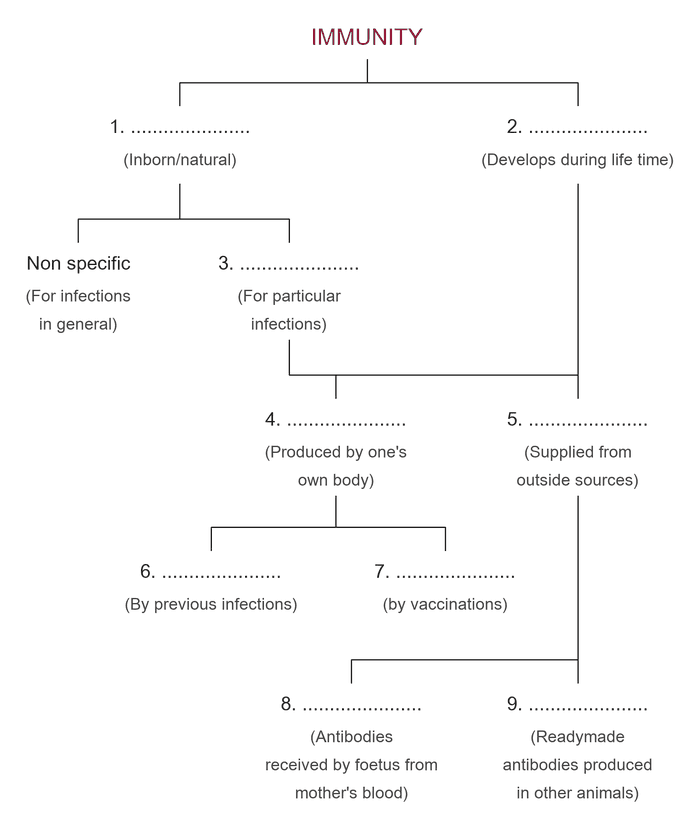
Given below is a scheme of classifying immunity against human diseases. Fill up the types of immunity in the blanks 1-9.
 Solve with AI
Written solution
Solution:
Concept: Immunity is innate (inborn) or acquired (developed during life). The textbook's scheme then divides it into active (made by one's own body) and passive (supplied from outside), and each of these into natural and artificial.
Step 1 — Top level (blanks 1 and 2).
The note under blank 1 says inborn, so it is innate immunity; the note under blank 2 says it develops during life, so it is acquired immunity.
Step 2 — Kinds under innate (blank 3).
Beside 'non specific' (for infections in general) is the kind meant for particular infections, so blank 3 is specific.
Step 3 — Active and passive (blanks 4 and 5).
Immunity produced by one's own body is active (blank 4); immunity supplied from outside sources is passive (blank 5).
Step 4 — Kinds of active immunity (blanks 6 and 7).
Active immunity gained from a previous infection is natural (blank 6); active immunity gained from vaccination is artificial (blank 7).
Step 5 — Kinds of passive immunity (blanks 8 and 9).
Antibodies received by the foetus from the mother's blood give natural passive immunity (blank 8); ready-made antibodies produced in other animals and injected give artificial passive immunity (blank 9).
The completed scheme:
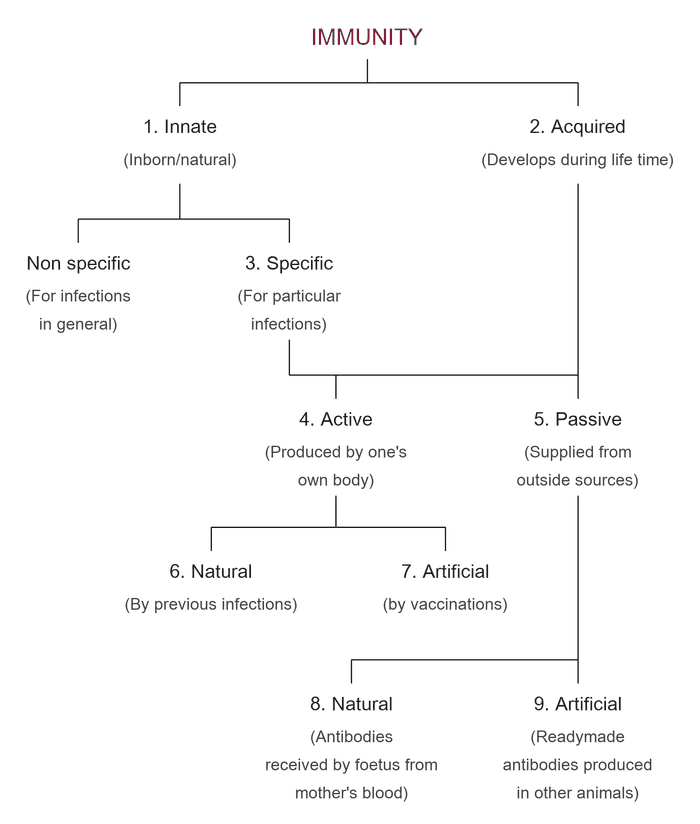
Watch out: Blanks 8 and 9 hang from blank 5 (passive), not from blank 7; read every note before filling a blank.
Therefore, 1 innate, 2 acquired, 3 specific, 4 active, 5 passive, 6 natural, 7 artificial, 8 natural, 9 artificial.
- 255 marks
Question 25
Choose the odd one out and write the category for the remaining terms.
(a) Carbolic acid, Formalin, Benzoic acid, Boric acid
(b) Mercurochrome, Cresol, Phenol, Bordeaux mixture
(c) ATP, DPT, BCG, TAB
(d) Saliva, Sweat, Skin, Tears
(e) Chloromycetin, Streptomyces, Streptomycin, Aureomycin
Solve with AIWritten solution
Solution:
Concept: In each group, three terms share one category; the odd one belongs to a different category.
Step 1 — Group (a).
Formalin (40% formaldehyde) is a strong disinfectant, while carbolic acid (dilute), benzoic acid and boric acid are mild enough for the body.
Odd one: formalin; the others are antiseptics.
Step 2 — Group (b).
Mercurochrome was a mild antiseptic for wounds, while cresol, phenol and bordeaux mixture (a copper sulphate and lime spray that kills fungi on crops) are strong germ-killers used on places and plants.
Odd one: mercurochrome; the others are disinfectants.
Step 3 — Group (c).
ATP (adenosine triphosphate) is the energy-carrying molecule of cells, while DPT, BCG and TAB are vaccines.
Odd one: ATP; the others are vaccines.
Step 4 — Group (d).
The skin is a solid covering that blocks germs, while saliva, sweat and tears are fluids that kill germs.
Odd one: skin (a mechanical barrier); the others are germ-killing body secretions.
Step 5 — Group (e).
Streptomyces is a soil bacterium, the source of streptomycin, while chloromycetin, streptomycin and aureomycin are drugs made by such microbes.
Odd one: Streptomyces (an organism); the others are antibiotics.
Watch out: Carbolic acid and phenol are the same chemical; it counts as an antiseptic when dilute, as in (a), and as a disinfectant when strong, as in (b).
Therefore, (a) formalin, antiseptics; (b) mercurochrome, disinfectants; (c) ATP, vaccines; (d) skin, germ-killing secretions; (e) Streptomyces, antibiotics.
- 262 marks
Question 26
List any four ways in which the antibiotics are being used.
Solve with AIWritten solution
Solution:
Concept: Antibiotics kill microorganisms or stop their growth, so they are used wherever harmful microbes must be checked: in people, in plants, in food and in farm animals.
Step 1 — In medicine.
Antibiotics are given to cure infections caused by bacteria and to prevent infection after surgical operations.
Step 2 — As food preservatives.
Some antibiotics (for example nisin, used in cheese and canned foods) stop microbes from spoiling food.
Step 3 — In animal feed.
Antibiotics have been added to animal feed to prevent internal infections in farm animals.
Step 4 — Against plant pathogens.
Antibiotic sprays such as streptomycin control bacterial diseases of crops.
Note: Today the use of antibiotics in food and in animal feed is strictly limited by law, because their careless use breeds antibiotic-resistant bacteria that medicines can no longer kill.
Therefore, antibiotics are used in medicine, as food preservatives, in animal feed and to control plant pathogens.
- 272 marks
Question 27
List the merits of local defence systems.
Solve with AIWritten solution
Solution:
Concept: The local defence system (skin, mucus, germ-killing secretions and phagocytes) is the body's first, general line of defence. It does not need to recognise a particular germ.
Step 1 — It acts at once.
The barriers and secretions are always present, so they start working instantaneously when a germ arrives.
Step 2 — It needs no earlier contact.
It does not depend on previous exposure to the infection, unlike antibodies, which take days to form the first time.
Step 3 — It works against many germs.
Because it is non-specific, it is effective against a wide range of potentially infectious agents.
Therefore, the local defence system works instantly, needs no previous exposure and acts against a wide range of germs.
- 2812 marks
Question 28
Differentiate between :
(a) Antiseptic and antibiotic,
(b) Antiseptic and disinfectant,
(c) Disinfectant and deodorant,
(d) Vaccination and sterilisation
(e) Active immunity and passive immunity,
(f) Innate immunity and acquired immunity.
Solve with AIWritten solution
Solution:
Concept: To differentiate two terms, compare them point by point: what they are, where or how they are used and what they do.
Step 1 — Part (a): Antiseptic and antibiotic.
Both kill germs, but they differ in source and in where they act.
Antiseptic Antibiotic A mild chemical substance, e.g. iodine. A chemical substance produced by microorganisms, e.g. penicillin. Applied on the body surface (skin, wounds). Mostly taken inside the body (by mouth or injection). Step 2 — Part (b): Antiseptic and disinfectant.
Both are germ-killing chemicals, but they differ in strength and place of use.
Antiseptic Disinfectant Mild germ-killing chemical. Strong germ-killing chemical. Causes no harm to skin and body. May harm skin and body. Applied on the body, e.g. iodine. Applied on spots and places, e.g. phenol. Step 3 — Part (c): Disinfectant and deodorant.
A disinfectant acts on germs, while a deodorant acts only on smell.
Disinfectant Deodorant Kills germs on spots and places. Does not kill germs. Prevents the spread of disease, e.g. phenol, cresol. Only removes or masks a bad smell. Step 4 — Part (d): Vaccination and sterilisation.
Vaccination protects the body from inside, while sterilisation kills germs on objects outside it.
Vaccination Sterilisation Introducing dead or weakened germs (a vaccine) into the body. Killing all germs on articles and instruments by heat (boiling, steam) or chemicals. Develops immunity against a particular disease. Stops germs from reaching the body; gives no immunity. Step 5 — Part (e): Active and passive immunity.
Both protect against a disease, but they differ in who makes the antibodies.
Active immunity Passive immunity Antibodies made by one's own body. Ready-made antibodies received from outside. Long-lasting protection. Temporary protection. Effective only after a time gap. Effective immediately. Step 6 — Part (f): Innate and acquired immunity.
Both are kinds of immunity, but they differ in when and how they arise.
Innate immunity Acquired immunity Inborn; due to the genetic make-up. Develops during one's lifetime. Present without any infection or vaccination. Results from infection, vaccination or ready-made antibodies. Watch out: Keep each row of a table on the same point (for example, source against source), or the comparison loses its marks.
Therefore, each pair differs as shown in the tables: in source, strength, place of use, effect, who makes the antibodies and when the immunity arises.
- 293 marks
Question 29
The principle of vaccination is to produce immunity against a disease. Explain.
Solve with AIWritten solution
Solution:
Concept: A vaccine lets the body practise against a germ without suffering the disease, so that it is ready when the real germ comes.
Step 1 — What a vaccine contains.
A vaccine contains killed or weakened germs, or their inactivated toxins (toxoids); these cannot cause the disease.
Step 2 — The first response.
Inside the body, the antigens of the vaccine stimulate the lymphocytes to produce specific antibodies, and some lymphocytes remain as memory cells.
Step 3 — The later response.
When the real germs of that disease enter later, the memory cells recognise them quickly and large amounts of antibodies are made at once, so the germs are destroyed before they can cause the disease.
Step 4 — The result.
Vaccination therefore gives artificially acquired active immunity, which usually lasts a long time; booster doses keep it strong.
Therefore, vaccination produces immunity because the vaccine's antigens make the body form antibodies and memory cells, which destroy the real germs quickly when they attack later.
- 303 marks
Question 30
"Abnormally, large number of WBCs in the blood are usually an indication of some infection in our body." Comment on the statement.
Solve with AIWritten solution
Solution:
Concept: White blood cells (WBCs) are the body's germ-fighting cells: phagocytes engulf germs, and lymphocytes make antibodies.
Step 1 — Judge the statement.
The statement is correct, because the body makes more WBCs whenever it has to fight germs.
Step 2 — What happens in an infection.
When germs invade, the bone marrow releases more WBCs into the blood, and many of them squeeze out of the capillaries (diapedesis) to reach the infected spot and destroy the germs.
Step 3 — What a blood test shows.
So a raised WBC count in a blood test is usually a sign that the body is fighting an infection. Pus in a wound is a mass of dead WBCs, dead germs and tissue fluid.
Watch out: The statement says 'usually': a high count can also have other causes, such as blood cancer (leukaemia), so a doctor reads it together with other signs.
Therefore, an abnormally large number of WBCs usually shows that the body is fighting an infection, because it makes more WBCs to destroy the invading germs.
- 319 marks
Question 31
Explain briefly, the role of the following health aids:
(a) Antiseptics
(b) Disinfectants
(c) Vaccines.
Solve with AIWritten solution
Solution:
Concept: Antiseptics and disinfectants kill germs outside the body (on skin and on places); vaccines build immunity inside the body.
Step 1 — Part (a): Antiseptics.
Antiseptics are mild chemicals (for example iodine, boric acid, spirit) that kill germs on the body surface without harming the skin. Applied on cuts and wounds, they stop germs from entering and causing infection.
Step 2 — Part (b): Disinfectants.
Disinfectants are strong chemicals (for example phenol, cresol, lime, 40% formalin) that kill germs on spots and places such as drains, toilets, floors and stagnant water, where germs breed. They stop the spread of disease, but they must not touch the skin.
Step 3 — Part (c): Vaccines.
Vaccines are dead or weakened germs, or toxoids, that make the body produce specific antibodies and memory cells. They give long-lasting immunity and so prevent diseases such as polio, tuberculosis, measles, diphtheria and tetanus.
Watch out: Antiseptics and disinfectants only kill germs that are already present; they give no immunity.
Therefore, antiseptics kill germs on the body surface, disinfectants kill germs on spots and places, and vaccines prevent diseases by building long-lasting immunity.
- 323 marks
Question 32
Suppose a person develops the disease diphtheria. Comment upon the principle of the treatment he should receive.
Solve with AIWritten solution
Solution:
Concept: Diphtheria germs release a powerful toxin. A patient who already has the disease needs antibodies immediately, so the treatment is passive immunisation.
Step 1 — Why a vaccine will not help now.
A vaccine works only after a time gap, while the body slowly makes its own antibodies; the sick patient has no time to wait.
Step 2 — What is given.
The patient is given anti-diphtheria serum, that is, ready-made antibodies (antitoxins) prepared in the blood of a horse that has been injected with small doses of diphtheria toxin.
Step 3 — How it works.
These antitoxins neutralise the toxin at once, before it can damage the heart and nerves. This is artificially acquired passive immunity: quick, but temporary.
Step 4 — What is added today.
Doctors also give an antibiotic (such as penicillin or erythromycin) to kill the diphtheria bacteria themselves, and keep the patient isolated.
Watch out: The vaccine (toxoid) prevents diphtheria in healthy children; it is not the treatment for a sick patient.
Therefore, the patient should receive ready-made antitoxin (anti-diphtheria serum) to neutralise the toxin at once; this is passive immunisation.
- 333 marks
Question 33
Why is it important to know how the germs leave the body of a patient ?
Solve with AIWritten solution
Solution:
Concept: A disease spreads by the route its germs take out of the patient. Knowing the exit route tells us how to block the spread.
Step 1 — The exit routes.
Germs leave a patient through coughing and sneezing, sputum, faeces, urine, vomit or blood, depending on the disease.
Step 2 — Treating the discharges.
Knowing the route, we can disinfect or safely dispose of those discharges; for example, the stools of a cholera patient are disinfected, and a tuberculosis patient covers the mouth while coughing.
Step 3 — Protecting others.
It also tells us how to isolate the patient and protect healthy people, and so prevents the spread of the disease in the community.
Therefore, knowing how germs leave a patient lets us disinfect those discharges and isolate the patient, which stops the disease from spreading.
- 348 marks
Question 34
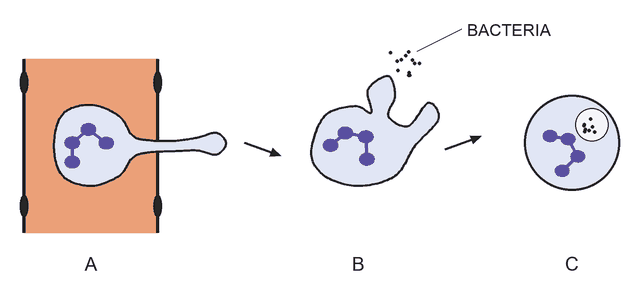
The figures A, B and C given below represent a kind of protective method in our body. Study the same and answer the following questions :
(a) Name and define the process which occurs in figure A.
(b) What kind of blood vessel is shown in figure-A? Write its one specific structural feature.
(c) Name and define the process occurring in figure-B.
(d) What kind of blood cell is shown in the figures? Write its technical name also.
(e) Name the specific type of cell containing a 4 lobed nucleus of the category answered by you in part (d) above.
Solve with AIWritten solution
Solution:
Concept: The figures show a white blood cell at work: in A it squeezes out of a blood capillary, in B it moves towards bacteria and sends out projections, and in C it has engulfed them.
Step 1 — Part (a): the process in figure A.
The white cell is passing through the wall of the capillary into the tissue. This is diapedesis: the squeezing out of white blood cells through the walls of blood capillaries into the surrounding tissues.
Step 2 — Part (b): the blood vessel in figure A.
The vessel is a blood capillary. Its special feature is that its wall is only one cell thick (a single layer of thin endothelial cells), which lets the white cell squeeze between the cells.
Step 3 — Part (c): the process in figure B.
The white cell is attracted to the bacteria and surrounds them with projections. This is phagocytosis: the engulfing and destroying of bacteria or other foreign particles by white blood cells. Figure C shows the bacteria enclosed in a vacuole, where they are digested.
Step 4 — Part (d): the kind of blood cell.
The cell is a white blood cell; its technical name is leucocyte. Here it is acting as a phagocyte.
Step 5 — Part (e): the cell with a lobed nucleus.
Among the white blood cells, the neutrophil has a nucleus of several lobes (usually 2 to 5; four in this figure) and is the main phagocyte.
Watch out: Diapedesis (squeezing out) and phagocytosis (eating) are two different steps; do not swap them.
Therefore, (a) diapedesis, (b) a blood capillary with walls one cell thick, (c) phagocytosis, (d) white blood cell or leucocyte, (e) neutrophil.
What Class 9 Biology Ch 17 covers
The sections of the chapter, in the order the book takes them. Every question above comes from one of these.
- 01Need to Keep Healthy
- 02Immunity
- 03Vaccination and Immunisation
- 04Antitoxins
- 05Antiseptics and Disinfectants
- 06Antibiotics – Penicillin and Others
More ways to study this chapter
The same chapter asked three other ways. Practise it, revise it, and see what the board has set on Ch 17 before.
Class 9 Biology Ch 17 questions students ask
How many questions are there in Class 9 Biology Ch 17?
34 questions. Every one is solved step by step on this page.
Are these Class 9 Biology solutions free?
Yes. Every question and its full working is free to read, with no account needed.
Can I download the Class 9 Biology Ch 17 solutions as a PDF?
There is no PDF to download. Every solution is on this page instead, which means it is searchable, always the current syllabus, and readable on a phone. Use your browser's print option if you want it on paper.