
Opening your dashboard
Class 9 Biology Chapter 17 Aids to Health: Practice Questions
41 questions on Chapter 17, each worked through on its own page with the AI tutor. Class 9 Biology, ICSE 2026-27.
41 questions
1–5 marks · Mixed difficulty
- 11 mark
Question 1
Bloom's level: Remember
On exposure to antigens, antibodies are produced by a special type of :
- 21 mark
Question 2
Bloom's level: Remember
The term antibiotics for germ-killing drugs obtained from microorganisms was coined in 1942 by :
- 31 mark
Question 3
Bloom's level: Remember
The toxins used to make the diphtheria and tetanus vaccines (toxoids) are made harmless by adding :
- 41 mark
Question 4
Bloom's level: Remember
World Health Day, celebrated to spread awareness about keeping oneself healthy, falls on :
- 51 mark
Question 5
Bloom's level: Understand
Boiling surgical instruments in water before an operation is called a physical method of disinfection because :
- 61 mark
Question 6
Bloom's level: Understand
A baby rarely catches certain diseases in the first few months of life, mainly because :
- 71 mark
Question 7
Bloom's level: Understand
Sulpha drugs such as sulphadiazine kill bacteria by :
- 81 mark
Question 8
Bloom's level: Apply
A farmer bitten by a poisonous snake is rushed to a hospital. The most suitable treatment to save him is :
- 91 mark
Question 9
Bloom's level: Apply
A 10-month-old child has already received the three doses of DPT, the three doses of oral polio and BCG. According to the National Immunisation Schedule in your book, the vaccine the child should get next is :
- 101 mark
Question 10
Bloom's level: Analyse
Assertion (A): An antiserum injection given to a diphtheria patient protects him against diphtheria for the rest of his life.
Reason (R): An antiserum contains ready-made antibodies produced in the blood of an animal such as a horse.
- 111 mark
Question 11
Bloom's level: Evaluate
Assertion (A): Penicillin is used to treat several infections caused by bacteria.
Reason (R): Penicillin is a strong disinfectant that is applied on floors and drains where germs multiply.
- 121 mark
Question 12
Bloom's level: Analyse
Assertion (A): Sweat helps to protect the body against germs on the skin.
Reason (R): Evaporation of sweat cools the body on a hot day.
- 131 mark
Question 13
Bloom's level: Understand
Removing stagnant water from the surroundings is called a community-level health measure, not just a personal one. Why?
- 142 marks
Question 14
Bloom's level: Understand
Once germs have entered the body, it fights them in a non-specific way and in a specific way. Explain the difference, with one example of each.
- 152 marks
Question 15
Bloom's level: Understand
A vaccine made of killed germs cannot cause the disease. Explain how it still protects a person from that disease.
- 162 marks
Question 16
Bloom's level: Understand
Penicillin and streptomycin both stop bacteria from growing and multiplying, but in different ways. Explain how each one acts.
- 172 marks
Question 17
Bloom's level: Apply
The school sick room has these on its shelf: tincture of iodine, cresol, a deodorant spray, lime.
Which one would you choose for :
(i) a fresh scrape on a student's knee, and
(ii) cleaning the sick-room sink after a sick child has vomited into it?
Give a reason for each choice.
- 182 marks
Question 18
Bloom's level: Apply
Seema is 18 weeks pregnant and has never been immunised against tetanus. The schedule says : first dose of tetanus toxoid between 16 and 24 weeks of pregnancy, second dose between 24 and 32 weeks.
(i) Within how many weeks from now must she take the first dose?
(ii) Between how many weeks from now should she take the second dose?
- 192 marks
Question 19
Bloom's level: Apply
Name the exact type of acquired immunity in each case :
(i) A nurse gets a tetanus toxoid injection.
(ii) A man who had chickenpox as a child does not get it again.
(iii) A boy bitten by a snake is given anti-venin.
(iv) A newborn baby receives its mother's antibodies before birth.
- 202 marks
Question 20
Bloom's level: Analyse
Using tetanus as the example, analyse how a toxin, a toxoid and an antitoxin are related to one another.
- 212 marks
Question 21
Bloom's level: Apply
This chapter deals with natural (the body's own) and artificial (man-made) ways of protecting ourselves from disease. Classify each of these as natural or artificial :
skin, BCG vaccine, tears, penicillin, antibodies made after an infection, mercurochrome.
- 222 marks
Question 22
Bloom's level: Evaluate
A student writes : "Salvarsan, produced in 1910, was a perfect medicine because it killed the germs of syphilis." Do you agree? Justify your answer.
- 233 marks
Question 23
Bloom's level: Apply
Case: While gardening, Riya got a deep scratch from a rose thorn. She did not wash it. Two days later the scratch was red and swollen, and a little yellowish pus had formed in it.
(a) Which barrier of the local defence system was broken, and how should the scratch have been treated at once?
(b) Explain how the white blood cells reached the scratch and dealt with the germs.
(c) What is the pus made of?
- 244 marks
Question 24
Bloom's level: Analyse
Case: A district started a measles vaccination drive in 2017. The number of measles cases reported each year was :
Year 2015 2016 2017 2018 2019 Measles cases 1040 1000 520 240 120 (a) What is the nature of the measles vaccine, and at what age is it given?
(b) Calculate the percentage fall in measles cases from 2016 to 2019.
(c) The cases did not drop to zero at once in 2017. Suggest two reasons from your knowledge of vaccination.
- 254 marks
Question 25
Bloom's level: Evaluate
Case: Aman caught a common cold caused by a virus. Without asking a doctor, he took some left-over antibiotic tablets from an old strip. He stopped them after two days when he felt a little better.
(a) What are antibiotics?
(b) Penicillin stops cell wall formation in bacteria, and streptomycin blocks bacterial ribosomes. Using this, judge whether antibiotics are likely to help Aman's cold.
(c) Evaluate his decision to take left-over tablets and to stop them after two days. What should he have done?
- 265 marks
Question 26
Bloom's level: Create
Fleming discovered penicillin by noticing a mould that stopped bacteria from growing around it. A student finds a new greenish mould on a rotting orange and wants to test whether it too produces a bacteria-killing substance. Design the experiment.
(a) List the materials and describe the set-up of the experimental and control dishes.
(b) State what you will observe if the mould does produce an antibiotic, and how you would compare its strength with penicillin.
(c) Give the conclusion you would draw and two precautions.
- 273 marks
Question 27
Bloom's level: Apply
After the monsoon, many children in a housing colony fell ill with malaria and diarrhoea. A health survey noted :
- Rain water collected in old tyres and flower pots.
- Children not washing hands before meals.
- An open garbage heap near the park.
- Children sleeping very late every night.
- Open, blocked drains.
- Some children not bathing regularly.
(a) Sort the six findings into personal-level and community-level problems.
(b) Suggest one remedy for each community-level problem.
(c) Which illness is linked to finding 1, and which to finding 2? Give a reason for each.
- 284 marks
Question 28
Bloom's level: Analyse
Study how some substances were used at home and in a clinic :
Substance How it was used Mercurochrome Applied on a child's cut finger Lime Sprinkled into an open drain Deodorant spray Sprayed on a wound to prevent infection Dilute boric acid Used to wash a small scrape 40% formalin Used to wipe a patient's hands Cresol Used to clean the clinic floor (a) Classify the six substances as antiseptic, disinfectant or neither.
(b) Identify the two wrong uses in the table and explain why each is wrong.
(c) What property of a germ-killing substance decides whether it can be used on the body?
- 293 marks
Question 29
Bloom's level: Apply
Neha eats a samosa carrying some germs, and the same day a classmate sneezes near her face.
(a) Name, in order, the defences that act against the germs in the samosa.
(b) Name the defences that act against the germs she breathes in.
(c) Some germs still reach her body tissues. Which two lines of defence take over now?
- 305 marks
Question 30
Bloom's level: Create
You are helping at a one-day immunisation camp. Using the National Immunisation Schedule in your book, prepare a plan for these people :
- Arjun, 4 months old, not yet vaccinated
- Zoya, 11 months old, has had all three doses of DPT and polio, and BCG
- Kabir, 20 months old, completed all vaccines up to measles
- Mira, 5½ years old, completed all vaccines due before 5 years
- Dev, 10 years old, completed all vaccines due before 10 years
- Lata, 20 weeks pregnant, never immunised against tetanus
(a) Construct a table showing what each person should receive at the camp.
(b) Three of them must come back for further doses. Who are they, and when should they return?
(c) Explain why Arjun's DPT is given as three doses rather than one.
- 311 mark
Question 31
Which one of the following correctly pairs a part of the body's local defence system with the way it acts against germs ?
- 321 mark
Question 32
Which one of the following vaccines is prepared from living but weakened germs ?
- 331 mark
Question 33
Assertion (A): Phenol and cresol are not used for dressing a wound on the skin.
Reason (R): Disinfectants are strong chemical substances which may harm the skin and the body.
- 342 marks
Question 34
(i) Keeping healthy needs care at two levels. Name the two levels and give one measure taken at each level.
(ii) How does a heap of garbage or a pool of stagnant water lying in a locality affect the health of the people who live there ?
- 352 marks
Question 35
Distemper is a highly infectious disease of dogs which kills about half of the dogs that catch it, yet human beings never suffer from it.
(i) Name the kind of immunity that protects human beings against distemper. By virtue of what do we possess this immunity ?
(ii) State one way in which this kind of immunity differs from the immunity that a child gets after an attack of measles.
- 362 marks
Question 36
(i) What is meant by a toxin ? Give two examples.
(ii) Describe briefly how the anti-venin injection used for treating a case of snake bite is obtained.
- 372 marks
Question 37
(i) Name two sulphonamide (sulpha) drugs and state how these drugs kill bacteria.
(ii) Penicillin, as it was first obtained, and a sulphonamide differ in their source. State this difference.
- 384 marks
Question 38
The figure shows a culture dish, seen from above, in which a scientist was growing a bacterium in his laboratory in the year 1928. The small round spots (3) are the colonies of the bacterium. The growth numbered 1 was not put there by him; it appeared by itself. Region 2, all round this growth, has no colonies of the bacterium.
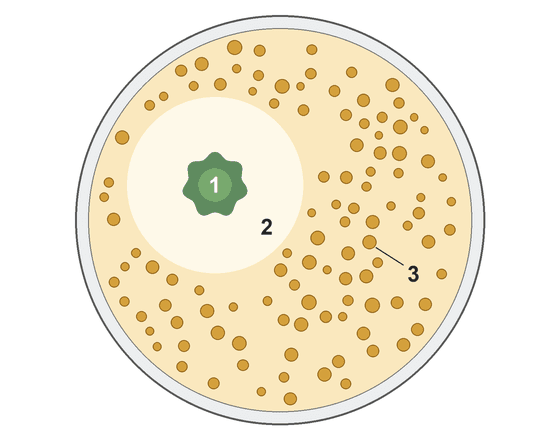
(i) Name the scientist and the bacterium that he was growing.
(ii) What kind of organism is the growth numbered 1 ? Explain why there are no colonies of the bacterium in region 2.
(iii) Name the substance concerned, and state how it acts on bacteria. Give one use of such substances other than fighting infections in human beings.
- 394 marks
Question 39
The figure shows, in three stages, how the body deals with bacteria that have got past its barriers and entered the tissues.
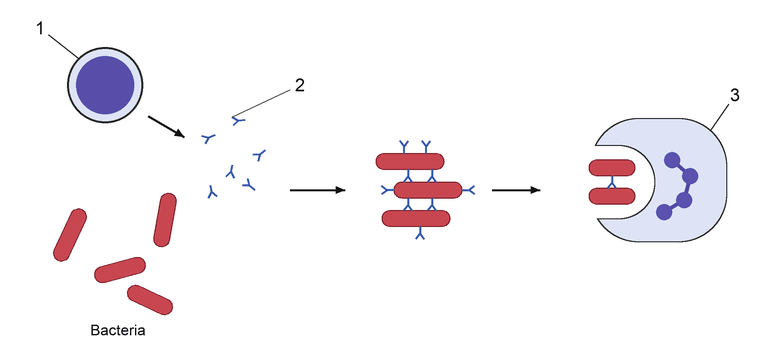
(i) Name the cell numbered 1 and the particles numbered 2 which it releases.
(ii) What effect do the particles 2 have on the bacteria, as shown in the middle stage ? What does the cell numbered 3 then do ?
(iii) State the chemical nature of the particles 2. Why are they said to be specific ?
- 403 marks
Question 40
(i) By which two routes is a vaccine usually introduced into the body ? Name one vaccine for each route.
(ii) In the vaccination against smallpox, a person was inoculated with the cowpox virus and not with the smallpox virus. Explain why this protected the person against smallpox.
(iii) Why is the smallpox vaccination no longer given ?
- 411 mark
Question 41
Class 9 Sample Paper 2 · Section A
Define the following:
BCG