
Opening your dashboard
Class 9 Biology Chapter 17 Aids to Health: Competency-Based Questions (CBQ)
40 questions on Chapter 17, each worked through on its own page with the AI tutor. Class 9 Biology, ICSE 2026-27.
40 questions
1–5 marks · Mixed difficulty
- 11 mark
Question 1
Cognitive domain: Application
A school's athletics team practises on a dry, dusty ground. The coach tells the runners, "While jogging, breathe in through your nose and not through your open mouth." Which of the following best supports the coach's advice ?
- 21 mark
Question 2
Cognitive domain: Understanding
Sana had measles when she was six years old. She is now fifteen and has never had measles again, although her younger cousin had it last year in the same house. But Sana catches a common cold almost every winter. Which statement best explains this ?
- 31 mark
Question 3
Cognitive domain: Application
Long ago, village doctors in England noticed something odd. Dairy workers who had once caught cowpox, a mild disease that gives only a single pustule, did not fall ill during outbreaks of the deadly smallpox. Later, people were inoculated with cowpox virus on purpose. Using what you know about antibodies, why did cowpox protect these workers from smallpox ?
- 41 mark
Question 4
Cognitive domain: Analysis
The table shows when three germ-killing medicines came into use.
Medicine What the record says Salvarsan Produced in 1910; based on an arsenic compound Sulphonamides Discovered in the 1930s Penicillin Named in 1929; first tried on humans in the early 1940s In 1937, a doctor has to treat a patient who has a bacterial disease. She wants a medicine that is already in use for patients and is not based on arsenic. Which choice fits the record ?
- 51 mark
Question 5
Cognitive domain: Understanding
Assertion (A): A hospital attendant mops the floor of a ward with phenol, but phenol is not dabbed on a patient's wound.
Reason (R): Disinfectants are strong germ-killing chemicals that cause harm to the skin and body.
- 61 mark
Question 6
Cognitive domain: Analysis
Assertion (A): A child who is given the measles vaccine this morning is fully protected against measles from this evening.
Reason (R): Inside the body, a vaccine stimulates the WBCs to produce antibodies against the germs of that particular disease.
- 71 mark
Question 7
Cognitive domain: Understanding
Meera's pet dog fell ill with distemper, a highly infectious disease of dogs. The family nursed the dog for two weeks. Nobody in the family had ever had distemper or had taken any injection against it, yet none of them caught it.
Complete the sentence :
The family was protected by ______ immunity, and it is of the ______ kind because it is a natural resistance to one particular kind of germ only.
- 81 mark
Question 8
Cognitive domain: Application
At an institute that prepares anti-sera, small doses of snake venom are injected into a healthy horse over several weeks. Later, serum is prepared from the horse's blood and is supplied to hospitals as antivenin for snake-bite patients.
Complete the sentence :
The horse develops ______ immunity against the venom because its own body produces the antibodies, whereas the patient who is given the antivenin gets ______ immunity.
- 91 mark
Question 9
Cognitive domain: Application
Part of the National Immunisation Schedule reads :
Age Typhoid (TAB) vaccine 5–6 years 2 doses at an interval of 1–2 months 10 years booster dose 16 years booster dose Anita is 5 years old today. She will follow this schedule fully.
Complete the sentence :
By her 17th birthday, Anita will have received ______ doses of the typhoid vaccine in all, and every one of these doses will contain ______ germs of typhoid.
- 102 marks
Question 10
Cognitive domain: Evaluation
While revising, Dev notices that his book lists lysol among the antiseptics and again among the disinfectants. He says, "This must be a printing mistake. A chemical is either an antiseptic or a disinfectant. It cannot be both."
Is Dev's claim justified ? Give reasons for your answer.
- 112 marks
Question 11
Cognitive domain: Application
A patient with a bacterial infection of the throat is given penicillin by her doctor. The medicine reaches every part of her body through the blood. The bacteria stop multiplying, but the cells of her own body are not damaged.
Using the way penicillin acts, and what you know about the structure of an animal cell, explain why penicillin stops the bacteria but spares the patient's cells.
- 122 marks
Question 12
Cognitive domain: Evaluation
Fourteen-year-old Kabir has taken every vaccine in the National Immunisation Schedule on time. He tells his friends, "I am fully immunised. So I need not bother about washing my hands before meals, and it does not matter to me if water stands in the coolers and pots around our building."
Evaluate Kabir's claim. Give two reasons for your answer.
- 134 marks
Question 13
Cognitive domain: Analysis
Case: In a college laboratory, a round bacterium that grows in clusters (Staphylococcus) was spread evenly over nutrient jelly in a culture dish. A few days later the technician found that an unwanted mould had also started growing near one edge of the dish. The figure shows the dish seen from above : P is the mould, Q is the region around it and R is one of the many colonies of bacteria.
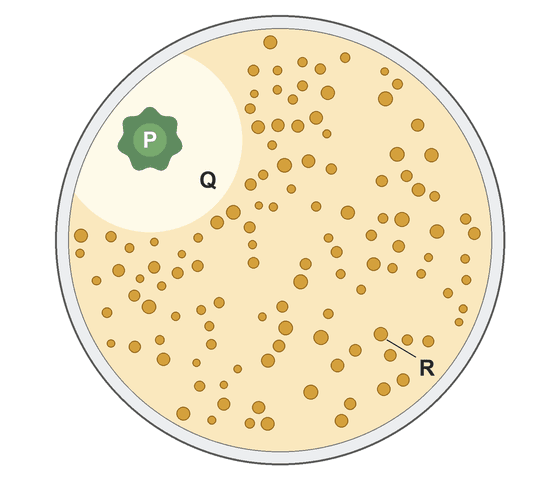
(a) The bacteria were spread evenly over the whole dish. What does the figure tell you about the growth of bacteria in region Q compared with the rest of the dish ?
(b) The mould touches only a small part of the jelly, yet region Q is much wider than the mould. Explain how region Q was formed, and why colonies like R are still growing farther away.
(c) A similar observation led to the first antibiotic. Before the new substance was used on patients, it was tried on laboratory animals. What did this trial have to show ?
- 145 marks
Question 14
Cognitive domain: Analysis
Case: During an outbreak of diphtheria, two healthy adults, P and Q, who had never had the disease, were each given one injection on the same day. One of them received diphtheria toxoid and the other received anti-diphtheria serum. A laboratory measured the level of antibodies against the diphtheria toxin in their blood.
Time after the injection Antibody level in P (units) Antibody level in Q (units) Just before the injection 0 0 1 day 0 80 1 week 10 60 2 weeks 45 35 4 weeks 85 10 12 weeks 80 0 (a) Who received the toxoid and who received the serum ? Give one piece of evidence from the table for each.
(b) Name the exact kind of acquired immunity that P and Q each got.
(c) Which of the two is better protected one day after the injection, and which one after 12 weeks ? Use the figures in the table.
(d) P was injected only once, yet the antibody level in P is still high after 12 weeks. Explain.
- 155 marks
Question 15
Cognitive domain: Creativity
Case: For the school science exhibition, a Class 9 team wants to build a model called "The Body Fort". Visitors from Class 5 should be able to see that germs are first stopped at the entry points of the body, and that the germs which still get in are fought inside. The team has cardboard, cloth, sponge, sticky tape, a spray bottle of water, coloured paper and scissors.
(a) Plan the outer part of the fort to show the local defence system. Choose any three of its defences and suggest what in the model could stand for each.
(b) Suggest a simple activity with coloured paper shapes by which a visitor can find out that an antibody acts against one particular kind of germ only.
(c) Write two short messages for the board next to the model, telling visitors how they can help their own "fort" stay strong.
(d) State one way in which your model is unlike the real defence of the body.
- 161 mark
Question 16
Cognitive domain: Analysis
(Hypothetical data.) The graph shows the antibodies in the blood of a baby during the first nine months. One set of antibodies came from the mother before birth. The other set was made by the baby's own body after the first dose of a vaccine, given at the age of 3 months.
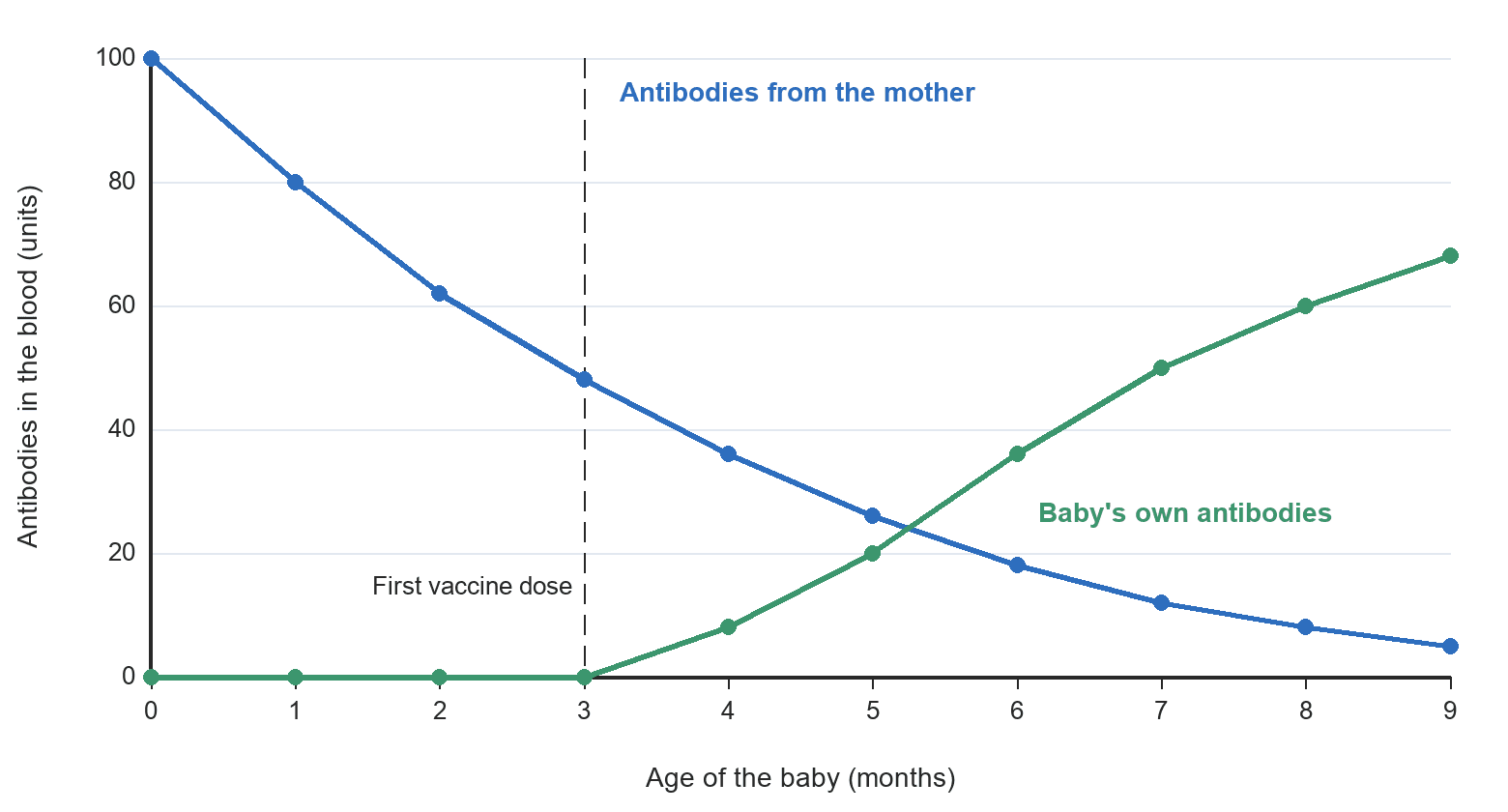
Which conclusion is correct ?
- 171 mark
Question 17
Cognitive domain: Application
Four children are at a village fair.
- Asha rubs her eyes with unwashed hands.
- Binu drinks a glass of dirty water from a roadside pot.
- Charu breathes in the dust raised by a passing tractor.
- Dev gets a deep cut on his knee from a broken bottle.
Which of these statements gives a correct route of entry of germs and a correct defence of the body against it ?
- 181 mark
Question 18
Cognitive domain: Analysis
In the early days of antibiotics, doctors sometimes gave a patient a combination of penicillin and a sulpha drug, sold under the name "pentidsulph". Penicillin interferes with the formation of the cell wall of bacteria. Sulpha drugs, such as sulphadiazine, interfere with the metabolism of bacteria.
Which of the following best explains why such a combination could be a sensible choice ?
- 191 mark
Question 19
Cognitive domain: Understanding
Two cases are described.
Case 1: A farmer handles wheat plants affected by a highly infectious plant disease every day, but he never falls ill with it.
Case 2: During an outbreak of a disease among the people of a village, a few villagers do not fall ill at all, because they were born with a natural resistance to that particular disease.
Which row names the kind of innate immunity in each case correctly ?
- 201 mark
Question 20
Cognitive domain: Analysis
(Hypothetical data.) In a school laboratory, a swab was rubbed on the palm of a student's hand, and the germs on it were allowed to grow into visible colonies on nutrient jelly. The test was done three times with the same student: after no washing, after rinsing with water only, and after washing with soap and water.
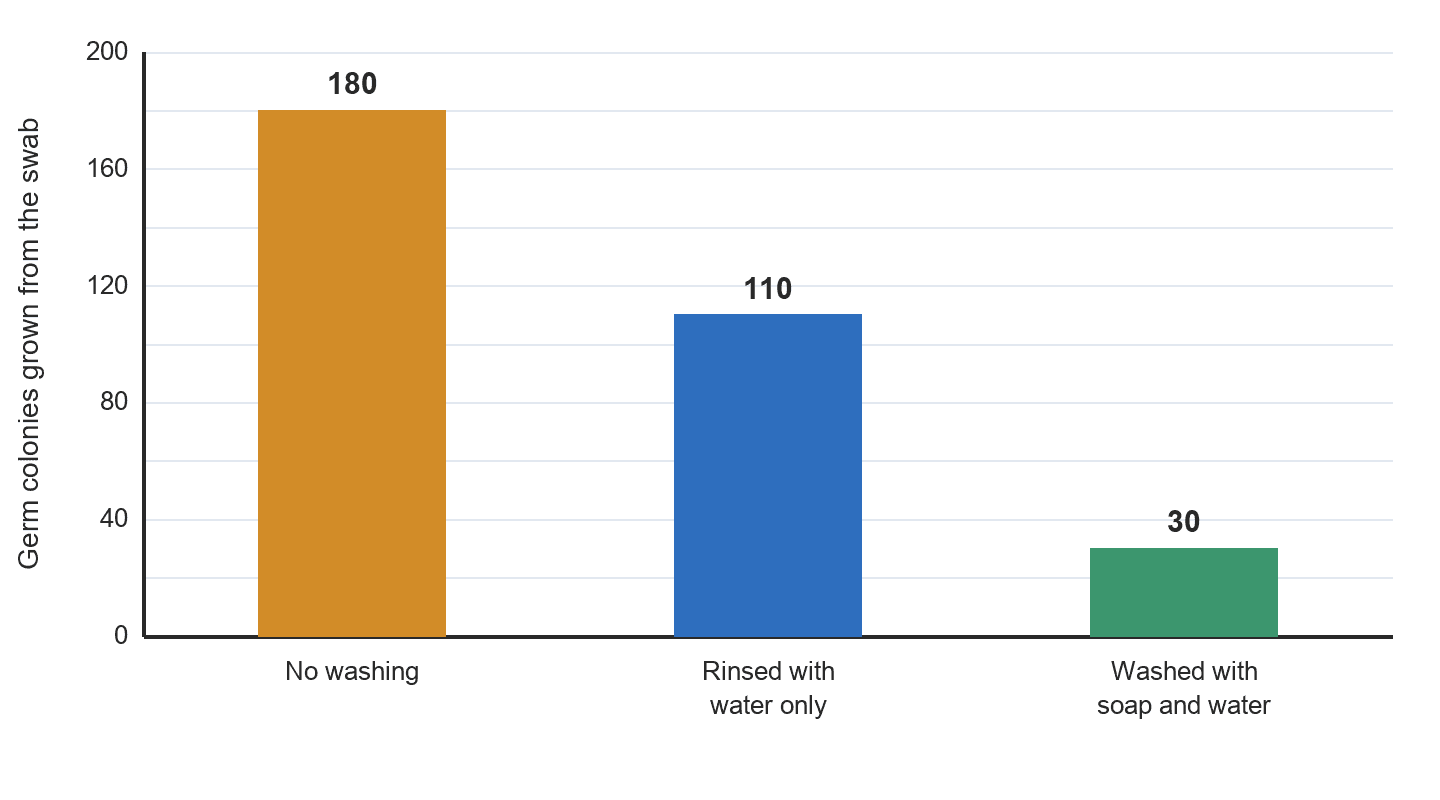
Which conclusion is supported by the bar chart ?
- 211 mark
Question 21
Cognitive domain: Application
Salk's vaccine against poliomyelitis is prepared from polio viruses that have been killed in the laboratory, and it is given by injection. Which statement about a child who receives this vaccine is correct ?
- 221 mark
Question 22
Cognitive domain: Understanding
Assertion (A): The hairs inside the nostrils help to keep germs out of the body.
Reason (R): The mucus of the windpipe traps many bacteria, and the cilia of the windpipe throw out the trapped bacteria.
- 231 mark
Question 23
Cognitive domain: Analysis
A student made a table to compare the two kinds of acquired immunity. Only one row of the table is correct.
Row Active immunity Passive immunity 1 Made of ready-made antibodies from outside Produced by the person's own body 2 Gives temporary protection Gives effective, long-lasting protection 3 Produced only by a vaccine Produced only by a previous infection 4 Effective only after a time gap Immediately effective Which row is correct ?
- 241 mark
Question 24
Cognitive domain: Application
A farm worker sprays Bordeaux mixture on the stems of the fruit plants in his orchard and washes the floor of his cattle shed with a cresol solution. Which statement about these two chemicals is correct ?
- 251 mark
Question 25
Cognitive domain: Understanding
Assertion (A): A child who has received all the doses of the DPT vaccine can still fall ill with measles.
Reason (R): Antibodies are specific, that is, one kind of antibody acts against one particular type of antigen only.
- 262 marks
Question 26
Cognitive domain: Evaluation
In a class test, Meena wrote, "Dettol and Savlon are good antiseptics." Her teacher gave her no marks for this answer. Meena says, "Everybody uses these two at home, so my answer must be correct."
Evaluate Meena's claim. Say why the answer earned no marks and what she should have written instead.
- 272 marks
Question 27
Cognitive domain: Analysis
Four items were noted in a medical laboratory.
- P : the poison released into the blood by the germs of tetanus
- Q : the protein made in the blood of a horse that was injected with snake venom, which is used as antivenin
- R : the sting poison of a scorpion
- S : the serum with ready-made antibodies against diphtheria, obtained from the blood of a horse
(a) Which of the four items are toxins and which are antibodies ?
(b) Old books called the body's answer to a poison an "antitoxin", but our book says the more general term "antibody" is now used. Why is "antibody" the more suitable term ?
- 282 marks
Question 28
Cognitive domain: Application
A part of the National Immunisation Schedule printed in our book reads :
Age Vaccination 15 years and above COVID-19 vaccine : 2 doses at an interval of 1–2.5 months COVID-19 vaccine : booster dose given to healthcare workers, people above 60 years and people with other health conditions Four adults come to a vaccination centre for the booster dose : Mrs Rao, a 65-year-old retired teacher; Anil, a 28-year-old nurse in a hospital; Sonia, a 24-year-old bank clerk with no health problem; and Mr Das, a 35-year-old man who has diabetes.
(a) Which of the four are eligible for the booster dose, according to the schedule ?
(b) For each person you chose, name the group of the schedule to which he or she belongs.
- 292 marks
Question 29
Cognitive domain: Evaluation
In a quiz, a student says, "Chemotherapy, the treatment of diseases by chemicals, began only when Alexander Fleming discovered penicillin."
(a) Judge the claim. Give one fact from our book that supports your judgement.
(b) Name the group of medicines that was discovered in the 1930s and proved effective in many bacterial diseases. Say whether these medicines are natural or synthetic.
- 302 marks
Question 30
Cognitive domain: Understanding
Rohan ate some stale food at a picnic. By the evening he had vomiting and loose motions. His father said, "Do not be alarmed. This is a sign that your body is fighting the germs."
(a) Is the father right ? Name the part of the local defence system to which vomiting and loose motions belong, and explain how they help.
(b) Name two other examples of this kind of defence that help the body in the breathing system.
- 312 marks
Question 31
Cognitive domain: Analysis
Our book divides the body's defence against germs into five groups :
A1 — prevent entry mechanically; A2 — prevent entry by killing; A3 — thrown out if entering; B1 — fight at the entry point (non-specific); B2 — fight in the deeper parts (specific).
Match each of the following with one group, and give a reason for each choice.
(i) The tough outer layer of the skin
(ii) Tears
(iii) Sneezing
(iv) White blood cells engulfing bacteria at a wound
(v) Antibodies in the blood
- 323 marks
Question 32
Cognitive domain: Analysis
(Hypothetical data.) Three new germ-killing chemicals, P, Q and R, were tested in a laboratory. Each was used at the same strength on a culture of disease-causing bacteria and on a culture of human skin cells.
Chemical Bacteria killed (%) Human skin cells damaged (%) P 95 80 Q 90 2 R 20 1 (a) Which chemical is the most promising as a medicine to be taken into the body ? Give a reason from the data.
(b) Chemical P is no good as a medicine. Suggest how a chemical like P could still be used to prevent disease, and name the group of chemicals it would then belong to.
(c) Before chemical Q is ever given to patients, what should be done next ? Use what happened with penicillin to support your answer.
- 333 marks
Question 33
Cognitive domain: Analysis
Read this hospital note. (Hypothetical case.)
A man was found to be infected with HIV after a blood transfusion with unscreened blood. For some years he looked healthy. Later he began to suffer one severe infection after another, and his body could not fight them off.
(a) Write the full form of HIV, and name the cells of the immune system that the virus attacks.
(b) Explain why other severe infections developed unchecked in this man.
(c) State one more way by which HIV is transmitted, and say whether AIDS can be cured at present.
- 343 marks
Question 34
Cognitive domain: Analysis
The steps below describe how the body of a man who has caught diphtheria deals with the poison of the diphtheria germs. They are written in a mixed-up order.
- P : The poison is made harmless, and it is then destroyed and eliminated by the body.
- Q : The germs multiply in the throat and release their poison (toxin) into the blood.
- R : The antibodies circulate freely in the blood and lymph.
- S : Lymphocytes recognise the poison as foreign and make the antibody that suits it.
- T : The antibody recognises the poison and binds to it.
(a) Write the letters in the correct order.
(b) Name the step in which the antitoxin is made, and say why the same antibody will not act against the poison of the tetanus germs.
(c) The man is given anti-diphtheria serum on the first day of the illness. Which of the five steps does this serum make unnecessary for a while ?
- 353 marks
Question 35
Cognitive domain: Understanding
A health teacher tells her class that the local defence system has three merits. She gives three examples.
- P : A newborn baby has never had any infection, yet her skin keeps out the germs that are on the hands of the visitors who hold her.
- Q : Dust that carries many different kinds of germs is trapped in the same way by the hairs inside a boy's nostrils.
- R : A sneeze starts the instant dust tickles the nose.
State the merit of the local defence system that each example mainly shows, and give a reason in each case.
- 363 marks
Question 36
Cognitive domain: Creativity
World Health Day is celebrated on 7 April to create consciousness about keeping oneself healthy and to spread the message at all levels. Your class has to speak three short lines for the morning assembly.
Write three short slogans or lines, one on each of the following, and give a reason for each from our chapter :
(a) a personal-level habit for keeping healthy;
(b) a community-level measure for keeping the surroundings healthy;
(c) a message about taking the vaccines of the National Immunisation Schedule on time.
- 375 marks
Question 37
Cognitive domain: Analysis
Case: (Hypothetical data.) After an outbreak of measles in a village, a health worker studied 200 children of 2 to 5 years of age. Of these, 150 had been given the measles vaccine (some of them only a few days before the outbreak began) and 50 had not been vaccinated. During the outbreak, 6 of the vaccinated children and 30 of the unvaccinated children caught measles.
(a) Find the percentage of children who caught measles among the vaccinated and among the unvaccinated.
(b) How many times higher was the chance of catching measles for an unvaccinated child than for a vaccinated child ? What does this tell you about the effect of the vaccine ?
(c) Six vaccinated children still caught measles. Give one possible reason, using what you know about the way active immunity develops.
- 384 marks
Question 38
Cognitive domain: Evaluation
Case: (Hypothetical data.) A hospital laboratory spread bacteria taken from a patient's wound evenly over nutrient jelly in a culture dish. Small paper discs soaked in three different antibiotics, and one plain paper disc, were then placed on the jelly. After one day the width of the clear ring with no bacterial growth around each disc was measured.
Disc Width of the clear ring (mm) Penicillin 24 Streptomycin 9 Antibiotic X 0 Plain paper disc, no antibiotic 0 (a) Why was a plain paper disc also placed on the jelly ?
(b) Arrange the three antibiotics from the most effective to the least effective against these bacteria. Explain how the clear ring is formed around a disc.
(c) A colleague says, "Antibiotic X gave no ring, so it is useless and should be thrown away." Evaluate this statement.
- 394 marks
Question 39
Cognitive domain: Analysis
Case: (Hypothetical data.) The health club of a school carried out a four-week clean-up drive. Every Friday the members counted the places in and around the school where rain water was standing, and the number of students who had been absent that week because of illness.
Week Places with standing water Students absent due to illness 1 12 18 2 8 15 3 3 9 4 1 6 (a) Find the percentage fall from week 1 to week 4 in (i) the places with standing water and (ii) the number of absent students. Give the answers correct to one decimal place.
(b) A member says, "The table proves that standing water alone was the cause of all the absences." Evaluate this statement.
(c) The clean-up drive is a community-level measure. Name two personal-level measures that the students should add.
- 405 marks
Question 40
Cognitive domain: Evaluation
Case: The health officer of a small hill town has money for only two of the following four plans this year, to reduce disease in the town.
- Plan 1 : A camp where all the children are given the vaccines listed in the National Immunisation Schedule.
- Plan 2 : Spraying a strong germ-killing chemical on the drains, the garbage heaps and the walls of the cattle sheds.
- Plan 3 : Giving every resident a course of antibiotic tablets every month, so that nobody falls ill.
- Plan 4 : Giving every family a bottle of a mild germ-killing solution for cuts and scrapes, with a leaflet on washing hands.
(a) Name the kind of chemical used in Plan 2 and the kind used in Plan 4. Name the kind of immunity that Plan 1 produces.
(b) Choose any two plans and justify your choice with reasons from the chapter.
(c) Evaluate Plan 3. Give two reasons why it is a poor plan.