
Opening your dashboard
Class 8 Physics Chapter 1: Matter Solutions
66 textbook questions with step-by-step answers, free to read, for ICSE 2026-27.
Get talked through Ch 1, not just shown the answer
Reading a finished solution is not the same as being able to do it. The AI tutor takes one question at a time and works it with you, in your own words, until you can.
- Ask it out loud, in your own words
- It gives you the next step, not the answer
- Stuck on part (ii)? Start there
66 questions with solutions
1–4 marks · Mixed difficulty
- 11 mark
Question 1
The inter-molecular force is maximum in :
Solve with AIAnswer
- Correct
(A) solids
(B) gases
(C) liquids
(D) none of the above.
Answer: (A) solids
Concept: The closer the molecules, the smaller the inter-molecular space and the stronger the attraction between them. So the space is least in solids, more in liquids and greatest in gases, while the force of attraction is greatest in solids, less in liquids and least in gases.
Step 1 — See what the question asks.
The inter-molecular force is the pull that molecules exert on one another. We must find the state in which this pull is strongest.
Step 2 — Link the force to the packing.
The pull between two molecules is stronger when they are closer. The molecules of a solid are packed most closely of all three states.
Step 3 — Choose the state.
So the inter-molecular force is greatest in solids. This strong pull holds the molecules in fixed positions, which is why a solid has a definite shape and a definite volume.
Watch out: Do not confuse the force with the space: the space is greatest in gases, but the force is greatest in solids.
Why the other options are wrong:
- (B) gases: Gas molecules are far apart, so the force between them is the least, not the greatest.
- (C) liquids: Liquid molecules attract one another, but less strongly than the molecules of a solid.
- (D) none of the above: Option (A) is correct, so “none of the above” cannot be the answer.
Therefore, the inter-molecular force is maximum in solids, option (A).
- 21 mark
Question 2
The inter-molecular space is maximum in :
Solve with AIAnswer
(A) liquids
(B) solids
- Correct
(C) gases
(D) none of the above.
Answer: (C) gases
Concept: The closer the molecules, the smaller the inter-molecular space and the stronger the attraction between them. So the space is least in solids, more in liquids and greatest in gases, while the force of attraction is greatest in solids, less in liquids and least in gases.
Step 1 — See what the question asks.
Inter-molecular space is the empty space between the molecules. We must find the state in which this space is largest.
Step 2 — Compare the three states.
The molecules of a solid are packed closely, those of a liquid a little less closely, and those of a gas are very far apart.
Step 3 — Choose the state.
So the inter-molecular space is greatest in gases. This is why a gas can be compressed so easily.
Watch out: The space and the force change in opposite ways; the most space (gases) goes with the least force.
Why the other options are wrong:
- (A) liquids: Liquids have more space than solids, but much less than gases.
- (B) solids: Solids have the least inter-molecular space, not the most.
- (D) none of the above: Option (C) is correct, so “none of the above” cannot be the answer.
Therefore, the inter-molecular space is maximum in gases, option (C).
- 31 mark
Question 3
The molecules can move freely anywhere in :
Solve with AIAnswer
- Correct
(A) gases
(B) liquids
(C) solids
(D) none of the above.
Answer: (A) gases
Concept: In a solid the molecules are packed most closely, attract one another most strongly and only vibrate about fixed positions. In a liquid they are a little farther apart, attract less strongly and move about within the boundary of the liquid. In a gas they are far apart, attract very weakly and move freely everywhere in the space they get.
Step 1 — See what the question asks.
We must find the state in which the molecules can go anywhere at all in the space available to them.
Step 2 — Use the force of attraction.
In a gas the attraction between the molecules is very weak and the spaces are large. Nothing holds the molecules together, so they move at random in every direction.
Step 3 — Choose the state.
So the molecules move freely anywhere in gases. That is why a gas spreads out to fill the whole of any vessel.
Watch out: Liquid molecules also move, but only within the liquid; “anywhere” fits only a gas.
Why the other options are wrong:
- (B) liquids: Liquid molecules move only within the boundary of the liquid, not anywhere in the vessel.
- (C) solids: Solid molecules only vibrate about fixed positions; they do not move from place to place.
- (D) none of the above: Option (A) is correct, so “none of the above” cannot be the answer.
Therefore, the molecules move freely anywhere in gases, option (A).
- 41 mark
Question 4
The molecules move only within the boundary in :
Solve with AIAnswer
- Correct
(A) liquids
(B) gases
(C) solids
(D) none of the above.
Answer: (A) liquids
Concept: In a solid the molecules are packed most closely, attract one another most strongly and only vibrate about fixed positions. In a liquid they are a little farther apart, attract less strongly and move about within the boundary of the liquid. In a gas they are far apart, attract very weakly and move freely everywhere in the space they get.
Step 1 — See what the question asks.
We must find the state in which the molecules move about, but stay inside a boundary.
Step 2 — Use the force of attraction.
In a liquid the molecules are free to move past one another. The attraction between them is still strong enough to keep them together, so they cannot fly off into the space above.
Step 3 — Choose the state.
So the molecules move only within the boundary in liquids. This is why a liquid takes the shape of its container but keeps its own volume.
Why the other options are wrong:
- (B) gases: Gas molecules are not held within a boundary; they spread through the whole space available.
- (C) solids: Solid molecules do not move from place to place at all; they only vibrate about fixed positions.
- (D) none of the above: Option (A) is correct, so “none of the above” cannot be the answer.
Therefore, the molecules move only within the boundary in liquids, option (A).
- 51 mark
Question 5
The temperature at which a liquid gets converted into its vapour state is called its :
Solve with AIAnswer
(A) melting point
- Correct
(B) boiling point
(C) dew point
(D) freezing point.
Answer: (B) boiling point
Concept: Boiling (vaporization) is the quick change of a liquid into vapour at a fixed temperature called the boiling point, 100 °C for water at normal atmospheric pressure. Bubbles of vapour form all through the liquid. The boiling point falls when the pressure on the liquid falls.
Step 1 — Name the change.
The change asked about is liquid → vapour (gas).
Step 2 — Recall the name of its temperature.
The fixed temperature at which a liquid changes into vapour, without any further rise in temperature, is called its boiling point. For water it is 100 °C at normal atmospheric pressure.
Watch out: Melting point and freezing point belong to the solid ⇄ liquid change, not the liquid → vapour change.
Why the other options are wrong:
- (A) melting point: The melting point is the temperature of the solid → liquid change.
- (C) dew point: The dew point is the temperature at which the water vapour in the air begins to condense into dew, a vapour → liquid change.
- (D) freezing point: The freezing point is the temperature of the liquid → solid change.
Therefore, the temperature at which a liquid changes into vapour is its boiling point, option (B).
- 61 mark
Question 6
Rapid conversion of water into steam is an example of :
Solve with AIAnswer
(A) evaporation
(B) freezing
(C) melting
- Correct
(D) vaporization.
Answer: (D) vaporization
Concept: Boiling (vaporization) is the quick change of a liquid into vapour at a fixed temperature called the boiling point, 100 °C for water at normal atmospheric pressure. Bubbles of vapour form all through the liquid. The boiling point falls when the pressure on the liquid falls. Evaporation, on the other hand, is slow and happens only at the surface.
Step 1 — Name the change.
Water changing into steam is a liquid → vapour change.
Step 2 — Decide which liquid → vapour process it is.
The question says the change is rapid. The slow change of a liquid into vapour is evaporation; the rapid change, with bubbles forming all through the water, is vaporization (boiling).
Watch out: Both evaporation and vaporization turn a liquid into vapour; the word “rapid” is what points to vaporization.
Why the other options are wrong:
- (A) evaporation: Evaporation is a slow change from the surface only, not a rapid one.
- (B) freezing: Freezing is the change from liquid to solid, not from liquid to vapour.
- (C) melting: Melting is the change from solid to liquid, not from liquid to vapour.
Therefore, the rapid change of water into steam is vaporization, option (D).
- 71 mark
Question 7
Evaporation takes place :
Solve with AIAnswer
- Correct
(A) from the surface of liquid
(B) throughout the liquid
(C) from the mid-portion of the liquid
(D) from the bottom of liquid.
Answer: (A) from the surface of liquid
Concept: Evaporation is the slow change of a liquid into vapour from its surface only, at all temperatures. The escaping molecules need heat, which the liquid takes from itself and its surroundings, so evaporation produces cooling.
Step 1 — Think about which molecules can escape.
A molecule can leave a liquid only if nothing stops it. Only the molecules at the surface have open air above them.
Step 2 — Use the energy idea.
Some surface molecules gain enough kinetic energy to break away from the pull of their neighbours, and they escape into the air. This is evaporation, so it is a surface process.
Why the other options are wrong:
- (B) throughout the liquid: Vapour forming throughout the liquid is boiling, not evaporation.
- (C) from the mid-portion of the liquid: Molecules in the middle of the liquid are surrounded by other molecules and cannot escape directly into the air.
- (D) from the bottom of liquid: Molecules at the bottom are even farther from the air, so they cannot escape directly either.
Therefore, evaporation takes place from the surface of the liquid, option (A).
- 81 mark
Question 8
Boiling takes place :
Solve with AIAnswer
(A) from the surface of the liquid
- Correct
(B) throughout the liquid
(C) from mid-portion of liquid
(D) from none of the above.
Answer: (B) throughout the liquid
Concept: Boiling (vaporization) is the quick change of a liquid into vapour at a fixed temperature called the boiling point, 100 °C for water at normal atmospheric pressure. Bubbles of vapour form all through the liquid. The boiling point falls when the pressure on the liquid falls.
Step 1 — Recall what is seen when water boils.
When water boils, bubbles form at the bottom and all through the water, rise to the top and burst.
Step 2 — Explain the bubbles.
Each bubble is filled with vapour. Since the bubbles form everywhere in the liquid, the liquid is changing into vapour throughout its mass.
Watch out: A change from the surface only is evaporation; boiling happens all through the liquid.
Why the other options are wrong:
- (A) from the surface of the liquid: Change into vapour from the surface only is evaporation, not boiling.
- (C) from mid-portion of liquid: Boiling is not limited to the middle part; bubbles form all through the liquid.
- (D) from none of the above: Option (B) is correct, so “none of the above” cannot be the answer.
Therefore, boiling takes place throughout the liquid, option (B).
- 91 mark
Question 9
Identify the correct statement.
(1) The molecules of water move faster than ice.
(2) The molecules are more closely packed in ice then water.
(3) The molecules of water vibrate to and fro only but those of ice are free to move within the boundary of the vessel in which it is kept.
(4) The molecules have more intermolecular space in ice than in water.
Solve with AIAnswer
(A) (1), (2) and (3)
(B) (2), (3) and (4)
- Correct
(C) (1) and (2)
(D) all are correct
Answer: (C) statements 1 and 2
Concept: In a solid the molecules are packed most closely, attract one another most strongly and only vibrate about fixed positions. In a liquid they are a little farther apart, attract less strongly and move about within the boundary of the liquid. In a gas they are far apart, attract very weakly and move freely everywhere in the space they get. The question applies this model to ice (a solid) and water (a liquid).
Step 1 — Judge statement 1.
When ice melts, its molecules take in heat and gain energy. So the molecules of water move faster than those of ice. Statement 1 is true.
Step 2 — Judge statement 2.
In the chapter's model, the molecules of a solid are packed more closely than those of a liquid. Ice is a solid, so the model says they are more closely packed in ice. Statement 2 is true in this model.
Step 3 — Judge statement 3.
Statement 3 has the two states the wrong way round. It is the molecules of ice that only vibrate, and the molecules of water that move within the vessel. Statement 3 is false.
Step 4 — Judge statement 4.
The model says a solid has less inter-molecular space than a liquid, so statement 4 is false in this model.
Step 5 — Pick the option.
The true statements are 1 and 2, which is option (C).
Watch out: Ice and water are a special case, so read the question as testing the general solid-liquid model of the chapter.
Note: ice and water are an exception to the general rule. Water expands when it freezes, so ice is less dense than water and its molecules are, on average, a little farther apart than in water. Strictly, statement 2 is false and statement 4 is true for ice and water. No option offers statements 1 and 4, so the printed key (C), based on the general model, is kept.
Why the other options are wrong:
- (A) statements 1, 2 and 3: This includes statement 3, which has ice and water the wrong way round.
- (B) statements 2, 3 and 4: This includes statement 3, which is false, and statement 4, which the model also treats as false.
- (D) all are correct: Statement 3 is false, so not all the statements are correct.
Therefore, the correct statements are 1 and 2, option (C).
- 101 mark
Question 10
Choose the answer based on the codes given in the options.
Assertion (A) : We often pour tea in a saucer to cool it faster.
Reason (R) : Evaporation takes place at all temperatures.
Solve with AIAnswer
(A) Both A and R are true and R is the correct explanation of A
- Correct
(B) Both A and R are true and R is not the correct explanation of A
(C) Assertion is true but reason is false
(D) Assertion is false but reason is true
Answer: (B) both true, R does not explain A
Concept: Evaporation is faster when the temperature is higher, when the exposed surface is larger and when air moves over the surface (wind). It is slower when the air is humid, that is, when it already holds much water vapour. Volatile liquids such as alcohol, acetone and petrol evaporate faster than water.
Step 1 — Judge the assertion.
Tea poured into a saucer spreads into a thin, wide layer, so its exposed surface becomes much larger. Evaporation from a larger surface is faster, and evaporation takes heat from the tea. So the tea cools faster, and the assertion is true.
Step 2 — Judge the reason.
Evaporation does take place at all temperatures, not only at the boiling point. The reason is true.
Step 3 — Decide whether R explains A.
Evaporation at all temperatures happens for tea in the cup as well. It does not explain why the saucer cools the tea faster; the larger surface area explains that. So R is not the correct explanation of A.
Watch out: A true reason is not automatically the explanation; ask whether it tells you why the assertion happens.
Why the other options are wrong:
- (A) both true, R explains A: R does not explain A; the faster cooling comes from the larger surface area in the saucer.
- (C) A true, R false: R is true: evaporation does take place at all temperatures.
- (D) A false, R true: A is true: tea in a saucer does cool faster.
Therefore, both A and R are true, but R is not the correct explanation of A, option (B).
- 111 mark
Question 11
Choose the answer based on the codes given in the options.
Assertion (A) : The molecules in a liquid can move within the boundary of the vessel.
Reason (R) : A liquid has a definite volume and a definite shape.
Solve with AIAnswer
(A) Both A and R are true and R is the correct explanation of A
(B) Both A and R are true and R is not the correct explanation of A
- Correct
(C) Assertion is true but reason is false
(D) Assertion is false but reason is true
Answer: (C) A true, R false
Concept: In a solid the molecules are packed most closely, attract one another most strongly and only vibrate about fixed positions. In a liquid they are a little farther apart, attract less strongly and move about within the boundary of the liquid. In a gas they are far apart, attract very weakly and move freely everywhere in the space they get.
Step 1 — Judge the assertion.
In a liquid the molecules are free to move past one another, but the attraction between them keeps them within the boundary of the vessel. The assertion is true.
Step 2 — Judge the reason.
A liquid has a definite volume, but it has no definite shape: it takes the shape of whatever vessel it is poured into. The reason says a liquid has a definite shape, so the reason is false.
Step 3 — Choose the code.
The assertion is true and the reason is false, which is option (C).
Watch out: A liquid keeps its volume but not its shape; only a solid has both a definite shape and a definite volume.
Note: the book's key says both A and R are true. That is a misprint, because the chapter itself (and Section B, Question 5) says a liquid has no definite shape, so R is false.
Why the other options are wrong:
- (A) both true, R explains A: This needs R to be true, but R is false: a liquid has no definite shape.
- (B) both true, R does not explain A: This also needs R to be true, but R is false.
- (D) A false, R true: A is true, not false: liquid molecules do move within the boundary of the vessel.
Therefore, the assertion is true but the reason is false, option (C).
- 121 mark
Question 12
Fill in the blank :
Evaporation takes place at ........ temperatures.
Solve with AIWritten solution
Solution:
Concept: Evaporation is the slow change of a liquid into vapour from its surface only, at all temperatures. The escaping molecules need heat, which the liquid takes from itself and its surroundings, so evaporation produces cooling.
Step 1 — See what is asked.
We must say at which temperatures evaporation happens.
Step 2 — Use an everyday example.
Wet clothes dry even on a cold winter day, and water in an open dish slowly disappears at room temperature. Water is evaporating far below its boiling point, so evaporation is not tied to one fixed temperature.
Watch out: Boiling happens at one fixed temperature; evaporation happens at every temperature.
Therefore, evaporation takes place at all temperatures.
- 131 mark
Question 13
Fill in the blank :
........ process is just the reverse of melting.
Solve with AIWritten solution
Solution:
Concept: Melting is the change from solid to liquid on heating. It happens at a fixed temperature called the melting point (0 °C for ice). Freezing is the reverse change, liquid to solid on cooling, and it happens at the same temperature.
Step 1 — Write the change in melting.
In melting, a solid changes into a liquid on heating.
Step 2 — Reverse it.
The reverse change is liquid → solid, which happens on cooling. This change is called freezing; for example, water freezes into ice at 0 °C.
Therefore, freezing is just the reverse of melting.
- 141 mark
Question 14
Fill in the blank :
........ is a process that involves direct conversion of a solid into its vapour on heating.
Solve with AIWritten solution
Solution:
Concept: Sublimation is the direct change of a solid into vapour on heating, without first becoming a liquid. The reverse change, vapour directly into solid on cooling, is called deposition. Camphor, naphthalene, iodine and dry ice (solid carbon dioxide) sublime.
Step 1 — Write the change described.
The change is solid → vapour directly on heating, with no liquid stage in between.
Step 2 — Name it.
This direct change is called sublimation. Camphor and naphthalene are common examples.
Therefore, sublimation is the direct conversion of a solid into its vapour on heating.
- 151 mark
Question 15
Fill in the blank :
The temperature at which a solid converts into a liquid is called its ........
Solve with AIWritten solution
Solution:
Concept: Melting is the change from solid to liquid on heating. It happens at a fixed temperature called the melting point (0 °C for ice). Freezing is the reverse change, liquid to solid on cooling, and it happens at the same temperature.
Step 1 — Write the change described.
The change is solid → liquid, which is melting.
Step 2 — Name its temperature.
The fixed temperature at which a solid changes into a liquid is called its melting point. For example, the melting point of ice is 0 °C.
Therefore, the temperature at which a solid converts into a liquid is called its melting point.
- 161 mark
Question 16
Fill in the blank :
The smallest unit of matter that exists freely in nature is called ........
Solve with AIWritten solution
Solution:
Concept: Matter is anything that occupies space and has mass. It is made up of very tiny particles called molecules. A molecule is the smallest unit of a substance that can exist freely in nature and still has all the properties of that substance.
Step 1 — See what is asked.
We need the name of the smallest particle of a substance that can exist on its own in nature.
Step 2 — Name it.
This particle is the molecule. It still has all the properties of the substance; a water molecule, for example, is still water.
Therefore, the smallest unit of matter that exists freely in nature is called a molecule.
- 171 mark
Question 17
Fill in the blank :
Molecules of a substance are always in a state of ........ and so they possess ........
Solve with AIWritten solution
Solution:
Concept: In the molecular model, molecules have three key properties. There are spaces between them (the inter-molecular space), they attract one another (the inter-molecular force of attraction), and they are always moving, so they have kinetic energy.
Step 1 — Fill the first blank.
Molecules are never at rest; they are always moving. So the first blank is motion.
Step 2 — Fill the second blank.
The energy a body has because it is moving is called kinetic energy. Since molecules are always moving, they possess kinetic energy.
Therefore, molecules are always in a state of motion, and so they possess kinetic energy.
- 181 mark
Question 18
Fill in the blank :
Inter-molecular space is maximum in ........ less in ........ and the least in ........
Solve with AIWritten solution
Solution:
Concept: The closer the molecules, the smaller the inter-molecular space and the stronger the attraction between them. So the space is least in solids, more in liquids and greatest in gases, while the force of attraction is greatest in solids, less in liquids and least in gases.
Step 1 — Order the states by packing.
Gas molecules are farthest apart, liquid molecules are closer, and solid molecules are closest.
Step 2 — Fill the blanks in that order.
The space between molecules is therefore maximum in gases, less in liquids and least in solids.
Therefore, inter-molecular space is maximum in gases, less in liquids and the least in solids.
- 191 mark
Question 19
Fill in the blank :
Inter-molecular force of attraction is maximum in ........, less in ........ and the least in ........
Solve with AIWritten solution
Solution:
Concept: The closer the molecules, the smaller the inter-molecular space and the stronger the attraction between them. So the space is least in solids, more in liquids and greatest in gases, while the force of attraction is greatest in solids, less in liquids and least in gases.
Step 1 — Link force to packing.
The closer the molecules, the more strongly they attract one another.
Step 2 — Fill the blanks in that order.
Solid molecules are closest, so their attraction is greatest; liquid molecules come next, and gas molecules, which are farthest apart, attract least.
Therefore, inter-molecular force of attraction is maximum in solids, less in liquids and the least in gases.
- 201 mark
Question 20
Write true or false :
The temperature of a substance remains unaffected during its change of state.
Solve with AIWritten solution
Solution:
Concept: A change of state is the change of a substance from one state to another by taking in or giving out heat. For a pure substance at a steady pressure it happens at a constant temperature: while the state is changing, the heat only changes the state, not the temperature.
Step 1 — Recall what happens while a state changes.
While ice is melting, its temperature stays at 0 °C even though heat is still being given. The heat is used only to change the state.
Step 2 — Decide.
So the temperature does not change during a change of state, and the statement is true.
Watch out: The temperature stays constant only while the change is going on; once the whole substance has changed state, further heating raises its temperature again.
Therefore, the statement is true: the temperature stays constant during a change of state.
- 211 mark
Question 21
Write true or false :
Ice melts at 100°C.
Solve with AIWritten solution
Solution:
Concept: Melting is the change from solid to liquid on heating. It happens at a fixed temperature called the melting point (0 °C for ice). Freezing is the reverse change, liquid to solid on cooling, and it happens at the same temperature.
Step 1 — Recall the melting point of ice.
Ice melts at 0 °C.
Step 2 — Compare with the statement.
100 °C is the boiling point of water, not the melting point of ice. So the statement is false.
Therefore, the statement is false. Correct statement: ice melts at 0 °C.
- 221 mark
Question 22
Write true or false :
Water at 100°C has more heat than steam at 100°C.
Solve with AIWritten solution
Solution:
Concept: A change of state is the change of a substance from one state to another by taking in or giving out heat. For a pure substance at a steady pressure it happens at a constant temperature: while the state is changing, the heat only changes the state, not the temperature.
Step 1 — Follow water at 100 °C as it turns into steam.
To change water at 100 °C into steam at 100 °C, we must keep heating it, yet its temperature does not rise. The heat taken in is used only to change the state.
Step 2 — Compare the two.
Steam at 100 °C has all the heat of the water at 100 °C plus this extra heat (about 2260 J for every gram of water). So steam at 100 °C has more heat than water at 100 °C.
Step 3 — Decide.
The statement says the opposite, so it is false.
Watch out: The same temperature does not mean the same heat; steam holds the extra heat it took in while boiling. This is why a scald from steam is worse than one from boiling water.
Therefore, the statement is false. Correct statement: steam at 100 °C has more heat than water at 100 °C.
- 231 mark
Question 23
Write true or false :
Evaporation of a liquid causes cooling.
Solve with AIWritten solution
Solution:
Concept: Evaporation is the slow change of a liquid into vapour from its surface only, at all temperatures. The escaping molecules need heat, which the liquid takes from itself and its surroundings, so evaporation produces cooling.
Step 1 — Recall where the heat for evaporation comes from.
A liquid needs heat to change into vapour. It takes this heat from itself and from whatever it touches.
Step 2 — Decide.
Losing heat makes the surroundings colder; spirit on the palm, for example, feels cold. So the statement is true.
Therefore, the statement is true: evaporation of a liquid causes cooling.
- 241 mark
Question 24
Write true or false :
Water evaporates only at 100°C.
Solve with AIWritten solution
Solution:
Concept: Evaporation is the slow change of a liquid into vapour from its surface only, at all temperatures. The escaping molecules need heat, which the liquid takes from itself and its surroundings, so evaporation produces cooling.
Step 1 — Recall when water evaporates.
Water evaporates at all temperatures; puddles dry up on a cool day.
Step 2 — Decide.
100 °C is the temperature at which water boils. Evaporation is not limited to it, so the statement is false.
Therefore, the statement is false. Correct statement: water evaporates at all temperatures (it boils at 100 °C).
- 251 mark
Question 25
Write true or false :
Boiling takes place at all temperatures.
Solve with AIWritten solution
Solution:
Concept: Boiling (vaporization) is the quick change of a liquid into vapour at a fixed temperature called the boiling point, 100 °C for water at normal atmospheric pressure. Bubbles of vapour form all through the liquid. The boiling point falls when the pressure on the liquid falls.
Step 1 — Recall when a liquid boils.
A liquid boils only at one fixed temperature, its boiling point (100 °C for water at normal pressure).
Step 2 — Decide.
It is evaporation, not boiling, that takes place at all temperatures. So the statement is false.
Therefore, the statement is false. Correct statement: boiling takes place at a fixed temperature called the boiling point.
- 261 mark
Question 26
Write true or false :
Evaporation takes place over the entire mass of the liquid.
Solve with AIWritten solution
Solution:
Concept: Evaporation is the slow change of a liquid into vapour from its surface only, at all temperatures. The escaping molecules need heat, which the liquid takes from itself and its surroundings, so evaporation produces cooling.
Step 1 — Recall where evaporation happens.
Only the molecules at the surface can escape into the air, so evaporation takes place from the surface only.
Step 2 — Decide.
Change into vapour throughout the mass of the liquid is boiling. So the statement is false.
Therefore, the statement is false. Correct statement: evaporation takes place only from the surface of the liquid.
- 271 mark
Question 27
Write true or false :
The process of a gas converting directly into solid is called vaporization.
Solve with AIWritten solution
Solution:
Concept: Sublimation is the direct change of a solid into vapour on heating, without first becoming a liquid. The reverse change, vapour directly into solid on cooling, is called deposition. Camphor, naphthalene, iodine and dry ice (solid carbon dioxide) sublime.
Step 1 — Name the change described.
A gas changing directly into a solid, with no liquid stage, is called deposition. It is the reverse of sublimation.
Step 2 — Decide.
Vaporization is the change from liquid to vapour, which is a different change. So the statement is false.
Therefore, the statement is false. Correct statement: the direct change of a gas into a solid is called deposition.
- 281 mark
Question 28
Write true or false :
At high altitudes, water boils above 100°C.
Solve with AIWritten solution
Solution:
Concept: Boiling (vaporization) is the quick change of a liquid into vapour at a fixed temperature called the boiling point, 100 °C for water at normal atmospheric pressure. Bubbles of vapour form all through the liquid. The boiling point falls when the pressure on the liquid falls.
Step 1 — Find how the pressure changes.
At high altitudes, such as on mountains, there is less air above us, so the air pressure is lower.
Step 2 — Apply the rule.
A lower pressure on a liquid lowers its boiling point. So on mountains water boils below 100 °C, which is why food takes longer to cook there.
Step 3 — Decide.
The statement says above 100 °C, so it is false.
Therefore, the statement is false. Correct statement: at high altitudes water boils below 100 °C.
- 291 mark
Question 29
Write true or false :
The melting point of ice is 0°C.
Solve with AIWritten solution
Solution:
Concept: Melting is the change from solid to liquid on heating. It happens at a fixed temperature called the melting point (0 °C for ice). Freezing is the reverse change, liquid to solid on cooling, and it happens at the same temperature.
Step 1 — Recall the melting point of ice.
Ice at 0 °C takes in heat and melts into water at 0 °C.
Step 2 — Decide.
So the melting point of ice is 0 °C, and the statement is true.
Therefore, the statement is true: the melting point of ice is 0 °C.
- 301 mark
Question 30
Match with the correct option from Column B :
Column A : (a) Molecules
Column B : (i) water boils · (ii) evaporation · (iii) changes from solid to gas · (iv) matter · (v) water freezes
Solve with AIWritten solution
Solution:
Concept: Matter is anything that occupies space and has mass. It is made up of very tiny particles called molecules. A molecule is the smallest unit of a substance that can exist freely in nature and still has all the properties of that substance.
Step 1 — Recall what molecules make up.
All matter is made of tiny particles called molecules.
Step 2 — Match.
So “molecules” goes with option (iv), matter.
Therefore, (a) molecules matches (iv) matter.
- 311 mark
Question 31
Match with the correct option from Column B :
Column A : (b) 100°C
Column B : (i) water boils · (ii) evaporation · (iii) changes from solid to gas · (iv) matter · (v) water freezes
Solve with AIWritten solution
Solution:
Concept: Boiling (vaporization) is the quick change of a liquid into vapour at a fixed temperature called the boiling point, 100 °C for water at normal atmospheric pressure. Bubbles of vapour form all through the liquid. The boiling point falls when the pressure on the liquid falls.
Step 1 — Recall what happens at 100 °C.
100 °C is the boiling point of water at normal atmospheric pressure.
Step 2 — Match.
So 100 °C goes with option (i), water boils.
Therefore, (b) 100 °C matches (i) water boils.
- 321 mark
Question 32
Match with the correct option from Column B :
Column A : (c) 0°C
Column B : (i) water boils · (ii) evaporation · (iii) changes from solid to gas · (iv) matter · (v) water freezes
Solve with AIWritten solution
Solution:
Concept: Melting is the change from solid to liquid on heating. It happens at a fixed temperature called the melting point (0 °C for ice). Freezing is the reverse change, liquid to solid on cooling, and it happens at the same temperature.
Step 1 — Recall what happens at 0 °C.
Water freezes into ice at 0 °C, the same temperature at which ice melts.
Step 2 — Match.
So 0 °C goes with option (v), water freezes.
Therefore, (c) 0 °C matches (v) water freezes.
- 331 mark
Question 33
Match with the correct option from Column B :
Column A : (d) At all temperatures
Column B : (i) water boils · (ii) evaporation · (iii) changes from solid to gas · (iv) matter · (v) water freezes
Solve with AIWritten solution
Solution:
Concept: Evaporation is the slow change of a liquid into vapour from its surface only, at all temperatures. The escaping molecules need heat, which the liquid takes from itself and its surroundings, so evaporation produces cooling.
Step 1 — Find the change that happens at every temperature.
Boiling and freezing happen at fixed temperatures. Evaporation is the only change in the list that takes place at all temperatures.
Step 2 — Match.
So “at all temperatures” goes with option (ii), evaporation.
Therefore, (d) at all temperatures matches (ii) evaporation.
- 341 mark
Question 34
Match with the correct option from Column B :
Column A : (e) Camphor
Column B : (i) water boils · (ii) evaporation · (iii) changes from solid to gas · (iv) matter · (v) water freezes
Solve with AIWritten solution
Solution:
Concept: Sublimation is the direct change of a solid into vapour on heating, without first becoming a liquid. The reverse change, vapour directly into solid on cooling, is called deposition. Camphor, naphthalene, iodine and dry ice (solid carbon dioxide) sublime.
Step 1 — Recall what camphor does on heating.
Camphor does not melt first; it changes directly from solid into vapour. This is sublimation.
Step 2 — Match.
So camphor goes with option (iii), changes from solid to gas.
Therefore, (e) camphor matches (iii) changes from solid to gas.
- 352 marks
Question 35
Define the term matter. What is it composed of ?
Solve with AIWritten solution
Solution:
Concept: Matter is anything that occupies space and has mass. It is made up of very tiny particles called molecules. A molecule is the smallest unit of a substance that can exist freely in nature and still has all the properties of that substance.
Step 1 — Define matter.
Matter is anything that occupies space, has mass and can be felt by our senses. Air, water, iron, oxygen, milk, oil, sugar and salt are all examples of matter. In fact, every living and non-living thing around us is made of matter.
Step 2 — State what it is made of.
Matter is made up of very tiny particles called molecules. A molecule is the smallest unit of a substance that can exist freely in nature and still has all the properties of that substance.
Step 3 — Go one level deeper.
Molecules themselves are made of still smaller particles called atoms. For example, a molecule of water is made of two atoms of hydrogen and one atom of oxygen.
Therefore, matter is anything that occupies space and has mass, and it is composed of tiny particles called molecules.
- 362 marks
Question 36
State three properties of molecules of matter.
Solve with AIWritten solution
Solution:
Concept: In the molecular model, molecules have three key properties. There are spaces between them (the inter-molecular space), they attract one another (the inter-molecular force of attraction), and they are always moving, so they have kinetic energy.
Step 1 — First property: molecules are very small.
A molecule is extremely small, of the order of m across, so it cannot be seen even with an ordinary microscope.
Step 2 — Second property: molecules have spaces between them.
The empty space between molecules is called the inter-molecular space. When a spoonful of salt is dissolved in a glass of water, the water level rises far less than the volume of the salt, because the salt particles fit into the spaces between the water molecules.
Step 3 — Third property: molecules are always moving.
Molecules are never at rest. Because they are moving, they possess kinetic energy, and they move faster when the substance is heated.
Step 4 — One more property (for extra marks).
Molecules attract one another. This pull is called the inter-molecular force of attraction, and it is what holds a solid or a liquid together.
Therefore, three properties of molecules are: they are very small, they have spaces between them, and they are always in motion (they also attract one another).
- 373 marks
Question 37
What do you mean by inter-molecular spaces ? How do they vary in different states of matter ?
Solve with AIWritten solution
Solution:
Concept: The closer the molecules, the smaller the inter-molecular space and the stronger the attraction between them. So the space is least in solids, more in liquids and greatest in gases, while the force of attraction is greatest in solids, less in liquids and least in gases.
Step 1 — Define inter-molecular space.
Molecules in matter are not packed without gaps. The empty space between the molecules of a substance is called the inter-molecular space.
Step 2 — Compare the three states.
The table below shows how the space changes from one state to another.
State Inter-molecular space Solid very small (molecules very closely packed) Liquid more than in solids Gas very large (maximum) Step 3 — Link it to compression.
Because gases have the most empty space, they can be compressed easily. Liquids can be compressed only very slightly, and solids hardly at all.
Therefore, inter-molecular space is the empty space between molecules; it is least in solids, more in liquids and maximum in gases.
- 383 marks
Question 38
What is meant by inter-molecular forces of attraction ? How do they vary in solids, liquids and gases ?
Solve with AIWritten solution
Solution:
Concept: The closer the molecules, the smaller the inter-molecular space and the stronger the attraction between them. So the space is least in solids, more in liquids and greatest in gases, while the force of attraction is greatest in solids, less in liquids and least in gases.
Step 1 — Define the force.
The force with which the molecules of a substance attract one another is called the inter-molecular force of attraction. It is the force that holds the molecules together.
Step 2 — Compare the three states.
The closer the molecules are, the stronger this force is. The table below shows how it changes.
State Inter-molecular force of attraction Solid very strong (maximum) Liquid weaker than in solids Gas very weak, almost negligible (least) Step 3 — Link it to shape and volume.
The strong force in a solid keeps its shape fixed. The weaker force in a liquid keeps only its volume fixed. The very weak force in a gas lets it spread to fill any space.
Watch out: The force and the space change in opposite ways: the most force (solids) goes with the least space.
Therefore, the inter-molecular force of attraction is the pull between molecules; it is maximum in solids, less in liquids and least in gases.
- 392 marks
Question 39
Which of the following are correct ?
(a) Solids have definite shape and definite volume.
(b) Liquids have definite volume but no definite shape.
(c) Gases have definite volume but no definite shape.
(d) Liquids have both definite shape and definite volume.
Solve with AIWritten solution
Solution:
Concept: In a solid the molecules are packed most closely, attract one another most strongly and only vibrate about fixed positions. In a liquid they are a little farther apart, attract less strongly and move about within the boundary of the liquid. In a gas they are far apart, attract very weakly and move freely everywhere in the space they get.
Step 1 — Check statement (a).
The molecules of a solid are held in fixed positions by strong forces, so a solid keeps both its shape and its volume. Statement (a) is correct.
Step 2 — Check statement (b).
Liquid molecules can move within the boundary, so a liquid takes the shape of its container, but its volume stays the same. Statement (b) is correct.
Step 3 — Check statement (c).
Gas molecules move freely everywhere, so a gas fills the whole vessel it is kept in. A gas has neither a definite volume nor a definite shape. Statement (c) is incorrect.
Step 4 — Check statement (d).
A liquid has a definite volume but no definite shape. Statement (d) is incorrect.
Therefore, statements (a) and (b) are correct.
- 402 marks
Question 40
A liquid can change into vapour state
(a) at a fixed temperature, and
(b) at all temperatures
Name the processes involved in both the cases.
Solve with AIWritten solution
Solution:
Concept: Evaporation is the slow change of a liquid into vapour from its surface only, at all temperatures. The escaping molecules need heat, which the liquid takes from itself and its surroundings, so evaporation produces cooling. Boiling (vaporization) is the quick change of a liquid into vapour at a fixed temperature called the boiling point, 100 °C for water at normal atmospheric pressure. Bubbles of vapour form all through the liquid. The boiling point falls when the pressure on the liquid falls.
Step 1 — Case (a): at a fixed temperature.
A liquid that changes into vapour at one fixed temperature, its boiling point, is boiling (vaporization). It is quick, and bubbles form all through the liquid; water does this at 100 °C.
Step 2 — Case (b): at all temperatures.
A liquid that changes into vapour at any temperature is evaporating. It is slow and happens only at the surface.
Therefore, (a) the process at a fixed temperature is vaporization (boiling), and (b) the process at all temperatures is evaporation.
- 412 marks
Question 41
State (a) the melting point of ice and (b) the boiling point of water.
Solve with AIWritten solution
Solution:
Concept: Water has two fixed points at normal atmospheric pressure: ice melts at one fixed temperature and water boils at another.
Step 1 — Melting point of ice.
Ice changes into water at 0 °C, and its temperature stays at 0 °C until all of it has melted.
Step 2 — Boiling point of water.
Water changes into steam at 100 °C at normal atmospheric pressure. On a high mountain, where the pressure is lower, it boils at a lower temperature.
Therefore, (a) the melting point of ice is 0 °C, and (b) the boiling point of water is 100 °C at normal atmospheric pressure.
- 422 marks
Question 42
What is evaporation ?
Solve with AIWritten solution
Solution:
Concept: Evaporation is the slow change of a liquid into vapour from its surface only, at all temperatures. The escaping molecules need heat, which the liquid takes from itself and its surroundings, so evaporation produces cooling.
Step 1 — Define evaporation.
Evaporation is the change of a liquid into vapour at all temperatures, taking place only from the surface of the liquid.
Step 2 — Give everyday examples.
Water sprayed on a floor dries up after some time, and a wet cloth dries in the air. In both cases the water has evaporated.
Step 3 — Explain it with molecules.
Some molecules near the surface gain enough kinetic energy, by bumping into other molecules, to break free of the pull of their neighbours. They escape into the air, taking heat with them. That is why evaporation is slow and why it produces cooling.
Therefore, evaporation is the slow change of a liquid into vapour, at all temperatures, from its surface.
- 432 marks
Question 43
State three factors which affect the rate of evaporation of a liquid.
Solve with AIWritten solution
Solution:
Concept: Evaporation is faster when the temperature is higher, when the exposed surface is larger and when air moves over the surface (wind). It is slower when the air is humid, that is, when it already holds much water vapour. Volatile liquids such as alcohol, acetone and petrol evaporate faster than water.
Step 1 — Factor 1: temperature.
The higher the temperature, the faster the evaporation, because more surface molecules have enough energy to escape. A wet cloth dries faster on a hot day than on a cold day.
Step 2 — Factor 2: area of the exposed surface.
The larger the exposed surface, the faster the evaporation, because more molecules are at the surface. A cloth dries faster when spread out than when folded.
Step 3 — Factor 3: humidity of the air.
Evaporation is faster in dry air than in humid air, because humid air already holds much water vapour. Clothes dry faster on dry summer days than in the rainy season.
Step 4 — Other factors (any can be given).
Moving air (wind) speeds up evaporation by carrying the vapour away, and volatile liquids such as alcohol evaporate faster than water.
Therefore, three factors are the temperature, the area of the exposed surface and the humidity of the air (wind and the nature of the liquid also matter).
- 442 marks
Question 44
Why are volatile liquids such as alcohol and spirit stored in tightly closed bottles ?
Solve with AIWritten solution
Solution:
Concept: Evaporation is the slow change of a liquid into vapour from its surface only, at all temperatures. The escaping molecules need heat, which the liquid takes from itself and its surroundings, so evaporation produces cooling.
Step 1 — See what “volatile” means.
Alcohol and spirit are volatile liquids: they have a low boiling point and the attraction between their molecules is weak. So they evaporate very quickly, even at room temperature.
Step 2 — Think about an open bottle.
If the bottle were left open, the vapour would keep escaping into the air, and the liquid would soon be lost.
Step 3 — See what the tight lid does.
A tightly closed bottle traps the vapour, so the liquid cannot escape and is kept safe.
Therefore, volatile liquids are kept in tightly closed bottles so that they do not evaporate and escape into the air.
- 452 marks
Question 45
Why is cooling produced on evaporation of a liquid ?
Solve with AIWritten solution
Solution:
Concept: Evaporation is the slow change of a liquid into vapour from its surface only, at all temperatures. The escaping molecules need heat, which the liquid takes from itself and its surroundings, so evaporation produces cooling.
Step 1 — A liquid needs heat to become vapour.
To change into vapour, molecules must break away from the pull of their neighbours, and for this they need energy in the form of heat.
Step 2 — Find where the heat comes from.
During evaporation the liquid takes this heat from its surroundings: the container, our skin, the nearby air and the rest of the liquid.
Step 3 — See the result.
The molecules that escape are the faster, more energetic ones, and they carry this heat away. As heat is taken away, the temperature of the surroundings falls, which is cooling.
Step 4 — Give an example.
Spirit poured on the palm feels cold, and a thermometer bulb wrapped in spirit-soaked cotton shows a fall in reading.
Therefore, cooling is produced because the evaporating liquid takes the heat it needs from its surroundings.
- 462 marks
Question 46
Give two applications of evaporation.
Solve with AIWritten solution
Solution:
Concept: Evaporation is the slow change of a liquid into vapour from its surface only, at all temperatures. The escaping molecules need heat, which the liquid takes from itself and its surroundings, so evaporation produces cooling.
Step 1 — Application 1: the earthen pot (surahi).
In summer, water in an earthen pot stays cool. Water seeps out through the tiny pores of the pot and evaporates from its outer surface, taking heat from the water inside.
Step 2 — Application 2: wet cloth strips in high fever.
Wet cloth strips are put on the forehead of a patient with high fever. The water evaporates, taking heat from the body, so the body temperature comes down.
Step 3 — Other applications (any can be given).
Tea is poured into a saucer to cool it faster, and sweating helps keep our body temperature near 37 °C as the sweat evaporates.
Therefore, two applications of evaporation are cooling water in an earthen pot and cooling a feverish patient with wet cloth strips.
- 473 marks
Question 47
What do you mean by sublimation ? Explain with an example.
Solve with AIWritten solution
Solution:
Concept: Sublimation is the direct change of a solid into vapour on heating, without first becoming a liquid. The reverse change, vapour directly into solid on cooling, is called deposition. Camphor, naphthalene, iodine and dry ice (solid carbon dioxide) sublime.
Step 1 — Define sublimation.
Sublimation is the process in which a solid, on heating, changes directly into vapour without first becoming a liquid. The reverse change, vapour directly into solid on cooling, is called deposition.
Step 2 — Give an example.
Put a few pieces of camphor in a china dish, cover it with an inverted funnel and warm it gently. The camphor does not melt; it turns straight into vapour, and the vapour turns back into solid camphor on the cool inner walls of the funnel.
Step 3 — Explain it with molecules.
In such solids the molecules at the surface can escape easily, so on heating they leave the solid directly as vapour, without passing through the liquid state.
Step 4 — Other examples.
Naphthalene, iodine and dry ice (solid carbon dioxide) also sublime.
Therefore, sublimation is the direct change of a solid into vapour on heating, for example camphor.
- 482 marks
Question 48
Why does the size of naphthalene balls decrease when left open ?
Solve with AIWritten solution
Solution:
Concept: Sublimation is the direct change of a solid into vapour on heating, without first becoming a liquid. The reverse change, vapour directly into solid on cooling, is called deposition. Camphor, naphthalene, iodine and dry ice (solid carbon dioxide) sublime.
Step 1 — Recall what naphthalene does.
Naphthalene is a substance that sublimes. Even at room temperature, without any heating, it slowly changes directly from solid into vapour.
Step 2 — Follow the ball over time.
The vapour mixes with the air and is lost. As more and more of the solid turns into vapour, the ball loses mass, so it becomes smaller.
Step 3 — Link to daily life.
This is why moth balls kept among woollen clothes become smaller and finally disappear.
Therefore, naphthalene balls become smaller because naphthalene slowly sublimes into vapour at room temperature.
- 494 marks
Question 49
Discuss the three states of matter : solid, liquid and gas on the basis of molecular model.
Solve with AIWritten solution
Solution:
Concept: In a solid the molecules are packed most closely, attract one another most strongly and only vibrate about fixed positions. In a liquid they are a little farther apart, attract less strongly and move about within the boundary of the liquid. In a gas they are far apart, attract very weakly and move freely everywhere in the space they get.
Step 1 — Start from the molecular model.
Matter is made of molecules that have spaces between them, attract one another and are always moving. How closely they are packed and how strongly they attract decide the state of matter.
Step 2 — Solids.
In a solid the molecules are very closely packed, so the inter-molecular space is very small, and the attraction between them is very strong. The molecules cannot leave their places; they only vibrate about fixed positions. So a solid has a definite shape and a definite volume and can hardly be compressed. Examples: ice, iron, wood.
Step 3 — Liquids.
In a liquid the molecules are less closely packed, and the attraction between them is weaker than in a solid. The molecules can move within the boundary of the liquid, but cannot leave it. So a liquid has a definite volume but no definite shape; it takes the shape of its vessel. Examples: water, oil, milk.
Step 4 — Gases.
In a gas the molecules are far apart, and the attraction between them is negligible. The molecules move at high speed in all directions through the space available. So a gas has neither a definite shape nor a definite volume; it fills the whole vessel and is easily compressed. Examples: air, oxygen, steam.
Step 5 — Summary.
The table below puts the three states side by side.
Property Solid Liquid Gas Inter-molecular space least more maximum Force of attraction maximum less least Motion of molecules vibrate only move within boundary move freely everywhere Shape definite not definite not definite Volume definite definite not definite Therefore, the three states differ in how closely the molecules are packed, how strongly they attract and how freely they move, and this decides their shape and volume.
- 504 marks
Question 50
What do you mean by 'the change of state' ? Write the flow chart showing the complete cycle of change of state of matter.
Solve with AIWritten solution
Solution:
Concept: A change of state is the change of a substance from one state to another by taking in or giving out heat. For a pure substance at a steady pressure it happens at a constant temperature: while the state is changing, the heat only changes the state, not the temperature.
Step 1 — Define change of state.
The change of a substance from one state of matter to another, by taking in or giving out heat, at a constant temperature, is called a change of state.
Step 2 — Draw the flow chart.
The chart below shows all six changes. Red arrows take in heat; blue arrows give out heat.

Step 3 — Read the chart pair by pair.
Each change has a reverse change.
- Solid → liquid is melting (heat taken in); liquid → solid is freezing (heat given out).
- Liquid → gas is vaporisation (heat taken in); gas → liquid is condensation (heat given out).
- Solid → gas directly is sublimation (heat taken in); gas → solid directly is deposition (heat given out).
Step 4 — Follow one complete cycle.
Ice (solid) melts into water (liquid) at 0 °C, and water boils into steam (gas) at 100 °C. Steam condenses back into water, and water freezes back into ice, which completes the cycle. Camphor and iodine show the direct solid ⇄ gas route.
Therefore, a change of state is the change from one state to another by taking in or giving out heat at a constant temperature, and the flow chart shows the complete cycle.
- 513 marks
Question 51
Differentiate between melting point and boiling point, giving atleast one example of each.
Solve with AIWritten solution
Solution:
Concept: Melting is the change from solid to liquid on heating. It happens at a fixed temperature called the melting point (0 °C for ice). Freezing is the reverse change, liquid to solid on cooling, and it happens at the same temperature. Boiling (vaporization) is the quick change of a liquid into vapour at a fixed temperature called the boiling point, 100 °C for water at normal atmospheric pressure. Bubbles of vapour form all through the liquid. The boiling point falls when the pressure on the liquid falls.
Step 1 — Compare the two in a table.
The table below sets out the differences.
Melting point Boiling point The temperature at which a solid changes into a liquid without any further rise in temperature. The temperature at which a liquid changes into vapour without any further rise in temperature. It belongs to a solid. It belongs to a liquid. At this temperature the solid and the liquid are present together. At this temperature the liquid and its vapour are present together, and bubbles form all through the liquid. It changes very little with pressure. It rises when the pressure rises and falls when the pressure falls. Step 2 — Give examples.
Melting points: ice 0 °C, naphthalene 80 °C, copper 1085 °C. Boiling points: water 100 °C, alcohol (ethanol) about 78 °C, ether about 35 °C.
Step 3 — Note what they share.
At both temperatures the heat taken in changes only the state, not the temperature.
Therefore, the melting point is the fixed temperature of solid → liquid (ice 0 °C), and the boiling point is the fixed temperature of liquid → vapour (water 100 °C).
- 524 marks
Question 52
Describe the process of condensation and sublimation with examples.
Solve with AIWritten solution
Solution:
Concept: Sublimation is the direct change of a solid into vapour on heating, without first becoming a liquid. The reverse change, vapour directly into solid on cooling, is called deposition. Camphor, naphthalene, iodine and dry ice (solid carbon dioxide) sublime. Condensation is the change of vapour into liquid on cooling.
Step 1 — Describe condensation.
Condensation is the change of a vapour into a liquid, at a constant temperature, by giving out heat (on cooling). The temperature at which this happens is the condensation point.
Step 2 — Explain condensation with molecules.
When a vapour is cooled, its molecules lose energy, slow down and come closer, and the attraction between them pulls them together into a liquid.
Step 3 — Give examples of condensation.
Steam at 100 °C condenses into water at 100 °C on cooling. Water drops form on the outside of a glass of ice-cold water, because water vapour in the air condenses on the cold glass. Dew forms on grass on cool mornings.
Step 4 — Describe sublimation.
Sublimation is the change of a solid directly into vapour on heating, without first becoming a liquid. The reverse, vapour directly into solid on cooling, is deposition.
Step 5 — Explain sublimation with molecules.
In such solids the surface molecules escape easily, so on heating they leave the solid directly as vapour.
Step 6 — Give examples of sublimation.
Camphor, iodine, naphthalene and dry ice (solid carbon dioxide) sublime. Naphthalene balls sublime slowly even without heating, so they become smaller with time.
Therefore, condensation is vapour → liquid on cooling (steam into water, dew), and sublimation is solid → vapour directly on heating (camphor, naphthalene).
- 533 marks
Question 53
Explain the terms melting and melting point.
Solve with AIWritten solution
Solution:
Concept: Melting is the change from solid to liquid on heating. It happens at a fixed temperature called the melting point (0 °C for ice). Freezing is the reverse change, liquid to solid on cooling, and it happens at the same temperature.
Step 1 — Explain melting.
Melting (fusion) is the change from the solid state to the liquid state on heating, at a fixed temperature. For example, ice at 0 °C takes in heat and melts into water at 0 °C.
Step 2 — Explain melting point.
The melting point of a solid is the temperature at which it changes into a liquid without any further rise in temperature. Examples: ice 0 °C, naphthalene 80 °C, copper 1085 °C.
Step 3 — Explain it with molecules.
On heating, the molecules of a solid vibrate more and more strongly. At the melting point they get enough energy to overcome part of the attraction that holds them in place, and they start moving about, so the solid becomes a liquid.
Step 4 — Explain the constant temperature.
While the solid is melting, the heat taken in is used to free the molecules, not to raise the temperature. So the temperature stays at the melting point until all the solid has melted.
Therefore, melting is the change from solid to liquid on heating, and the melting point is the fixed temperature at which it happens.
- 544 marks
Question 54
Describe an experiment to demonstrate that a substance absorbs heat during melting without change in its temperature.
Solve with AIWritten solution
Solution:
Concept: Melting is the change from solid to liquid on heating. It happens at a fixed temperature called the melting point (0 °C for ice). Freezing is the reverse change, liquid to solid on cooling, and it happens at the same temperature. So while a solid melts, its temperature stays constant although it keeps taking in heat.
Step 1 — Collect the apparatus.
We need a test tube with some wax, a thermometer, a beaker of water, a wire gauze, a tripod stand, a burner and a stand with clamps.
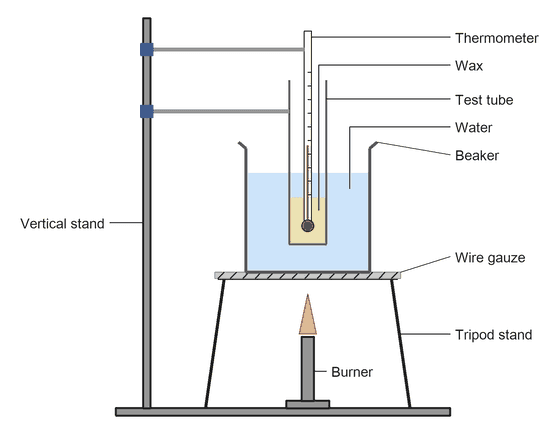
Step 2 — Set it up.
Put the wax in the test tube and clamp the tube upright so that it stands in the beaker of water (a water bath heats the wax evenly). Clamp the thermometer so that its bulb is inside the wax. Place the beaker on the wire gauze on the tripod stand.
Step 3 — Heat and record.
Heat the beaker gently with the burner and note the temperature of the wax every minute until well after all the wax has melted.
Step 4 — Read the observations.
A sample set of readings is shown below.
Time (in minute) 0 2 4 6 7 8 9 10 12 Temperature of wax (in °C) 25 35 45 55 55 55 55 60 70 The temperature rises steadily, by 5 °C every minute, up to 55 °C. It then stays at 55 °C from the 6th to the 9th minute while the wax melts, although heat is still being supplied. After all the wax has melted, it rises again by 5 °C every minute.
Step 5 — Draw the conclusion.
During melting, the wax takes in heat but its temperature does not change. The heat is used only to change the solid into a liquid. In these readings the melting point of the wax is 55 °C.
Watch out: Candle wax is a mixture, so in a real experiment its temperature stays only nearly steady (within a degree or two) while it melts; ice (0 °C) or naphthalene (80 °C) gives a sharper flat stretch.
Therefore, the experiment shows that a substance absorbs heat during melting without any change in its temperature.
- 553 marks
Question 55
Explain the terms vaporization and boiling point.
Solve with AIWritten solution
Solution:
Concept: Boiling (vaporization) is the quick change of a liquid into vapour at a fixed temperature called the boiling point, 100 °C for water at normal atmospheric pressure. Bubbles of vapour form all through the liquid. The boiling point falls when the pressure on the liquid falls.
Step 1 — Explain vaporization.
Vaporization (boiling) is the change from the liquid state to the vapour state, on heating, at a constant temperature, by taking in heat. For example, water at 100 °C takes in heat and changes into steam at 100 °C. It is quick, and it happens all through the liquid.
Step 2 — Explain boiling point.
The boiling point of a liquid is the temperature at which it changes into vapour without any further rise in temperature. Examples: water 100 °C, alcohol (ethanol) about 78 °C, ether about 35 °C.
Step 3 — Explain it with molecules.
On heating, the liquid molecules move faster and faster. At the boiling point they have enough energy to overcome the attraction of their neighbours and leave the liquid as vapour. The heat taken in at this stage separates the molecules instead of raising the temperature.
Step 4 — Note the effect of pressure.
The boiling point rises when the pressure on the liquid rises (as in a pressure cooker) and falls when the pressure falls (as on a mountain).
Therefore, vaporization is the change from liquid to vapour on heating at a constant temperature, and the boiling point is that fixed temperature.
- 564 marks
Question 56
Describe an experiment to demonstrate that water absorbs heat during boiling at a constant temperature.
Solve with AIWritten solution
Solution:
Concept: Boiling (vaporization) is the quick change of a liquid into vapour at a fixed temperature called the boiling point, 100 °C for water at normal atmospheric pressure. Bubbles of vapour form all through the liquid. The boiling point falls when the pressure on the liquid falls. So while water boils, its temperature stays constant although it keeps taking in heat.
Step 1 — Collect the apparatus.
We need a beaker of water, a thermometer, a wire gauze, a tripod stand, a burner and a stand with a clamp.

Step 2 — Set it up.
Place the beaker of water on the wire gauze on the tripod stand. Clamp the thermometer so that its bulb is in the water but does not touch the bottom of the beaker.
Step 3 — Heat and record.
Heat the beaker with the burner and note the temperature of the water every minute.
Step 4 — Read the observations.
The reading rises steadily (for example 20 °C, 30 °C, 40 °C, … every minute) until it reaches 100 °C. Then bubbles form all through the water, rise and burst at the surface, and the water changes into steam. While the water keeps boiling, the thermometer stays at 100 °C, although the burner is still supplying heat.
Step 5 — Draw the conclusion.
During boiling, water takes in heat at a constant temperature. The heat is used only to change water into steam, not to raise its temperature.
Watch out: Keep the bulb off the bottom of the beaker; the hot glass there would give a reading above that of the water.
Therefore, the experiment shows that water absorbs heat during boiling at a constant temperature of 100 °C (at normal atmospheric pressure).
- 573 marks
Question 57
Wet clothes dry more quickly on a warm dry day than on a cold humid day. Explain.
Solve with AIWritten solution
Solution:
Concept: Evaporation is faster when the temperature is higher, when the exposed surface is larger and when air moves over the surface (wind). It is slower when the air is humid, that is, when it already holds much water vapour. Volatile liquids such as alcohol, acetone and petrol evaporate faster than water.
Step 1 — See how clothes dry.
Wet clothes dry because the water in them evaporates. So they dry faster when evaporation is faster.
Step 2 — On a warm dry day.
The temperature is high, so more water molecules have enough energy to escape. The air is dry, so it can easily take in more water vapour. Evaporation is fast, and the clothes dry quickly.
Step 3 — On a cold humid day.
The temperature is low, so fewer molecules have enough energy to escape. The air already holds a lot of water vapour, so the water from the cloth cannot escape into it easily. Evaporation is slow, and the clothes take longer to dry.
Therefore, wet clothes dry more quickly on a warm dry day because both the high temperature and the dry air make evaporation faster.
- 583 marks
Question 58
Explain with an example that when a liquid evaporates, it takes heat from its surroundings.
Solve with AIWritten solution
Solution:
Concept: Evaporation is the slow change of a liquid into vapour from its surface only, at all temperatures. The escaping molecules need heat, which the liquid takes from itself and its surroundings, so evaporation produces cooling.
Step 1 — State the idea.
A liquid needs heat to change into vapour. While it evaporates it takes this heat from whatever it touches, so those surroundings become cooler.
Step 2 — Example 1: spirit on the palm.
Pour a few drops of spirit (or alcohol) on your palm. The spirit evaporates quickly, and the palm feels cold, because the spirit has taken heat from it.
Step 3 — Example 2: a thermometer wrapped in spirit-soaked cotton.
Wrap cotton soaked in spirit round the bulb of a thermometer. As the spirit evaporates, the reading falls, because the spirit takes heat from the bulb.
Therefore, an evaporating liquid takes heat from its surroundings, as spirit on the palm shows by making it feel cold.
- 593 marks
Question 59
Explain why in hot summer days water remains cool in earthen pots.
Solve with AIWritten solution
Solution:
Concept: Evaporation is the slow change of a liquid into vapour from its surface only, at all temperatures. The escaping molecules need heat, which the liquid takes from itself and its surroundings, so evaporation produces cooling.
Step 1 — Look at the pot.
An earthen pot (surahi) has very fine pores in its walls. Water slowly seeps out through them to the outer surface.
Step 2 — See what happens outside.
On hot summer days this water on the outside evaporates quickly, because the temperature is high and the air is usually dry.
Step 3 — Find where the heat comes from.
The heat needed for this evaporation is taken from the pot and the water inside it. As the water inside keeps losing heat, its temperature falls.
Step 4 — Compare with other pots.
A metal or plastic pot has no pores, so no water reaches its outer surface and it cannot cool the water in this way.
Therefore, water stays cool in an earthen pot because water seeping through its pores evaporates from the outside, taking heat from the water inside.
- 604 marks
Question 60
Describe an experiment to demonstrate the process of sublimation.
Solve with AIWritten solution
Solution:
Concept: Sublimation is the direct change of a solid into vapour on heating, without first becoming a liquid. The reverse change, vapour directly into solid on cooling, is called deposition. Camphor, naphthalene, iodine and dry ice (solid carbon dioxide) sublime.
Step 1 — Collect the apparatus.
We need powdered ammonium chloride, a china dish, a funnel, a piece of cotton, a wire mesh, a tripod stand and a burner.

Step 2 — Set it up.
Put the powdered ammonium chloride in the china dish and cover the dish with the funnel turned upside down. Plug the stem of the funnel with cotton so that the vapour cannot escape. Place the dish on the wire mesh on the tripod stand.
Step 3 — Heat and watch.
Heat the dish gently with the burner and watch the funnel.
Step 4 — Read the observations.
White fumes (vapour) rise from the dish into the funnel, and the solid in the dish never melts into a liquid. As the vapour rises it cools, and solid ammonium chloride collects on the cooler upper inner walls of the funnel.
Step 5 — Draw the conclusion.
On heating, the solid changed directly into vapour (sublimation), and on cooling the vapour changed directly back into solid (deposition), with no liquid stage.
Note: strictly, ammonium chloride does not sublime in the way camphor does. On heating it breaks up into ammonia gas and hydrogen chloride gas, and these join again into solid ammonium chloride on the cool funnel. What we see looks exactly like sublimation, so the book uses it as the example.
Therefore, the experiment demonstrates sublimation: a solid changes directly into vapour on heating and back into solid on cooling.
- 612 marks
Question 61
Some ice is taken in a beaker and its temperature is recorded after each one minute interval. The observations are listed below :
Time (in minute) Temperature (in °C) 0 0 1 0 2 0 3 0 4 0 5 0 6 3.8 7 7.6 8 11.4 From the above observations what conclusion do you draw about the melting point of ice ?
Solve with AIWritten solution
Solution:
Concept: Melting is the change from solid to liquid on heating. It happens at a fixed temperature called the melting point (0 °C for ice). Freezing is the reverse change, liquid to solid on cooling, and it happens at the same temperature. While a solid melts, its temperature stays at the melting point.
Step 1 — Read the first part of the table.
From 0 to 5 minutes the temperature stays at 0 °C, although the ice keeps taking in heat. During this time the ice is melting; the heat is used only to change ice into water, so the temperature does not rise.
Step 2 — Read the second part of the table.
After 5 minutes all the ice has melted. Now the heat raises the temperature of the water by the same amount each minute. The rise in each minute is shown below.
Step 3 — Draw the conclusion.
Ice melts at one fixed temperature, and its temperature stays constant while it melts.
Therefore, the melting point of ice is 0 °C, and the temperature stays at 0 °C until all the ice has melted.
- 622 marks
Question 62
Water in a dish evaporates faster than in a bottle. Give reason.
Solve with AIWritten solution
Solution:
Concept: Evaporation is faster when the temperature is higher, when the exposed surface is larger and when air moves over the surface (wind). It is slower when the air is humid, that is, when it already holds much water vapour. Volatile liquids such as alcohol, acetone and petrol evaporate faster than water.
Step 1 — Recall where evaporation happens.
Evaporation takes place only from the surface of a liquid. The larger the exposed surface, the more molecules can escape each second.
Step 2 — Compare the dish and the bottle.
A dish is wide and open, so its water has a large exposed surface. A bottle has a narrow mouth, so its water has a small exposed surface, and the vapour cannot easily escape through the narrow neck.
Step 3 — Decide.
More surface means faster evaporation, so the water in the dish evaporates faster.
Therefore, water in a dish evaporates faster than in a bottle because the dish gives the water a much larger exposed surface.
- 633 marks
Question 63
A certain quantity of water is heated from 20°C to 100°C. Its temperature is recorded after each 1 minute. The observations are :
Time (in minute) Temperature (in °C) 0 20 1 30 2 40 3 50 4 60 5 70 6 80 7 90 8 100 9 100 10 100 11 100 12 100 What conclusion do you draw from the above table about the boiling point of water ? Explain.
Solve with AIWritten solution
Solution:
Concept: Boiling (vaporization) is the quick change of a liquid into vapour at a fixed temperature called the boiling point, 100 °C for water at normal atmospheric pressure. Bubbles of vapour form all through the liquid. The boiling point falls when the pressure on the liquid falls. While a liquid boils, its temperature stays at the boiling point.
Step 1 — Read the first part of the table.
From 0 to 8 minutes the temperature rises steadily from 20 °C to 100 °C. The rise in each minute is shown below.
In this stage the heat supplied raises the temperature of the water.
Step 2 — Read the second part of the table.
From 8 to 12 minutes the temperature stays at 100 °C, although heat is still being supplied. During this time the water is boiling and changing into steam.
Step 3 — Explain the flat part.
At 100 °C the heat taken in is not used to raise the temperature. It is used to change water into steam, by separating the molecules against their attraction. So the temperature stays constant while the water boils.
Therefore, water boils at a fixed temperature of 100 °C (at normal atmospheric pressure), and its temperature does not change while it boils.
- 642 marks
Question 64
A patient suffering from high fever is advised to put wet cloth strips on his forehead. Why ?
Solve with AIWritten solution
Solution:
Concept: Evaporation is the slow change of a liquid into vapour from its surface only, at all temperatures. The escaping molecules need heat, which the liquid takes from itself and its surroundings, so evaporation produces cooling.
Step 1 — See what happens to the wet strips.
The water in the wet cloth strips evaporates from the warm forehead.
Step 2 — Find where the heat comes from.
Evaporation needs heat, and the water takes this heat from the patient's forehead and body.
Step 3 — See the result.
As heat is taken away, the body temperature falls, which helps to bring the fever down.
Watch out: Use ordinary tap water, not ice-cold water; very cold water makes the skin's blood vessels narrow and can cause shivering, which slows the cooling.
Therefore, wet cloth strips are put on the forehead because the evaporating water takes heat from the body and lowers its temperature.
- 652 marks
Question 65
When we put some acetone or petrol on our palm, it feels cold. Give reason.
Solve with AIWritten solution
Solution:
Concept: Evaporation is the slow change of a liquid into vapour from its surface only, at all temperatures. The escaping molecules need heat, which the liquid takes from itself and its surroundings, so evaporation produces cooling.
Step 1 — Recall what acetone and petrol are like.
Acetone and petrol are volatile liquids: they evaporate very quickly, even at room temperature.
Step 2 — Find where the heat comes from.
To evaporate, they need heat, which they take from the palm.
Step 3 — See the result.
As the palm loses heat quickly, its temperature falls, so it feels cold.
Therefore, acetone or petrol feels cold on the palm because it evaporates quickly and takes heat from the palm.
- 663 marks
Question 66
On a humid day, you sweat more and feel less cool in comparison to a breezy day where sweating makes you feel much cooler. Give reason.
Solve with AIWritten solution
Solution:
Concept: Evaporation is faster when the temperature is higher, when the exposed surface is larger and when air moves over the surface (wind). It is slower when the air is humid, that is, when it already holds much water vapour. Volatile liquids such as alcohol, acetone and petrol evaporate faster than water.
Step 1 — Recall how sweat cools us.
Sweat cools the body only when it evaporates, because evaporation takes heat from the skin. Sweat that just stays on the skin or drips off does not cool us much.
Step 2 — On a humid day.
The air already holds a lot of water vapour, so the sweat evaporates slowly. It collects on the skin, so we seem to sweat more, but little of it evaporates. Little heat is taken from the body, so we feel less cool.
Step 3 — On a breezy day.
The moving air keeps carrying the vapour away from the skin, and drier air takes its place. The sweat evaporates quickly and takes a lot of heat from the body, so we feel much cooler.
Therefore, we feel less cool on a humid day because sweat evaporates slowly in humid air, and much cooler on a breezy day because moving air makes it evaporate quickly.
What Class 8 Physics Ch 1 covers
The sections of the chapter, in the order the book takes them. Every question above comes from one of these.
- 01Characteristics of Molecules
- 02States of Matter
- 03Molecular Model of Solids
- 04Molecular Model of Liquids
- 05Molecular Model of Gases
- 06Change of State
More ways to study this chapter
The same chapter asked three other ways. Practise it, revise it, and see what the board has set on Ch 1 before.
Class 8 Physics Ch 1 questions students ask
How many questions are there in Class 8 Physics Ch 1?
66 questions. Every one is solved step by step on this page.
Are these Class 8 Physics solutions free?
Yes. Every question and its full working is free to read, with no account needed.
Can I download the Class 8 Physics Ch 1 solutions as a PDF?
There is no PDF to download. Every solution is on this page instead, which means it is searchable, always the current syllabus, and readable on a phone. Use your browser's print option if you want it on paper.