
Opening your dashboard
Class 8 Physics Chapter 1 Matter: Practice Questions
46 questions on Chapter 1, each worked through on its own page with the AI tutor. Class 8 Physics, ICSE 2026-27.
46 questions
1–5 marks · Mixed difficulty
- 11 mark
Question 1
Bloom's level: Remember
The size of a molecule is nearly :
- 21 mark
Question 2
Bloom's level: Remember
The force of attraction between the molecules of two different substances, such as water and glass, is called :
- 31 mark
Question 3
Bloom's level: Understand
When milk is poured from a jug into a glass, its shape changes but its volume stays the same. This is because the molecules of a liquid :
- 41 mark
Question 4
Bloom's level: Apply
The melting point of copper is 1085°C. In a factory, molten copper at 1200°C is poured into a mould and left to cool. The copper starts to become solid at :
- 51 mark
Question 5
Bloom's level: Apply
Four identical wet towels are dried in four different ways. Which towel will dry the fastest ?
- 61 mark
Question 6
Bloom's level: Analyse
A colourless liquid is heated steadily in a water bath. Its temperature, recorded every minute, is :
Time (in minute) 0 1 2 3 4 5 6 Temperature (in °C) 30 45 60 72 78 78 78 Bubbles form all through the liquid from the 4th minute. Using the boiling points in your book (water 100°C, alcohol 78.3°C, ether 35°C), what can you conclude ?
- 71 mark
Question 7
Bloom's level: Analyse
The figure shows the arrangement of molecules in three substances P, Q and R.
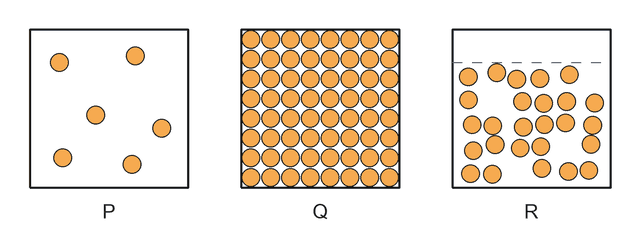
Which statement is correct ?
- 81 mark
Question 8
Bloom's level: Evaluate
After rain, a puddle on a road disappears by the afternoon although the temperature of the day is only 32°C. Riya says, "The puddle disappeared because the sun made the water boil." Which is the best judgement of Riya's statement ?
- 91 mark
Question 9
Bloom's level: Understand
A piece of dry ice (solid carbon dioxide) kept on a tray at room temperature slowly disappears, but the tray stays dry. This is because the dry ice :
- 101 mark
Question 10
Bloom's level: Understand
Read the Assertion (A) and the Reason (R) and choose the correct option.
Assertion (A): The temperature of ice remains at 0°C while it is melting, although it keeps absorbing heat.
Reason (R): The heat absorbed during melting is used in increasing the separation between the molecules (their potential energy), not their kinetic energy.
- 111 mark
Question 11
Bloom's level: Remember
Read the Assertion (A) and the Reason (R) and choose the correct option.
Assertion (A): Steam at 100°C condenses into water only at a temperature below 100°C.
Reason (R): The amount of heat rejected when vapour changes into liquid is the same as the heat absorbed when the same mass of liquid changes into vapour.
- 121 mark
Question 12
Bloom's level: Understand
Read the Assertion (A) and the Reason (R) and choose the correct option.
Assertion (A): A gas has neither a definite shape nor a definite volume.
Reason (R): The inter-molecular forces of attraction in a gas are very strong.
- 132 marks
Question 13
Bloom's level: Remember
What is latent heat ? Why is it also called hidden heat ?
- 142 marks
Question 14
Bloom's level: Understand
Say whether each of the following is due to the force of cohesion or the force of adhesion. Give a reason for each.
(a) Raindrops stick to a glass window.
(b) It is difficult to break a piece of coal into tiny particles.
(c) Glue holds two sheets of paper together.
(d) A small drop of mercury on a table stays together as a round ball.
- 152 marks
Question 15
Bloom's level: Apply
(a) A molecule is about m in size. How many such molecules, placed side by side in a straight line, would make a row 1 mm long ?
(b) The inter-molecular force acts only up to a separation of m. In a gas, molecules are on average about m apart. Is there an appreciable force of attraction between them ? What does this explain about gases ?
- 162 marks
Question 16
Bloom's level: Understand
A steel spoon kept in a drawer for a year still has the same shape and size. Explain this on the basis of the molecular model of solids.
- 172 marks
Question 17
Bloom's level: Understand
Liquids can flow but solids cannot. Explain why, using the molecular model.
- 182 marks
Question 18
Bloom's level: Apply
Use the table in your book: heat absorbed during melting is J for every kg of ice and J for every kg of wax. Find the heat needed to melt completely
(a) 2 kg of ice at 0°C,
(b) 500 g of wax at 55°C.
- 192 marks
Question 19
Bloom's level: Apply
Common salt is made from sea water in shallow, wide pans on the sea coast, mostly during the hot, dry months. Explain both choices.
- 202 marks
Question 20
Bloom's level: Evaluate
Water is boiling in an open pan of rice. Aman says, "If I turn the flame up higher, the water will become hotter than 100°C and the rice will cook much faster." Is Aman right ? Justify your answer.
- 212 marks
Question 21
Bloom's level: Apply
A few crystals of iodine are heated gently in a beaker covered with a watch glass that has some ice on it. Violet vapour fills the beaker and, after some time, shiny crystals appear on the underside of the watch glass. No liquid is seen at any time.
(a) Name the change at the bottom of the beaker and the change on the watch glass.
(b) Why is ice kept on the watch glass ?
- 222 marks
Question 22
Bloom's level: Analyse
The smell of hot food being cooked in the kitchen reaches the next room within seconds, but the smell of the same food when it is cold is hardly noticed. What do these observations tell us about the molecules of the food vapour ?
- 233 marks
Question 23
Bloom's level: Apply
The table gives the melting and boiling points of four substances.
Substance Melting point Boiling point Wax 55°C (not needed) Ether -116°C 35°C Water 0°C 100°C Copper 1085°C 2562°C (a) State whether each substance is a solid, a liquid or a gas at 30°C.
(b) State the state of each substance at 60°C.
(c) Which substances change state when warmed from 30°C to 60°C ? Name each change.
- 245 marks
Question 24
Bloom's level: Analyse
A solid X is heated steadily and its temperature is recorded every minute. The graph shows the result.
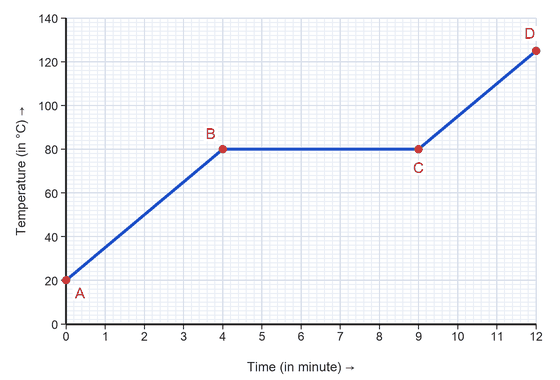
(a) In which state is X along AB, along BC and along CD ?
(b) What is the melting point of X ? Using the table of melting points in your book (ice 0°C, wax 55°C, naphthalene 80°C, copper 1085°C), name X.
(c) How long does X take to melt completely ?
(d) Heat is supplied all the time, yet the temperature does not rise along BC. Explain this using the molecular model.
(e) If liquid X at 125°C is allowed to cool, at what temperature will it start to become solid, and what will happen to its temperature while it is becoming solid ?
- 254 marks
Question 25
Bloom's level: Apply
Case study: After the classroom floor is mopped, the class teacher switches on the ceiling fans. Within ten minutes the floor is dry, but a little water that collected in a small dent in the floor takes much longer to dry. Students walking barefoot on the wet floor say that it feels cool.
(a) Name the process by which the floor dries. Does the water boil ?
(b) Why does the floor dry faster when the fans are on ?
(c) Explain why the water in the dent takes longer to dry, and why the wet floor feels cool to bare feet.
- 264 marks
Question 26
Bloom's level: Apply
Case study: Tenzing lives in Leh, a town high in the mountains, where water in an open pan boils at about 88°C. His cousin lives in Chennai, by the sea, where water boils at 100°C.
(a) In whose house will dal take longer to cook in an open pan ? Give a reason.
(b) Why does water boil at a lower temperature in Leh ?
(c) Tenzing's mother uses a pressure cooker. Explain how it helps. She also adds salt to the water; what effect does this have on the boiling point ?
- 274 marks
Question 27
Bloom's level: Analyse
Two identical wide dishes A and B each contain 50 mL of water. Dish A is kept in the sun (air at 35°C) and dish B in the shade (air at 25°C). The volume of water left is measured every hour.
Time (in hour) 0 1 2 3 Water left in A (in mL) 50 42 34 26 Water left in B (in mL) 50 46 42 38 (a) Find the volume of water that evaporates from each dish every hour.
(b) Which factor affecting the rate of evaporation does this experiment test ? What is your conclusion ? Why was it important to use identical dishes and equal amounts of water ?
(c) If the rate stays the same, after how long will dish A become empty ? How much water will dish B still have at that time ?
- 284 marks
Question 28
Bloom's level: Evaluate
A student prepared this table on changes of state. Check every row. State whether the name and the heat entries are correct, and correct any mistake.
Change Name written Heat written Solid → Liquid Melting Rejected Liquid → Gas Condensation Absorbed Gas → Liquid Condensation Rejected Liquid → Solid Freezing Absorbed Solid → Gas Deposition Absorbed Gas → Solid Sublimation Rejected Finally, write one simple rule that tells whether heat is absorbed or rejected in a change of state.
- 295 marks
Question 29
Bloom's level: Create
You are given a mixture of common salt and ammonium chloride powder. Common salt does not sublime, but ammonium chloride does. Design a simple experiment to get back the ammonium chloride separately from the mixture. Include :
(a) the apparatus you will use and how you will arrange it,
(b) the steps you will follow,
(c) what you expect to see and where each substance will be at the end,
(d) one safety precaution.
- 304 marks
Question 30
Bloom's level: Create
Case study: Your teacher asks a group of 16 students to act out the states of matter in the playground, with each student playing one molecule. The students may hold hands, stand still, sway, walk or run.
(a) Plan how the group should act out a solid. Say how close the students stand, whether they hold hands, and how they move.
(b) Plan how the group should change its acting to show the solid melting into a liquid, and then how the liquid should move.
(c) Plan how to show the liquid boiling into a gas. Suggest a signal the teacher can use to stand for 'supplying heat', and explain what the signal does to the 'molecules'.
- 311 mark
Question 31
A gas completely fills any vessel in which it is kept, because its molecules :
- 321 mark
Question 32
Which of the following pairs contains only substances that sublime on heating ?
- 331 mark
Question 33
Water is boiling in an open pan at 100°C and the burner is kept on. The heat supplied by the burner during boiling is used :
- 341 mark
Question 34
Fill in the blank :
The force of attraction between the molecules of the same substance is called the force of ...............
- 351 mark
Question 35
Write true or false :
The temperature at which ice melts is lower than the temperature at which water freezes.
- 362 marks
Question 36
Give a reason for each of the following, on the basis of the molecular model :
(a) A liquid has a definite volume.
(b) A liquid does not have a definite shape.
- 372 marks
Question 37
Name the change of state taking place in each of the following cases. In each case state whether heat is absorbed or given out by the substance.
(a) Liquid ghee kept in a refrigerator becomes hard.
(b) Tiny drops of water appear on the outer surface of a steel glass filled with ice-cold water.
- 384 marks
Question 38
(a) Draw neat diagrams to show the arrangement of molecules in a solid, a liquid and a gas.
(b) Compare the three states of matter in the form of a table under the following heads : inter-molecular space, inter-molecular force of attraction, shape and volume.
- 395 marks
Question 39
Some crushed ice at 0°C is taken in a beaker and heated steadily on a burner. The temperature of the contents of the beaker is noted after every 2 minutes. The readings are given below :
Time (in minute) 0 2 4 6 8 10 12 14 16 18 Temperature (in °C) 0 0 0 25 50 75 100 100 100 100 (a) From the table, write (i) the melting point of ice, (ii) the boiling point of water.
(b) Heat is being supplied all the time, yet the temperature does not rise during the first 4 minutes. Explain why.
(c) (i) What does the beaker contain at the end of 8 minutes ? (ii) By how many °C does the temperature rise in each minute between 4 minutes and 12 minutes ?
- 404 marks
Question 40
(a) What is evaporation ?
(b) State two differences between evaporation and boiling.
(c) A wet handkerchief dries sooner when it is spread out than when it is kept folded. Give a reason.
- 411 mark
Question 41
Fill in the blank :
The force of attraction between the molecules of the same substance is called ........
- 421 mark
Question 42
Give a reason for the following :
A gas can be easily compressed.
- 433 marks
Question 43
Give any six characteristics of matter and its constituent particles.
- 441 mark
Question 44
Match with the correct option from Column B :
Column A : Latent heat of fusion of ice
Column B : (1) m s (2) Aryabhata (3) Attraction (4) Dispersion (5) 336000 J kg (6) Repulsion (7) 300000 m s
- 451 mark
Question 45
Give a reason for the following :
An ice cube is used for cooling a drink.
- 462 marks
Question 46
State what is meant by the 'specific latent heat of fusion' of a substance.
Also calculate the specific latent heat of fusion of ice, if 200 g of ice at 0°C is converted into water at 0°C by supplying 67200 J of heat.