
Question 544 marksMedium
Describe an experiment to demonstrate that a substance absorbs heat during melting without change in its temperature.
Confirming your payment
Sign up now and get 250 free tokens.
Matter · Question 54 of 66
Describe an experiment to demonstrate that a substance absorbs heat during melting without change in its temperature.
Solution:
Concept: Melting is the change from solid to liquid on heating. It happens at a fixed temperature called the melting point (0 °C for ice). Freezing is the reverse change, liquid to solid on cooling, and it happens at the same temperature. So while a solid melts, its temperature stays constant although it keeps taking in heat.
Step 1 — Collect the apparatus.
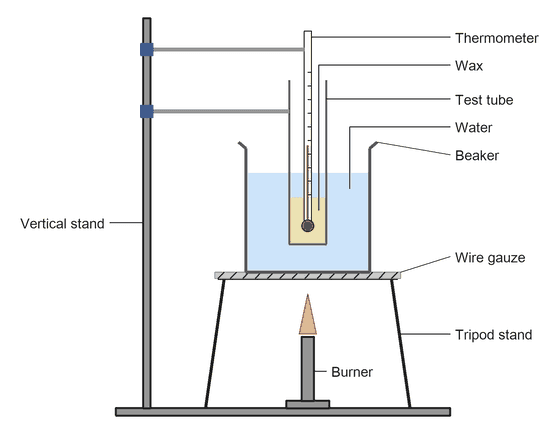
We need a test tube with some wax, a thermometer, a beaker of water, a wire gauze, a tripod stand, a burner and a stand with clamps.
Step 2 — Set it up.
Put the wax in the test tube and clamp the tube upright so that it stands in the beaker of water (a water bath heats the wax evenly). Clamp the thermometer so that its bulb is inside the wax. Place the beaker on the wire gauze on the tripod stand.
Step 3 — Heat and record.
Heat the beaker gently with the burner and note the temperature of the wax every minute until well after all the wax has melted.
Step 4 — Read the observations.
A sample set of readings is shown below.
| Time (in minute) | 0 | 2 | 4 | 6 | 7 | 8 | 9 | 10 | 12 |
|---|---|---|---|---|---|---|---|---|---|
| Temperature of wax (in °C) | 25 | 35 | 45 | 55 | 55 | 55 | 55 | 60 | 70 |
The temperature rises steadily, by 5 °C every minute, up to 55 °C. It then stays at 55 °C from the 6th to the 9th minute while the wax melts, although heat is still being supplied. After all the wax has melted, it rises again by 5 °C every minute.
Step 5 — Draw the conclusion.
During melting, the wax takes in heat but its temperature does not change. The heat is used only to change the solid into a liquid. In these readings the melting point of the wax is 55 °C.
Watch out: Candle wax is a mixture, so in a real experiment its temperature stays only nearly steady (within a degree or two) while it melts; ice (0 °C) or naphthalene (80 °C) gives a sharper flat stretch.
Therefore, the experiment shows that a substance absorbs heat during melting without any change in its temperature.