
Opening your dashboard
Class 8 Maths Chapter 22: Area of a Trapezium and a Polygon Solutions
94 textbook questions with step-by-step answers, free to read, for ICSE 2026-27.
Get talked through Ch 22, not just shown the answer
Reading a finished solution is not the same as being able to do it. The AI tutor takes one question at a time and works it with you, in your own words, until you can.
- Ask it out loud, in your own words
- It gives you the next step, not the answer
- Stuck on part (ii)? Start there
94 questions with solutions
1–3 marks · Mixed difficulty
The first 33 solutions are on this page. This chapter is a long one, so the rest open on their own page to keep this one quick to load.
- 11 mark
Question 1
Two sides of a triangle are 12 cm and 15 cm. If the height of the triangle corresponding to 12 cm side is 10 cm, then the height of the triangle corresponding to 15 cm side is :
Solve with AIAnswer
(A) 4 cm
(B) 12 cm
- Correct
(C) 8 cm
(D) 16 cm
Answer: (C) 8 cm
Concept: The area of a triangle is , where the height (altitude) is the perpendicular distance from the opposite vertex to the line of that base.
Step 1 — Find the area.
The height on the 12 cm side is 10 cm, so we use these two together.
Step 2 — Use the 15 cm side.
The area does not change when we take another side as the base. Let cm be the height on the 15 cm side.
Watch out: Keep the ½ on both sides of the comparison: the same triangle has the same area whichever side is the base.
Why the other options are wrong:
- (A) 4 cm: 4 cm comes from 15 × h = 60, which drops the ½; with h = 4 the area would be only 30 cm².
- (B) 12 cm: With a height of 12 cm on the 15 cm side the area would be 90 cm², not 60 cm².
- (D) 16 cm: With a height of 16 cm on the 15 cm side the area would be 120 cm², twice the true area.
Therefore, the height on the 15 cm side is 8 cm, option (C).
- 21 mark
Question 2
The base of a right-angled triangle is 8 cm and its hypotenuse is 10 cm. The area of the triangle is :
Solve with AIAnswer
(A) 80 cm²
(B) 40 cm²
(C) 48 cm²
- Correct
(D) 24 cm²
Answer: (D) 24 cm²
Concept: In a right-angled triangle, the two sides that make the right angle are perpendicular, so one is the base and the other is the height.
So its area is .
By Pythagoras' theorem, .
Step 1 — Find the height.
The base 8 cm and the height are the two sides that make the right angle, and 10 cm is the hypotenuse. So Pythagoras' theorem gives the height.
Step 2 — Find the area.
We take half of base times height.
Watch out: The hypotenuse is not a height; the height is the other side of the right angle.
Why the other options are wrong:
- (A) 80 cm²: 80 cm² is 8 × 10: it uses the hypotenuse as the height and also drops the ½.
- (B) 40 cm²: 40 cm² is ½ × 8 × 10: it uses the hypotenuse as the height.
- (C) 48 cm²: 48 cm² is 8 × 6: the height is right, but the ½ is missing.
Therefore, the area of the triangle is 24 cm², option (D).
- 31 mark
Question 3
The area of a triangle with sides 4 cm, 3 cm and 5 cm is :
Solve with AIAnswer
(A) 12 cm²
(B) 15 cm²
(C) 10 cm²
- Correct
(D) 6 cm²
Answer: (D) 6 cm²
Concept: In a right-angled triangle, the two sides that make the right angle are perpendicular, so one is the base and the other is the height.
So its area is .
By Pythagoras' theorem, .
Step 1 — Check for a right angle.
The longest side is 5 cm, and the squares of the other two sides add up to its square.
Since too, the triangle is right-angled, with legs 3 cm and 4 cm.
Step 2 — Find the area.
The two legs are base and height.
Watch out: Only the two sides that make the right angle are base and height; the 5 cm side is the hypotenuse.
Why the other options are wrong:
- (A) 12 cm²: 12 cm² is 3 × 4, the product of the legs without the ½.
- (B) 15 cm²: 15 cm² is 3 × 5, which uses the hypotenuse and drops the ½.
- (C) 10 cm²: 10 cm² is ½ × 4 × 5, which uses the hypotenuse as the height.
Therefore, the area of the triangle is 6 cm², option (D).
- 41 mark
Question 4
The altitude of an isosceles triangle is 4 cm and its base is 2 cm more than its height. The area of the triangle is :
Solve with AIAnswer
(A) 24 cm²
- Correct
(B) 12 cm²
(C) 16 cm²
(D) 8 cm²
Answer: (B) 12 cm²
Concept: The area of a triangle is , where the height (altitude) is the perpendicular distance from the opposite vertex to the line of that base.
Step 1 — Find the base.
The base is 2 cm more than the height of 4 cm.
Step 2 — Find the area.
The altitude to the base is the height.
Watch out: The base is 4 + 2 = 6 cm, not 2 cm and not 4 cm.
Why the other options are wrong:
- (A) 24 cm²: 24 cm² is 6 × 4, with the ½ left out.
- (C) 16 cm²: 16 cm² is 4 × 4, which uses the height in place of the base and drops the ½.
- (D) 8 cm²: 8 cm² is ½ × 4 × 4, which uses the height in place of the 6 cm base.
Therefore, the area of the triangle is 12 cm², option (B).
- 51 mark
Question 5
Area of an equilateral triangle with each side 6 cm is :
Solve with AIAnswer
(A) cm²
- Correct
(B) cm²
(C) cm²
(D) cm²
Answer: (B) cm²
Concept: For an equilateral triangle of side , the area is and the height is . Both come from Pythagoras' theorem, because the altitude bisects the base.
Step 1 — Use the equilateral-triangle formula.
Each side is 6 cm, so we put in .
Watch out: Square the side first, then divide by 4.
Why the other options are wrong:
- (A) cm²: is : the division by 4 is missing.
- (C) cm²: divides by 2 instead of 4.
- (D) cm²: divides by 3 instead of 4.
Therefore, the area is cm², option (B).
- 63 marks
Question 6
Find the area of of a triangle whose sides are:
10 cm, 24 cm and 26 cm
Solve with AIWritten solution
Solution:
Concept: Heron's formula: for a triangle with sides , , and semi-perimeter , the area is . It needs only the three sides.
Given: Sides 10 cm, 24 cm and 26 cm.
Step 1 — Find the semi-perimeter.
We add the three sides and halve the sum.
Step 2 — Use Heron's formula.
We put s = 30 and the sides 10, 24 and 26 into the formula.
Step 3 — Check.
The squares of the two shorter sides add up to the square of the longest side, so the triangle is right-angled with legs 10 cm and 24 cm.
Watch out: S is HALF the perimeter (30 cm), not the whole perimeter.
Therefore, the area of the triangle is 120 cm².
- 73 marks
Question 7
Two sides of a triangle are 6 cm and 8 cm. If the height of the triangle corresponding to 6 cm side is 4 cm; find :
(i) area of the triangle
(ii) height of the triangle corresponding to 8 cm side.
Solve with AIWritten solution
Solution:
Concept: The area of a triangle is , where the height (altitude) is the perpendicular distance from the opposite vertex to the line of that base.
Given: Sides 6 cm and 8 cm; height on the 6 cm side = 4 cm.
Step 1 — Part (i): find the area.
The height on the 6 cm side is 4 cm.
Step 2 — Part (ii): find the other height.
The same area must come from the 8 cm side. Let its height be cm.
Watch out: Each height goes with its own base; the 4 cm height belongs to the 6 cm side.
Therefore, (i) area = 12 cm²; (ii) height on the 8 cm side = 3 cm.
- 83 marks
Question 8
The sides of a triangle are 16 cm, 12 cm and 20 cm. Find :
(i) area of the triangle
(ii) height of the triangle corresponding to the largest side
(iii) height of the triangle corresponding to the smallest side.
Solve with AIWritten solution
Solution:
Concept: In a right-angled triangle, the two sides that make the right angle are perpendicular, so one is the base and the other is the height.
So its area is .
By Pythagoras' theorem, .
Given: Sides 16 cm, 12 cm and 20 cm.
Step 1 — Check for a right angle.
The longest side is 20 cm.
Since as well, the triangle is right-angled, with legs 12 cm and 16 cm.
Step 2 — Part (i): find the area.
The two legs are base and height.
Step 3 — Part (ii): height on the largest side.
Let cm be the height on the 20 cm side.
Step 4 — Part (iii): height on the smallest side.
Let cm be the height on the 12 cm side.
This is the other leg, 16 cm, as it should be in a right-angled triangle.
Watch out: The height on the hypotenuse is shorter than both legs.
Therefore, (i) area = 96 cm²; (ii) 9.6 cm; (iii) 16 cm.
- 93 marks
Question 9
The base and the height of a triangle are in the ratio 4 : 5. If the area of the triangle is 40 m², find its base and height.
Solve with AIWritten solution
Solution:
Concept: The area of a triangle is , where the height (altitude) is the perpendicular distance from the opposite vertex to the line of that base.
Given: Base : height = 4 : 5; area = 40 m².
Step 1 — Write the base and height.
The ratio is 4 : 5, so we let the base be m and the height m.
Step 2 — Use the area.
Half of base times height is 40 m².
We take , because a length cannot be negative.
Step 3 — Find the lengths.
We multiply back.
Watch out: After finding x, multiply back to get the base and the height.
Therefore, the base is 8 m and the height is 10 m.
- 103 marks
Question 10
The base and the height of a triangle are in the ratio 5 : 3. If the area of the triangle is 67·5 m²; find its base and height.
Solve with AIWritten solution
Solution:
Concept: The area of a triangle is , where the height (altitude) is the perpendicular distance from the opposite vertex to the line of that base.
Given: Base : height = 5 : 3; area = 67.5 m².
Step 1 — Write the base and height.
The ratio is 5 : 3, so we let the base be m and the height m.
Step 2 — Use the area.
Half of base times height is 67.5 m².
We take , because a length cannot be negative.
Step 3 — Find the lengths.
We multiply back.
Watch out: Half of 5x × 3x is 7.5x², not 15x².
Therefore, the base is 15 m and the height is 9 m.
- 113 marks
Question 11
The area of an equilateral triangle is cm²; find its perimeter.
Solve with AIWritten solution
Solution:
Concept: For an equilateral triangle of side , the area is and the height is . Both come from Pythagoras' theorem, because the altitude bisects the base.
Given: Area = cm².
Step 1 — Find the side.
Let the side be cm. We set the area formula equal to the given area.
Here stands for the side , so cm.
Step 2 — Find the perimeter.
An equilateral triangle has three equal sides.
Watch out: The cancels on both sides; then multiply by 4 before taking the square root.
Therefore, the perimeter is 72 cm.
- 123 marks
Question 12
The area of an equilateral triangle is numerically equal to its perimeter. Find its perimeter correct to 2 decimal places.
Solve with AIWritten solution
Solution:
Concept: For an equilateral triangle of side , the area is and the height is . Both come from Pythagoras' theorem, because the altitude bisects the base.
Given: Area and perimeter are equal in number.
Step 1 — Form the equation.
Let the side be units. The area equals the perimeter in number.
Here stands for , and we divided by because a side is not 0.
Step 2 — Find the perimeter.
The perimeter is three sides.
Watch out: Divide both sides by a (a ≠ 0) instead of expanding; round only at the end.
Therefore, the perimeter is ≈ 20.78 units.
- 133 marks
Question 13
A field is in the shape of a quadrilateral ABCD in which side AB = 18 m, side AD = 24 m, side BC = 40 m, DC = 50 m and angle A = 90°.

Find the area of the field.
Solve with AIWritten solution
Solution:
Concept: In a right-angled triangle, the two sides that make the right angle are perpendicular, so one is the base and the other is the height.
So its area is .
By Pythagoras' theorem, .
Given: AB = 18 m, AD = 24 m, BC = 40 m, DC = 50 m, ∠A = 90°.
Step 1 — Split the field.
Join the diagonal BD. It divides ABCD into triangle ABD (right-angled at A) and triangle BCD.
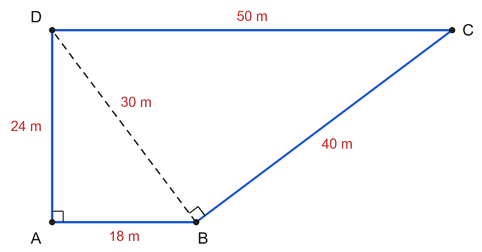
Step 2 — Find BD.
Triangle ABD has legs AB = 18 m and AD = 24 m.
Step 3 — Area of triangle ABD.
The legs are base and height.
Step 4 — Triangle BCD is right-angled.
Its sides are BD = 30 m, BC = 40 m and DC = 50 m, and the squares of the two shorter sides add up to the square of the longest.
Since , ∠DBC = 90°.
Step 5 — Area of triangle BCD.
Its legs BD and BC are base and height.
Step 6 — Area of the field.
We add the two triangles.
Watch out: Check whether the second triangle is right-angled before using ½ × base × height.
Therefore, the area of the field is 816 m².
- 143 marks
Question 14
The lengths of the sides of a triangle are in the ratio 4 : 5 : 3 and its perimeter is 96 cm. Find its area.
Solve with AIWritten solution
Solution:
Concept: In a right-angled triangle, the two sides that make the right angle are perpendicular, so one is the base and the other is the height.
So its area is .
By Pythagoras' theorem, .
Given: Sides in the ratio 4 : 5 : 3, perimeter 96 cm.
Step 1 — Find the sides.
The sides are in the ratio 4 : 5 : 3, so we write them as , and cm and add them to get the perimeter.
So the sides are 32 cm, 40 cm and 24 cm.
Step 2 — Check for a right angle.
The longest side is 40 cm.
Since , the triangle is right-angled with legs 24 cm and 32 cm.
Step 3 — Find the area.
The legs are base and height.
Watch out: Heron's formula (s = 48) gives the same 384 cm²; spotting the right angle is quicker.
Therefore, the area of the triangle is 384 cm².
- 153 marks
Question 15
One of the equal sides of an isosceles triangle is 13 cm and its perimeter is 50 cm. Find the area of the triangle.
Solve with AIWritten solution
Solution:
Concept: In an isosceles triangle, the altitude drawn to the base bisects the base. So half the base, the height and one equal side form a right-angled triangle, and Pythagoras' theorem links them.
Given: Equal sides 13 cm each; perimeter 50 cm.
Step 1 — Find the base.
The perimeter is the two equal sides plus the base.
Step 2 — Find the height.
The altitude bisects the base, so half the base (12 cm), the altitude and a 13 cm side form a right-angled triangle.
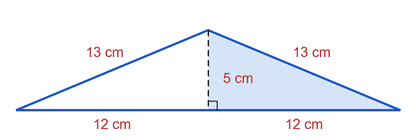
Step 3 — Find the area.
We take half of base times height.
Watch out: Use HALF the base (12 cm) in Pythagoras' theorem, but the whole base (24 cm) in the area.
Therefore, the area of the triangle is 60 cm².
- 163 marks
Question 16
The altitude and the base of a triangular field are in the ratio 6 : 5. If its cost is ₹ 49,57,200 at the rate of ₹ 36,720 per hectare and 1 hectare = 10,000 sq. m, find (in metre) the dimensions of the field.
Solve with AIWritten solution
Solution:
Concept: The area of a triangle is , where the height (altitude) is the perpendicular distance from the opposite vertex to the line of that base.
Given: Cost ₹ 49,57,200 at ₹ 36,720 per hectare; altitude : base = 6 : 5.
Step 1 — Find the area in hectares.
The total cost divided by the cost of one hectare gives the number of hectares.
Step 2 — Change to square metres.
One hectare is 10000 m².
Step 3 — Use the ratio.
The altitude and base are in the ratio 6 : 5, so let them be m and m.
Step 4 — Find the dimensions.
We multiply back.
Watch out: Change hectares into square metres before using the area formula.
Therefore, the altitude is 1800 m and the base is 1500 m.
- 173 marks
Question 17
Find the area of the right-angled triangle with hypotenuse 40 cm and one of the other two sides 24 cm.
Solve with AIWritten solution
Solution:
Concept: In a right-angled triangle, the two sides that make the right angle are perpendicular, so one is the base and the other is the height.
So its area is .
By Pythagoras' theorem, .
Given: Hypotenuse 40 cm, one side 24 cm.
Step 1 — Find the third side.
The hypotenuse is 40 cm and one leg is 24 cm, so Pythagoras' theorem gives the other leg.
Step 2 — Find the area.
The two legs are base and height.
Watch out: The hypotenuse is not a height; use the two legs.
Therefore, the area of the triangle is 384 cm².
- 183 marks
Question 18
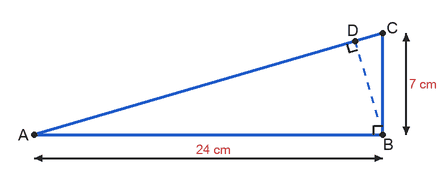
Use the information given in the given figure to find :
(i) the length of AC.
(ii) the area of Δ ABC.
(iii) the length of BD, correct to one decimal place.
 Solve with AI
Written solution
Solution:
Concept: In a right-angled triangle, the two sides that make the right angle are perpendicular, so one is the base and the other is the height.
So its area is .
By Pythagoras' theorem, .
Given: ∠B = 90°, AB = 24 cm, BC = 7 cm, BD ⊥ AC.
Step 1 — Part (i): find AC.
∠B = 90°, so AC is the hypotenuse of triangle ABC.
Step 2 — Part (ii): find the area.
The legs AB and BC are base and height.
Step 3 — Part (iii): find BD.
BD ⊥ AC, so BD is the height on the base AC, and the same area gives BD. Let BD be cm.
Correct to one decimal place, BD = 6.7 cm.
Watch out: BD is the height on AC, so pair it with AC (25 cm), not with AB.
Therefore, (i) AC = 25 cm; (ii) area = 84 cm²; (iii) BD = 6.7 cm (correct to one decimal place).
- 191 mark
Question 19
The length and the breadth of a rectangle are in the ratio 9 : 5. If its area is 180 m²; the length (longest side) of the rectangle is :
Solve with AIAnswer
(A) 36 m
(B) 20 m
(C) 10 m
- Correct
(D) 18 m
Answer: (D) 18 m
Concept: A rectangle of length and breadth has area .
Its perimeter is .
A square of side has area and perimeter .
Step 1 — Write the sides.
The ratio is 9 : 5, so the length is m and the breadth m.
Step 2 — Use the area.
Length times breadth is 180 m².
Step 3 — Find the length.
We multiply back.
Watch out: X is not the length; the length is 9x.
Why the other options are wrong:
- (A) 36 m: A length of 36 m would need x = 4, and then the area would be 36 × 20 = 720 m².
- (B) 20 m: If the length were 20 m, the breadth would be 20 × 5/9 ≈ 11.1 m and the area about 222 m², not 180 m².
- (C) 10 m: 10 m is the breadth, 5x, not the length.
Therefore, the length of the rectangle is 18 m, option (D).
- 201 mark
Question 20
The adjacent sides of a rectangle are 16 m and 9 m. The length of the square whose area is equal to the area of the rectangle is :
Solve with AIAnswer
(A) 16 m
(B) 18 m
- Correct
(C) 12 m
(D) 72 m
Answer: (C) 12 m
Concept: A rectangle of length and breadth has area .
Its perimeter is .
A square of side has area and perimeter .
Step 1 — Find the area of the rectangle.
We multiply the adjacent sides.
Step 2 — Find the side of the square.
The square has the same area, so its side is the square root of 144.
Watch out: Take the square root of the area; do not halve it.
Why the other options are wrong:
- (A) 16 m: A square of side 16 m has area 256 m², not 144 m².
- (B) 18 m: A square of side 18 m has area 324 m², not 144 m².
- (D) 72 m: 72 is half of 144; halving the area does not give the side.
Therefore, the side of the square is 12 m, option (C).
- 211 mark
Question 21
The area of a square, with perimeter 16 cm is :
Solve with AIAnswer
- Correct
(A) 16 cm²
(B) 8 cm²
(C) 12 cm²
(D) 128 cm²
Answer: (A) 16 cm²
Concept: A rectangle of length and breadth has area .
Its perimeter is .
A square of side has area and perimeter .
Step 1 — Find the side.
A square has four equal sides, so the side is the perimeter divided by 4.
Step 2 — Find the area.
The area is the side squared.
Watch out: Here the area and the perimeter happen to be the same number, 16; that is a coincidence of side 4.
Why the other options are wrong:
- (B) 8 cm²: 8 cm² is 2 × 4, which is not side × side.
- (C) 12 cm²: 12 cm² is 3 × 4, which is not side × side.
- (D) 128 cm²: 128 cm² is 16 × 8; a square of that area would have a side of about 11.3 cm and a perimeter of about 45 cm, not 16 cm.
Therefore, the area of the square is 16 cm², option (A).
- 221 mark
Question 22
The perimeter of square with area 169 m² is :
Solve with AIAnswer
- Correct
(A) 52 m
(B) 26 m
(C) 39 m
(D) 19·5 m²
Answer: (A) 52 m
Concept: A rectangle of length and breadth has area .
Its perimeter is .
A square of side has area and perimeter .
Step 1 — Find the side.
The side is the square root of the area.
Step 2 — Find the perimeter.
A square has four equal sides.
Watch out: The perimeter counts all four sides.
Why the other options are wrong:
- (B) 26 m: 26 m is 2 × 13, only two of the four sides.
- (C) 39 m: 39 m is 3 × 13, only three of the four sides.
- (D) 19·5 m²: 19.5 is 1.5 × 13, and it is written in m², a unit of area, so it cannot be a perimeter.
Therefore, the perimeter of the square is 52 m, option (A).
- 231 mark
Question 23
The area of square with diagonal 10 cm is:
Solve with AIAnswer
(A) 100 cm²
- Correct
(B) 50 cm²
(C) 25 cm²
(D) 75 cm²
Answer: (B) 50 cm²
Concept: The diagonal of a square of side is the hypotenuse of a right-angled triangle with legs and , so .
Hence the area is , and the side is .
Step 1 — Use the diagonal formula.
The area of a square is half the square of its diagonal.
Step 2 — Check with the side.
The side is cm, and , the same area.
Watch out: The diagonal is longer than the side, so 10² is too big; halve it.
Why the other options are wrong:
- (A) 100 cm²: 100 cm² treats the diagonal as a side.
- (C) 25 cm²: 25 cm² divides 10² by 4 instead of 2.
- (D) 75 cm²: 75 cm² would need a diagonal of cm, not 10 cm.
Therefore, the area of the square is 50 cm², option (B).
- 243 marks
Question 24
Find the length and perimeter of a rectangle, whose area = 120 cm² and breadth = 8 cm.
Solve with AIWritten solution
Solution:
Concept: A rectangle of length and breadth has area .
Its perimeter is .
A square of side has area and perimeter .
Given: Area = 120 cm², breadth = 8 cm.
Step 1 — Find the length.
Area = length × breadth, so the length is the area divided by the breadth.
Step 2 — Find the perimeter.
The perimeter is twice the sum of the length and breadth.
Watch out: The perimeter adds the length and breadth TWICE.
Therefore, length = 15 cm and perimeter = 46 cm.
- 253 marks
Question 25
The perimeter of a rectangle is 46 m and its length is 15 m. Find its :
(i) breadth (ii) area (iii) diagonal
Solve with AIWritten solution
Solution:
Concept: A rectangle of length and breadth has area .
Its perimeter is .
A square of side has area and perimeter .
Given: Perimeter = 46 m, length = 15 m.
Step 1 — Part (i): find the breadth.
The perimeter is , so half of it is . Let the breadth be m.
Step 2 — Part (ii): find the area.
Length times breadth.
Step 3 — Part (iii): find the diagonal.
The diagonal is the hypotenuse of the right-angled triangle made by the length and breadth.
Watch out: Half the perimeter is l + b; do not subtract 15 from 46.
Therefore, (i) breadth = 8 m; (ii) area = 120 m²; (iii) diagonal = 17 m.
- 263 marks
Question 26
The diagonal of a rectangle is 34 cm. If its breadth is 16 cm, find its :
(i) length (ii) area
Solve with AIWritten solution
Solution:
Concept: A rectangle of length and breadth has area .
Its perimeter is .
A square of side has area and perimeter .
Given: Diagonal = 34 cm, breadth = 16 cm.
Step 1 — Part (i): find the length.
The diagonal is the hypotenuse of the right-angled triangle made by the length and breadth.
Step 2 — Part (ii): find the area.
Length times breadth.
Watch out: The diagonal is the hypotenuse, so subtract the squares.
Therefore, (i) length = 30 cm; (ii) area = 480 cm².
- 273 marks
Question 27
The area of a small rectangular plot is 84 m². If the difference between its length and the breadth is 5 m, find its perimeter.
Solve with AIWritten solution
Solution:
Concept: A rectangle of length and breadth has area .
Its perimeter is .
A square of side has area and perimeter .
Given: Area = 84 m², length − breadth = 5 m.
Step 1 — Form the equation.
Let the breadth be m. The length is 5 m more, m, and their product is the area.
Step 2 — Choose the root.
So or . A length cannot be negative, so the breadth is 7 m and the length is 12 m.
Step 3 — Find the perimeter.
Twice the sum of length and breadth.
Watch out: Reject the negative root; then find the perimeter, which is what is asked.
Therefore, the perimeter of the plot is 38 m.
- 283 marks
Question 28
The diagonal of a square is 15 m; find the length of its one side and perimeter.
Solve with AIWritten solution
Solution:
Concept: The diagonal of a square of side is the hypotenuse of a right-angled triangle with legs and , so .
Hence the area is , and the side is .
Given: Diagonal = 15 m.
Step 1 — Find the side.
The diagonal of a square is times its side, so the side is the diagonal divided by .
Step 2 — Find the perimeter.
Four sides of the square.
Watch out: Multiply the exact side by 4 and round at the end, so the perimeter is not thrown off by an early rounding.
Therefore, the side is 10.61 m (10.6 m to one decimal place) and the perimeter is 42.43 m (42.4 m to one decimal place).
- 293 marks
Question 29
The length of a rectangle is 16 cm and its perimeter is equal to the perimeter of a square with side 12·5 cm. Find the area of the rectangle.
Solve with AIWritten solution
Solution:
Concept: A rectangle of length and breadth has area .
Its perimeter is .
A square of side has area and perimeter .
Given: Length 16 cm; perimeter = perimeter of a square of side 12.5 cm.
Step 1 — Find the perimeter of the square.
Four sides of 12.5 cm.
Step 2 — Find the breadth of the rectangle.
The rectangle has the same perimeter. Let its breadth be cm.
Step 3 — Find the area.
Length times breadth.
Watch out: Equal perimeters do not mean equal areas; find the breadth first.
Therefore, the area of the rectangle is 144 cm².
- 303 marks
Question 30
The perimeter of a square is numerically equal to its area. Find its area.
Solve with AIWritten solution
Solution:
Concept: A rectangle of length and breadth has area .
Its perimeter is .
A square of side has area and perimeter .
Given: Perimeter and area are equal in number.
Step 1 — Form the equation.
Let the side be units. The perimeter equals the area in number.
Here stands for ; we divided by , which is not 0 for a real square.
Step 2 — Find the area.
The area is the side squared.
Watch out: A side of 0 also satisfies the equation, but it is not a square.
Therefore, the area of the square is 16 square units.
- 313 marks
Question 31
Each side of a rectangle is doubled. Find the ratio between :
(i) perimeters of the original rectangle and the resulting rectangle
(ii) areas of the original rectangle and the resulting rectangle
Solve with AIWritten solution
Solution:
Concept: A rectangle of length and breadth has area .
Its perimeter is .
A square of side has area and perimeter .
Given: Each side of the rectangle is doubled.
Step 1 — Name the sides.
Let the original sides be and . After doubling, they are and .
Step 2 — Part (i): perimeters.
We compare the two perimeters.
The new perimeter is twice the old one, so the ratio of the perimeters is 1 : 2.
Step 3 — Part (ii): areas.
We compare the two areas.
The new area is four times the old one, so the ratio of the areas is 1 : 4.
Watch out: Doubling the sides doubles the perimeter but multiplies the area by 2 × 2 = 4.
Therefore, (i) 1 : 2; (ii) 1 : 4.
- 323 marks
Question 32
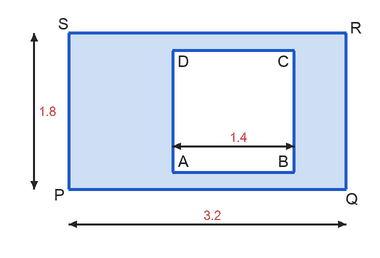
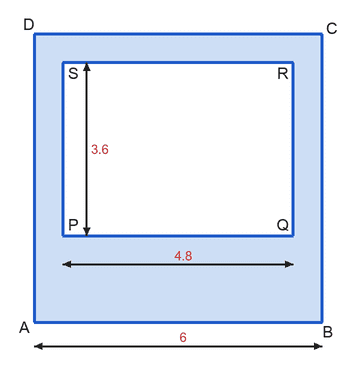
In each of the following cases ABCD is a square and PQRS is a rectangle. Find, in each case, the area of the shaded portion.
(All measurements are in metre).
(i)
(ii)
 Solve with AI
Written solution
Solution:
Concept: Shaded area = area of the outer figure − area of the unshaded figure inside it.
Given: All measurements in metres.
Step 1 — Part (i): the two areas.
The shaded part is the rectangle PQRS with the unshaded square ABCD removed.
Step 2 — Part (i): the shaded area.
We subtract.
Step 3 — Part (ii): the two areas.
Now the shaded part is the square ABCD with the unshaded rectangle PQRS removed.
Step 4 — Part (ii): the shaded area.
We subtract.
Watch out: In (i) the square is inside the rectangle; in (ii) the rectangle is inside the square.
Therefore, (i) 3.8 m²; (ii) 18.72 m².
- 333 marks
Question 33
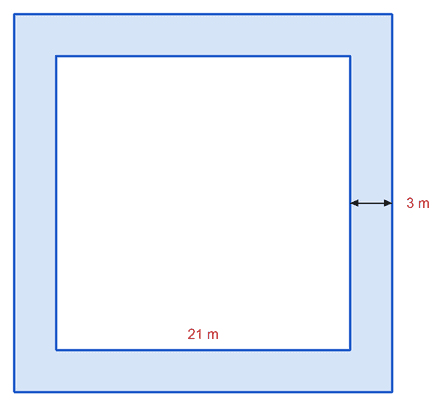
A path of uniform width, 3 m, runs around the outside of a square field of side 21 m.
Find the area of the path.
Solve with AIWritten solution
Solution:
Concept: A rectangle of length and breadth has area .
Its perimeter is .
A square of side has area and perimeter .
Given: Square field of side 21 m; path 3 m wide outside it.
Step 1 — Find the outer side.
The path is outside, so it adds 3 m on each side of the field.
Step 2 — Find the area of the path.
The path is the outer square minus the field.
Watch out: The path adds its width on BOTH sides, so the side grows by 2 × 3 = 6 m.
Therefore, the area of the path is 288 m².
- 343 marks
Question 34
A path of uniform width, 2·5 m, runs around the inside of a rectangular field 30 m by 27 m.
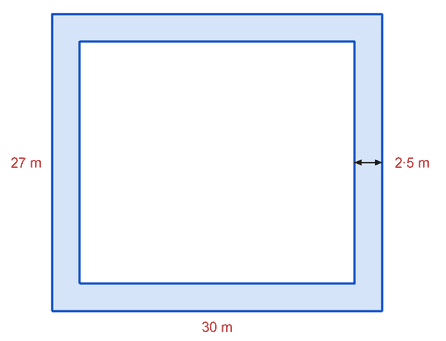
Find the area of the path.
- 353 marks
Question 35
The length of a hall is 18 m and its width is 13·5 m. Find the least number of square tiles, each of side 25 cm, required to cover the floor of the hall,
(i) without leaving any margin.
(ii) leaving a margin of width 1·5 m all around.
In each case, find the cost of the tiles required at the rate of ₹ 6 per tile.
- 363 marks
Question 36
A rectangular field is 30 m in length and 22 m in width. Two mutually perpendicular roads, each 2·5 m wide, are drawn inside the field so that one road is parallel to the length of the field and the other road is parallel to its width.
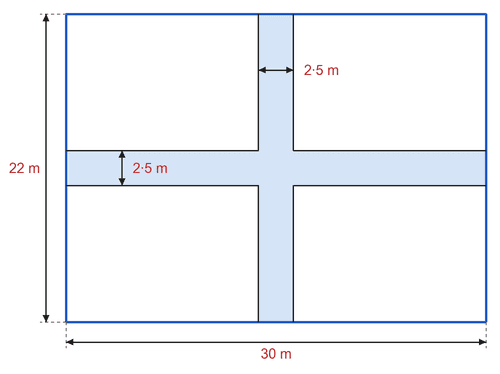
Calculate the area of the crossroads.
- 373 marks
Question 37
The length and the breadth of a rectangular field are in the ratio 5 : 4 and its area is 3380 m². Find the cost of fencing it at the rate of ₹ 75 per m.
- 383 marks
Question 38
The length and the breadth of a conference hall are in the ratio 7 : 4 and its perimeter is 110 m. Find :
(i) area of the floor of the hall.
(ii) number of tiles, each a rectangle of size 25 cm × 20 cm, required for flooring of the hall.
(iii) the cost of the tiles at the rate of ₹ 1,400 per hundred tiles.
- 391 mark
Question 39
The parallel sides of a trapezium are 12 cm and 10 cm. If the distance between the parallel sides is 10 cm; the area of the trapezium is :
- 401 mark
Question 40
Two parallel sides of a trapezium are in the ratio 2 : 3 and the distance between them is 12 cm. If the area of the trapezium is 240 cm²; the length of its larger parallel side is :
- 411 mark
Question 41
The adjacent sides of a parallelogram are 12 cm and 9 cm. The distance between longer sides is 6 cm; the distance between shorter sides is :
- 421 mark
Question 42
Each side of a rhombus is 9 cm and the distance between its opposite sides is 6 cm. The area of the rhombus is :
- 431 mark
Question 43
The diagonal of a rhombus is 15 cm and its area is 60 cm²; the other diagonal of the rhombus is :
- 443 marks
Question 44
The following figure shows the cross-section ABCD of a swimming pool which is a trapezium in shape.
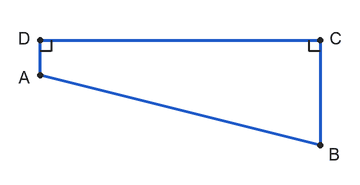
If the width DC of the swimming pool is 6·4 m, depth (AD) at the shallow end is 80 cm and depth (BC) at the deepest end is 2·4 m, find its area of cross-section.
- 453 marks
Question 45
The parallel sides of a trapezium are in the ratio 3 : 4. If the distance between the parallel sides is 9 dm and its area is 126 dm², find the lengths of its parallel sides.
- 463 marks
Question 46
The two parallel sides and the distance between them are in the ratio 3 : 4 : 2. If the area of the trapezium is 175 cm², find its height.
- 473 marks
Question 47
The adjacent sides of a parallelogram are 21 cm and 28 cm. If its one diagonal is 35 cm, find the area of the parallelogram.
- 483 marks
Question 48
The diagonals of a rhombus are 18 cm and 24 cm. Find :
(i) its area (ii) length of its sides
(iii) its perimeter
- 493 marks
Question 49
The perimeter of a rhombus is 40 cm. If one diagonal is 16 cm, find :
(i) its other diagonal (ii) its area
- 503 marks
Question 50
The length of the diagonals of a rhombus is in the ratio 4 : 3. If its area is 384 cm², find its side.
- 513 marks
Question 51
A thin metal iron-sheet is a rhombus in shape, with each side 10 m. If one of its diagonals is 16 m, find the cost of painting its both sides at the rate of ₹ 6 per m².
Also, find the distance between the opposite sides of this rhombus.
- 523 marks
Question 52
The area of a trapezium is 279 sq. cm and the distance between its two parallel sides is 18 cm. If one of its parallel sides is longer than the other side by 5 cm, find the lengths of its parallel sides.
- 533 marks
Question 53
The area of a rhombus is equal to the area of a triangle. If base of triangle is 24 cm, its corresponding altitude is 16 cm and one of the diagonals of the rhombus is 19·2 cm, find its other diagonal.
- 543 marks
Question 54
Find the area of the trapezium ABCD in which AB//DC, AB = 18 cm, ∠B = ∠C = 90°, CD = 12 cm and AD = 10 cm.
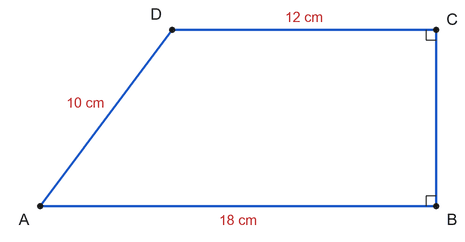
- 551 mark
Question 55
The circumference of a circle is numerically same as its area; then its radius is :
- 561 mark
Question 56
The perimeter of a square of side 11 cm is equal to circumference of a circle; then the diameter of the circle is :
- 571 mark
Question 57
The circumference of a circle is equal to the sum of the circumferences of two circles with radii 10 cm and 12 cm. The radius of the circle formed is :
- 581 mark
Question 58
The diameter of a circular wheel is 56 cm. The distance moved by it in 100 rounds is :
- 591 mark
Question 59
A circular wheel of radius 3·5 cm makes 600 rounds in 48 seconds, its speed is :
- 603 marks
Question 60
Find the radius and area of a circle, whose circumference is :
(i) 132 cm (ii) 22 m
- 613 marks
Question 61
Find the radius and circumference of a circle, whose area is :
(i) 154 cm² (ii) 6·16 m²
- 623 marks
Question 62
The circumference of a circular table is 88 m. Find its area.
- 633 marks
Question 63
The area of a circle is 1386 sq. cm, find its circumference.
- 643 marks
Question 64
Find the area of a flat circular ring formed by two concentric circles (circles with same centre) whose radii are 9 cm and 5 cm.
- 653 marks
Question 65
The radii of the inner and outer circumferences of a circular-running-track are 63 m and 70 m respectively. Find :
(i) the area of the track
(ii) the difference between the lengths of the two circumferences of the track
- 663 marks
Question 66
A circular field of radius 105 m has a circular path of uniform width of 5 m along and inside its boundary. Find the area of the path.
- 673 marks
Question 67
A wire, when bent in the form of a square, encloses an area of 484 cm². Find :
(i) one side of the square
(ii) length of the wire
(iii) the largest area enclosed, if the same wire is bent to form a circle.
- 683 marks
Question 68
A wire, when bent in the form of a square, encloses an area of 196 cm². If the same wire is bent to form a circle, find the area of the circle.
- 693 marks
Question 69
The radius of a circular wheel is 42 cm. Find the distance travelled by it in :
(i) 1 revolution (ii) 50 revolutions
(iii) 200 revolutions
- 703 marks
Question 70
The diameter of wheel is 0·70 m. Find the distance covered by it in 500 revolutions.
If the wheel takes 5 minutes to make 500 revolutions; find its speed in :
(i) m/s (ii) km/hr
- 713 marks
Question 71
A bicycle wheel, diameter 56 cm, is making 45 revolutions in every 10 seconds. At what speed, in kilometre per hour, is the bicycle travelling ?
- 723 marks
Question 72
A roller has a diameter of 1·4 m. Find :
(i) its circumference
(ii) the number of revolutions it makes while travelling 61·6 m.
- 733 marks
Question 73
Find the area of the circle, length of whose circumference is equal to the sum of the lengths of the circumferences with radii 15 cm and 13 cm.
- 743 marks
Question 74
A piece of wire of length 108 cm is bent to form a semicircular arc bounded by its diameter. Find its radius and area enclosed.
- 753 marks
Question 75
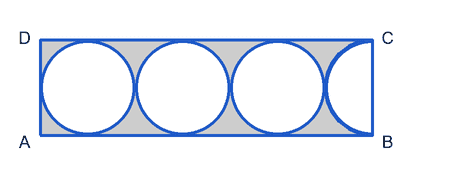
In the following figure, a rectangle ABCD encloses three circles. If BC = 14 cm, find the area of the shaded portion. (Take )
- 761 mark
Question 76
Each side of a triangle is doubled, the ratio of areas of the original triangle to the new (resulting) triangle is :
- 771 mark
Question 77
The perimeter of a rectangle is equal to the perimeter of a square. If each side of the square is 30 cm and length of the rectangle is 40 cm; the breadth of the rectangle is :
- 781 mark
Question 78
The area of a trapezium is 80 square unit. If its two parallel sides are 6 unit and 14 unit; the distance between parallel sides is :
- 791 mark
Question 79
The external and internal radii of a ring shaped metal sheet are 10 cm and 8 cm respectively. The area of its one face, in terms of π is :
- 801 mark
Question 80
The adjacent sides of a rectangle are 20 cm and 24 cm. If its perimeter is equal to the circumference of a circle, the radius of the circle is :
- 811 mark
Question 81
Statement 1 : ABCD is a parallelogram. Base AB = 12 cm, perpendicular dropped from B to AD is 9 cm, area of the parallelogram ABCD = 54 cm².
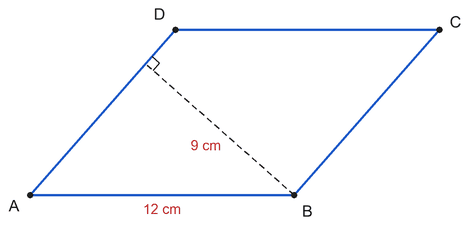
Statement 2 : The area of parallelogram = Base × Height.
Which of the following options is correct?
- 821 mark
Question 82
The following questions are Assertion-Reason based questions. Choose your answer based on the codes given below.
(1) Both A and R are correct, and R is the correct explanation for A.
(2) Both A and R are correct, and R is not the correct explanation for A.
(3) A is true, but R is false.
(4) A is false, but R is true.
Assertion (A) : The diagonal of a rectangle is 17 m and its breadth is 8 m. Half of the area of the rectangle is 120 m².
Reason (R) : The diagonal of every rectangle, divides it into two congruent right-triangles.
- 831 mark
Question 83
The following questions are Assertion-Reason based questions. Choose your answer based on the codes given below.
(1) Both A and R are correct, and R is the correct explanation for A.
(2) Both A and R are correct, and R is not the correct explanation for A.
(3) A is true, but R is false.
(4) A is false, but R is true.
Assertion (A) : The area of an equilateral triangle of height cm is cm².
Reason (R) : The area of an equilateral triangle = × (Height)².
- 841 mark
Question 84
The following questions are Assertion-Reason based questions. Choose your answer based on the codes given below.
(1) Both A and R are correct, and R is the correct explanation for A.
(2) Both A and R are correct, and R is not the correct explanation for A.
(3) A is true, but R is false.
(4) A is false, but R is true.
Assertion (A) : The diagonal of a square is cm. Its area = 81 cm².
Reason (R) : The area of a square = × d², where d is the length of the diagonals.
- 851 mark
Question 85
The following questions are Assertion-Reason based questions. Choose your answer based on the codes given below.
(1) Both A and R are correct, and R is the correct explanation for A.
(2) Both A and R are correct, and R is not the correct explanation for A.
(3) A is true, but R is false.
(4) A is false, but R is true.
Assertion (A) : The area of trapezium with base 10 cm, height 5 cm and the side parallel to the given base being 6 cm is 40 cm².
Reason (R) : The area of trapezium
- 863 marks
Question 86
The perimeter of a trapezium is 52 cm. If its non-parallel sides are 10 cm each and its altitude is 8 cm, find the area of the trapezium.
- 873 marks
Question 87
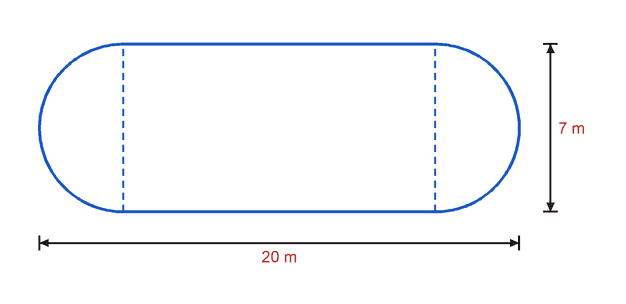
The shape of a garden is rectangular in the middle and semicircular at each end as shown in the figure. Find the area and perimeter of the garden.
- 883 marks
Question 88
Each side of rhombus is 13 cm and one of its diagonals is 10 cm. Find :
(i) the length of its other diagonal
(ii) its area.
- 893 marks
Question 89
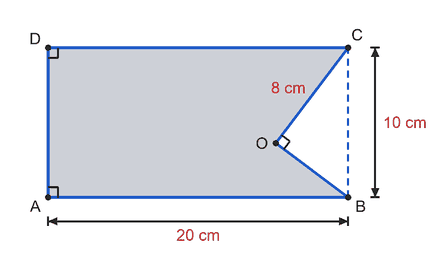
The given figure shows a rectangle ABCD and a right triangle BOC. Find the area of the shaded portion.
- 903 marks
Question 90
(i) Find the area of the circle whose circumference is 264 cm.
(ii) Find the circumference of a circle whose area is 1386 cm².
- 913 marks
Question 91
A copper wire when bent in the form of a square encloses an area of 484 cm². When the same wire is bent in the form of a circle, find the area of the circle formed.
- 923 marks
Question 92
The perimeters of two squares are 120 cm and 64 cm. Find the perimeter of the square whose area is equal to the sum of the areas of these two squares.
- 933 marks
Question 93
Find the perimeter of a square whose area is equal to half the sum of areas of three squares with sides 3 cm, 4 cm and 5 cm.
- 943 marks
Question 94
If the diameter of a car wheel is 28 cm, how many times will the wheel rotate in a journey of 11 km ?
What Class 8 Maths Ch 22 covers
The sections of the chapter, in the order the book takes them. Every question above comes from one of these.
- 01Review
- 02Perimeter and Area of Triangles
- 03Perimeter and Area of Rectangles
- 04Perimeter and Area of Squares
- 05Trapezium
- 06Parallelogram
More ways to study this chapter
The same chapter asked three other ways. Practise it, revise it, and see what the board has set on Ch 22 before.
Class 8 Maths Ch 22 questions students ask
How many questions are there in Class 8 Maths Ch 22?
94 questions. Every one is solved step by step on this page.
Are these Class 8 Maths solutions free?
Yes. Every question and its full working is free to read, with no account needed.
Can I download the Class 8 Maths Ch 22 solutions as a PDF?
There is no PDF to download. Every solution is on this page instead, which means it is searchable, always the current syllabus, and readable on a phone. Use your browser's print option if you want it on paper.