
Question 473 marksEasy
The adjacent sides of a parallelogram are 21 cm and 28 cm. If its one diagonal is 35 cm, find the area of the parallelogram.
Confirming your payment
Sign up now and get 250 free tokens.
Area of a Trapezium and a Polygon · Question 47 of 94
The adjacent sides of a parallelogram are 21 cm and 28 cm. If its one diagonal is 35 cm, find the area of the parallelogram.
Solution:
Concept: In a right-angled triangle, the two sides that make the right angle are perpendicular, so one is the base and the other is the height.
So its area is .
By Pythagoras' theorem, .
Given: Adjacent sides 21 cm and 28 cm, one diagonal 35 cm.
Step 1 — Look at one half.
The diagonal of 35 cm cuts the parallelogram into two congruent triangles, each with sides 21 cm, 28 cm and 35 cm.
Step 2 — Test for a right angle.
We compare the sum of the squares of the two shorter sides with the square of the longest side.
The two results are equal, so by the converse of Pythagoras' theorem the angle between the 21 cm and 28 cm sides is 90°.
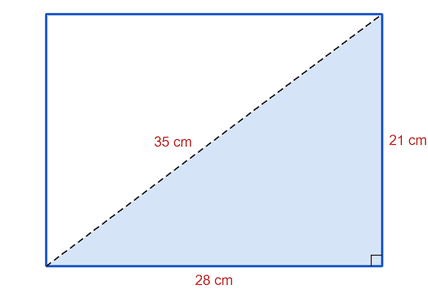
Step 3 — Find the area of one triangle.
The two perpendicular sides are the base and the height.
Step 4 — Find the area of the parallelogram.
The parallelogram is made of two such triangles.
This agrees with 21 × 28 = 588, because a parallelogram with a right angle is a rectangle.
Watch out: The area is not 21 × 28 for every parallelogram; it works here only because the angle turned out to be 90°.
Therefore, the area of the parallelogram is 588 cm².