Answer: (D) Statement 1 is false, and statement 2 is true.
Concept: The area of a parallelogram is base×height, where the height is the perpendicular distance between the base and the side opposite it. Any side can be the base, if we use the height that goes with it.
Step 1 — Judge statement 2.
The area of a parallelogram is base × height, where the height is the perpendicular distance between that base and the opposite side. Statement 2 is true.
Step 2 — See which base the 9 cm belongs to.
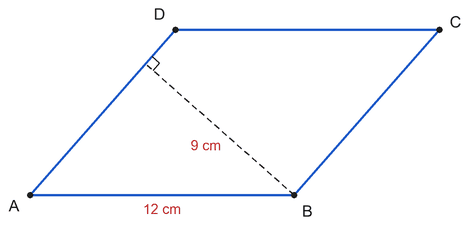
The perpendicular from B falls on AD, so 9 cm is the height that goes with the base AD. The area is therefore AD × 9, and AD is not given.
Step 3 — Check the value 54 cm².
The number 54 is ½ × 12 × 9: it pairs the base AB with the height that belongs to AD, and it uses the triangle formula. Even if 9 cm were wrongly taken as the height on AB, base × height would give 108 cm², not 54 cm².
12×9=108
So the area 54 cm² does not follow from the data, and statement 1 is false.
Watch out: A height belongs to one particular base; the perpendicular from B to AD is the height for AD, not for AB.
Why the other options are wrong:
- (A): This calls statement 1 true, but its area of 54 cm² does not follow from the data.
- (B): This calls statement 2 false, but it is the standard formula for the area of a parallelogram.
- (C): This has the two statements the wrong way round: statement 1 is false and statement 2 is true.
Therefore, statement 1 is false and statement 2 is true, option (D).