
Opening your dashboard
Class 8 Maths Chapter 16: Understanding Shapes Solutions
72 textbook questions with step-by-step answers, free to read, for ICSE 2026-27.
Get talked through Ch 16, not just shown the answer
Reading a finished solution is not the same as being able to do it. The AI tutor takes one question at a time and works it with you, in your own words, until you can.
- Ask it out loud, in your own words
- It gives you the next step, not the answer
- Stuck on part (ii)? Start there
72 questions with solutions
1–3 marks · Mixed difficulty
The first 53 solutions are on this page. This chapter is a long one, so the rest open on their own page to keep this one quick to load.
- 11 mark
Question 1
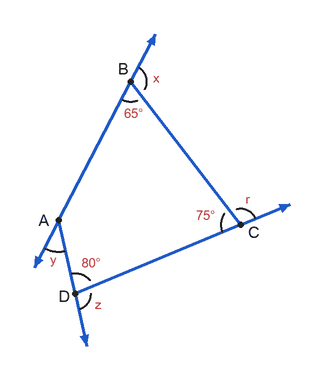
The value of x + y + z + r is :
 Solve with AI
Answer
(A) 180°
(B) 270°
- Correct
(C) 360°
(D) 720°
Answer: (C) 360°
Concept: When the sides of a polygon are produced in order, the exterior angles always add up to 360° (4 right angles), whatever the number of sides. At each vertex, the interior angle and the exterior angle form a linear pair, so they add up to 180°.
Step 1 — Find the fourth angle.
The figure gives three interior angles of quadrilateral ABCD. The four angles add up to 360°, so ∠A is what is left.
Step 2 — Find each exterior angle.
Each of x, r, z and y lies between a produced side and the next side, so it forms a linear pair with the interior angle at that vertex. Each one is 180° minus that interior angle.
Step 3 — Add them.
Now add the four exterior angles.
This agrees with the rule: the exterior angles of any polygon add up to 360°.
Watch out: 360° is the sum of the EXTERIOR angles of every polygon; for the interior angles, 360° holds only for a quadrilateral.
Why the other options are wrong:
- (A) 180°: 180° is the sum of the interior angles of a triangle, not of these four exterior angles.
- (B) 270°: 270° is three right angles; the four exterior angles add up to four right angles (360°).
- (D) 720°: 720° is the interior-angle sum of a hexagon (or twice 360°), not the exterior-angle sum.
Therefore, x + y + z + r = 360°, option (C).
- 21 mark
Question 2
The angles of a quadrilateral are in the ratio in the ratio 2 : 5 : 7 : 4. The largest angle is :
Solve with AIAnswer
(A) 40°
(B) 100°
- Correct
(C) 140°
(D) 80°
Answer: (C) 140°
Concept: The four interior angles of any quadrilateral add up to 360°.
Step 1 — Write the angles with one unknown.
The angles are in the ratio 2 : 5 : 7 : 4, so we write them as 2k, 5k, 7k and 4k degrees. They are the angles of a quadrilateral, so they add up to 360°.
Step 2 — Find the largest angle.
The largest share of the ratio is 7, so the largest angle is 7k.
The four angles are 40°, 100°, 140° and 80°, and they do add up to 360°.
Watch out: Find k first; k itself (20°) is not an angle of the quadrilateral.
Why the other options are wrong:
- (A) 40°: 40° is 2k, the smallest angle.
- (B) 100°: 100° is 5k, not the largest angle.
- (D) 80°: 80° is 4k, not the largest angle.
Therefore, the largest angle is 140°, option (C).
- 31 mark
Question 3
In quadrilateral ABCD, ∠A = 45°, ∠B = 55° and ∠D = 60°; the quadrilateral is :
Solve with AIAnswer
- Correct
(A) concave
(B) convex
(C) right angled
(D) none of these
Answer: (A) concave
Concept: A polygon is convex if each of its interior angles is less than 180°. It is concave (re-entrant) if at least one interior angle is more than 180°. The four angles of a quadrilateral add up to 360°.
Step 1 — Find the fourth angle.
Three angles are given, and the four angles add up to 360°.
Step 2 — Decide the type.
∠C = 200° is more than 180°, so the quadrilateral has a reflex interior angle. That makes it concave.
Watch out: Always find the missing angle before deciding; the three given angles alone are all acute.
Why the other options are wrong:
- (B) convex: A convex quadrilateral needs every angle less than 180°, but ∠C = 200°.
- (C) right angled: None of the angles 45°, 55°, 60° and 200° is 90°, so it is not right-angled.
- (D) none of these: The quadrilateral is concave, which is option (A), so “none of these” is wrong.
Therefore, the quadrilateral is concave, option (A).
- 41 mark
Question 4
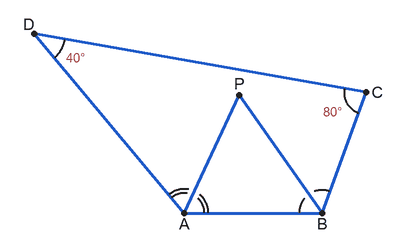
In quadrilateral ABCD, ∠D = 40°, ∠C = 80° AP bisects angle A and BP bisects angle ∠B; then ∠APB is equal :
 Solve with AI
Answer
(A) 90°
(B) 120°
(C) 80°
- Correct
(D) 60°
Answer: (D) 60°
Concept: The four interior angles of any quadrilateral add up to 360°. The angles of a triangle add up to 180°, and a bisector cuts an angle into two equal halves.
Step 1 — Find ∠A + ∠B.
The four angles of quadrilateral ABCD add up to 360°, and ∠C and ∠D are given.
Step 2 — Use the bisectors.
AP bisects ∠A, so ∠PAB is half of ∠A. BP bisects ∠B, so ∠PBA is half of ∠B. Together they are half of 240°.
Step 3 — Use triangle APB.
The three angles of triangle APB add up to 180°.
In fact ∠APB always equals half of (∠C + ∠D), and half of 120° is again 60°.
Watch out: AP and BP take only HALF of ∠A and ∠B into triangle APB.
Why the other options are wrong:
- (A) 90°: ∠APB would be 90° only if ∠A + ∠B were 180°; here ∠A + ∠B = 240°.
- (B) 120°: 120° is ∠PAB + ∠PBA, the other two angles of triangle APB, not ∠APB.
- (C) 80°: 80° is ∠C, which is given; it is not ∠APB.
Therefore, ∠APB = 60°, option (D).
- 51 mark
Question 5
The sum of interior angles of a polygon is 900°. The number of side in this polygon is :
Solve with AIAnswer
(A) 5
- Correct
(B) 7
(C) 9
(D) 11
Answer: (B) 7
Concept: The sum of the interior angles of a polygon with sides is , which is the same as right angles. (From one vertex, the diagonals cut the polygon into triangles, and each triangle has an angle sum of 180°.)
Step 1 — Set up the equation.
Let the polygon have n sides. Its interior angles add up to (n − 2) × 180°, and this must equal 900°.
Step 2 — Check.
A 7-sided polygon (heptagon) has angle sum (7 − 2) × 180°.
Watch out: Solve for n − 2 first and then add 2; 900 ÷ 180 = 5 is not the number of sides.
Why the other options are wrong:
- (A) 5: A 5-sided polygon has angle sum (5 − 2) × 180° = 540°.
- (C) 9: A 9-sided polygon has angle sum (9 − 2) × 180° = 1260°.
- (D) 11: An 11-sided polygon has angle sum (11 − 2) × 180° = 1620°.
Therefore, the polygon has 7 sides, option (B).
- 63 marks
Question 6
Calculate the sum of angles of a polygon with 10 sides:
Solve with AIWritten solution
Solution:
Concept: The sum of the interior angles of a polygon with sides is , which is the same as right angles. (From one vertex, the diagonals cut the polygon into triangles, and each triangle has an angle sum of 180°.)
Step 1 — Use the angle-sum formula.
For a polygon with n sides the interior angles add up to (n − 2) × 180°. Here n = 10.
Step 2 — Check with right angles.
The same sum in right angles is (2n − 4) right angles, which is 16 right angles.
Watch out: Use n − 2, not n: a 10-sided polygon splits into 8 triangles, not 10.
Therefore, the sum of the angles of a 10-sided polygon is 1440°.
- 73 marks
Question 7
Find the number of sides in a polygon if the sum of its interior angles is 16 right angles.
Solve with AIWritten solution
Solution:
Concept: The sum of the interior angles of a polygon with sides is , which is the same as right angles. (From one vertex, the diagonals cut the polygon into triangles, and each triangle has an angle sum of 180°.)
Step 1 — Set up the equation.
The angle sum of an n-sided polygon is (2n − 4) right angles. Here it is 16 right angles.
Step 2 — Check.
A 10-sided polygon has angle sum (10 − 2) × 180° = 1440°, and 16 right angles are also 16 × 90° = 1440°.
Watch out: The angle sum is given in RIGHT ANGLES, so use (2n − 4), not degrees.
Therefore, the polygon has 10 sides.
- 83 marks
Question 8
Is it possible to have a polygon whose sum of interior angles is :
870°
Solve with AIWritten solution
Solution:
Concept: A polygon must have a whole number of sides, at least 3. So a given angle sum (or angle) is possible only when the formula gives a whole number . The sum of the interior angles of a polygon with sides is , which is the same as right angles. (From one vertex, the diagonals cut the polygon into triangles, and each triangle has an angle sum of 180°.)
Step 1 — Try to find n.
Suppose a polygon with n sides has angle sum 870°. Then (n − 2) × 180° = 870°.
Step 2 — Find n.
Add 2 to get the number of sides.
Step 3 — Decide.
The number of sides must be a whole number, but n = is not. (A hexagon has 720° and a heptagon has 900°, and 870° lies between them.) So no polygon has this angle sum.
Watch out: It is not enough for 870° to be more than 180°; the angle sum must be an exact multiple of 180°.
Therefore, no, a polygon cannot have an angle sum of 870°.
- 93 marks
Question 9
Is it possible to have a polygon whose sum of interior angles is :
2340°
Solve with AIWritten solution
Solution:
Concept: A polygon must have a whole number of sides, at least 3. So a given angle sum (or angle) is possible only when the formula gives a whole number . The sum of the interior angles of a polygon with sides is , which is the same as right angles. (From one vertex, the diagonals cut the polygon into triangles, and each triangle has an angle sum of 180°.)
Step 1 — Try to find n.
Suppose a polygon with n sides has angle sum 2340°. Then (n − 2) × 180° = 2340°.
Step 2 — Decide.
The value n = 15 is a whole number greater than 3, so such a polygon exists: it has 15 sides.
Therefore, yes, it is possible: a polygon with 15 sides has an angle sum of 2340°.
- 103 marks
Question 10
Is it possible to have a polygon whose sum of interior angles is :
7 right angles ?
Solve with AIWritten solution
Solution:
Concept: A polygon must have a whole number of sides, at least 3. So a given angle sum (or angle) is possible only when the formula gives a whole number . The sum of the interior angles of a polygon with sides is , which is the same as right angles. (From one vertex, the diagonals cut the polygon into triangles, and each triangle has an angle sum of 180°.)
Step 1 — Try to find n.
The angle sum of an n-sided polygon is (2n − 4) right angles. Suppose it is 7 right angles.
Step 2 — Decide.
The number of sides must be a whole number, but n = is not. (Notice that 2n − 4 is always even, so the angle sum is always an EVEN number of right angles, and 7 is odd.)
Therefore, no, a polygon cannot have an angle sum of 7 right angles.
- 113 marks
Question 11
If all the angles of a hexagon are equal, find the measure of each angle.
Solve with AIWritten solution
Solution:
Concept: The sum of the interior angles of a polygon with sides is , which is the same as right angles. (From one vertex, the diagonals cut the polygon into triangles, and each triangle has an angle sum of 180°.)
Step 1 — Find the angle sum.
A hexagon has 6 sides, so its angles add up to (6 − 2) × 180°.
Step 2 — Share it equally.
All 6 angles are equal, so each one is the sum divided by 6.
Therefore, each angle of the hexagon is 120°.
- 123 marks
Question 12
If all the angles of a 14-sided figure are equal, find the measure of each angle.
Solve with AIWritten solution
Solution:
Concept: The sum of the interior angles of a polygon with sides is , which is the same as right angles. (From one vertex, the diagonals cut the polygon into triangles, and each triangle has an angle sum of 180°.)
Step 1 — Find the angle sum.
A 14-sided figure has angles adding up to (14 − 2) × 180°.
Step 2 — Share it equally.
All 14 angles are equal, so divide the sum by 14 and write the answer as a mixed number.
Watch out: 1080 ÷ 7 is not a whole number, so keep the exact answer as a fraction (about 154.29°).
Therefore, each angle of the 14-sided figure is .
- 133 marks
Question 13
Find the sum of exterior angles obtained on producing the sides of a polygon, in order, with 7 sides.
Solve with AIWritten solution
Solution:
Concept: When the sides of a polygon are produced in order, the exterior angles always add up to 360° (4 right angles), whatever the number of sides. At each vertex, the interior angle and the exterior angle form a linear pair, so they add up to 180°.
Step 1 — Add interior and exterior angles.
At each of the 7 vertices, the interior angle and the exterior angle make a straight line, so together they are 180°. Over all 7 vertices this gives 7 × 180°.
Step 2 — Subtract the interior angles.
The interior angles of a 7-sided polygon add up to (7 − 2) × 180° = 900°. What is left is the sum of the exterior angles.
The same working for any number of sides n always leaves n × 180° − (n − 2) × 180° = 360°.
Watch out: The exterior-angle sum does NOT depend on the number of sides.
Therefore, the sum of the exterior angles of a 7-sided polygon is 360° (4 right angles).
- 143 marks
Question 14
The sides of a hexagon are produced in order. If the measures of exterior angles so obtained are (6x − 1)°, (10x + 2)°, (8x + 2)°, (9x − 3)°, (5x + 4)° and (12x + 6)°, find each exterior angle.
Solve with AIWritten solution
Solution:
Concept: When the sides of a polygon are produced in order, the exterior angles always add up to 360° (4 right angles), whatever the number of sides. At each vertex, the interior angle and the exterior angle form a linear pair, so they add up to 180°.
Step 1 — Form the equation.
The six exterior angles of the hexagon add up to 360°. Add the x-terms and the numbers separately.
Step 2 — Find each exterior angle.
Substitute x = 7 in each expression.
Exterior angle Working Value (6x − 1)° 6 × 7 − 1 41° (10x + 2)° 10 × 7 + 2 72° (8x + 2)° 8 × 7 + 2 58° (9x − 3)° 9 × 7 − 3 60° (5x + 4)° 5 × 7 + 4 39° (12x + 6)° 12 × 7 + 6 90° Step 3 — Check.
The six angles must add up to 360°.
Watch out: Collect the constant terms carefully: −1 + 2 + 2 − 3 + 4 + 6 = 10.
Therefore, the exterior angles are 41°, 72°, 58°, 60°, 39° and 90°.
- 153 marks
Question 15
The interior angles of a pentagon are in the ratio 4 : 5 : 6 : 7 : 5. Find each angle of the pentagon.
Solve with AIWritten solution
Solution:
Concept: The sum of the interior angles of a polygon with sides is , which is the same as right angles. (From one vertex, the diagonals cut the polygon into triangles, and each triangle has an angle sum of 180°.)
Step 1 — Find the angle sum.
A pentagon has 5 sides, so its angles add up to (5 − 2) × 180°.
Step 2 — Write the angles with one unknown.
In the ratio 4 : 5 : 6 : 7 : 5 the angles are 4k, 5k, 6k, 7k and 5k degrees.
Step 3 — Find each angle.
Multiply each share by k = 20°.
Share Working Angle 4k 4 × 20° 80° 5k 5 × 20° 100° 6k 6 × 20° 120° 7k 7 × 20° 140° 5k 5 × 20° 100° Check: 80° + 100° + 120° + 140° + 100° = 540°.
Watch out: The ratio has five parts (5 appears twice), so the total number of shares is 27.
Therefore, the angles of the pentagon are 80°, 100°, 120°, 140° and 100°.
- 163 marks
Question 16
Two angles of a hexagon are 120° and 160°. If the remaining four angles are equal, find each equal angle.
Solve with AIWritten solution
Solution:
Concept: The sum of the interior angles of a polygon with sides is , which is the same as right angles. (From one vertex, the diagonals cut the polygon into triangles, and each triangle has an angle sum of 180°.)
Step 1 — Find the angle sum.
A hexagon's angles add up to (6 − 2) × 180°.
Step 2 — Subtract the two given angles.
The four equal angles share what is left after 120° and 160°.
Step 3 — Share equally.
Divide by 4.
Check: 120° + 160° + 4 × 110° = 720°.
Therefore, each of the four equal angles is 110°.
- 173 marks
Question 17
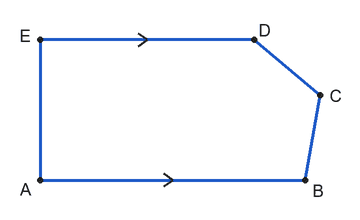
The figure given below shows a pentagon ABCDE with sides AB and ED parallel to each other, and ∠B : ∠C : ∠D = 5 : 6 : 7.
(i) Using formula, find the sum of interior angles of the pentagon.
(ii) Write the value of ∠A + ∠E.
(iii) Find angles B, C and D.
Solve with AIWritten solution
Solution:
Concept: The sum of the interior angles of a polygon with sides is , which is the same as right angles. (From one vertex, the diagonals cut the polygon into triangles, and each triangle has an angle sum of 180°.) Co-interior angles between parallel lines add up to 180°.
Step 1 — (i) Angle sum by formula.
The pentagon has 5 sides, so its angles add up to (n − 2) × 180° with n = 5.
Step 2 — (ii) Use the parallel sides.
AB ∥ ED and AE joins them, so AE is a transversal. ∠A and ∠E lie between the parallel lines on the same side of AE, so they are co-interior angles and add up to 180°.
Step 3 — (iii) Find ∠B + ∠C + ∠D.
Take ∠A + ∠E away from the angle sum.
Step 4 — Share in the ratio 5 : 6 : 7.
Write the angles as 5k, 6k and 7k degrees.
Now multiply each share by k = 20°.
Watch out: ∠A + ∠E = 180° comes from AB ∥ ED, not from ∠A and ∠E being right angles; the stem does not say they are.
Therefore, (i) the angle sum is 540°, (ii) ∠A + ∠E = 180°, and (iii) ∠B = 100°, ∠C = 120° and ∠D = 140°.
- 183 marks
Question 18
Two angles of a polygon are right angles and the remaining are 120° each. Find the number of sides in it.
(Hint: .)
Solve with AIWritten solution
Solution:
Concept: The sum of the interior angles of a polygon with sides is , which is the same as right angles. (From one vertex, the diagonals cut the polygon into triangles, and each triangle has an angle sum of 180°.)
Step 1 — Form the equation.
Let the polygon have n sides. Two angles are 90° each, and the other n − 2 angles are 120° each. Together they make the angle sum (2n − 4) × 90°, as the hint says.
Step 2 — Check.
With 5 sides the angles are 90°, 90°, 120°, 120° and 120°, which add up to 540°. A pentagon's angle sum is (5 − 2) × 180° = 540°, so it fits.
Watch out: Only n − 2 of the angles are 120°, because two of the n angles are right angles.
Therefore, the polygon has 5 sides.
- 193 marks
Question 19
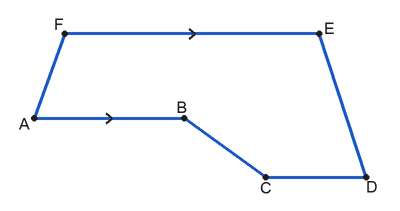
In a hexagon ABCDEF, side AB is parallel to side FE and ∠B : ∠C : ∠D : ∠E = 6 : 4 : 2 : 3.
Find ∠B and ∠D.
Solve with AIWritten solution
Solution:
Concept: The sum of the interior angles of a polygon with sides is , which is the same as right angles. (From one vertex, the diagonals cut the polygon into triangles, and each triangle has an angle sum of 180°.) Co-interior angles between parallel lines add up to 180°.
Step 1 — Use the parallel sides.
AB ∥ FE and AF joins them, so AF is a transversal and ∠A, ∠F are co-interior angles: ∠A + ∠F = 180°.
Step 2 — Find the sum of the other four angles.
A hexagon's angles add up to (6 − 2) × 180° = 720°.
Step 3 — Share in the ratio 6 : 4 : 2 : 3.
Write the four angles as 6k, 4k, 2k and 3k degrees.
Step 4 — Find ∠B and ∠D.
∠B has 6 shares and ∠D has 2 shares.
(The others are ∠C = 144° and ∠E = 108°. Since ∠B is more than 180°, this hexagon is concave.)
Watch out: An interior angle of a polygon may be more than 180°; that only means the polygon is concave.
Therefore, ∠B = 216° and ∠D = 72°.
- 203 marks
Question 20
The angles of a hexagon are x + 10°, 2x + 20°, 2x − 20°, 3x − 50°, x + 40° and x + 20°. Find x.
Solve with AIWritten solution
Solution:
Concept: The sum of the interior angles of a polygon with sides is , which is the same as right angles. (From one vertex, the diagonals cut the polygon into triangles, and each triangle has an angle sum of 180°.)
Step 1 — Form the equation.
A hexagon's angles add up to (6 − 2) × 180° = 720°. Add the x-terms and the numbers separately.
Step 2 — Check.
With x = 70° the angles are 80°, 160°, 120°, 160°, 110° and 90°, and these add up to 720°.
Watch out: The constants are +10 + 20 − 20 − 50 + 40 + 20 = +20; a sign slip here changes x.
Therefore, x = 70°.
- 213 marks
Question 21
In a pentagon, two angles are 40° and 60° and the rest are in the ratio 1 : 3 : 7. Find the biggest angle of the pentagon.
Solve with AIWritten solution
Solution:
Concept: The sum of the interior angles of a polygon with sides is , which is the same as right angles. (From one vertex, the diagonals cut the polygon into triangles, and each triangle has an angle sum of 180°.)
Step 1 — Find what the other three angles share.
A pentagon's angles add up to 540°. Take away the two given angles.
Step 2 — Share in the ratio 1 : 3 : 7.
Write the three angles as k, 3k and 7k degrees.
Step 3 — Find the biggest angle.
The biggest has 7 shares.
The angles are 40°, 60°, 40°, 120° and 280°. The 280° angle is reflex, so this pentagon is concave.
Watch out: The biggest angle is the largest of ALL five, so compare 280° with 40° and 60° too.
Therefore, the biggest angle of the pentagon is 280°.
- 221 mark
Question 22
Each interior angle of a regular polygon is double of its exterior angle, the number of sides in the polygon is :
Solve with AIAnswer
(A) 3
(B) 4
- Correct
(C) 6
(D) 8
Answer: (C) 6
Concept: At every vertex of a polygon, the interior angle and the exterior angle form a linear pair, so interior angle + exterior angle = 180°. In a regular polygon, .
Step 1 — Set up the equation.
Let each exterior angle be x°. Then each interior angle is 2x°, and at a vertex the two add up to 180°.
Step 2 — Find the number of sides.
Each exterior angle is 60°, so the number of sides is 360° divided by 60°.
Watch out: X is the EXTERIOR angle; the interior angle is 2x = 120°, and n comes from the exterior angle.
Why the other options are wrong:
- (A) 3: A regular triangle has interior angle 60° and exterior angle 120°, so its interior angle is half, not double, the exterior angle.
- (B) 4: A square has interior and exterior angles both 90°, so they are equal.
- (D) 8: A regular octagon has interior angle 135° and exterior angle 45°, so the interior angle is three times the exterior angle.
Therefore, the polygon has 6 sides, option (C).
- 231 mark
Question 23
The sum of all interior angles of a regular polygon is 1260°; then the number of sides in the polygon is :
Solve with AIAnswer
(A) 7
(B) 6
- Correct
(C) 9
(D) 8
Answer: (C) 9
Concept: The sum of the interior angles of a polygon with sides is , which is the same as right angles. (From one vertex, the diagonals cut the polygon into triangles, and each triangle has an angle sum of 180°.)
Step 1 — Set up the equation.
A polygon with n sides has angle sum (n − 2) × 180°, and here it is 1260°.
Watch out: 1260 ÷ 180 = 7 gives n − 2, so add 2 to get n.
Why the other options are wrong:
- (A) 7: 7 sides give an angle sum of (7 − 2) × 180° = 900°; 7 is n − 2 here, not n.
- (B) 6: 6 sides give an angle sum of 720°.
- (D) 8: 8 sides give an angle sum of 1080°.
Therefore, the polygon has 9 sides, option (C).
- 241 mark
Question 24
The sum of all interior angles of a regular polygon is equal to sum of all its exterior angles. The number of sides in the polygon is :
Solve with AIAnswer
- Correct
(A) 4
(B) 5
(C) 6
(D) 8
Answer: (A) 4
Concept: The sum of the interior angles of a polygon with sides is , which is the same as right angles. (From one vertex, the diagonals cut the polygon into triangles, and each triangle has an angle sum of 180°.) When the sides of a polygon are produced in order, the exterior angles always add up to 360° (4 right angles), whatever the number of sides. At each vertex, the interior angle and the exterior angle form a linear pair, so they add up to 180°.
Step 1 — Use the exterior-angle sum.
The exterior angles of every polygon add up to 360°. So the interior angles must also add up to 360°.
Why the other options are wrong:
- (B) 5: 5 sides give an interior-angle sum of 540°, which is more than 360°.
- (C) 6: 6 sides give an interior-angle sum of 720°.
- (D) 8: 8 sides give an interior-angle sum of 1080°.
Therefore, the polygon has 4 sides (a square), option (A).
- 251 mark
Question 25
If each interior angle of a regular polygon is right angle. The number of sides in the polygon is :
Solve with AIAnswer
(A) 4
(B) 5
- Correct
(C) 6
(D) 8
Answer: (C) 6
Concept: At every vertex of a polygon, the interior angle and the exterior angle form a linear pair, so interior angle + exterior angle = 180°. In a regular polygon, .
Step 1 — Change the interior angle to degrees.
One right angle is 90°, and .
Step 2 — Find the exterior angle.
Interior and exterior angles at a vertex add up to 180°.
Step 3 — Find the number of sides.
Divide 360° by the exterior angle.
Watch out: Change the right angles to degrees first: right angles is 120°, not 133°.
Why the other options are wrong:
- (A) 4: A square has interior angle 90°, which is one right angle.
- (B) 5: A regular pentagon has interior angle 108°.
- (D) 8: A regular octagon has interior angle 135°.
Therefore, the polygon has 6 sides, option (C).
- 261 mark
Question 26
The ratio between each interior angle of a regular polygon and each exterior angle of it is 3 : 2. The number of sides in the polygon is :
Solve with AIAnswer
(A) 6
(B) 4
(C) 8
- Correct
(D) none of these
Answer: (D) none of these
Concept: At every vertex of a polygon, the interior angle and the exterior angle form a linear pair, so interior angle + exterior angle = 180°. In a regular polygon, .
Step 1 — Share 180° in the ratio 3 : 2.
At each vertex the interior and exterior angles add up to 180°. In the ratio 3 : 2 the exterior angle gets 2 parts out of 5.
Step 2 — Find the number of sides.
Divide 360° by the exterior angle.
Step 3 — Compare with the options.
The polygon is a regular pentagon (interior angle 108°, and 108 : 72 = 3 : 2). 5 is not in (A), (B) or (C).
Watch out: Work out n before choosing; “none of these” is right only because 5 is not offered.
Why the other options are wrong:
- (A) 6: A regular hexagon has angles 120° and 60°, in the ratio 2 : 1.
- (B) 4: A square has angles 90° and 90°, in the ratio 1 : 1.
- (C) 8: A regular octagon has angles 135° and 45°, in the ratio 3 : 1.
Therefore, the polygon has 5 sides, which is not offered, so the answer is option (D) none of these.
- 273 marks
Question 27
Fill in the blanks :
In case of regular polygon, with :
no. of sides each exterior angle each interior angle (i) 8 ........ ........ (ii) 12 ........ ........ (iii) ........ 72° ........ (iv) ........ 45° ........ (v) ........ ........ 150° (vi) ........ ........ 140° Solve with AIWritten solution
Solution:
Concept: In a regular polygon with sides, all the sides are equal and all the angles are equal. The equal exterior angles add up to 360°, so each exterior angle is and . Each interior angle is 180° minus the exterior angle.
Step 1 — (i) 8 sides.
Each exterior angle is 360° shared among 8 vertices; the interior angle is the rest of 180°.
Step 2 — (ii) 12 sides.
Do the same with 12 vertices.
Step 3 — (iii) Exterior angle 72°.
The number of sides is 360° divided by the exterior angle.
Step 4 — (iv) Exterior angle 45°.
Again divide 360° by the exterior angle.
Step 5 — (v) Interior angle 150°.
First find the exterior angle, then the number of sides.
Step 6 — (vi) Interior angle 140°.
Do the same for 140°.
Step 7 — Complete the table.
The filled-in values are shown in bold.
no. of sides each exterior angle each interior angle (i) 8 45° 135° (ii) 12 30° 150° (iii) 5 72° 108° (iv) 8 45° 135° (v) 12 30° 150° (vi) 9 40° 140° Watch out: Always go through the EXTERIOR angle: n = 360° ÷ exterior angle, never 360° ÷ interior angle.
Therefore, the missing entries are (i) 45°, 135°; (ii) 30°, 150°; (iii) 5, 108°; (iv) 8, 135°; (v) 12, 30°; (vi) 9, 40°.
- 283 marks
Question 28
Find the number of sides in a regular polygon, if its each interior angle is :
160°
Solve with AIWritten solution
Solution:
Concept: In a regular polygon with sides, all the sides are equal and all the angles are equal. The equal exterior angles add up to 360°, so each exterior angle is and . Each interior angle is 180° minus the exterior angle.
Step 1 — Find the exterior angle.
At each vertex the interior and exterior angles add up to 180°.
Step 2 — Find the number of sides.
In a regular polygon the number of sides is 360° divided by the exterior angle.
Watch out: Dividing 360° by the INTERIOR angle 160° gives no sensible answer; use the exterior angle 20°.
Therefore, the regular polygon has 18 sides.
- 293 marks
Question 29
Find the number of sides in a regular polygon, if its each interior angle is :
135°
Solve with AIWritten solution
Solution:
Concept: In a regular polygon with sides, all the sides are equal and all the angles are equal. The equal exterior angles add up to 360°, so each exterior angle is and . Each interior angle is 180° minus the exterior angle.
Step 1 — Find the exterior angle.
At each vertex the interior and exterior angles add up to 180°.
Step 2 — Find the number of sides.
In a regular polygon the number of sides is 360° divided by the exterior angle.
Therefore, the regular polygon has 8 sides.
- 303 marks
Question 30
Find the number of sides in a regular polygon, if its each interior angle is :
of a right angle.
Solve with AIWritten solution
Solution:
Concept: In a regular polygon with sides, all the sides are equal and all the angles are equal. The equal exterior angles add up to 360°, so each exterior angle is and . Each interior angle is 180° minus the exterior angle.
Step 1 — Find the exterior angle.
First change the interior angle to degrees: of 90°. Then subtract it from 180°.
Step 2 — Find the number of sides.
In a regular polygon the number of sides is 360° divided by the exterior angle.
Therefore, the regular polygon has 5 sides.
- 313 marks
Question 31
Find the number of sides in a regular polygon, if its each exterior angle is :
of a right angle
Solve with AIWritten solution
Solution:
Concept: In a regular polygon with sides, all the sides are equal and all the angles are equal. The equal exterior angles add up to 360°, so each exterior angle is and . Each interior angle is 180° minus the exterior angle.
Step 1 — Change the exterior angle to degrees.
One right angle is 90°, and the exterior angle is one-third of it.
Step 2 — Find the number of sides.
In a regular polygon the number of sides is 360° divided by the exterior angle.
Therefore, the regular polygon has 12 sides.
- 323 marks
Question 32
Find the number of sides in a regular polygon, if its each exterior angle is :
two-fifths of a right angle
Solve with AIWritten solution
Solution:
Concept: In a regular polygon with sides, all the sides are equal and all the angles are equal. The equal exterior angles add up to 360°, so each exterior angle is and . Each interior angle is 180° minus the exterior angle.
Step 1 — Change the exterior angle to degrees.
One right angle is 90°, and the exterior angle is two-fifths of it.
Step 2 — Find the number of sides.
In a regular polygon the number of sides is 360° divided by the exterior angle.
Therefore, the regular polygon has 10 sides.
- 333 marks
Question 33
Is it possible to have a regular polygon whose each interior angle is :
170°
Solve with AIWritten solution
Solution:
Concept: A polygon must have a whole number of sides, at least 3. So a given angle sum (or angle) is possible only when the formula gives a whole number . In a regular polygon with sides, all the sides are equal and all the angles are equal. The equal exterior angles add up to 360°, so each exterior angle is and . Each interior angle is 180° minus the exterior angle.
Step 1 — Find the exterior angle.
At each vertex the interior and exterior angles add up to 180°.
Step 2 — Find n.
The number of sides is 360° divided by the exterior angle.
Step 3 — Decide.
The value 36 is a whole number (at least 3), so such a regular polygon exists.
Therefore, yes, it is possible: a regular polygon with 36 sides has each interior angle 170°.
- 343 marks
Question 34
Is it possible to have a regular polygon whose each interior angle is :
138°
Solve with AIWritten solution
Solution:
Concept: A polygon must have a whole number of sides, at least 3. So a given angle sum (or angle) is possible only when the formula gives a whole number . In a regular polygon with sides, all the sides are equal and all the angles are equal. The equal exterior angles add up to 360°, so each exterior angle is and . Each interior angle is 180° minus the exterior angle.
Step 1 — Find the exterior angle.
At each vertex the interior and exterior angles add up to 180°.
Step 2 — Try to find n.
The number of sides would be 360° divided by 42°.
Step 3 — Decide.
The number of sides must be a whole number, and is not, so no regular polygon has interior angle 138°.
Watch out: 42° does not divide 360° exactly, so n cannot be whole.
Therefore, no, a regular polygon cannot have each interior angle 138°.
- 353 marks
Question 35
Is it possible to have a regular polygon whose each exterior angle is :
80°
Solve with AIWritten solution
Solution:
Concept: A polygon must have a whole number of sides, at least 3. So a given angle sum (or angle) is possible only when the formula gives a whole number . In a regular polygon with sides, all the sides are equal and all the angles are equal. The equal exterior angles add up to 360°, so each exterior angle is and . Each interior angle is 180° minus the exterior angle.
Step 1 — Try to find n.
In a regular polygon the number of sides is 360° divided by the exterior angle.
Step 2 — Decide.
The number of sides must be a whole number, and is not, so no regular polygon has exterior angle 80°.
Therefore, no, a regular polygon cannot have each exterior angle 80°.
- 363 marks
Question 36
Is it possible to have a regular polygon whose each exterior angle is :
40% of a right angle
Solve with AIWritten solution
Solution:
Concept: A polygon must have a whole number of sides, at least 3. So a given angle sum (or angle) is possible only when the formula gives a whole number . In a regular polygon with sides, all the sides are equal and all the angles are equal. The equal exterior angles add up to 360°, so each exterior angle is and . Each interior angle is 180° minus the exterior angle.
Step 1 — Change the exterior angle to degrees.
40% of a right angle means 40 hundredths of 90°.
Step 2 — Find n.
The number of sides is 360° divided by the exterior angle.
Step 3 — Decide.
The value 10 is a whole number, so such a regular polygon exists: a regular decagon.
Therefore, yes, it is possible: a regular polygon with 10 sides has each exterior angle 36°.
- 373 marks
Question 37
Find the number of sides in a regular polygon, if its interior angle is equal to its exterior angle.
Solve with AIWritten solution
Solution:
Concept: At every vertex of a polygon, the interior angle and the exterior angle form a linear pair, so interior angle + exterior angle = 180°. In a regular polygon, .
Step 1 — Find the angles.
Let each interior angle be x°. The exterior angle is equal to it, and the two add up to 180°.
Step 2 — Find the number of sides.
Each exterior angle is 90°, so divide 360° by 90°.
Therefore, the regular polygon has 4 sides (it is a square).
- 383 marks
Question 38
The exterior angle of a regular polygon is one-third of its interior angle. Find the number of sides in the polygon.
Solve with AIWritten solution
Solution:
Concept: At every vertex of a polygon, the interior angle and the exterior angle form a linear pair, so interior angle + exterior angle = 180°. In a regular polygon, .
Step 1 — Set up the equation.
Let each exterior angle be x°. It is one-third of the interior angle, so the interior angle is 3x°. Together they make 180°.
Step 2 — Find the number of sides.
Each exterior angle is 45°.
Watch out: If the exterior angle is one-third of the interior angle, the interior angle is THREE times the exterior angle.
Therefore, the regular polygon has 8 sides.
- 393 marks
Question 39
The measure of each interior angle of a regular polygon is five times the measure of its exterior angle. Find :
(i) measure of each interior angle,
(ii) measure of each exterior angle and
(iii) number of sides in the polygon
Solve with AIWritten solution
Solution:
Concept: At every vertex of a polygon, the interior angle and the exterior angle form a linear pair, so interior angle + exterior angle = 180°. In a regular polygon, .
Step 1 — Set up the equation.
Let each exterior angle be x°. The interior angle is five times it, 5x°, and the two add up to 180°.
Step 2 — (i) Interior angle.
Multiply the exterior angle by 5.
Step 3 — (ii) Exterior angle.
From Step 1, each exterior angle is x° = 30°.
Step 4 — (iii) Number of sides.
Divide 360° by the exterior angle.
Therefore, (i) each interior angle is 150°, (ii) each exterior angle is 30°, and (iii) the polygon has 12 sides.
- 403 marks
Question 40
The ratio between the interior angle and the exterior angle of a regular polygon is 2 : 1. Find :
(i) each exterior angle of the polygon,
(ii) number of sides in the polygon.
Solve with AIWritten solution
Solution:
Concept: At every vertex of a polygon, the interior angle and the exterior angle form a linear pair, so interior angle + exterior angle = 180°. In a regular polygon, .
Step 1 — (i) Share 180° in the ratio 2 : 1.
Interior and exterior angles add up to 180°. In the ratio 2 : 1 the exterior angle gets 1 part out of 3.
Step 2 — (ii) Number of sides.
Divide 360° by the exterior angle.
Watch out: The EXTERIOR angle is the smaller share (1 part), since the ratio is interior : exterior = 2 : 1.
Therefore, (i) each exterior angle is 60°, and (ii) the polygon has 6 sides.
- 413 marks
Question 41
The ratio between the exterior angle and the interior angle of a regualr polygon is 1 : 4. Find the number of sides in the plygon.
Solve with AIWritten solution
Solution:
Concept: At every vertex of a polygon, the interior angle and the exterior angle form a linear pair, so interior angle + exterior angle = 180°. In a regular polygon, .
Step 1 — Share 180° in the ratio 1 : 4.
Exterior and interior angles add up to 180°. The exterior angle gets 1 part out of 5.
Step 2 — Find the number of sides.
Divide 360° by the exterior angle.
Therefore, the regular polygon has 10 sides.
- 423 marks
Question 42
The sum of interior angles of a regular polygon is twice the sum of its exterior angles. Find the number of sides of the polygon.
Solve with AIWritten solution
Solution:
Concept: The sum of the interior angles of a polygon with sides is , which is the same as right angles. (From one vertex, the diagonals cut the polygon into triangles, and each triangle has an angle sum of 180°.) When the sides of a polygon are produced in order, the exterior angles always add up to 360° (4 right angles), whatever the number of sides. At each vertex, the interior angle and the exterior angle form a linear pair, so they add up to 180°.
Step 1 — Set up the equation.
The exterior angles always add up to 360°, so the interior angles add up to 2 × 360°.
Therefore, the polygon has 6 sides.
- 433 marks
Question 43
AB, BC and CD are three consecutive sides of a regular polygon.
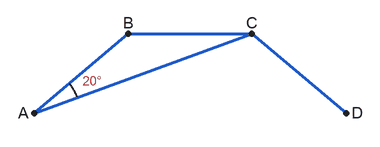
If angle BAC = 20°, find:
(i) its each interior angle
(ii) its each exterior angle
(iii) the number of sides in the polygon.
Solve with AIWritten solution
Solution:
Concept: In a regular polygon with sides, all the sides are equal and all the angles are equal. The equal exterior angles add up to 360°, so each exterior angle is and . Each interior angle is 180° minus the exterior angle. The angles opposite equal sides of a triangle are equal.
Step 1 — Use the isosceles triangle.
In a regular polygon all sides are equal, so AB = BC and triangle ABC is isosceles. The angles opposite the equal sides are equal, so ∠BCA is equal to ∠BAC.
Hence ∠BCA = 20°.
Step 2 — (i) Interior angle.
∠ABC is the angle of the polygon at B. The angles of triangle ABC add up to 180°.
Step 3 — (ii) Exterior angle.
The exterior angle makes 180° with the interior angle.
Step 4 — (iii) Number of sides.
Divide 360° by the exterior angle.
Watch out: ∠BAC is an angle of triangle ABC, not an angle of the polygon; the polygon's angle at B is ∠ABC.
Therefore, (i) each interior angle is 140°, (ii) each exterior angle is 40°, and (iii) the polygon has 9 sides.
- 443 marks
Question 44
Two alternate sides of a regular polygon, when produced, meet at right angle.

Calculate the number of sides in the polygon.
Solve with AIWritten solution
Solution:
Concept: In a regular polygon with sides, all the sides are equal and all the angles are equal. The equal exterior angles add up to 360°, so each exterior angle is and . Each interior angle is 180° minus the exterior angle.
Step 1 — Draw the picture.
Let AB, BC and CD be consecutive sides. AB and CD are alternate sides (one side, BC, lies between them). Produce AB beyond B and DC beyond C; they meet at a point P, and the stem says ∠BPC = 90°.
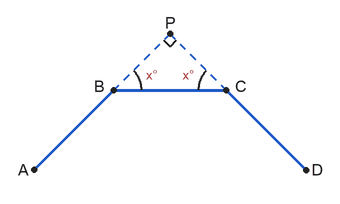
Step 2 — Spot the exterior angles.
∠PBC lies between AB produced and BC, so it is an exterior angle of the polygon. In the same way, ∠PCB is an exterior angle. In a regular polygon all exterior angles are equal; call each one x°.
Step 3 — Use triangle PBC.
The angles of triangle PBC add up to 180°.
Step 4 — Find the number of sides.
Each exterior angle is 45°.
Watch out: The angles of triangle PBC at B and C are EXTERIOR angles of the polygon, not interior ones.
Therefore, the polygon has 8 sides.
- 453 marks
Question 45
In a regular pentagon ABCDE, draw a diagonal BE and then find the measure of :
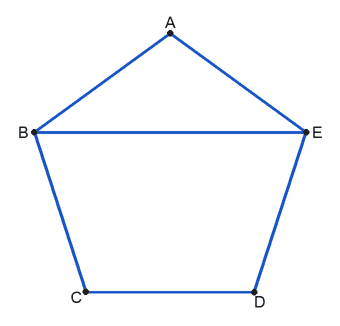
(i) ∠BAE (ii) ∠ABE (iii) ∠BED
Solve with AIWritten solution
Solution:
Concept: In a regular polygon with sides, all the sides are equal and all the angles are equal. The equal exterior angles add up to 360°, so each exterior angle is and . Each interior angle is 180° minus the exterior angle. The angles opposite equal sides of a triangle are equal.
Step 1 — (i) ∠BAE.
∠BAE is an interior angle of the regular pentagon. Each interior angle is the angle sum shared by 5.
Step 2 — (ii) ∠ABE.
AB = AE (sides of the regular pentagon), so triangle ABE is isosceles and ∠ABE = ∠AEB. These two equal angles share what is left of 180°.
Step 3 — (iii) ∠BED.
∠AED is an interior angle of the pentagon (108°), and the diagonal BE splits it into ∠AEB and ∠BED.
Therefore, (i) ∠BAE = 108°, (ii) ∠ABE = 36°, and (iii) ∠BED = 72°.
- 463 marks
Question 46
The ratio between the number of sides of two regular polygons is 3 : 4 and the ratio between the sum of their interior angles is 2 : 3. Find the number of sides in each polygon.
Solve with AIWritten solution
Solution:
Concept: The sum of the interior angles of a polygon with sides is , which is the same as right angles. (From one vertex, the diagonals cut the polygon into triangles, and each triangle has an angle sum of 180°.)
Step 1 — Name the numbers of sides.
The numbers of sides are in the ratio 3 : 4, so call them 3x and 4x.
Step 2 — Write the ratio of the angle sums.
The angle sums are (3x − 2) × 180° and (4x − 2) × 180°, and their ratio is 2 : 3. The 180° cancels.
Step 3 — Find the sides.
So the polygons have 3 × 2 = 6 and 4 × 2 = 8 sides.
Check: their angle sums are 720° and 1080°, and 720 : 1080 = 2 : 3.
Watch out: X is not the number of sides; the polygons have 3x and 4x sides.
Therefore, the polygons have 6 sides and 8 sides.
- 473 marks
Question 47
Three of the exterior angles of a hexagon are 40°, 51° and 86°. If each of the remaining exterior angles is x°, find the value of x.
Solve with AIWritten solution
Solution:
Concept: When the sides of a polygon are produced in order, the exterior angles always add up to 360° (4 right angles), whatever the number of sides. At each vertex, the interior angle and the exterior angle form a linear pair, so they add up to 180°.
Step 1 — Count the exterior angles.
A hexagon has 6 exterior angles. Three are given, so the other three are x° each. All six add up to 360°.
Watch out: A hexagon has six exterior angles, so there are THREE angles of x°, not one.
Therefore, x = 61.
- 483 marks
Question 48
Calculate the number of sides of a regular polygon if :
its interior angle is five times its exterior angle.
Solve with AIWritten solution
Solution:
Concept: At every vertex of a polygon, the interior angle and the exterior angle form a linear pair, so interior angle + exterior angle = 180°. In a regular polygon, .
Step 1 — Set up the equation.
Let each exterior angle be x°. The interior angle is 5x°, and the two add up to 180°.
Step 2 — Find the number of sides.
Divide 360° by the exterior angle.
Therefore, the regular polygon has 12 sides.
- 493 marks
Question 49
Calculate the number of sides of a regular polygon if :
the ratio between its exterior angle and interior angle is 2 : 7.
Solve with AIWritten solution
Solution:
Concept: At every vertex of a polygon, the interior angle and the exterior angle form a linear pair, so interior angle + exterior angle = 180°. In a regular polygon, .
Step 1 — Share 180° in the ratio 2 : 7.
Exterior and interior angles add up to 180°. The exterior angle gets 2 parts out of 9.
Step 2 — Find the number of sides.
Divide 360° by the exterior angle.
Therefore, the regular polygon has 9 sides.
- 503 marks
Question 50
Calculate the number of sides of a regular polygon if :
its exterior angle exceeds its interior angle by 60°.
Solve with AIWritten solution
Solution:
Concept: At every vertex of a polygon, the interior angle and the exterior angle form a linear pair, so interior angle + exterior angle = 180°. In a regular polygon, .
Step 1 — Set up the equation.
Let each interior angle be x°. The exterior angle is 60° more, (x + 60)°, and the two add up to 180°.
Step 2 — Find the exterior angle.
Add 60° to the interior angle.
Step 3 — Find the number of sides.
Divide 360° by the exterior angle.
Watch out: Here the EXTERIOR angle is the bigger one, so use 120° (not 60°) to find n.
Therefore, the regular polygon has 3 sides (it is an equilateral triangle).
- 511 mark
Question 51
Each interior angle of a regular polygon is 165°. The number of sides in the polygon is :
Solve with AIAnswer
(A) 12
- Correct
(B) 24
(C) 20
(D) 6
Answer: (B) 24
Concept: At every vertex of a polygon, the interior angle and the exterior angle form a linear pair, so interior angle + exterior angle = 180°. In a regular polygon, .
Step 1 — Find the exterior angle.
At each vertex the interior and exterior angles add up to 180°.
Step 2 — Find the number of sides.
Divide 360° by the exterior angle.
Why the other options are wrong:
- (A) 12: A regular 12-sided polygon has interior angle 150°.
- (C) 20: A regular 20-sided polygon has interior angle 162°.
- (D) 6: A regular hexagon has interior angle 120°.
Therefore, the polygon has 24 sides, option (B).
- 521 mark
Question 52
Two angles of a quadrilateral are of 50° each and the other two angles are also equal. The measure of each of these equal angles is :
Solve with AIAnswer
- Correct
(A) 130°
(B) 310°
(C) 155°
(D) none of these
Answer: (A) 130°
Concept: The four interior angles of any quadrilateral add up to 360°.
Step 1 — Subtract the two known angles.
The four angles add up to 360°. Two of them are 50° each.
Step 2 — Share equally.
The other two angles are equal, so each is half of 260°.
Watch out: There are TWO angles of 50°; subtract both before halving.
Why the other options are wrong:
- (B) 310°: 310° is 360° − 50°: it uses only one 50° angle and does not share the rest between two angles.
- (C) 155°: 155° is half of 310°, so it uses only one of the two 50° angles.
- (D) none of these: 130° is offered as option (A), so “none of these” is wrong.
Therefore, each of the equal angles is 130°, option (A).
- 531 mark
Question 53
A polygon has n sides, the number of diagonals in this polygon is :
Solve with AIAnswer
(A)
(B)
- Correct
(C)
(D)
Answer: (C)
Concept: A diagonal of a polygon joins two non-consecutive vertices; a line joining two consecutive vertices is a side.
Step 1 — Count from one vertex.
A diagonal joins two vertices that are not next to each other. From one vertex we can join every other vertex except itself and its two neighbours, so each vertex starts n − 3 diagonals.
Step 2 — Count over all vertices.
The n vertices give n(n − 3) diagonal-ends. Every diagonal has two ends, so it has been counted twice; halve the total.
Step 3 — Check with a pentagon.
For n = 5 the formula gives 5 diagonals, which is right (a pentagon has 5 diagonals).
Watch out: Do not forget to halve: each diagonal is counted once from each of its two ends.
Why the other options are wrong:
- (A) : This counts every pair of vertices, so it includes the n sides as well; for a pentagon it gives 10, not 5.
- (B) : For a pentagon this gives 7.5, which is not even a whole number.
- (D) : For a pentagon this gives 2.5, which is not even a whole number.
Therefore, a polygon with n sides has diagonals, option (C).
- 541 mark
Question 54
The interior angle of a regular polygon is four times its exterior angle. The number of sides in the polygon is :
- 551 mark
Question 55
Two angles of a quadrilateral are 69° and 113°. If the other two angles are equal then each of equal angles is :
- 561 mark
Question 56
Statement 1 : A polygon whose one or more interior angle is less than two right angles is called a convex polygon.
Statement 2 : The line joining any two consecutive vertices of a triangle of a polygon is called its diagonal.
Which of the following options is correct?
- 571 mark
Question 57
Assertion (A) : It is possible to have a regular polygon, the sum of whose interior angle is 1000°.
Reason (R) : The sum of the interior angles of a polygon with n sides .
- 581 mark
Question 58
Assertion (A) : The sum of the interior angles of a regular polygon is thrice the sum of its exterior angles. The polygon is an octagon.
Reason (R) : Each interior angle of a regular polygon
- 591 mark
Question 59
Assertion (A) : The number of diagonals of a nonagon = 27.
Reason (R) : The number of diagonals of an n-sided polygon .
- 601 mark
Question 60
Assertion (A) : The ratio between the exterior and interior angle of a regular polygon is 1: 8. The number of sides of the regular polygon is 18.
Reason (R) : The sum of the exterior angles and interior angles of a convex polygon are 360° and respectively.
- 613 marks
Question 61
The angles of a quadrilateral are in the ratio 3 ; 5 : 7. If the difference between the largest and the smallest of these angles is 76°; find the fourth angle of the quadrilateral.
- 623 marks
Question 62
Three angles of a quadrilateral are in the ratio 4 : 5 : 6. The sum of the least and the greatest of these angles is 160°. Find all the angles of the quadrilateral.
- 633 marks
Question 63
The sum of three angles of a quadrilateral is 5 times the fourth angle. Find the fourth angles.
- 643 marks
Question 64
A heptagon has four angles each of 132° and remaining three angles are equal. Find the size of each of the three angles.
- 653 marks
Question 65
Each interior angle of a regular polygon is 144°. Find the interior angle of a regular polygon which has double the number of sides as the first polygon.
- 663 marks
Question 66
The exterior angles of a pentagon are in the ratio 1 : 2 : 3 : 4 : 5. Find its interior angles.
- 673 marks
Question 67
The angles of a pentagon are x°, (x − 10)°, (x + 20)°, (2x − 44)° and (2x − 70)°. Find the value of x.
- 683 marks
Question 68
In quadrilateral ABCD, sides AB and DC are parallel to each other.
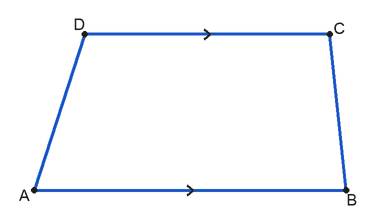
If ∠A : ∠D = 2 : 3 and ∠B : ∠C = 7 : 8; find all the angles of quadrilateral ABCD.
- 693 marks
Question 69
In quadrilateral ABCD; 2∠A = 3∠B = 2∠C = 6∠D. Find all the angles of the quadrilateral.
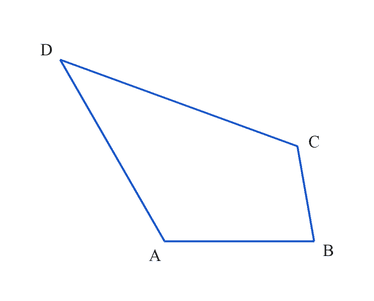
- 703 marks
Question 70
The sum of interior angles of a regular polygon is thrice the sum of its exterior angles. Find the number of sides in the polygon.
- 713 marks
Question 71
Angles of a quadrilateral are (4x)°, 5(x + 2)°, (7x − 20)° and 6(x + 3)°. Find :
(i) the value of x.
(ii) each angle of the quadrilateral.
- 723 marks
Question 72
Use the information given in the following figure to find :
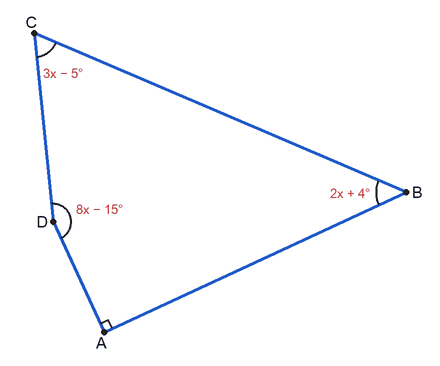
(i) x.
(ii) ∠B and ∠C.
What Class 8 Maths Ch 16 covers
The sections of the chapter, in the order the book takes them. Every question above comes from one of these.
- 01Different Types of Curves
- 02Polygon
- 03Types of Polygons
- 04Sum of Angles of a Polygon
- 05Sum of Exterior Angles of a Polygon
- 06Regular Polygon
More ways to study this chapter
The same chapter asked three other ways. Practise it, revise it, and see what the board has set on Ch 16 before.
Class 8 Maths Ch 16 questions students ask
How many questions are there in Class 8 Maths Ch 16?
72 questions. Every one is solved step by step on this page.
Are these Class 8 Maths solutions free?
Yes. Every question and its full working is free to read, with no account needed.
Can I download the Class 8 Maths Ch 16 solutions as a PDF?
There is no PDF to download. Every solution is on this page instead, which means it is searchable, always the current syllabus, and readable on a phone. Use your browser's print option if you want it on paper.