Solution:
Concept: The sum of the interior angles of a polygon with n sides is (n−2)×180∘, which is the same as (2n−4) right angles. (From one vertex, the diagonals cut the polygon into n−2 triangles, and each triangle has an angle sum of 180°.) Co-interior angles between parallel lines add up to 180°.
Step 1 — (i) Angle sum by formula.
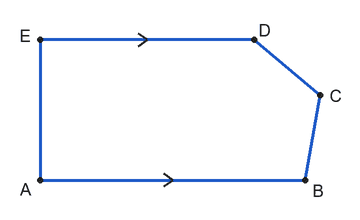
The pentagon has 5 sides, so its angles add up to (n − 2) × 180° with n = 5.
Sum=(5−2)×180∘=3×180∘=540∘
Step 2 — (ii) Use the parallel sides.
AB ∥ ED and AE joins them, so AE is a transversal. ∠A and ∠E lie between the parallel lines on the same side of AE, so they are co-interior angles and add up to 180°.
Step 3 — (iii) Find ∠B + ∠C + ∠D.
Take ∠A + ∠E away from the angle sum.
∠B+∠C+∠D=540∘−180∘=360∘
Step 4 — Share in the ratio 5 : 6 : 7.
Write the angles as 5k, 6k and 7k degrees.
5k+6k+7k18kk=360=360=20
Now multiply each share by k = 20°.
∠B=5×20∘=100∘
∠C=6×20∘=120∘
∠D=7×20∘=140∘
Watch out: ∠A + ∠E = 180° comes from AB ∥ ED, not from ∠A and ∠E being right angles; the stem does not say they are.
Therefore, (i) the angle sum is 540°, (ii) ∠A + ∠E = 180°, and (iii) ∠B = 100°, ∠C = 120° and ∠D = 140°.