
Question 433 marksEasy
AB, BC and CD are three consecutive sides of a regular polygon.
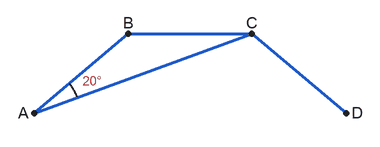
If angle BAC = 20°, find:
(i) its each interior angle
(ii) its each exterior angle
(iii) the number of sides in the polygon.
Confirming your payment
Sign up now and get 250 free tokens.
Understanding Shapes · Question 43 of 72
AB, BC and CD are three consecutive sides of a regular polygon.
If angle BAC = 20°, find:
(i) its each interior angle
(ii) its each exterior angle
(iii) the number of sides in the polygon.
Solution:
Concept: In a regular polygon with sides, all the sides are equal and all the angles are equal. The equal exterior angles add up to 360°, so each exterior angle is and . Each interior angle is 180° minus the exterior angle. The angles opposite equal sides of a triangle are equal.
Step 1 — Use the isosceles triangle.
In a regular polygon all sides are equal, so AB = BC and triangle ABC is isosceles. The angles opposite the equal sides are equal, so ∠BCA is equal to ∠BAC.
Hence ∠BCA = 20°.
Step 2 — (i) Interior angle.
∠ABC is the angle of the polygon at B. The angles of triangle ABC add up to 180°.
Step 3 — (ii) Exterior angle.
The exterior angle makes 180° with the interior angle.
Step 4 — (iii) Number of sides.
Divide 360° by the exterior angle.
Watch out: ∠BAC is an angle of triangle ABC, not an angle of the polygon; the polygon's angle at B is ∠ABC.
Therefore, (i) each interior angle is 140°, (ii) each exterior angle is 40°, and (iii) the polygon has 9 sides.