
Opening your dashboard
Class 8 Chemistry Chapter 9: Carbon and Its Compounds Solutions
58 textbook questions with step-by-step answers, free to read, for ICSE 2026-27.
Get talked through Ch 9, not just shown the answer
Reading a finished solution is not the same as being able to do it. The AI tutor takes one question at a time and works it with you, in your own words, until you can.
- Ask it out loud, in your own words
- It gives you the next step, not the answer
- Stuck on part (ii)? Start there
58 questions with solutions
1–5 marks · Mixed difficulty
- 11 mark
Question 1
In combined state, carbon occurs as :
Solve with AIAnswer
(A) coal
(B) diamond
(C) graphite
- Correct
(D) petroleum
Answer: (D) petroleum
Concept: Carbon occurs in the free state as diamond, graphite and coal, and in the combined state in compounds such as carbon dioxide, carbonates (marble, limestone), natural gas and petroleum.
Step 1 — Sort the options into free and combined carbon.
Diamond and graphite are pure carbon, and the book lists coal with them as a free (uncombined) form. Petroleum is a mixture of compounds of carbon and hydrogen (hydrocarbons).
Step 2 — Pick the combined form.
Only petroleum contains carbon joined chemically to another element, so it is carbon in the combined state.
Watch out: Coal is impure, but the book still counts it with the free (uncombined) forms of carbon.
Why the other options are wrong:
- (A) coal: The book lists coal as a free-state form of carbon, not a combined one.
- (B) diamond: Diamond is pure crystalline carbon, so it is carbon in the free state.
- (C) graphite: Graphite is also pure crystalline carbon in the free state.
Therefore, carbon occurs in the combined state in petroleum, option (D).
- 21 mark
Question 2
A crystalline form of carbon is :
Solve with AIAnswer
(A) lamp black
(B) gas carbon
(C) sugar
- Correct
(D) fullerene
Answer: (D) fullerene
Concept: In a crystalline form the atoms are arranged in a regular, repeating pattern. The crystalline forms of carbon are diamond, graphite and fullerenes; the others are amorphous.
Step 1 — Recall the crystalline allotropes.
Diamond, graphite and fullerenes are the three crystalline forms of carbon.
Step 2 — Match with the options.
Of the four options, only fullerene is in this list.
Why the other options are wrong:
- (A) lamp black: Lamp black (soot) is an amorphous form of carbon.
- (B) gas carbon: Gas carbon is also an amorphous form of carbon.
- (C) sugar: Sugar is a compound of carbon, hydrogen and oxygen, so it is not a form of carbon at all.
Therefore, the crystalline form of carbon among the options is fullerene, option (D).
- 31 mark
Question 3
Graphite is used to make crucibles because it is :
Solve with AIAnswer
(A) a good conductor of electricity
(B) a good conductor of heat
(C) soft and slippery
- Correct
(D) has high melting point
Answer: (D) has high melting point
Concept: A crucible holds metals while they are melted, so it must stay solid far above the melting point of the metal.
Step 1 — Ask what a crucible needs.
Molten metals such as iron are at about 1,500 °C, so the crucible itself must not melt or soften at that temperature.
Step 2 — Match the property of graphite.
Graphite has a very high melting point: at normal pressure it stays solid up to about 3,600 °C (it then turns straight into vapour). This is the property the book gives for its use in crucibles.
Watch out: Graphite's softness and electrical conduction are real properties, but they are used elsewhere (lubricants, pencils, electrodes).
Why the other options are wrong:
- (A) a good conductor of electricity: This property is used for electrodes and carbon brushes, not for crucibles.
- (B) a good conductor of heat: Good heat conduction does help a crucible heat evenly, but it is not the property the book gives; a crucible that melted would be useless however well it conducted heat.
- (C) soft and slippery: This property makes graphite a lubricant and a pencil lead; a soft material is no reason to choose it for a crucible.
Therefore, graphite is used for crucibles because it has a high melting point, option (D).
- 41 mark
Question 4
Diamond is used for :
Solve with AIAnswer
(A) making the electrodes of electric furnaces.
(B) making crucibles for melting metals.
- Correct
(C) cutting and drilling rocks and glass.
(D) making carbon brushes for electric motors.
Answer: (C) cutting and drilling rocks and glass.
Concept: Diamond is the hardest naturally occurring substance, so it can scratch and cut every other material.
Step 1 — Recall the key property of diamond.
Each carbon atom in diamond is held by four strong bonds in a rigid three-dimensional network, so diamond is extremely hard.
Step 2 — Match the use.
A very hard material is needed for cutting and drilling rocks and glass, so diamond (often the cheaper black diamond) is used in glass cutters and drill tips.
Why the other options are wrong:
- (A) making the electrodes of electric furnaces: Furnace electrodes must conduct electricity; they are made of graphite, and diamond does not conduct.
- (B) making crucibles for melting metals: Crucibles for melting metals are made of graphite.
- (D) making carbon brushes for electric motors: Carbon brushes for electric motors are made of graphite, which conducts electricity and is slippery.
Therefore, diamond is used for cutting and drilling rocks and glass, option (C).
- 51 mark
Question 5
Carbon forms innumerable compounds because :
Solve with AIAnswer
(A) it has four electrons in its outermost shell.
(B) it behaves as a metal as well as a non-metal.
- Correct
(C) carbon atoms can form long chains.
(D) it combines with other elements to form covalent compounds.
Answer: (C) carbon atoms can form long chains.
Concept: Catenation is the property of carbon atoms to link with one another into long straight chains, branched chains and rings.
Step 1 — Recall why carbon compounds are so many.
Carbon atoms join to each other in chains of almost any length and shape, and each chain can carry different atoms. This gives millions of different compounds.
Step 2 — Choose the option that names this.
Option (C), "carbon atoms can form long chains", is catenation, which the book gives as the reason.
Watch out: Carbon's valency of four helps catenation, but on its own it does not explain the huge number of compounds; the book's answer is the chain-forming property.
Why the other options are wrong:
- (A): Carbon does have four outer electrons, and this lets each atom bond in four directions, but the book's reason for the innumerable compounds is catenation.
- (B): Carbon is a non-metal; it does not behave as a metal.
- (D): Many elements form covalent compounds, yet only carbon forms innumerable compounds, so this is not the reason.
Therefore, carbon forms innumerable compounds because its atoms can form long chains, option (C).
- 65 marks
Question 6
Fill in the blanks :
(a) ________ is present in both living and non-living things.
(b) The property of an element to exist in two or more forms but in the same physical state is called ________
(c) ________ and ________ are the two major crystalline allotropes of carbon.
(d) ________ is the hardest substance that occurs naturally.
(e) The name 'carbon' is derived from the Latin word ________
Solve with AIWritten solution
Solution:
Concept: Carbon is found in all living things (food, wood, our bodies) and in many non-living things (coal, minerals, air). Allotropy is the existence of an element in two or more forms in the same physical state, with the same chemical properties but different physical properties. Carbon has crystalline allotropes (diamond, graphite, fullerenes) and amorphous forms (coal, coke, charcoal, lamp black, gas carbon).
Step 1 — Fill blanks (a) and (b).
(a) Carbon is present in both living and non-living things.
(b) The property of an element to exist in two or more forms in the same physical state is called allotropy.
Step 2 — Fill blanks (c) and (d).
(c) Diamond and graphite are the two major crystalline allotropes of carbon.
(d) Diamond is the hardest substance that occurs naturally.
Step 3 — Fill blank (e).
(e) The name 'carbon' comes from the Latin word carbo, which means coal (charcoal).
Watch out: Allotropes are forms in the SAME physical state; ice and steam are not allotropes of water.
Therefore, the blanks are (a) carbon, (b) allotropy, (c) diamond and graphite, (d) diamond, (e) carbo.
- 75 marks
Question 7
Write 'true' or 'false' against the following statements and correct the false ones :
(a) Carbon occurs as carbon dioxide in the atmosphere.
(b) Graphite is the purest form of carbon.
(c) Coloured diamonds are costlier than colourless and transparent diamonds.
(d) Graphite has layers of hexagonal carbon bondings.
(e) Diamond is soluble in all solvents.
Solve with AIWritten solution
Solution:
Concept: Diamond is the purest natural form of carbon; it is hard, transparent and insoluble, while graphite is built of flat layers of hexagonal rings.
Step 1 — Check (a).
(a) True. The air contains carbon dioxide, about 0.04 % by volume, so carbon occurs in the atmosphere as carbon dioxide.
Step 2 — Check (b).
(b) False. Correct statement: diamond is the purest naturally occurring form of carbon.
Step 3 — Check (c).
(c) False. Correct statement: colourless, transparent diamonds are costlier than ordinary coloured diamonds, because colour usually comes from impurities and impurities lower the value.
Step 4 — Check (d).
(d) True. In graphite each carbon atom is bonded to three others in flat layers of hexagonal rings, and the layers are held together only by weak forces.
Step 5 — Check (e).
(e) False. Correct statement: diamond is insoluble in all ordinary solvents.
Watch out: A 'false' statement must be corrected, not just marked false.
Note: Rare natural "fancy" colours such as pink, blue or red are an exception and can cost even more than colourless diamonds; the book's statement is about ordinary coloured stones.
Therefore, (a) and (d) are true, while (b), (c) and (e) are false and corrected as above.
- 83 marks
Question 8
Give an appropriate term for the following :
(a) Substances whose atoms or molecules are arranged in a definite pattern.
(b) Different forms of an element found in the same physical state.
(c) The property by which atoms of an element link together to form long chain or ring compounds.
Solve with AIWritten solution
Solution:
Concept: A crystal has its particles in a definite repeating pattern; allotropes are forms of one element in the same physical state; catenation is self-linking of atoms.
Step 1 — Name the term for (a).
Substances whose atoms or molecules are arranged in a definite pattern are crystals (crystalline substances).
Step 2 — Name the term for (b).
Different forms of an element in the same physical state are its allotropes (allotropic forms).
Step 3 — Name the term for (c).
The property by which atoms of an element link together into long chains or rings is catenation (self-linking).
Therefore, the terms are (a) crystals, (b) allotropes and (c) catenation.
- 93 marks
Question 9
Name the following :
(a) The hardest naturally occurring substance.
(b) A greyish black non-metal that is a good conductor of electricity.
(c) The third crystalline form of carbon.
Solve with AIWritten solution
Solution:
Concept: The three crystalline forms of carbon are diamond, graphite and fullerenes.
Step 1 — Name (a).
The hardest naturally occurring substance is diamond.
Step 2 — Name (b).
Graphite is a greyish-black non-metal, and unlike most non-metals it conducts electricity well, so the answer is graphite.
Step 3 — Name (c).
After diamond and graphite, the third crystalline form of carbon is fullerene (for example Buckminster fullerene).
Therefore, (a) diamond, (b) graphite and (c) fullerene.
- 101 mark
Question 10
How many carbon atoms are there in a Buckminster fullerene ?
Solve with AIWritten solution
Solution:
Concept: Fullerenes are cage-shaped molecules made only of carbon atoms; the best known is Buckminster fullerene, with the formula .
Step 1 — Read the formula.
The formula means one molecule contains 60 carbon atoms.
Step 2 — Describe the molecule.
The 60 atoms form a hollow ball of 20 hexagons and 12 pentagons, shaped like a football, so it is also called a buckyball.
Therefore, a Buckminster fullerene molecule has 60 carbon atoms.
- 115 marks
Question 11
Define the following terms :
(a) Allotropy
(b) Carat
(c) Crystal
(d) Catenation
Solve with AIWritten solution
Solution:
Concept: Each term below is a basic word of this chapter; a definition says exactly what the word means, with an example.
Step 1 — Define allotropy.
(a) Allotropy is the property of an element to exist in two or more forms in the same physical state, with the same chemical properties but different physical properties. Example: diamond and graphite are allotropes of carbon.
Step 2 — Define carat.
(b) Carat is the unit in which the mass of a diamond (or another gem) is expressed: 1 carat = 0.2 g (200 mg).
Step 3 — Define crystal.
(c) A crystal is a homogeneous solid in which the particles (atoms, molecules or ions) are arranged in a definite repeating pattern, so it has a definite geometric shape with flat faces. Examples: sodium chloride and sugar.
Step 4 — Define catenation.
(d) Catenation is the property of carbon atoms to link with one another (self-linking) to form long straight chains, branched chains or rings.
Watch out: The carat that measures the mass of a diamond is different from the 'karat' that gives the purity of gold.
Therefore, allotropy, carat (0.2 g), crystal and catenation are defined as above.
- 125 marks
Question 12
Answer the following in brief :
(a) Why is graphite a good conductor of electricity but not diamond ?
(b) Why is diamond very hard ?
(c) What are fullerenes ? Name the most common fullerene.
(d) What impurity is present in black diamond ?
Solve with AIWritten solution
Solution:
Concept: The properties of diamond and graphite depend on how their carbon atoms are bonded: four bonds per atom in diamond, three per atom in graphite.
Step 1 — Explain (a): conduction.
(a) In graphite each carbon atom is bonded to only three neighbours, so one outer electron of each atom is left free. These mobile electrons move through the layers and carry the current. In diamond each atom uses all four outer electrons for bonds, so no free electrons are left and diamond does not conduct.
Step 2 — Explain (b): hardness.
(b) In diamond every carbon atom is joined to four others by strong bonds pointing to the corners of a tetrahedron. This unit repeats in all three directions to form one giant, rigid network, which is very hard to break, so diamond is very hard.
Step 3 — Answer (c): fullerenes.
(c) Fullerenes are the third crystalline form of carbon: molecules in which carbon atoms are joined in a hollow, cage-like (ball or tube) shape. The most common fullerene is Buckminster fullerene, (the buckyball).
Step 4 — Answer (d): black diamond.
(d) The book states that black diamond contains copper oxide as an impurity, which gives it its dark colour.
Watch out: Graphite is a non-metal that conducts; do not say it conducts because it is a metal.
Note: Mineralogists find that the dark colour of natural black diamond (carbonado) comes mainly from tiny inclusions of graphite and other minerals; the book's answer is copper oxide.
Therefore, graphite conducts because of its free electrons, diamond is hard because of its rigid network of strong bonds, fullerenes are cage-like carbon molecules (commonest ), and the book names copper oxide as the impurity in black diamond.
- 135 marks
Question 13
Give two uses of the following mentioning the property being utilized in the said use.
(a) graphite
(b) diamond
Solve with AIWritten solution
Solution:
Concept: Every use of an allotrope depends on one of its special properties, so each use is given with the property behind it.
Step 1 — Give two uses of graphite.
(a) Graphite
- As a lubricant (graphite grease) in machines, because it is soft and slippery: its layers slide over one another.
- For electrodes of electric furnaces and carbon brushes of motors, because it is a good conductor of electricity.
Step 2 — Give two uses of diamond.
(b) Diamond
- In jewellery as a gem, because it sparkles brilliantly: it bends and reflects light strongly.
- For cutting glass and as tips of rock-drilling tools, because it is the hardest naturally occurring substance.
Watch out: Always name the property with the use; a use alone does not earn the mark.
Other correct uses: graphite for crucibles (very high melting point) and pencil leads (leaves a black mark).
Therefore, graphite is used as a lubricant (soft, slippery) and for electrodes (good conductor), and diamond as a gem (brilliant sparkle) and for cutting and drilling (hardest).
- 143 marks
Question 14
Write three differences between graphite and diamond.
Solve with AIWritten solution
Solution:
Concept: Diamond and graphite are both pure carbon, but their atoms are arranged differently, so their physical properties differ.
Step 1 — Compare their look, hardness and conduction.
The three main differences are shown in the table.
Diamond Graphite Pure diamond is colourless and transparent. Graphite is greyish black, opaque and shiny. It is the hardest naturally occurring substance. It is soft and greasy (slippery) to touch. It is a bad conductor of electricity. It is a good conductor of electricity. Step 2 — Add one more difference if needed.
Diamond is also denser (about 3.5 g/cm³) than graphite (about 2.2 g/cm³), because its atoms are packed more closely.
Watch out: Both burn in oxygen to give only carbon dioxide; that is a similarity (both are carbon), not a difference.
Therefore, diamond is transparent, very hard and non-conducting, while graphite is black, soft and a good conductor of electricity.
- 151 mark
Question 15
Anthracite is :
Solve with AIAnswer
(A) an inferior type of coal
- Correct
(B) a superior type of coal
(C) a cheapest form of coal
(D) none of the above
Answer: (B) a superior type of coal
Concept: Coal forms in stages, peat, lignite, bituminous coal and then anthracite, and the carbon content rises at each stage. The more carbon, the better the coal as a fuel.
Step 1 — Place anthracite in the series.
Anthracite is the last stage of coal formation and has the most carbon, about 92–98 %.
Step 2 — Judge its quality.
Because it has the most carbon and burns with great heat and little smoke, anthracite is the superior (best) type of coal.
Why the other options are wrong:
- (A) an inferior type of coal: The most inferior coal is peat (about 50–60 % carbon), not anthracite.
- (C) a cheapest form of coal: Anthracite is the best and costliest coal and is found in only a few places, so it is not the cheapest.
- (D) none of the above: Option (B) is correct, so "none of the above" is wrong.
Therefore, anthracite is a superior type of coal, option (B).
- 161 mark
Question 16
Destructive distillation of coal yields
Solve with AIAnswer
(A) coal tar
(B) coal gas
(C) coke
- Correct
(D) all of the above
Answer: (D) all of the above
Concept: Destructive distillation is the strong heating of a substance in the absence of air, so that it breaks down into new substances instead of burning.
Step 1 — List the products from coal.
When coal is heated strongly without air it gives coke (solid residue), coal tar (thick black liquid), ammoniacal liquor (watery liquid) and coal gas.
Step 2 — Compare with the options.
Coal tar, coal gas and coke are all in this list, so every one of the first three options is a product.
Watch out: When every listed item is correct, the answer is "all of the above", not any single item.
Why the other options are wrong:
- (A) coal tar: Coal tar is one product, but not the only one.
- (B) coal gas: Coal gas is one product, but not the only one.
- (C) coke: Coke is the residue left behind, but the other products form too.
Therefore, destructive distillation of coal yields coal tar, coal gas and coke, option (D).
- 171 mark
Question 17
Lamp black is :
Solve with AIAnswer
- Correct
(A) an amorphous form of carbon
(B) a crystalline form of carbon
(C) a pure form of carbon
(D) a cluster of carbon atoms
Answer: (A) an amorphous form of carbon
Concept: In an amorphous form the atoms have no regular arrangement. Lamp black (soot) is collected when oils burn in too little air, and its carbon has no regular pattern.
Step 1 — Recall how lamp black is classified.
The book lists lamp black with coal, coke, charcoal and gas carbon as the amorphous forms of carbon.
Step 2 — Choose the option.
So lamp black is an amorphous form of carbon.
Why the other options are wrong:
- (B) a crystalline form of carbon: The crystalline forms of carbon are diamond, graphite and fullerenes, not lamp black.
- (C) a pure form of carbon: Lamp black is about 98–99 % carbon, so it is not pure; the purest amorphous form is sugar charcoal.
- (D) a cluster of carbon atoms: A closed cluster (cage) of carbon atoms describes a fullerene molecule, not lamp black.
Therefore, lamp black is an amorphous form of carbon, option (A).
- 181 mark
Question 18
The process by which decayed plants slowly convert into coal is called :
Solve with AIAnswer
(A) petrification
- Correct
(B) carbonization
(C) carbonification
(D) fermentation
Answer: (B) carbonization
Concept: The book calls the slow change of buried plant matter into carbon-rich coal, under heat and pressure and without air, carbonization.
Step 1 — Recall the process.
Buried forests were slowly changed, over millions of years, into peat, lignite, bituminous coal and anthracite.
Step 2 — Name it as the chapter does.
The chapter names this process carbonization.
Note: Option (C) is another name used for the same process in some books, so it is not absurd; the printed key, carbonization, follows this chapter's term.
Why the other options are wrong:
- (A) petrification: Petrification is the slow turning of buried remains (such as wood) into stone, not into coal.
- (C) carbonification: Some geology books use "carbonification" (or "coalification") for this process, but the term this chapter uses, and keys, is carbonization.
- (D) fermentation: Fermentation is the breakdown of sugars by micro-organisms such as yeast, not the formation of coal.
Therefore, the process is called carbonization, option (B).
- 191 mark
Question 19
The purest form of the amorphous carbon is :
Solve with AIAnswer
(A) wood charcoal
- Correct
(B) sugar charcoal
(C) bone charcoal
(D) lamp black
Answer: (B) sugar charcoal
Concept: Sugar charcoal is made by heating cane sugar without air (or by removing its water with concentrated sulphuric acid). Sugar contains only carbon, hydrogen and oxygen, so nearly pure carbon is left.
Step 1 — Compare the sources.
Wood and bones contain mineral matter that stays in their charcoal as ash; sugar has no mineral matter.
Step 2 — Choose the purest.
So sugar charcoal is the purest form of amorphous carbon.
Why the other options are wrong:
- (A) wood charcoal: Wood charcoal keeps the mineral impurities (ash) of the wood.
- (C) bone charcoal: Bone charcoal is mainly calcium phosphate, with only about 10 % carbon.
- (D) lamp black: Lamp black is about 98–99 % carbon, which is less pure than sugar charcoal.
Therefore, the purest form of amorphous carbon is sugar charcoal, option (B).
- 205 marks
Question 20
Fill in the blanks :
(a) ________ is formed when charcoal is burnt in a limited supply of air.
(b) Coal is a ________ form of carbon.
(c) ________ is the most inferior form of coal.
(d) Wood charcoal is a ________ conductor of heat and electricity.
(e) ________ is used in making black shoe polish.
Solve with AIWritten solution
Solution:
Concept: Carbon burnt in too little air gives carbon monoxide; coal, coke, charcoal, lamp black and gas carbon are the amorphous forms of carbon.
Step 1 — Fill blanks (a) and (b).
(a) Carbon monoxide is formed when charcoal is burnt in a limited supply of air.
(b) Coal is an amorphous form of carbon.
Step 2 — Fill blanks (c) and (d).
(c) Peat is the most inferior form of coal (only about 50–60 % carbon).
(d) Wood charcoal is a bad conductor of heat and electricity.
Step 3 — Fill blank (e).
(e) Lamp black is used in making black shoe polish.
Therefore, the blanks are (a) carbon monoxide, (b) amorphous, (c) peat, (d) bad, (e) lamp black.
- 215 marks
Question 21
Write 'true' or 'false' against the following statements and correct the false ones :
(a) Lamp black is used in making shoe polish.
(b) Coke is obtained by destructive distillation of sugar.
(c) Activated charcoal is a good conductor of electricity.
(d) Wood charcoal is an important constituent of gun powder.
(e) Coal gas is used in the preparation of artificial fertilizers.
Solve with AIWritten solution
Solution:
Concept: Each amorphous form of carbon has its own source, properties and uses; check each statement against them.
Step 1 — Check (a).
(a) True. Lamp black is used in making black shoe polish (and printing ink).
Step 2 — Check (b).
(b) False. Correct statement: coke is obtained by the destructive distillation of coal.
Step 3 — Check (c).
(c) False. Correct statement: activated charcoal is a bad (poor) conductor of electricity; it is valued for adsorption, not conduction.
Step 4 — Check (d).
(d) True. Gunpowder is a mixture of charcoal, sulphur and potassium nitrate.
Step 5 — Check (e).
(e) False. Correct statement: ammoniacal liquor is used to prepare artificial fertilizers (ammonium sulphate); coal gas is used as a fuel.
Therefore, (a) and (d) are true, while (b), (c) and (e) are false and corrected as above.
- 225 marks
Question 22
Match the following :
The items of the two columns are given below.
Column A Column B (a) Ivory black (i) Artificial diamond (b) Lamp black (ii) Electrodes (c) Gas carbon (iii) Lubricant (d) Sugar charcoal (iv) Shoe polish (e) Graphite (vi) Black pigment Solve with AIWritten solution
Solution:
Concept: Each form of carbon is matched with the use that depends on its special property.
Step 1 — Match the blacks.
Ivory black (bone black) is a fine black powder, so it is used as a black pigment: (a) matches (vi). Lamp black is a fine soot used in shoe polish: (b) matches (iv).
Step 2 — Match gas carbon and sugar charcoal.
Gas carbon is hard and conducts electricity, so it is used for electrodes (for example in dry cells): (c) matches (ii). The book gives sugar charcoal, the purest amorphous carbon, as the starting material for artificial diamonds: (d) matches (i).
Step 3 — Match graphite.
Graphite is soft and slippery, so it is a lubricant: (e) matches (iii).
Watch out: Column B is printed as (i)–(iv) and (vi), with no (v); use the labels exactly as printed.
Therefore, (a) matches (vi) black pigment, (b) matches (iv) shoe polish, (c) matches (ii) electrodes, (d) matches (i) artificial diamond, (e) matches (iii) lubricant.
- 235 marks
Question 23
Name the following :
(a) Substances whose atoms or molecules are not arranged in a geometrical pattern.
(b) The best variety of coal.
(c) The purest form of amorphous carbon.
(d) An amorphous form of carbon that that burns without smoke.
(e) Mixture of carbon monoxide and hydrogen.
Solve with AIWritten solution
Solution:
Concept: Substances without a regular arrangement of particles are amorphous; coal grades by carbon content; water gas comes from steam and red-hot coke.
Step 1 — Name (a) and (b).
(a) Substances whose atoms or molecules are not arranged in a geometric pattern are amorphous substances.
(b) The best variety of coal, with the most carbon, is anthracite.
Step 2 — Name (c) and (d).
(c) The purest form of amorphous carbon is sugar charcoal.
(d) The amorphous form of carbon that burns without smoke is coke, because its volatile matter was driven off when it was made.
Step 3 — Name (e).
(e) A mixture of carbon monoxide and hydrogen is water gas, made by passing steam over red-hot coke:
Therefore, (a) amorphous substances, (b) anthracite, (c) sugar charcoal, (d) coke, (e) water gas.
- 245 marks
Question 24
Define the following :
(a) Carbonization
(b) Adsorption
(c) Destructive distillation
Solve with AIWritten solution
Solution:
Concept: Each term describes a process met in the study of the amorphous forms of carbon.
Step 1 — Define carbonization.
(a) Carbonization is the slow conversion of buried vegetable matter into carbon-rich coal by high temperature and pressure in the absence of air, over millions of years.
Step 2 — Define adsorption.
(b) Adsorption is the property of a substance to hold particles of gases, liquids or dissolved substances on its surface only (they do not go into its body). Example: wood charcoal adsorbs gases and colouring matter.
Step 3 — Define destructive distillation.
(c) Destructive distillation is the strong heating of a substance in the absence of air, so that it breaks down into new substances instead of burning. Example: coal gives coke, coal tar, coal gas and ammoniacal liquor.
Watch out: Adsorption (on the surface) is not absorption (taken in throughout, as water by a sponge).
Therefore, carbonization, adsorption and destructive distillation are defined as above.
- 252 marks
Question 25
Why is wood charcoal used in water filters and gas masks ?
Solve with AIWritten solution
Solution:
Concept: Wood charcoal is very porous, so a small piece has a huge inner surface, and it is a good adsorbent: gases and colouring matter stick to that surface.
Step 1 — Explain its use in water filters.
As water passes through a bed of charcoal, impurities, colouring matter and bad-smelling substances are adsorbed on the charcoal's surface, so cleaner, odour-free water comes out.
Step 2 — Explain its use in gas masks.
As air is breathed in through the charcoal layer, poisonous and foul-smelling gases are adsorbed on it, so cleaner air reaches the lungs.
Watch out: Charcoal adsorbs gases and dissolved matter; it does not kill germs, so filtered water may still need disinfecting.
Therefore, wood charcoal is used in water filters and gas masks because its porous surface adsorbs impurities and harmful gases.
- 265 marks
Question 26
Name the products formed when :
(a) wood is burnt in the absence of air.
(b) bone is heated in the absence of air.
(c) diamond is burnt in air at 900°C.
(d) graphite is subjected to high pressure and 3000°C temperature.
Solve with AIWritten solution
Solution:
Concept: Heating a substance strongly without air breaks it down (destructive distillation); burning any form of carbon in air gives carbon dioxide.
Step 1 — Name the products for (a).
(a) Wood heated without air gives wood charcoal, with wood tar, pyroligneous acid (a watery acidic liquid) and wood gas.
Step 2 — Name the products for (b).
(b) Bones heated without air give bone charcoal (animal charcoal), with bone oil (which contains pyridine) and gases such as ammonia.
Step 3 — Name the product for (c).
(c) Diamond is pure carbon, so when it burns in air at about 900 °C it gives only carbon dioxide:
Step 4 — Name the product for (d).
(d) Graphite under very high pressure at about 3,000 °C changes into artificial (synthetic) diamond.
Note: Burning diamond and getting only carbon dioxide is the proof that diamond is a form of carbon.
Therefore, (a) wood charcoal, (b) bone charcoal, (c) carbon dioxide and (d) artificial diamond are the main products.
- 275 marks
Question 27
Give two uses for each of the following :
(a) coal
(b) coke
(c) wood charcoal
(d) sugar charcoal
(e) bone charcoal
(f) lamp black
Solve with AIWritten solution
Solution:
Concept: Each amorphous form of carbon is used for the property it has most: heat from burning, adsorption, reducing power or blackness.
Step 1 — Give the uses of coal and coke.
(a) Coal: as a fuel in homes, industries and thermal power stations; and to make coke, coal gas and coal tar.
(b) Coke: as a smokeless fuel; and as a reducing agent in extracting metals (such as iron) from their ores.
Step 2 — Give the uses of wood and sugar charcoal.
(c) Wood charcoal: as an adsorbent in gas masks and water filters; and in making gunpowder.
(d) Sugar charcoal: as a reducing agent to get metals from their oxides; and (the book's use) for making artificial diamonds.
Step 3 — Give the uses of bone charcoal and lamp black.
(e) Bone charcoal: to remove the colour of raw cane sugar solution in sugar refining; and to remove excess fluoride from drinking water.
(f) Lamp black: in black shoe polish and printing ink; and as a filler in rubber tyres.
Therefore, the two uses of each form are as given above.
- 283 marks
Question 28
What is destructive distillation ? What are the products formed due to the destructive distillation of coal ?
Solve with AIWritten solution
Solution:
Concept: Destructive distillation is the strong heating of a substance in the absence of air, so that it breaks down into new substances instead of burning.
Step 1 — Define the process.
When a substance is heated strongly in the absence of air, it decomposes into simpler substances. This is called destructive distillation; with no air, the substance cannot burn.
Step 2 — Heat coal this way.
Powdered coal is heated strongly in a hard-glass test tube, and the vapours are led into a cooled receiver. Dark vapours come off and four main products form.
Step 3 — List the products.
The products collect in different parts of the apparatus.
- Coke — the grey, porous solid left in the test tube.
- Coal tar — a thick black liquid that collects as the lower layer in the receiver.
- Ammoniacal liquor — the watery upper layer in the receiver (it contains ammonia).
- Coal gas — a gas that passes on and burns at the jet; it is a fuel.
Some carbon from the hot vapours also deposits on the upper walls of the tube as gas carbon.
Watch out: Destructive distillation is done WITHOUT air; heating coal in air simply burns it to carbon dioxide.
Therefore, destructive distillation of coal gives coke, coal tar, ammoniacal liquor and coal gas.
- 293 marks
Question 29
How is wood charcoal made locally ? What other substances are formed in the process ?
Solve with AIWritten solution
Solution:
Concept: Wood heated with too little air cannot burn completely; its water and volatile matter are driven off and mostly carbon is left as wood charcoal.
Step 1 — Build the pile.
Logs of wood are stacked one above the other around a central gap that acts as a chimney.
Step 2 — Cut off most of the air.
The pile is covered with wet clay (mud), leaving only a few small holes near the bottom, so only a limited supply of air can enter.
Step 3 — Burn and cool.
The wood is lit. A little of it burns, and the heat chars the rest. When the fire dies out and the pile cools, a black, brittle, porous solid — wood charcoal — is left.
Step 4 — Name the other substances formed.
The vapours that escape contain wood tar, pyroligneous acid (a watery acidic liquid) and wood gas. In the local method they escape through the chimney; in the laboratory they can be collected by heating sawdust in a test tube.
Therefore, wood charcoal is made locally by burning a clay-covered pile of wood in a limited supply of air, and wood tar, pyroligneous acid and wood gas are also formed.
- 305 marks
Question 30
(a) Describe briefly about the formation of coal.
(b) Name four types of coal with the percentage of carbon present in each.
Solve with AIWritten solution
Solution:
Concept: Coal formed from buried plants by carbonization over millions of years; the longer the process ran, the higher the carbon content of the coal.
Step 1 — (a) Describe how the plants were buried.
Millions of years ago, huge forests were buried under layers of mud and rock, mainly during the Carboniferous period (about 360 to 300 million years ago).
Step 2 — (a) Describe how they changed.
Under high temperature and pressure and in the absence of air, the plant matter decayed slowly (at first by bacteria) and changed step by step: plants, then peat, then lignite, then bituminous coal, and finally anthracite. At each stage water and other matter were lost, so the carbon content increased. This slow change is carbonization.
Step 3 — (b) Name the types of coal.
The four types of coal, with the book's carbon contents, are shown in the table.
Type of coal Carbon (approximately) Peat 50–60 % Lignite (brown coal) 60–70 % Bituminous coal 70–90 % Anthracite 92–98 % Watch out: Peat is the first (poorest) stage and anthracite the last (best); the order shows the rising carbon content.
Therefore, coal formed by the slow carbonization of buried plants, and its four types are peat, lignite, bituminous coal and anthracite, with carbon rising from about 50 % to 98 %.
- 311 mark
Question 31
The gas which keeps our earth warm is:
Solve with AIAnswer
(A)
(B)
- Correct
(C)
(D) Ne
Answer: (C)
Concept: The earth absorbs sunlight and gives out heat as infrared radiation. Greenhouse gases such as carbon dioxide absorb part of this heat and keep the earth warm (the greenhouse effect).
Step 1 — Find the greenhouse gas among the options.
Oxygen, nitrogen and neon do not absorb the earth's infrared radiation; carbon dioxide does.
Step 2 — Choose the option.
So the gas that keeps the earth warm is carbon dioxide.
Watch out: Water vapour and methane are greenhouse gases too, but they are not among the options.
Why the other options are wrong:
- (A): Oxygen does not absorb the heat radiated by the earth; it is needed for breathing and burning.
- (B): Nitrogen, the main gas of air, does not absorb the earth's heat radiation either.
- (D) Ne: Neon is a noble gas present only in traces and is not a greenhouse gas.
Therefore, the gas that keeps our earth warm is carbon dioxide, option (C).
- 321 mark
Question 32
The acid used in the laboratory preparation of carbon dioxide gas is :
Solve with AIAnswer
- Correct
(A) dil. hydrochloric acid
(B) conc. sulphuric acid
(C) dil. sulphuric acid
(D) conc. hydrochloric acid
Answer: (A) dil. hydrochloric acid
Concept: In the laboratory, carbon dioxide is made by the action of dilute hydrochloric acid on marble chips (calcium carbonate).
Step 1 — Write the reaction.
Calcium carbonate reacts with dilute hydrochloric acid to give soluble calcium chloride, water and carbon dioxide:
Step 2 — See why this acid works.
Calcium chloride is soluble, so the surface of the marble stays clean and the reaction goes on steadily.
Why the other options are wrong:
- (B) conc. sulphuric acid: Concentrated sulphuric acid forms calcium sulphate, which is only very slightly soluble; it coats the marble chips and soon stops the reaction.
- (C) dil. sulphuric acid: Dilute sulphuric acid is avoided for the same reason: the calcium sulphate layer stops the reaction.
- (D) conc. hydrochloric acid: Concentrated hydrochloric acid gives off hydrogen chloride fumes that would make the carbon dioxide impure, so the acid is used dilute.
Therefore, the acid used is dilute hydrochloric acid, option (A).
- 331 mark
Question 33
The metal which burns in carbon dioxide is :
Solve with AIAnswer
(A) Iron
- Correct
(B) Magnesium
(C) Aluminium
(D) Copper
Answer: (B) Magnesium
Concept: Carbon dioxide does not support ordinary burning, but a very reactive metal that is already burning can take the oxygen out of it.
Step 1 — Recall the experiment.
A burning magnesium ribbon placed in a jar of carbon dioxide goes on burning, and white magnesium oxide forms with black specks of carbon.
Step 2 — Write the reaction.
Magnesium removes the oxygen from carbon dioxide and sets carbon free:
Why the other options are wrong:
- (A) Iron: Iron does not go on burning in carbon dioxide.
- (C) Aluminium: Aluminium is not among the metals the book lists as burning in carbon dioxide (sodium, potassium and magnesium).
- (D) Copper: Copper is a less active metal and does not burn in carbon dioxide.
Therefore, the metal that burns in carbon dioxide is magnesium, option (B).
- 341 mark
Question 34
The substance used in artificial respiration is :
Solve with AIAnswer
(A) carbon
(B) carbon dioxide
- Correct
(C) carbogen
(D) carbonization
Answer: (C) carbogen
Concept: Carbogen is a mixture of about 95 % oxygen and 5 % carbon dioxide. The book gives it as the substance used for artificial respiration: the oxygen supports life and the small amount of carbon dioxide stimulates breathing.
Step 1 — Identify a breathable mixture.
Only a gas mixture rich in oxygen can be used to help a patient breathe.
Step 2 — Choose the option.
Among the options this is carbogen.
Note: This is the book's answer; today doctors usually give pure oxygen instead, and carbogen is rarely used.
Why the other options are wrong:
- (A) carbon: Carbon is a solid element and cannot be breathed in.
- (B) carbon dioxide: Pure carbon dioxide does not support life; only a small share (about 5 %) is mixed with oxygen in carbogen.
- (D) carbonization: Carbonization is a process (the formation of coal), not a substance.
Therefore, the substance used in artificial respiration is carbogen, option (C).
- 351 mark
Question 35
The substance which can sublime is :
Solve with AIAnswer
(A) baking soda
(B) marble
(C) lime water
- Correct
(D) dry ice
Answer: (D) dry ice
Concept: Sublimation is the change of a solid directly into vapour (gas) on warming, without becoming a liquid.
Step 1 — Recall what dry ice is.
Dry ice is solid carbon dioxide. At normal pressure it turns straight into carbon dioxide gas at about −78 °C, so it sublimes.
Step 2 — Choose the option.
So the substance that can sublime is dry ice.
Why the other options are wrong:
- (A) baking soda: Baking soda decomposes on heating into sodium carbonate, water and carbon dioxide; it does not sublime.
- (B) marble: Marble (calcium carbonate) decomposes on strong heating into lime and carbon dioxide; it does not sublime.
- (C) lime water: Lime water is a solution (a liquid), not a solid that can sublime.
Therefore, the substance that can sublime is dry ice, option (D).
- 365 marks
Question 36
Write the balanced chemical equations for the preparation of carbon dioxide by :
(a) heating calcium carbonate.
(b) the action of acetic acid on sodium bicarbonate.
(c) the action of dilute sulphuric acid on sodium bicarbonate.
(d) the action of dilute hydrochloric acid on sodium carbonate.
Solve with AIWritten solution
Solution:
Concept: Carbonates break up on strong heating, and carbonates and bicarbonates react with acids; both give carbon dioxide.
Step 1 — (a) Heat calcium carbonate.
On strong heating, calcium carbonate decomposes into calcium oxide (quicklime) and carbon dioxide:
Step 2 — (b) Add acetic acid to sodium bicarbonate.
Acetic acid reacts with sodium bicarbonate to give sodium acetate, water and carbon dioxide:
Step 3 — (c) Add dilute sulphuric acid to sodium bicarbonate.
Two units of sodium bicarbonate are needed for each unit of sulphuric acid, because the acid has two replaceable hydrogens:
Step 4 — (d) Add dilute hydrochloric acid to sodium carbonate.
Sodium carbonate needs two units of hydrochloric acid:
Watch out: Count each kind of atom on both sides after writing every equation; (c) and (d) need the coefficient 2.
Therefore, the four balanced equations for making carbon dioxide are as written above.
- 375 marks
Question 37
What happens when :
(a) a lit splinter is introduced into a jar containing carbon dioxide ?
(b) moist blue litmus paper is placed in a jar containing carbon dioxide ?
(c) carbon dioxide is passed through lime water first in small amounts and then in excess ?
(d) vinegar is added to baking soda ?
(e) a soda water bottle is opened ?
Solve with AIWritten solution
Solution:
Concept: Carbon dioxide neither burns nor supports burning, forms a weak acid with water, turns lime water milky, and is given off when an acid acts on a carbonate or bicarbonate.
Step 1 — (a) Lit splinter in carbon dioxide.
The lit splinter goes out, because carbon dioxide neither burns nor supports burning.
Step 2 — (b) Moist blue litmus in carbon dioxide.
The moist blue litmus paper turns (faintly) red, because carbon dioxide dissolves in the moisture to form weak carbonic acid:
Step 3 — (c) Carbon dioxide through lime water.
At first the lime water turns milky, because insoluble calcium carbonate forms:
With excess carbon dioxide the milkiness disappears, because soluble calcium bicarbonate forms:
Step 4 — (d) Vinegar on baking soda.
There is brisk effervescence (fizzing) as carbon dioxide is given off by the acetic acid in vinegar:
Step 5 — (e) Opening a soda water bottle.
Carbon dioxide was dissolved under high pressure. On opening, the pressure falls, the gas becomes less soluble and it escapes with a fizz (effervescence).
Watch out: In (c) the milkiness appears first and disappears only with excess gas; say both stages.
Therefore, the splinter goes out, blue litmus turns red, lime water turns milky and then clear, vinegar and baking soda effervesce, and the soda water fizzes.
- 385 marks
Question 38
Give reasons for the following :
(a) An excess of carbon dioxide increases the temperature of the earth.
(b) Soda-acid and foam-type of fire extinguishers are not used for extinguishing electrical fires.
(c) Solid carbon dioxide is used for the refrigeration of food.
Solve with AIWritten solution
Solution:
Concept: Carbon dioxide absorbs heat radiated by the earth; water solutions conduct electricity; dry ice is very cold and sublimes without melting.
Step 1 — (a) Explain the warming.
The earth gives out heat as infrared radiation, and carbon dioxide in the air absorbs part of it (the greenhouse effect). When the amount of carbon dioxide increases, more heat is held back, so the earth's average temperature rises (global warming).
Step 2 — (b) Explain why these extinguishers are not used on electrical fires.
Soda-acid and foam extinguishers spray water solutions, which conduct electricity. On a live electrical fire they can give the user an electric shock and cause short circuits.
Step 3 — (c) Explain the use of dry ice.
Solid carbon dioxide (dry ice) is very cold, about −78 °C, and it sublimes straight into gas without melting. So it keeps food frozen without making it wet, and the carbon dioxide gas around the food slows its spoiling.
Watch out: Dry ice is too cold to touch with bare hands; it must be handled with gloves or tongs.
Therefore, extra carbon dioxide traps more heat, water-based extinguishers conduct electricity, and dry ice cools food without wetting it.
- 395 marks
Question 39
(a) Name the chemicals required for the preparation of carbon dioxide in the laboratory.
(b) Write the balanced chemical equation for the preparation of in the laboratory.
(c) How will you collect gas in the laboratory ?
(d) Draw a labelled diagram for the preparation of in the laboratory.
(e) Why is sulphuric acid not used for the preparation of carbon dioxide in the laboratory ?
(f) Give a chemical test for carbon dioxide.
Solve with AIWritten solution
Solution:
Concept: Carbon dioxide is prepared in the laboratory by the action of dilute hydrochloric acid on marble chips (calcium carbonate) in a Woulfe's bottle.
Step 1 — (a) Name the chemicals.
The chemicals are marble chips (calcium carbonate, ) and dilute hydrochloric acid ().
Step 2 — (b) Write the equation.
Calcium carbonate reacts with hydrochloric acid to give calcium chloride, water and carbon dioxide:
Step 3 — (c) Collect the gas.
Carbon dioxide is collected by upward displacement of air in a gas jar kept upright. Its relative molecular mass is 44, against about 29 for air, so it is about 1.5 times as heavy as air and settles at the bottom, pushing the air out. It is not collected over water because it is fairly soluble in water.
Step 4 — (d) Draw the apparatus.
The labelled set-up is shown below.
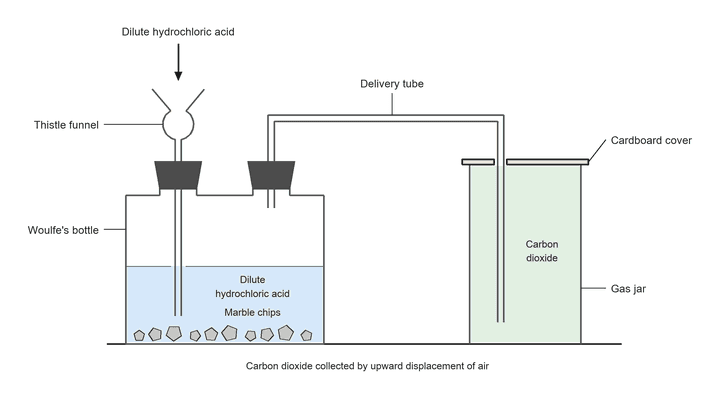
Dilute hydrochloric acid is poured through the thistle funnel until the marble chips are covered and the end of the funnel's stem dips in the acid, so that the gas cannot escape through the funnel. The gas leaves through the delivery tube, which reaches to the bottom of the gas jar.
Step 5 — (e) Explain why sulphuric acid is not used.
Sulphuric acid forms calcium sulphate, which is only very slightly soluble. It forms a coating over the marble chips, stops the acid from reaching them, and the reaction soon stops:
Step 6 — (f) Test the gas.
Pass the gas through lime water: it turns milky, and with excess gas the milkiness disappears.
Watch out: The thistle funnel's stem must dip below the acid, and the delivery tube must end above the acid, just below the cork.
Therefore, carbon dioxide is made from marble chips and dilute hydrochloric acid, collected by upward displacement of air, and identified by its turning lime water milky.
- 403 marks
Question 40
What is a fire extinguisher ? What is the substance used in the modern type of fire extinguishers ? How is it an improvement over the soda-acid and foam-type fire extinguishers ?
Solve with AIWritten solution
Solution:
Concept: Every fire needs fuel, heat and oxygen. Carbon dioxide neither burns nor supports burning and is heavier than air, so a layer of it cuts off the oxygen from a fire.
Step 1 — Define a fire extinguisher.
A fire extinguisher is a device that puts out a fire by covering it with a substance that cuts off its supply of air; in the types studied here, carbon dioxide is produced or stored in it for this purpose.
Step 2 — Name the substance in the modern type.
The modern type contains liquid carbon dioxide stored under pressure in a steel cylinder. When the valve is opened, the pressure falls and it comes out as gas and white "snow" (dry ice) that blankets the fire.
Step 3 — Explain the improvement.
The older types have limits that the liquid carbon dioxide type does not have.
- The soda-acid type cannot be used on oil fires, because its water is heavier than oil, sinks below it and may spread the burning oil.
- Both soda-acid and foam types spray water solutions, which conduct electricity, so they are dangerous on electrical fires.
- The liquid carbon dioxide type sprays no water, leaves no residue and does not conduct, so it can be used on oil fires and electrical fires.
Watch out: Never use water or a water-based extinguisher on a live electrical fire.
Therefore, a fire extinguisher cuts off the air supply of a fire; the modern type uses liquid carbon dioxide, which, unlike the soda-acid and foam types, is safe on oil and electrical fires.
- 413 marks
Question 41
Explain the term 'greenhouse effect'. What are its benefits ? How is it harmful ?
Solve with AIWritten solution
Solution:
Concept: The air lets sunlight through to the earth, but greenhouse gases such as carbon dioxide absorb part of the heat (infrared radiation) that the warmed earth gives out.
Step 1 — Explain the greenhouse effect.
Sunlight passes through the air and warms the earth's surface. The warm surface gives out heat as infrared radiation. Carbon dioxide and other greenhouse gases (water vapour, methane, nitrous oxide, CFCs) absorb part of this heat and send some of it back to the earth. This keeping in of the earth's heat by gases in the air is called the greenhouse effect; the name comes from glass houses that keep plants warm in cold regions.
Step 2 — State its benefit.
It keeps the earth warm enough for plants, animals and people to live. Without it the average surface temperature would be about −18 °C instead of about 15 °C.
Step 3 — Explain how it becomes harmful.
Burning fossil fuels and cutting down forests have raised the carbon dioxide in air to about 420 ppm (0.04 %) today. More greenhouse gases hold back more heat, causing global warming:
- the average temperature of the earth rises;
- glaciers and the land ice sheets of Greenland and Antarctica melt, and warming sea water expands, so the sea level rises and low coastal areas may be flooded;
- rainfall and crop patterns change, and droughts and storms become more severe;
- many plants and animals lose their habitats and may become extinct.
Watch out: Melting floating sea ice hardly raises the sea level; the rise comes from land ice and the expansion of warmer water.
Therefore, the greenhouse effect is the trapping of the earth's heat by gases such as carbon dioxide; it keeps the earth warm, but an excess causes global warming.
- 425 marks
Question 42
(a) State three ways by which carbon dioxide gas is added into the atmosphere.
(b) What steps should be taken to balance carbon dioxide in the atmosphere ?
Solve with AIWritten solution
Solution:
Concept: The amount of carbon dioxide in the air stays steady only when the amount added is balanced by the amount removed, mainly by green plants in photosynthesis.
Step 1 — (a) List three ways carbon dioxide is added.
Carbon dioxide is added to the air in three main ways.
- Respiration by human beings, animals and plants.
- Burning of fuels such as coal, wood, petrol and diesel in homes, vehicles, power stations and industries.
- Decay of dead plants and animals (volcanoes also add some).
Step 2 — (b) State the steps to balance it.
The balance is kept by adding less carbon dioxide and letting green plants remove more of it.
- Grow more trees and stop cutting down forests, because plants use carbon dioxide in photosynthesis.
- Burn less fossil fuel: use public transport and save electricity.
- Use clean sources of energy such as solar, wind and hydroelectric power, and biogas instead of wood and coal.
Note: Filters in factory chimneys remove smoke particles but not carbon dioxide, so they do not help balance it.
Therefore, carbon dioxide is added by respiration, burning and decay, and kept in balance by planting trees, burning less fossil fuel and using clean energy.
- 435 marks
Question 43
Fill in the blanks :
(a) ________ is formed when carbon is burnt in a limited supply of air or oxygen.
(b) Carbon monoxide burns in air with a ________ flame to form carbon dioxide.
(c) Carbon monoxide is a product of ________ combustion.
(d) A mixture of 95% oxygen and 5% carbon dioxide is called ________
(e) Carbon monoxide is used as a ________ in the extraction of pure metals from their corresponding ores.
Solve with AIWritten solution
Solution:
Concept: Carbon burnt in plenty of air gives carbon dioxide, but in a limited supply of air it gives carbon monoxide, a gas that burns and is a reducing agent.
Step 1 — Fill blanks (a) and (b).
(a) Carbon monoxide is formed when carbon is burnt in a limited supply of air or oxygen:
(b) Carbon monoxide burns in air with a blue flame to form carbon dioxide:
Step 2 — Fill blanks (c) and (d).
(c) Carbon monoxide is a product of incomplete combustion.
(d) A mixture of 95 % oxygen and 5 % carbon dioxide is called carbogen.
Step 3 — Fill blank (e).
(e) Carbon monoxide is used as a reducing agent in the extraction of metals from their ores, because it removes oxygen from their oxides.
Therefore, the blanks are (a) carbon monoxide, (b) blue, (c) incomplete, (d) carbogen, (e) reducing agent.
- 441 mark
Question 44
Assertion (A): Carbon can form a large number of compounds, most of which are studied under organic chemistry. Reason (R): Carbon atoms can form long chains with each other.
Solve with AIAnswer
- Correct
(A) Both A and R are true and R is the correct explanation of A.
(B) Both A and R are true but R is not the correct explanation of A.
(C) A is true but R is false.
(D) A is false but R is true.
Answer: (A) Both A and R are true and R is the correct explanation of A.
Concept: Catenation is the ability of carbon atoms to link with one another into long chains, branched chains and rings. Judge the Assertion (A) first, then the Reason (R), and only then decide whether R explains A.
Step 1 — Judge the Assertion.
A is true: carbon forms millions of compounds, and most of them are studied in organic chemistry.
Step 2 — Judge the Reason.
R is true: carbon atoms do join to each other in long chains.
Step 3 — Decide whether R explains A.
Because carbon atoms can form chains of any length and shape, a huge variety of compounds is possible. So R is the correct explanation of A.
Why the other options are wrong:
- (B): This says R does not explain A, but chain formation is exactly why carbon forms so many compounds.
- (C): This says R is false, but carbon atoms really do form long chains.
- (D): This says A is false, but carbon does form an enormous number of compounds.
Therefore, both A and R are true and R is the correct explanation of A, option (A).
- 451 mark
Question 45
Assertion (A): Coal is used as a fuel for domestic purposes and industries. Reason (R): Coal is an amorphous form of carbon.
Solve with AIAnswer
(A) Both A and R are true and R is the correct explanation of A.
- Correct
(B) Both A and R are true but R is not the correct explanation of A.
(C) A is true but R is false.
(D) A is false but R is true.
Answer: (B) Both A and R are true but R is not the correct explanation of A.
Concept: Coal is used as a fuel because it burns and gives out a lot of heat. Judge the Assertion (A) first, then the Reason (R), and only then decide whether R explains A.
Step 1 — Judge the Assertion.
A is true: coal is used as a fuel in homes and in industries such as power stations.
Step 2 — Judge the Reason.
R is true: coal is one of the amorphous forms of carbon.
Step 3 — Decide whether R explains A.
Being amorphous does not make a substance a good fuel; coal is a fuel because its carbon burns and releases heat. So R does not explain A.
Watch out: A true Reason is the explanation only if it answers "why" for the Assertion.
Why the other options are wrong:
- (A): This says R explains A, but being amorphous is not why coal is a fuel.
- (C): This says R is false, but coal really is an amorphous form of carbon.
- (D): This says A is false, but coal really is used as a domestic and industrial fuel.
Therefore, both A and R are true but R is not the correct explanation of A, option (B).
- 461 mark
Question 46
Assertion (A): Diamond and graphite are crystalline allotropes of carbon. Reason (R): Both diamond and graphite are good conductors of electricity and are used as gems.
Solve with AIAnswer
(A) Both A and R are true and R is the correct explanation of A.
(B) Both A and R are true but R is not the correct explanation of A.
- Correct
(C) A is true but R is false.
(D) A is false but R is true.
Answer: (C) A is true but R is false.
Concept: Diamond and graphite are both crystalline allotropes of carbon, but they have very different properties. Judge the Assertion (A) first, then the Reason (R), and only then decide whether R explains A.
Step 1 — Judge the Assertion.
A is true: diamond and graphite are crystalline allotropes of carbon.
Step 2 — Judge the Reason.
R is false: diamond is a bad conductor of electricity, and graphite, though a good conductor, is not used as a gem.
Step 3 — Decide the option.
A true Assertion with a false Reason gives "A is true but R is false".
Watch out: A statement joined by "both … and" is false if either half is false.
Why the other options are wrong:
- (A): This needs R to be true, but R is false.
- (B): This also needs R to be true, but R is false.
- (D): This says A is false, but A is true.
Therefore, A is true but R is false, option (C).
- 471 mark
Question 47
Assertion (A): The value of diamond decreases with an increase in the impurities. Reason (R): Colourless, transparent diamonds are the costliest.
Solve with AIAnswer
(A) Both A and R are true and R is the correct explanation of A.
- Correct
(B) Both A and R are true but R is not the correct explanation of A.
(C) A is true but R is false.
(D) A is false but R is true.
Answer: (B) Both A and R are true but R is not the correct explanation of A.
Concept: Impurities in a diamond give it colour and make it less transparent, so they lower its value. Judge the Assertion (A) first, then the Reason (R), and only then decide whether R explains A.
Step 1 — Judge the Assertion.
A is true: the book states that the value of a diamond decreases as the impurities in it increase.
Step 2 — Judge the Reason.
R is true for ordinary diamonds: colourless, transparent diamonds, which have hardly any impurity, are the costliest.
Step 3 — Decide whether R explains A.
R only names the costliest diamonds; it does not say why impurities lower the value (they add colour and reduce transparency). In fact A explains R, not the other way round. So R is not the correct explanation of A.
Watch out: Check the direction of the explanation: here A explains R, so R cannot explain A.
Note: The printed key, "A is false but R is true", contradicts the book's own statement that a diamond's value falls with impurities, so it is corrected here. (Rare natural "fancy" colours such as pink or blue are an exception that can cost even more.)
Why the other options are wrong:
- (A): This says R explains A, but R only states which diamonds cost most; it gives no reason for A.
- (C): This says R is false, but colourless, transparent diamonds are the costliest ordinary diamonds.
- (D): This says A is false, but the book itself states that the value falls as impurities increase.
Therefore, both A and R are true but R is not the correct explanation of A, option (B).
- 481 mark
Question 48
Assertion (A): Pencil leads are made up of graphite. Reason (R): Graphite leaves a black mark on paper.
Solve with AIAnswer
- Correct
(A) Both A and R are true and R is the correct explanation of A.
(B) Both A and R are true but R is not the correct explanation of A.
(C) A is true but R is false.
(D) A is false but R is true.
Answer: (A) Both A and R are true and R is the correct explanation of A.
Concept: Graphite is made of layers that slide off easily, so it leaves a black mark when rubbed on paper. Judge the Assertion (A) first, then the Reason (R), and only then decide whether R explains A.
Step 1 — Judge the Assertion.
A is true: pencil "leads" are made of graphite mixed with clay (they contain no lead metal).
Step 2 — Judge the Reason.
R is true: graphite leaves a black mark on paper.
Step 3 — Decide whether R explains A.
Graphite is chosen for pencils exactly because it leaves a black mark, so R is the correct explanation of A.
Why the other options are wrong:
- (B): This says R does not explain A, but leaving a mark is the very reason graphite is used in pencils.
- (C): This says R is false, but graphite does leave a black mark on paper.
- (D): This says A is false, but pencil leads really are made of graphite.
Therefore, both A and R are true and R is the correct explanation of A, option (A).
- 491 mark
Question 49
Assertion (A): Carbon dioxide is used in fire extinguishers. Reason (R): gas is a non supporter of combustion, which cuts off the supply of oxygen to fire.
Solve with AIAnswer
- Correct
(A) Both A and R are true and R is the correct explanation of A.
(B) Both A and R are true but R is not the correct explanation of A.
(C) A is true but R is false.
(D) A is false but R is true.
Answer: (A) Both A and R are true and R is the correct explanation of A.
Concept: A fire needs oxygen. Carbon dioxide neither burns nor supports burning, and it is heavier than air, so it settles over a fire like a blanket. Judge the Assertion (A) first, then the Reason (R), and only then decide whether R explains A.
Step 1 — Judge the Assertion.
A is true: carbon dioxide is used in fire extinguishers.
Step 2 — Judge the Reason.
R is true: carbon dioxide does not support combustion, and a layer of it cuts off the fire's oxygen.
Step 3 — Decide whether R explains A.
Cutting off the oxygen is exactly how carbon dioxide puts out a fire, so R is the correct explanation of A.
Why the other options are wrong:
- (B): This says R does not explain A, but R gives exactly how carbon dioxide puts out fires.
- (C): This says R is false, but carbon dioxide really does not support combustion.
- (D): This says A is false, but carbon dioxide really is used in fire extinguishers.
Therefore, both A and R are true and R is the correct explanation of A, option (A).
- 501 mark
Question 50
Assertion (A): Carbon monoxide is an extremely poisonous gas. Reason (R): The gas is formed due to incomplete combustion of carbon.
Solve with AIAnswer
(A) Both A and R are true and R is the correct explanation of A.
- Correct
(B) Both A and R are true but R is not the correct explanation of A.
(C) A is true but R is false.
(D) A is false but R is true.
Answer: (B) Both A and R are true but R is not the correct explanation of A.
Concept: Carbon monoxide is poisonous because it joins with the haemoglobin of blood and stops it from carrying oxygen. Judge the Assertion (A) first, then the Reason (R), and only then decide whether R explains A.
Step 1 — Judge the Assertion.
A is true: carbon monoxide is extremely poisonous; about 0.1 % of it in air can kill in a few hours.
Step 2 — Judge the Reason.
R is true: carbon monoxide forms when carbon burns in a limited supply of air (incomplete combustion).
Step 3 — Decide whether R explains A.
How a gas is formed does not decide whether it is poisonous. Carbon monoxide is poisonous because it forms carboxyhaemoglobin. So R does not explain A.
Why the other options are wrong:
- (A): This says R explains A, but the way the gas forms is not the reason it is poisonous.
- (C): This says R is false, but carbon monoxide really is formed by incomplete combustion.
- (D): This says A is false, but carbon monoxide really is extremely poisonous.
Therefore, both A and R are true but R is not the correct explanation of A, option (B).
- 512 marks
Question 51
How is carbon monoxide gas formed ? Give a balanced equation for the reaction.
Solve with AIWritten solution
Solution:
Concept: Carbon burnt in plenty of air gives carbon dioxide; in a limited supply of air there is not enough oxygen, and carbon monoxide forms (incomplete combustion).
Step 1 — State how it forms.
Carbon monoxide forms when carbon, or a fuel containing carbon, is burnt in a limited supply of air or oxygen, for example a coal fire in a closed room.
Step 2 — Write the balanced equation.
Two carbon atoms share one oxygen molecule, so each carbon gets only one oxygen atom:
Step 3 — Note a second way.
Carbon monoxide also forms when carbon dioxide passes over red-hot coke:
Watch out: Check the balance: two carbon and two oxygen atoms on each side.
Therefore, carbon monoxide is formed by burning carbon in a limited supply of air.
- 522 marks
Question 52
Give one use of carbon monoxide.
Solve with AIWritten solution
Solution:
Concept: Carbon monoxide is a strong reducing agent: it removes oxygen from metal oxides and itself becomes carbon dioxide.
Step 1 — State the use.
Carbon monoxide is used as a reducing agent in the extraction of metals from their oxides, for example iron in a blast furnace.
Step 2 — Show the reaction.
In the extraction of iron, carbon monoxide removes the oxygen from iron(III) oxide:
Another correct use: as a fuel, in water gas and producer gas.
Therefore, one use of carbon monoxide is as a reducing agent in the extraction of metals such as iron.
- 532 marks
Question 53
Write two remedies for carbon monoxide poisoning.
Solve with AIWritten solution
Solution:
Concept: Carbon monoxide poisoning starves the body of oxygen, so the victim needs fresh air and oxygen at once.
Step 1 — Give the first remedy.
Move the victim out into the open (fresh air) at once, away from the source of the gas, and open doors and windows.
Step 2 — Give the second remedy.
Give the victim oxygen and artificial respiration to restore normal breathing, and get medical help. The book names carbogen (95 % oxygen and 5 % carbon dioxide) for this.
Watch out: The rescuer must not stay long in the closed room or light a flame there; carbon monoxide also burns.
Note: Today pure oxygen through a mask (or high-pressure oxygen in hospital) is the standard treatment; carbogen is rarely used.
Therefore, the two remedies are to bring the victim into fresh air and to give oxygen (artificial respiration).
- 544 marks
Question 54
Complete the chemical equations and balance them.
(a) +
(b) +
Solve with AIWritten solution
Solution:
Concept: Carbon monoxide reduces a metal oxide to the metal and is itself oxidised to carbon dioxide.
Step 1 — (a) Reduce copper(II) oxide.
Each CuO gives up one oxygen atom, which one CO takes to become :
Step 2 — (b) Reduce iron(III) oxide.
One has three oxygen atoms, so three CO are needed, and two iron atoms are set free:
Watch out: Balance the oxygen first: every oxygen removed from the oxide turns one CO into one CO₂.
Therefore, CuO + CO gives Cu + CO₂, and Fe₂O₃ + 3CO gives 2Fe + 3CO₂.
- 555 marks
Question 55
Match the following :
The two columns are given below.
Column A Column B 1. A product of incomplete burning (a) Hopcolite 2. Nature of carbon monoxide (b) Combustible gas 3. A compound formed by the combination of haemoglobin and carbon monoxide (c) Carboxyhaemoglobin 4. A mixture of metallic oxides (d) Carbon monoxide 5. Carbon monoxide (e) Highly poisonous Solve with AIWritten solution
Solution:
Concept: Each item in Column B is used once; match each description with the carbon monoxide fact it names.
Step 1 — Match items 1 and 2.
We match the first two descriptions with Column B.
-
A product of incomplete burning is (d) carbon monoxide.
-
The nature of carbon monoxide is that it is a (b) combustible gas: it burns with a blue flame.
Step 2 — Match items 3 and 4.
Next we match the third and fourth descriptions.
-
The compound of haemoglobin and carbon monoxide is (c) carboxyhaemoglobin.
-
A mixture of metallic oxides is (a) Hopcolite (hopcalite, a mixture of manganese dioxide and copper oxide used in gas masks to change carbon monoxide into carbon dioxide).
Step 3 — Match item 5.
The last description matches the item that is left.
- Carbon monoxide is (e) highly poisonous.
Therefore, 1 matches (d), 2 matches (b), 3 matches (c), 4 matches (a) and 5 matches (e).
-
- 563 marks
Question 56
Explain the poisonous nature of carbon monoxide.
Solve with AIWritten solution
Solution:
Concept: The haemoglobin in red blood cells carries oxygen from the lungs to every cell of the body; carbon monoxide blocks this.
Step 1 — State how poisonous it is.
Carbon monoxide is a highly poisonous gas: about 0.1 % of it in air can kill in a few hours, and about 0.5 % within minutes.
Step 2 — Explain what it does in the blood.
When inhaled, it combines with haemoglobin to form a stable compound, carboxyhaemoglobin. Haemoglobin holds carbon monoxide about 200 times more strongly than oxygen, so even a little of the gas takes up much of the haemoglobin.
Step 3 — Explain the effect on the body.
Haemoglobin joined to carbon monoxide cannot carry oxygen, so the cells, especially of the brain and heart, are starved of oxygen. The person gets a headache, feels dizzy and sleepy, becomes unconscious and may die of lack of oxygen (asphyxia).
Watch out: The danger comes from blocking oxygen transport, not from any burning or irritating effect of the gas.
Therefore, carbon monoxide is poisonous because it forms carboxyhaemoglobin and stops the blood from carrying oxygen.
- 573 marks
Question 57
Why is carbon monoxide called the silent killer ?
Solve with AIWritten solution
Solution:
Concept: A poison we cannot sense gives no warning; carbon monoxide is colourless, odourless and tasteless, and it does not irritate the eyes or throat.
Step 1 — Explain why it is not noticed.
Because it has no colour, smell or taste, a person cannot see, smell or feel carbon monoxide in the air.
Step 2 — Give an example.
When coal or wood burns in a closed room with the doors and windows shut, the limited supply of air produces carbon monoxide. People sleeping there do not notice it, yet it combines with their haemoglobin and they may die of lack of oxygen. A car engine left running in a closed garage does the same.
Step 3 — Draw the conclusion.
Because it poisons quietly and without warning, carbon monoxide is called the silent killer.
Watch out: Never burn coal or a charcoal stove in a closed room; carbon monoxide alarms are the only reliable warning.
Therefore, carbon monoxide is called the silent killer because it is colourless and odourless and kills without being noticed.
- 583 marks
Question 58
Explain the reducing action of carbon monoxide with a suitable example.
Solve with AIWritten solution
Solution:
Concept: A reducing agent removes oxygen from another substance and is itself oxidised.
Step 1 — State the reducing action.
Carbon monoxide is a strong reducing agent. It removes oxygen from the oxides of less active metals, leaving the metal, and it is itself oxidised to carbon dioxide.
Step 2 — Give an example.
When carbon monoxide is passed over heated black copper(II) oxide, reddish-brown copper forms:
Step 3 — Give a second example.
In the same way, iron(III) oxide is reduced to iron in the blast furnace:
Watch out: The substance that is reduced is the metal oxide; carbon monoxide itself is oxidised.
Therefore, carbon monoxide reduces metal oxides such as copper(II) oxide to the metal, and this action is used to extract metals such as iron.
What Class 8 Chemistry Ch 9 covers
The sections of the chapter, in the order the book takes them. Every question above comes from one of these.
- 01Allotropy and Allotropes of Carbon
- 02Crystalline Allotropes of Carbon
- 03Amorphous Forms of Carbon
- 04Carbon Dioxide
- 05Properties of Carbon Dioxide
- 06Uses of Carbon Dioxide
More ways to study this chapter
The same chapter asked three other ways. Practise it, revise it, and see what the board has set on Ch 9 before.
Class 8 Chemistry Ch 9 questions students ask
How many questions are there in Class 8 Chemistry Ch 9?
58 questions. Every one is solved step by step on this page.
Are these Class 8 Chemistry solutions free?
Yes. Every question and its full working is free to read, with no account needed.
Can I download the Class 8 Chemistry Ch 9 solutions as a PDF?
There is no PDF to download. Every solution is on this page instead, which means it is searchable, always the current syllabus, and readable on a phone. Use your browser's print option if you want it on paper.