Solution:
Concept: Carbon dioxide is prepared in the laboratory by the action of dilute hydrochloric acid on marble chips (calcium carbonate) in a Woulfe's bottle.
Step 1 — (a) Name the chemicals.
The chemicals are marble chips (calcium carbonate, CaCO3) and dilute hydrochloric acid (HCl).
Step 2 — (b) Write the equation.
Calcium carbonate reacts with hydrochloric acid to give calcium chloride, water and carbon dioxide:
CaCO3+2HCl→CaCl2+H2O+CO2↑
Step 3 — (c) Collect the gas.
Carbon dioxide is collected by upward displacement of air in a gas jar kept upright. Its relative molecular mass is 44, against about 29 for air, so it is about 1.5 times as heavy as air and settles at the bottom, pushing the air out. It is not collected over water because it is fairly soluble in water.
Step 4 — (d) Draw the apparatus.
The labelled set-up is shown below.
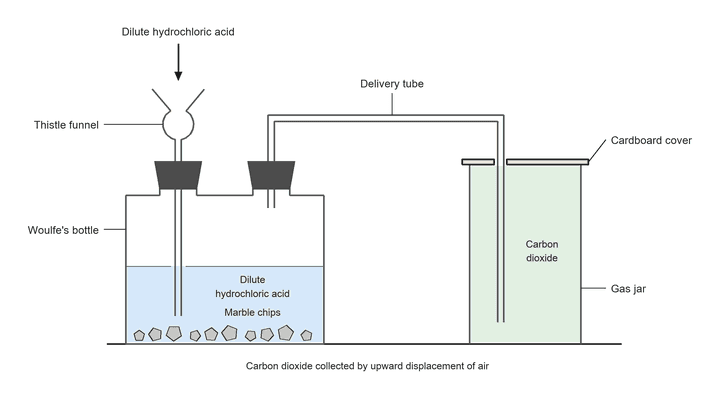
Dilute hydrochloric acid is poured through the thistle funnel until the marble chips are covered and the end of the funnel's stem dips in the acid, so that the gas cannot escape through the funnel. The gas leaves through the delivery tube, which reaches to the bottom of the gas jar.
Step 5 — (e) Explain why sulphuric acid is not used.
Sulphuric acid forms calcium sulphate, which is only very slightly soluble. It forms a coating over the marble chips, stops the acid from reaching them, and the reaction soon stops:
CaCO3+H2SO4→CaSO4+H2O+CO2
Step 6 — (f) Test the gas.
Pass the gas through lime water: it turns milky, and with excess gas the milkiness disappears.
Ca(OH)2+CO2→CaCO3↓+H2O
Watch out: The thistle funnel's stem must dip below the acid, and the delivery tube must end above the acid, just below the cork.
Therefore, carbon dioxide is made from marble chips and dilute hydrochloric acid, collected by upward displacement of air, and identified by its turning lime water milky.
