
Opening your dashboard
Class 8 Chemistry Chapter 9 Carbon and Its Compounds: Competency-Based Questions (CBQ)
40 questions on Chapter 9, each worked through on its own page with the AI tutor. Class 8 Chemistry, ICSE 2026-27.
40 questions
1–5 marks · Mixed difficulty
- 11 mark
Question 1
Cognitive domain: Application
A factory in Coimbatore makes electric motors. Inside a motor, a small block called a brush presses against a metal part that spins very fast. The brush must carry electric current to the spinning part, and it must rub against the metal smoothly without scratching it.
The store has four solid forms of carbon.
Solid Appearance Feel Conducts electricity? W Colourless, transparent, sparkling Extremely hard No X Black, porous, brittle Light, floats on water No Y Greyish black, porous Hard and rough Poorly Z Greyish black, shiny, opaque Soft and greasy Yes Which solid should the factory choose for the brushes, and why?
- 21 mark
Question 2
Cognitive domain: Analysis
A geology student collects four samples of coal from different depths of a coalfield in Jharkhand and has them tested.
Sample Colour Carbon content P Light brown 55% Q Brown 65% R Black 85% S Black 95% Which conclusion can she correctly draw about these samples?
- 31 mark
Question 3
Cognitive domain: Application
Gurpreet has to climb down into an old, deep, dry well on his farm to clean it. Before going in, he lowers a lighted lantern on a rope. The lantern burns well near the top, but close to the bottom of the well its flame goes out.
What is the best conclusion for Gurpreet to draw?
- 41 mark
Question 4
Cognitive domain: Understanding
The gram panchayat of a village lists four changes that took place in the village during the last year. A teacher asks her class which of these changes removes carbon dioxide from the air.
Which one is it?
- 51 mark
Question 5
Cognitive domain: Understanding
Assertion (A): A car parked in the sun with all its windows closed becomes much hotter inside than the air outside.
Reason (R): The glass of the windows lets the heat of the sun enter the car but does not let the trapped heat pass out easily.
- 61 mark
Question 6
Cognitive domain: Understanding
Assertion (A): The tool used for cutting sheets of window glass has a small diamond fixed at its tip.
Reason (R): Diamond is a bad conductor of electricity.
- 71 mark
Question 7
Cognitive domain: Recall
Rehana's grandmother makes kajal at home. She lights a cotton wick in a small lamp filled with mustard oil and holds a metal plate over the flame. A fine black powder slowly collects on the plate.
Fill in the blanks.
The black powder is called ________. It is an ________ form of carbon. It is formed because the oil burns in a ________ supply of air.
- 81 mark
Question 8
Cognitive domain: Application
In the school laboratory, Tanvi strongly heats a green powder, copper carbonate, in a dry test tube. The powder turns black. The gas that comes out of the test tube turns lime water milky.
Name the black solid left in the test tube.
- 91 mark
Question 9
Cognitive domain: Application
A kulfi seller in Jaipur packs kulfi cups in a cardboard box. Around the cups he places blocks of dry ice (solid carbon dioxide) instead of ordinary ice. Three hours later the kulfi is still frozen, and the blocks of dry ice have become much smaller.
Predict whether the cardboard under the dry ice will be wet or dry. Give a reason.
- 102 marks
Question 10
Cognitive domain: Analysis
A pencil factory makes the 'lead' of its pencils by mixing powdered graphite with clay and baking the mixture into thin rods. Clay is hard and leaves no mark on paper. The table shows the leads of three of its pencils.
Pencil Graphite in the lead Clay in the lead P 60% 40% Q 70% 30% R 80% 20% (a) Which pencil will give the darkest line with the lightest touch? Explain, using the structure of graphite.
(b) Which pencil will keep its sharp point for the longest time? Give a reason.
- 112 marks
Question 11
Cognitive domain: Understanding
In a class test, Dhruv writes: "Ice, water and steam are three allotropes of water, because they are three different forms of the same substance."
Point out the two mistakes in Dhruv's statement. Then give one correct example of allotropes.
- 122 marks
Question 12
Cognitive domain: Evaluation
In a school debate on global warming, Nikhil says: "Planting trees cannot help. Plants respire day and night and give out carbon dioxide, just as we do."
Is the fact that Nikhil states correct? Is his conclusion correct? Justify your answer.
- 134 marks
Question 13
Cognitive domain: Application
In a sugar factory, the syrup made from sugarcane juice is brown. To get white sugar, the hot syrup is passed slowly through a tall tank packed with small grains of charcoal. The syrup that comes out at the bottom is almost colourless. The charcoal does not take part in any chemical reaction. Yet, after some days, the syrup starts coming out brown again. The grains are then taken out, cleaned by strong heating and used again. Some factories use activated charcoal, which is charcoal that has been heated to about 900 °C in steam.
(a) Name the property of charcoal that removes the brown colour from the syrup. Where exactly on the charcoal does the colouring matter go?
(b) Why is the tank packed with small, porous grains and not with one big lump of charcoal? Why does the syrup start coming out brown after some days?
(c) Explain why activated charcoal does this job better than ordinary charcoal. Riya's mother keeps a small bowl of charcoal pieces in her refrigerator. What is the charcoal doing there, and why must she change it every few weeks?
- 145 marks
Question 14
Cognitive domain: Analysis
The science club of a school in Shimla borrowed a carbon monoxide meter. The meter shows the amount of carbon monoxide in the air in parts per million (ppm). It was set to sound an alarm at 50 ppm. On a cold January day, the members took a reading at four places in the school. At each place they also asked the people there whether they could see or smell anything unusual. The watchman said that he felt quite safe in his cabin.
Place What was burning Doors and windows Reading (ppm) Did people notice anything? Open playground Nothing Not applicable 0 No Kitchen LPG stove with a blue flame Window open 2 No Watchman's cabin Coal angithi Closed 180 No Garage Engine of the school van Shutter closed 240 No (a) A fuel was burning in the kitchen and also in the watchman's cabin. Explain why the reading in the cabin was so much higher. Write a balanced equation for the formation of carbon monoxide from carbon.
(b) The watchman said, "There is no smoke and no smell, so the air in my cabin is safe." Use the table to show that his test cannot be trusted. Then explain what carbon monoxide does inside the body.
(c) Write one safety rule for the cabin and one for the garage. Then state two things that must be done at once for a person found unconscious in the garage. Give a reason for each of the two.
- 155 marks
Question 15
Cognitive domain: Creativity
Ananya wants to show her class that the air we breathe out contains more carbon dioxide than the air in the room.
She has: freshly made clear lime water, two identical test tubes, a measuring cylinder, a drinking straw, a small hand pump of the kind used to blow air into an aquarium, and a stopwatch.
(a) Design a fair test that Ananya can do with these things. Say clearly what she must keep the same in the two test tubes.
(b) What will she see in each test tube? What should she conclude? Write a balanced equation for the change that takes place in the lime water.
(c) Ananya now wants to find out whether her breath has more carbon dioxide after two minutes of skipping than at rest. Describe how she can change her test to find this out. What should she measure?
(d) Name the process in her body that produces carbon dioxide. Name the process in green plants that removes carbon dioxide from the air.
- 161 mark
Question 16
Cognitive domain: Analysis
A science teacher shows the class the drawings of two crystalline forms of carbon, X and Y, but does not tell the names. Structure Y is shown in two views.
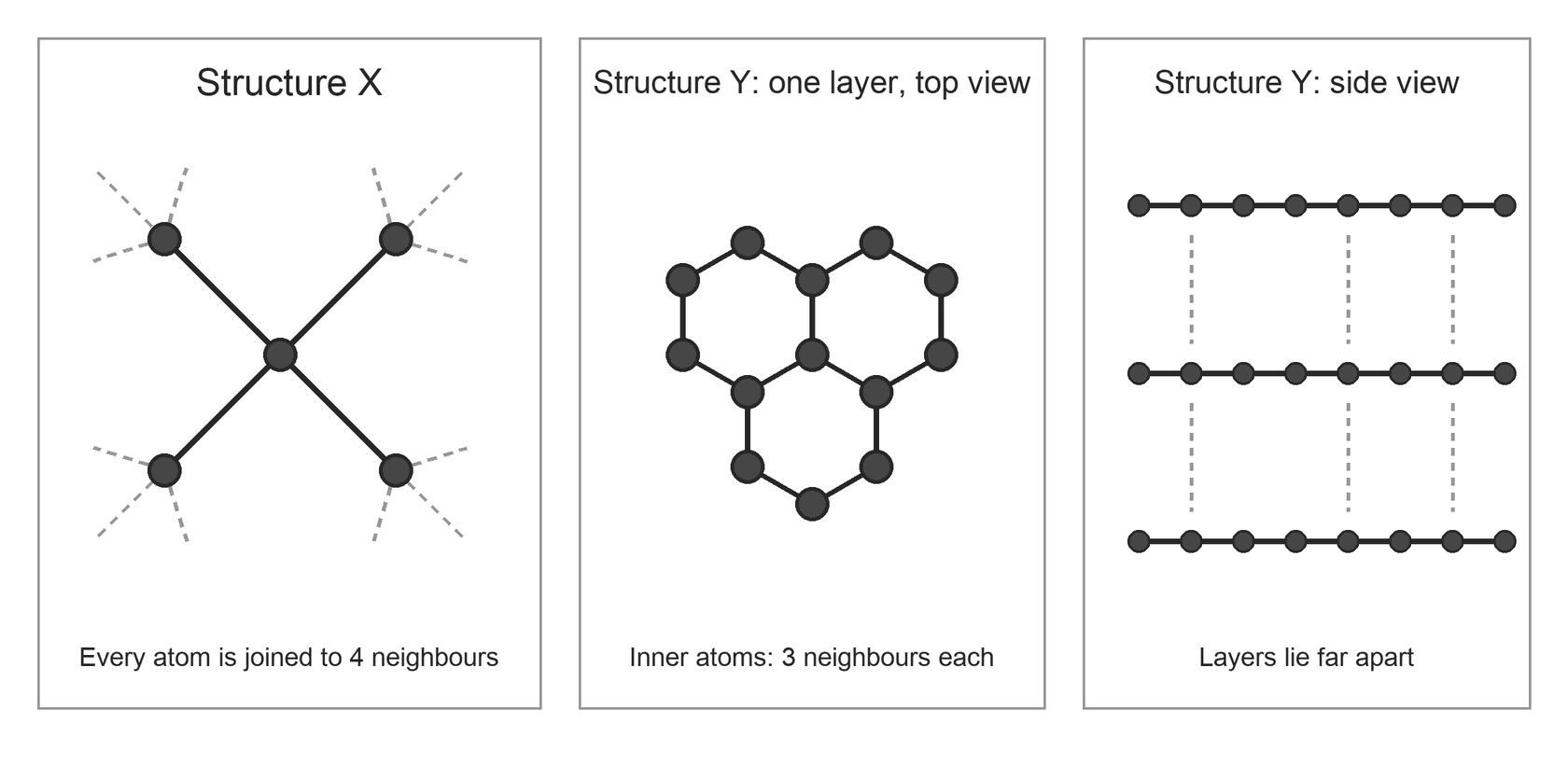
A carbon atom has four electrons in its outermost shell. Each line in the drawing is a bond that uses one electron of each of the two atoms it joins. Which row gives the properties that can be expected from the drawings?
- 171 mark
Question 17
Cognitive domain: Understanding
Aarav breaks open an old, used-up dry cell from a torch. In the middle he finds a grey rod that conducts electricity well. His teacher tells him that the rod is made of a form of amorphous carbon which is obtained as a deposit of carbon particles on the walls of a closed container when coal, or a petroleum product, is heated strongly in the absence of air.
Which form of carbon is this, and what supports the answer?
- 181 mark
Question 18
Cognitive domain: Application
A research laboratory changes 7.0 g of graphite into 7.0 g of diamond by heating it to a very high temperature under a very high pressure. The density of graphite is about 2.25 g/cm³ and the density of diamond is about 3.5 g/cm³.
Which statement about the change is correct?
- 191 mark
Question 19
Cognitive domain: Application
Four students try to make carbon dioxide for a class demonstration. They each have a gas jar, a test tube of lime water and the following materials.
Student Materials mixed 1 Marble chips (calcium carbonate) and water 2 Vinegar (acetic acid) and washing soda (sodium carbonate) 3 Dilute hydrochloric acid and clean sand (silicon dioxide, not a carbonate) 4 Dilute sulphuric acid and common salt (sodium chloride) The gas from only one of the four tubes turns lime water milky. Which student gets it?
- 201 mark
Question 20
Cognitive domain: Analysis
Assertion (A): A piece of wood charcoal floats on water, although the material of wood charcoal is heavier than water.
Reason (R): Wood charcoal is a good adsorbent of gases, liquids and solids.
- 211 mark
Question 21
Cognitive domain: Analysis
Assertion (A): In a sample of buckminster fullerene, all the carbon atoms are joined together in one giant continuous network, as in diamond.
Reason (R): A molecule of buckminster fullerene is a cage of 60 carbon atoms, written .
- 221 mark
Question 22
Cognitive domain: Understanding
A farmer near Nashik grows tomatoes in a polyhouse, a closed shed covered with clear plastic sheet. On sunny mornings, while the vents are shut, he lets a little carbon dioxide from a cylinder into the polyhouse, so that its level is about two and a half times that of the outside air. His tomato plants grow faster than those in an ordinary polyhouse.
Why does the extra carbon dioxide help the plants?
- 231 mark
Question 23
Cognitive domain: Application
A grain merchant in Punjab wants to keep wheat in a closed store for many months without any insect attacks and without spraying a poison on the grains. A science teacher suggests that he change the gas inside the store.
Which suggestion is correct?
- 241 mark
Question 24
Cognitive domain: Evaluation
The eco-club of a school wants to keep as much carbon dioxide as possible out of the air in the first year. It lists four proposals. (Hypothetical data.)
Proposal Effect during the first year (A) Plant 40 saplings Each young sapling removes 5 kg of carbon dioxide from the air in its first year (B) Stop burning rubbish every week Each burning adds 8 kg of carbon dioxide; the school burns rubbish once a week for 52 weeks (C) Switch off fans and lights when not needed Saves 60 kg of carbon dioxide in the year (D) Replace the diesel generator with solar panels Saves 450 kg of carbon dioxide in the year Which proposal keeps the most carbon dioxide out of the air in the first year?
- 251 mark
Question 25
Cognitive domain: Application
A chemical plant heats coal strongly in a closed vessel from which air is kept out. Four outputs are collected.
Output What it looks like P A black, thick liquid that settles at the bottom of the receiver and smells foul Q A colourless gas that burns with a yellowish flame R A watery liquid layer floating above P, which smells of ammonia S A grey, hard, porous solid left in the vessel One of these outputs is used in the preparation of artificial fertilizers. Which one?
- 262 marks
Question 26
Cognitive domain: Understanding
Tanvi writes in her copybook: "Carbon dioxide and marble both contain carbon, so both are studied under organic chemistry." Her teacher underlines the sentence and writes: "Think again."
(a) Is Tanvi's statement correct? Give a reason, naming the classes of compounds to which carbon dioxide and marble belong.
(b) Name the property of carbon that makes it form a very large number of compounds, and say what the property means.
- 272 marks
Question 27
Cognitive domain: Application
A teacher needs some very pure amorphous carbon for a class experiment. She has no furnace, but she has white, crystalline glucose, , and concentrated sulphuric acid. (Atomic masses: C = 12, H = 1, O = 16)
(a) Name the form of carbon she will get, and explain how the acid produces it from glucose.
(b) What mass of glucose must she take to get 3.6 g of this carbon? Assume that all the carbon of the glucose is left behind.
- 282 marks
Question 28
Cognitive domain: Evaluation
At a mining exhibition, a drill bit used for boring through hard rock is on display. Its cutting tip is set with small, dark, dull stones, and the label says "Diamond-tipped". A visitor says: "These cannot be real diamonds, because diamonds are colourless and they sparkle. And nobody would put diamonds on a drill, because diamonds are used only in jewellery."
(a) Judge the visitor's statement. Give the facts.
(b) Why are impure (dark) diamonds, and not colourless ones, used for such tips? Give one more use of impure diamond.
- 292 marks
Question 29
Cognitive domain: Application
A gas mixture from the top of a coal oven contains carbon dioxide and carbon monoxide. A student passes it slowly through a wash bottle containing concentrated potassium hydroxide solution and collects the gas that comes out of the other end.
(a) Name the gas that is absorbed and write the balanced chemical equation for its reaction with potassium hydroxide.
(b) Name the gas that is collected, and give a test that would show it is not carbon dioxide.
- 302 marks
Question 30
Cognitive domain: Analysis
To get land for farming, villagers cut down the trees on a small hill and burn the wood on the spot.
(a) Explain how the burning of the wood changes the amount of carbon dioxide in the air.
(b) Explain how the loss of the trees changes the amount of carbon dioxide in the air. Use the carbon dioxide cycle.
- 312 marks
Question 31
Cognitive domain: Analysis
Meera weighs a dry test tube with some baking soda (sodium bicarbonate, ) in it. She heats it strongly until no more gas comes off, lets it cool and weighs it again. The test tube and its contents are now 3.1 g lighter. The equation is:
(Atomic masses: Na = 23, H = 1, C = 12, O = 16)
(a) Which products leave the test tube, and so make it lighter?
(b) Find the mass of baking soda that Meera heated.
- 323 marks
Question 32
Cognitive domain: Analysis
A student tests three crystalline solids of carbon, X, Y and Z, and records the results. (Hypothetical data.)
Solid Hardness Conducts electricity? Dissolves in organic solvents? Density (g/cm³) X Cannot be scratched by any other natural substance No No 3.5 Y Very soft, leaves a black mark on paper Yes No 2.2 Z Soft No Yes 1.7 (a) Identify X, Y and Z as diamond, graphite or a fullerene. Give one reason for each.
(b) Use the arrangement of the carbon atoms to explain why Y conducts electricity but X does not.
- 333 marks
Question 33
Cognitive domain: Analysis
Sukhdev, a villager, makes wood charcoal. He piles logs one above the other with a gap in the centre, covers the pile with wet clay, leaves a few holes at the bottom and sets the wood on fire. When the fire dies out, he finds black, brittle, porous lumps. His neighbour builds a pile in the same way but leaves big cracks in the clay cover. After the fire, he finds only a heap of grey ash.
(a) Why does Sukhdev cover his pile with wet clay?
(b) Why does he leave a few holes at the bottom?
(c) Why did the neighbour get ash and not charcoal?
- 343 marks
Question 34
Cognitive domain: Application
In a hard-glass tube, 8.0 g of black copper(II) oxide is heated while carbon monoxide gas is passed over it. The black powder turns reddish-brown. The equation is:
(Atomic masses: Cu = 64, O = 16, C = 12)
(a) Find the mass of carbon monoxide needed to react completely with the copper(II) oxide.
(b) Find the mass of copper formed.
(c) Find the mass of carbon dioxide formed, and use your answers to show that the mass is conserved.
- 353 marks
Question 35
Cognitive domain: Creativity
Anaya wants to make a simple working model of the greenhouse effect for the science exhibition. She has two identical glass jars, two thermometers, a sheet of clear glass or plastic big enough to cover a jar, and a sunny window sill.
(a) Describe how she should set up the model.
(b) What result should she expect after the jars have stood in the sun for half an hour? Explain it.
(c) Name two things she must keep the same in the two jars to make the test fair.
- 363 marks
Question 36
Cognitive domain: Evaluation
A roll of magnesium ribbon catches fire in the school science store. A helper quickly picks up a liquid carbon dioxide fire extinguisher and sprays it on the burning ribbon. The ribbon goes on burning, and a black solid appears among the white ash.
(a) Evaluate the helper's choice of extinguisher.
(b) Write the balanced equation for the reaction between the burning magnesium and carbon dioxide.
(c) Why is the same extinguisher a good choice for a fire in a pile of paper?
- 375 marks
Question 37
Cognitive domain: Analysis
The carbon dioxide cycle keeps the amount of carbon dioxide in the air almost steady. Scientists study models of the cycle to see whether the amount of the gas in the air is rising, falling or staying the same. The figure shows five movements of carbon dioxide, P to T, in one year of a model for a small region. The numbers are the units of carbon dioxide moved in that year. (Hypothetical data.)
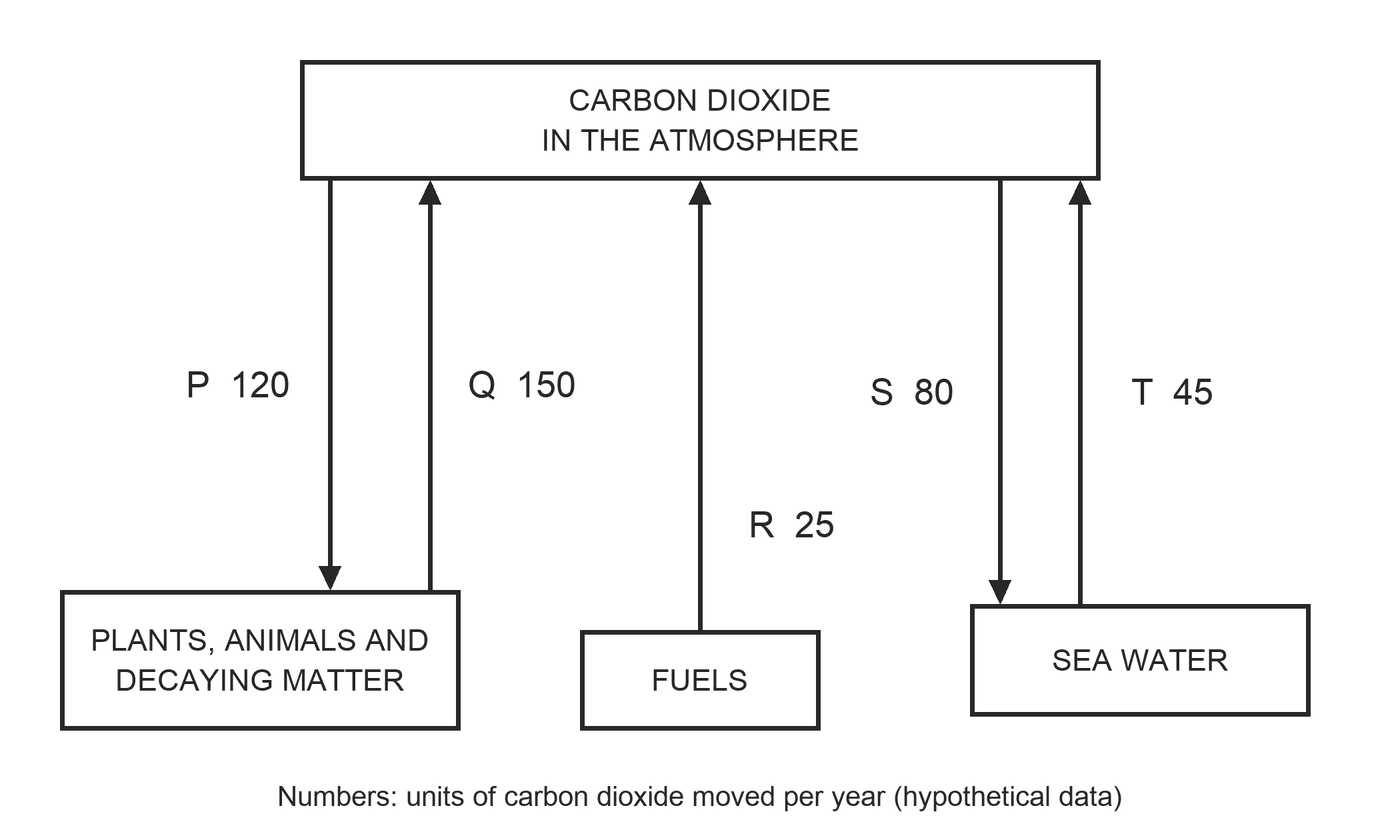
(a) Name the process shown by P and the process shown by R.
(b) Which arrows add carbon dioxide to the air and which remove it? Find the total amount added and the total amount removed.
(c) Find the net change in the amount of carbon dioxide in the air in one year. Is it rising, falling or steady?
(d) Because trees are cut down, P falls from 120 units to 105 units, and the other numbers stay the same. Find the new net change and name one effect on the earth if this goes on.
- 384 marks
Question 38
Cognitive domain: Evaluation
At a steel plant, a tall furnace is filled from the top with iron ore, mainly iron(III) oxide, , and with coke. Hot air is blown in near the bottom. The coke burns to carbon dioxide, which meets more red-hot coke higher up and changes into a poisonous gas, X. Gas X takes the oxygen from the ore and leaves iron behind. The table shows the gas that comes out of the top of the furnace. (Hypothetical data.)
Gas Volume in every 100 volumes Gas X 24 Carbon dioxide 22 Nitrogen 54 A manager suggests two ways to save money: "Use cheap coal in place of coke, and let the top gas out of the chimney as it is."
(a) Give two reasons why coke is a better choice than coal here.
(b) Name gas X, write the balanced equation for its action on the iron ore, and name the reducing agent.
(c) Use the table to judge the second suggestion. Give two reasons against it, and say what the plant should do with the top gas.
- 394 marks
Question 39
Cognitive domain: Analysis
A soft-drink plant makes soda water by dissolving carbon dioxide in water under pressure and then sealing the bottles. The table shows how much carbon dioxide dissolves in one litre of water at room temperature when the gas is at different pressures. (Hypothetical data.)
Pressure (times the pressure of the air) Carbon dioxide dissolved in 1 litre of water 1 1.5 g 2 3.0 g 3 4.5 g 4 6.0 g A bottle holds 0.6 litre of water and is filled at 4 times the pressure of the air.
(a) What does the table show about the solubility of carbon dioxide and the pressure?
(b) Find the mass of carbon dioxide dissolved in the bottle. Just after the bottle is opened, the carbon dioxide above the drink is at about the pressure of the air. Find the mass the water can then hold, and the mass of gas that comes out quickly as fizz.
(c) Explain why the drink fizzes when the bottle is opened, and why the bottles are sealed tightly.
- 405 marks
Question 40
Cognitive domain: Creativity
Kabir's grandmother makes kajal at home by holding a metal plate over the flame of an oil lamp, and the black powder that collects on the plate is soot. Kabir wants to use the same idea to find out which of three fuels, wood charcoal, coke or bituminous coal, burns without smoke. He has a small metal plate for each fuel, an iron stand, a stopwatch and a balance that reads to 0.01 g.
(a) Describe a fair test he can carry out. State three things he should keep the same.
(b) What would you expect to see for each of the three fuels? Say what the black deposit is.
(c) Why must he do the test in an open space and not in a closed room?
(d) Suggest one way to compare the amounts of deposit on the three plates.