
Opening your dashboard
Class 8 Chemistry Chapter 8: Water Solutions
48 textbook questions with step-by-step answers, free to read, for ICSE 2026-27.
Get talked through Ch 8, not just shown the answer
Reading a finished solution is not the same as being able to do it. The AI tutor takes one question at a time and works it with you, in your own words, until you can.
- Ask it out loud, in your own words
- It gives you the next step, not the answer
- Stuck on part (ii)? Start there
48 questions with solutions
1–5 marks · Mixed difficulty
- 11 mark
Question 1
The purest form of natural water is :
Solve with AIAnswer
(A) sea water
- Correct
(B) rain water
(C) river water
(D) spring water
Answer: (B) rain water
Concept: Natural water picks up impurities from whatever it touches. The less it touches the ground, the purer it is.
Step 1 — Recall how rain water forms.
The sun evaporates water from seas, rivers and lakes. Only the water turns into vapour; the dissolved salts are left behind. The vapour cools, condenses into clouds and falls as rain.
Step 2 — Compare it with the other sources.
Rain water has not flowed over land or through rocks, so it has almost no dissolved salts. It is therefore the purest form of natural water.
Watch out: Rain water is the purest NATURAL water, but it is not chemically pure: it dissolves some carbon dioxide and dust from the air as it falls.
Why the other options are wrong:
- (A) sea water: It has the most dissolved salts (about 3.5 %), so it is the least pure.
- (C) river water: It picks up dissolved salts, mud and wastes as it flows over the land.
- (D) spring water: It seeps through soil and rocks and dissolves many minerals from them.
Therefore, the purest form of natural water is rain water, option (B).
- 21 mark
Question 2
The ratio of hydrogen and oxygen by mass in a molecule of water is :
Solve with AIAnswer
(A) 1 : 16
(B) 2 : 8
- Correct
(C) 1 : 8
(D) 8 : 1
Answer: (C) 1 : 8
Concept: The mass ratio of elements in a compound is found from its formula and the atomic masses (H = 1 u, O = 16 u).
Step 1 — Write the formula of water.
One molecule of water, , has 2 hydrogen atoms and 1 oxygen atom.
Step 2 — Find the mass of each element in one molecule.
The two hydrogen atoms together have a mass of 2 u, and the one oxygen atom has a mass of 16 u.
Step 3 — Write the ratio in its simplest form.
Dividing both terms by 2 gives the simplest ratio.
Watch out: Count BOTH hydrogen atoms; using one hydrogen atom gives the wrong ratio 1 : 16.
Why the other options are wrong:
- (A) 1 : 16: This uses only one hydrogen atom (1 : 16); a water molecule has two.
- (B) 2 : 8: This equals 1 : 4, which doubles the true share of hydrogen.
- (D) 8 : 1: This is the ratio the wrong way round (oxygen : hydrogen).
Therefore, hydrogen and oxygen are combined in the ratio 1 : 8 by mass, option (C).
- 31 mark
Question 3
Sea water contains a large amount of :
Solve with AIAnswer
(A) suspended impurities
- Correct
(B) disolved common salt
(C) oily substances
(D) none of the above
Answer: (B) disolved common salt
Concept: Rivers carry dissolved salts from the land into the sea. When sea water evaporates, the salts stay behind, so they build up over a very long time.
Step 1 — Recall what sea water contains.
Sea water contains about 3.5 % dissolved salts, and most of this is common salt (sodium chloride).
Step 2 — Choose the option.
So sea water contains a large amount of dissolved common salt. This is also why common salt is obtained by evaporating sea water in salt pans.
Watch out: The salt is DISSOLVED: it cannot be seen and does not settle, unlike suspended impurities.
Why the other options are wrong:
- (A) suspended impurities: This is not what sea water holds in large amount; suspended matter settles down, and the salts are dissolved.
- (C) oily substances: These are found only where the sea is polluted, for example after an oil spill.
- (D) none of the above: This cannot be right, because option (B) is correct.
Therefore, sea water contains a large amount of dissolved common salt, option (B).
- 41 mark
Question 4
Water retuns on earth's surface from the atmosphere by the process of :
Solve with AIAnswer
(A) combustion
(B) respiration
(C) photosynthesis
- Correct
(D) condensation
Answer: (D) condensation
Concept: In the water cycle, water evaporates from the earth, the vapour condenses into clouds in the cold upper air, and the water falls back to the earth as rain or snow (precipitation).
Step 1 — Find the step that changes vapour back into water.
Water vapour in the atmosphere cools and condenses into tiny droplets, which form clouds.
Step 2 — Follow the droplets back to the earth.
The droplets join into bigger drops and fall as rain. So water returns to the earth's surface through condensation (followed by precipitation).
Watch out: Evaporation takes water UP into the air; condensation is the step that brings it back down.
Why the other options are wrong:
- (A) combustion: Burning fuels gives out water vapour into the air; it does not bring water back down.
- (B) respiration: This process also gives out water vapour into the air.
- (C) photosynthesis: This process uses up water inside plants; it does not return water from the atmosphere.
Therefore, water returns to the earth's surface by condensation, option (D).
- 51 mark
Question 5
Spring water is classified as :
Solve with AIAnswer
(A) surface water
(B) above surface water
- Correct
(C) undergound water
(D) none of these
Answer: (C) undergound water
Concept: Sources of water are grouped by where the water is found: surface water (oceans, seas, rivers, lakes), underground water (springs, wells) and above-surface water (rain).
Step 1 — Find where spring water comes from.
Rain water seeps into the ground and collects over rock layers. Where it finds a way out, it flows out as a spring.
Step 2 — Classify it.
Since the water comes from under the ground, spring water is underground water.
Why the other options are wrong:
- (A) surface water: This is the water of oceans, seas, rivers and lakes.
- (B) above surface water: Above-surface water is rain water.
- (D) none of these: This cannot be right, because spring water is underground water.
Therefore, spring water is classified as underground water, option (C).
- 64 marks
Question 6
Name the four main sources of water.
Solve with AIWritten solution
Solution:
Concept: Natural water is found on the earth's surface, under the ground and above the surface (as rain).
Step 1 — List the surface sources.
The largest store of water is in the oceans and seas. Fresh surface water is found in rivers and lakes.
Step 2 — List the underground source.
Rain water that soaks into the ground is drawn out through springs and wells.
Step 3 — List the above-surface source.
Rain is the water that falls from the clouds, and it feeds all the other sources.
Therefore, the four main sources of water are oceans and seas, rivers and lakes, springs and wells, and rain.
- 72 marks
Question 7
What is the importance of water cycle in nature?
Solve with AIWritten solution
Solution:
Concept: The water cycle is the continuous circulation of water from the earth's surface to the atmosphere and back, by evaporation, condensation and precipitation.
Step 1 — It regulates the climate.
Evaporation takes in heat and condensation gives it out in the upper air. This moves heat around the earth and keeps temperatures moderate, so the water cycle regulates the climate.
Step 2 — It makes water available everywhere.
The cycle carries water from the seas to the land as rain and snow. So water is available in all its forms (ice, liquid water and water vapour) all over the earth.
Step 3 — It keeps the amount of water balanced.
The water that evaporates is returned as rain, so the amount of water in the atmosphere and on the earth's surface stays balanced. This steady supply of fresh water supports plant and animal life.
Watch out: The water cycle does not create new water; it keeps re-circulating the same water.
Therefore, the water cycle regulates the climate, makes water available all over the earth in all its forms, and keeps the amount of water on the earth and in the air balanced for living things.
- 82 marks
Question 8
Name the two gases from which water is formed. What is the chemical composition of these two gases in water by mass ? Give the molecular formula of water.
Solve with AIWritten solution
Solution:
Concept: Water is a compound of hydrogen and oxygen, so its elements are always combined in the same fixed ratio by mass (H = 1 u, O = 16 u).
Step 1 — Name the two gases.
Water is formed when hydrogen burns in oxygen.
Step 2 — Find the composition by mass.
One molecule of water has 2 hydrogen atoms (2 × 1 = 2 u) and 1 oxygen atom (16 u). So the ratio by mass is found as below.
This means 2 g of hydrogen combine with 16 g of oxygen to give 18 g of water. In percentages, water is about 11.1 % hydrogen and 88.9 % oxygen by mass.
Step 3 — Write the molecular formula.
Each molecule has two hydrogen atoms joined to one oxygen atom, so the molecular formula is .
Watch out: The ratio by VOLUME of the gases that combine is 2 : 1 (hydrogen : oxygen), but by MASS it is 1 : 8.
Therefore, water is formed from hydrogen and oxygen combined in the ratio 1 : 8 by mass, and its molecular formula is H₂O.
- 95 marks
Question 9
Give reasons :
(a) Water is used as a cooling agent.
(b) Water pipes burst in severe winters.
(c) It is difficult to cook in hills as compared to plains.
(d) Ice floats on water.
(e) Sea water does not freeze at 0°C.
(f) Aquatic plants and animals survive in very cold regions.
(g) Water is used in room coolers and hot water bags.
Solve with AIWritten solution
Solution:
Concept: Each reason comes from a special property of water: it has a high specific heat capacity (it takes in a lot of heat to warm up), it shows anomalous expansion (it expands below 4 °C and on freezing), its boiling point falls when the pressure falls, and dissolved substances lower its freezing point.
Step 1 — (a) Water as a cooling agent.
Water has a very high specific heat capacity (about 4.2 J for every gram and every °C). So it can take in a large amount of heat from engines, machines and reactors while its own temperature rises only a little. This carries the heat away and stops the machines from overheating.
Step 2 — (b) Water pipes burst in severe winters.
Water expands when it is cooled below 4 °C, and it expands by about 9 % more when it freezes into ice. In severe winters the water inside the pipes freezes, and the ice needs more space than the water did. It pushes on the pipes so hard that they burst.
Step 3 — (c) Difficult to cook in the hills.
The atmospheric pressure is lower in the hills, and water boils at a lower temperature when the pressure is lower (about 90 °C at a height of 3,000 m). The food gets less heat at this lower temperature, so it takes much longer to cook. A pressure cooker raises the pressure, and with it the boiling point.
Step 4 — (d) Ice floats on water.
Because of anomalous expansion, water expands on freezing. The same mass takes up more volume, so ice has a lower density (about 0.92 g/cm³) than water (1 g/cm³). Anything less dense than water floats on it, so ice floats.
Step 5 — (e) Sea water does not freeze at 0 °C.
Sea water contains a large amount of dissolved salts. Dissolved impurities lower the freezing point of water, so sea water freezes only below 0 °C (at about −2 °C).
Step 6 — (f) Aquatic life survives in very cold regions.
Water is densest at 4 °C, so in winter the 4 °C water sinks and stays at the bottom. Only the surface water freezes, and the ice floats on top. Ice is a poor conductor of heat, so it shields the water below from the cold air. The water at the bottom stays liquid at about 4 °C, and fish and plants live in it.
Step 7 — (g) Water in room coolers and hot water bags.
Room coolers: water evaporates from the wet pads, and evaporation takes in a large amount of heat from the air blown through them, so the air comes out cool. Hot water bags: water holds a large amount of heat because of its high specific heat capacity and gives it out slowly, so the bag stays warm for a long time.
Watch out: In (b), the pipes burst because ice takes up MORE volume than the water it came from, not because ice is "hard".
Therefore, the reasons are water's high specific heat capacity (a, g), its anomalous expansion (b, d, f), the fall of its boiling point at low pressure (c), and the lowering of its freezing point by dissolved salts (e).
- 104 marks
Question 10
What is the effect on boiling point of water when :
(a) pressure is increased ?
(b) impurity is added ?
Solve with AIWritten solution
Solution:
Concept: Pure water boils at 100 °C at normal atmospheric pressure. Both the pressure on the water and anything dissolved in it change this boiling point.
Step 1 — (a) Pressure is increased.
A liquid boils when its vapour pressure equals the pressure on it. When the pressure on the water is increased, the water must be heated more to reach that pressure. So the boiling point rises above 100 °C. This is why food cooks faster in a pressure cooker (about 120 °C inside).
Step 2 — (b) An impurity is added.
A dissolved impurity such as common salt makes it harder for water molecules to escape as vapour. So the boiling point rises above 100 °C; salty water boils at a slightly higher temperature than pure water.
Watch out: Impurities RAISE the boiling point but LOWER the freezing point of water.
Therefore, the boiling point of water increases when the pressure is increased, and it also increases when an impurity is added.
- 113 marks
Question 11
Why is water very precious for all living beings ? List four points.
Solve with AIWritten solution
Solution:
Concept: We cannot live without water, yet about 97 % of the earth's water is salty sea water and most fresh water is frozen as ice. Less than 1 % of all the water on the earth is fresh water that we can readily use, so every drop is precious.
Step 1 — Water for drinking.
Our bodies are mostly water, and we lose water all the time in sweat, urine and breath. We must drink water to replace it and stay alive.
Step 2 — Water as the medium of life processes.
Water dissolves a large number of substances, so all the biochemical reactions inside our bodies take place in water. Blood, which is mostly water, also carries digested food, minerals and wastes around the body.
Step 3 — Water to regulate body temperature.
When we sweat, the water evaporates and takes heat away from the skin. This keeps our body temperature steady.
Step 4 — Water for plants and crops.
Seeds need water to germinate, and plants use water in photosynthesis to make food. Water also gives aquatic plants and animals a home and supplies them with dissolved nutrients and gases.
Therefore, water is precious because living beings need it for drinking, as the medium of all life processes, to regulate body temperature, and for growing plants and crops.
- 123 marks
Question 12
How does anomalous expansion of water help the aquatic organisms in cold climates?
Solve with AIWritten solution
Solution:
Concept: Anomalous expansion of water: water contracts on cooling only down to 4 °C; below 4 °C it expands. So water is densest at 4 °C, and ice (formed at 0 °C) is lighter than water.
Step 1 — The surface water cools and sinks.
In winter, the cold air cools the water at the surface of a lake. This cooled water becomes denser and sinks, and warmer water from below rises to take its place.
Step 2 — The whole lake reaches 4 °C.
This sinking and rising goes on until all the water in the lake is at 4 °C, the temperature at which water is densest.
Step 3 — Further cooling stays at the top.
When the surface water cools below 4 °C, it expands and becomes lighter. So it no longer sinks; it stays on top and finally freezes at 0 °C.
Step 4 — The ice acts as a blanket.
Ice is lighter than water, so it floats as a layer on the surface. Ice is a poor conductor of heat, so this layer protects the water below from the cold air.
Step 5 — Life survives below the ice.
The water below the ice stays liquid, and the bottom layer stays at about 4 °C, as the figure shows. Fish and other aquatic organisms live safely in this water all through the winter.
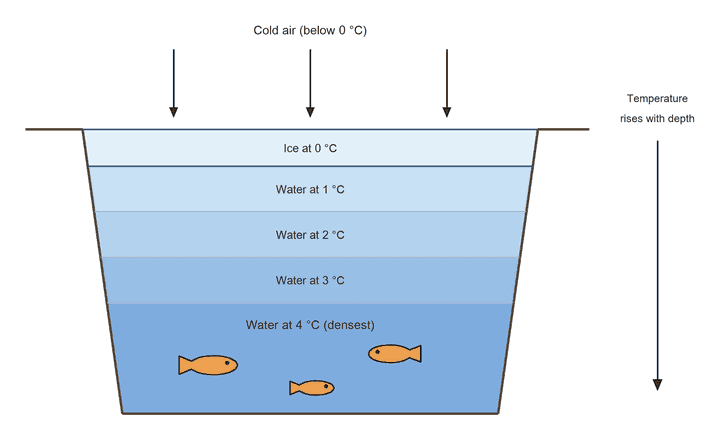
Watch out: The lake freezes from the TOP downwards, not from the bottom up, because water below 4 °C is lighter.
Therefore, anomalous expansion keeps the densest 4 °C water at the bottom and makes ice float as an insulating layer, so the water below stays liquid and aquatic organisms survive.
- 131 mark
Question 13
The gases dissolved in natural water are:
Solve with AIAnswer
- Correct
(A) oxygen and carbon dioxide
(B) hydrogen and oxygen
(C) sulphur dioxide and hydrogen
(D) chlorine and ammonia
Answer: (A) oxygen and carbon dioxide
Concept: Natural water is in contact with the air, so it dissolves some of the gases of the air. Oxygen and carbon dioxide are the two that matter for life in water.
Step 1 — Name the gases taken from the air.
Water dissolves oxygen and carbon dioxide from the air (nitrogen dissolves too, in small amounts).
Step 2 — Say why they matter.
Fish and other aquatic animals breathe the dissolved oxygen, and aquatic plants use the dissolved carbon dioxide for photosynthesis.
Why the other options are wrong:
- (B) hydrogen and oxygen: This is wrong because hydrogen is almost absent from the air, so natural water has no dissolved hydrogen.
- (C) sulphur dioxide and hydrogen: This is wrong because sulphur dioxide gets into water only from pollution, and hydrogen is not dissolved in natural water.
- (D) chlorine and ammonia: This is wrong because chlorine is only added to drinking water to kill germs, and ammonia appears only where water is polluted.
Therefore, the gases dissolved in natural water are oxygen and carbon dioxide, option (A).
- 141 mark
Question 14
Colloids have the particle size ranging between :
Solve with AIAnswer
- Correct
(A) to m
(B) to m
(C) to m
(D) to m
Answer: (A) to m
Concept: Solutions, colloids and suspensions differ in the size of their particles. The book takes particles smaller than m for a true solution, m to m for a colloid and larger than m for a suspension.
Step 1 — Place a colloid between the other two.
Colloid particles are bigger than those of a true solution but smaller than those of a suspension.
Step 2 — Read off the range.
So, in the book's limits, colloid particles range from m up to m. This matches option (A).
Watch out: A larger negative power of ten is a SMALLER size: m is smaller than m.
Note: many books today put the lower limit for colloid particles at about m (1 nm) rather than m; the upper limit, m, is the same.
Why the other options are wrong:
- (B): This range is below m, the size the book gives for particles of a true solution.
- (C): This range is above m, the size of the particles of a suspension.
- (D): This is far smaller than even an atom (about m across), so no particles of a mixture are this small.
Therefore, colloid particles range from m to m, option (A).
- 151 mark
Question 15
Which of the following salts is hydrated?
Solve with AIAnswer
(A) Common salt
(B) Potassium nitrate
- Correct
(C) Blue vitriol
(D) Ammonium chloride
Answer: (C) Blue vitriol
Concept: A hydrated salt has a fixed number of water molecules, the water of crystallisation, built into its crystals.
Step 1 — Write the formula of blue vitriol.
Blue vitriol is copper sulphate pentahydrate, .
Step 2 — Look for water of crystallisation.
Its formula has five molecules of water in each unit of the crystal, so it is a hydrated salt. This water also gives the crystals their blue colour.
Why the other options are wrong:
- (A) Common salt: Its formula, NaCl, has no water; it forms crystals with no water of crystallisation, so it is anhydrous.
- (B) Potassium nitrate: Its formula, KNO₃, has no water; it crystallises without water of crystallisation.
- (D) Ammonium chloride: Its formula, NH₄Cl, shows no water of crystallisation.
Therefore, blue vitriol (CuSO₄·5H₂O) is the hydrated salt, option (C).
- 161 mark
Question 16
Which of the following substances is hygroscopic in nature ?
Solve with AIAnswer
- Correct
(A) silica gel
(B) caustic soda
(C) iron (III) chloride
(D) calcium carbonate
Answer: (A) silica gel
Concept: A hygroscopic substance absorbs moisture from the air without dissolving in it. A deliquescent substance absorbs so much moisture that it dissolves in it and forms a solution.
Step 1 — Test each substance.
Silica gel takes up moisture from the air but stays a dry-looking solid. Caustic soda and iron(III) chloride take up moisture and turn into a solution. Calcium carbonate does not take up moisture.
Step 2 — Choose the hygroscopic one.
Only silica gel absorbs moisture without dissolving, so it is hygroscopic. This is why it is used as a drying agent in packets.
Watch out: Deliquescent substances also absorb moisture; the difference is that they dissolve in it.
Why the other options are wrong:
- (B) caustic soda: It absorbs moisture and dissolves in it, so the book classes it as deliquescent.
- (C) iron (III) chloride: Iron(III) chloride also absorbs moisture and dissolves in it, so it is deliquescent.
- (D) calcium carbonate: It is a dry powder that does not absorb moisture from the air.
Therefore, silica gel is hygroscopic, option (A).
- 171 mark
Question 17
The products formed when water is subjected to electrolysis are :
Solve with AIAnswer
- Correct
(A) hydrogen and oxygen
(B) hydrogen and sulphur dioxide
(C) only hydrogen
(D) only oxygen
Answer: (A) hydrogen and oxygen
Concept: Electrolysis is the breaking down of a compound by passing an electric current through it. Water is a compound of hydrogen and oxygen only.
Step 1 — Pass a current through water.
Pure water conducts electricity very poorly, so a few drops of acid are added. The current then decomposes the water into its two elements.
Step 2 — Write the equation.
Hydrogen collects at the cathode and oxygen at the anode, in the ratio 2 : 1 by volume.
Why the other options are wrong:
- (B) hydrogen and sulphur dioxide: Water contains no sulphur, so sulphur dioxide cannot be formed from it.
- (C) only hydrogen: Hydrogen is not formed alone; oxygen is always formed with it.
- (D) only oxygen: Oxygen is not formed alone; hydrogen is always formed with it.
Therefore, electrolysis of water gives hydrogen and oxygen, option (A).
- 185 marks
Question 18
Classify the following into solutions, colloids and suspensions :
Sugar and water, chalk and water, milk, sand and water, salt and water, soap solution.
Solve with AIWritten solution
Solution:
Concept: Mixtures are grouped by the size of their particles. The book takes particles smaller than m for a true solution, m to m for a colloid and larger than m for a suspension. A suspension's particles are big enough to settle down.
Step 1 — Find the solutions.
Sugar and common salt dissolve completely in water and give clear liquids that never settle. So sugar and water and salt and water are solutions.
Step 2 — Find the colloids.
In milk, tiny drops of fat and protein particles stay spread through the water; in soap solution, clusters of soap molecules do the same. They do not settle, but the liquid looks cloudy. So milk and soap solution are colloids.
Step 3 — Find the suspensions.
Chalk and sand do not dissolve, and their particles settle at the bottom on standing. So chalk and water and sand and water are suspensions.
Solutions Colloids Suspensions Sugar and water Milk Chalk and water Salt and water Soap solution Sand and water Watch out: Soap solution is a colloid even though it is called a "solution".
Note: many books today put the lower limit for colloid particles at about m (1 nm) rather than m; the upper limit, m, is the same.
Therefore, sugar and water and salt and water are solutions; milk and soap solution are colloids; chalk and water and sand and water are suspensions.
- 194 marks
Question 19
Name the gas produced when :
(a) steam is passed over hot coke.
(b) chlorine is dissolved in water and exposed to sunlight.
(c) a piece of calcium is added to water.
(d) when fossil fuel is burnt.
Solve with AIWritten solution
Solution:
Concept: Water reacts with some non-metals (hot carbon), with chlorine in sunlight and with active metals; burning fuels that contain carbon gives carbon dioxide.
Step 1 — (a) Steam over hot coke.
Steam passed over white-hot coke (about 1000 °C) gives a mixture of carbon monoxide and hydrogen. This mixture of gases is called water gas.
Step 2 — (b) Chlorine water in sunlight.
Chlorine reacts with water to form hydrochloric acid and hypochlorous acid. In sunlight the hypochlorous acid breaks down and gives out oxygen.
Adding the two steps (the first one taken twice) gives the overall equation.
Step 3 — (c) Calcium in water.
Calcium is an active metal. It reacts steadily with cold water to form calcium hydroxide and give off hydrogen.
Step 4 — (d) Burning fossil fuel.
Fossil fuels such as coal, petrol and natural gas contain carbon and hydrogen. When they burn, the carbon forms carbon dioxide and the hydrogen forms water vapour, for example with natural gas (methane):
Watch out: Water gas is a MIXTURE of two gases (CO and H₂), not a single gas and not water vapour.
Therefore, the gases are (a) water gas (carbon monoxide + hydrogen), (b) oxygen, (c) hydrogen and (d) carbon dioxide.
- 205 marks
Question 20
Define the following terms :
(a) Solution
(b) Solute
(c) Solvent
Solve with AIWritten solution
Solution:
Concept: A solution has two parts: the substance that dissolves (solute) and the liquid it dissolves in (solvent), so solution = solute + solvent.
Step 1 — (a) Solution.
A solution is a homogeneous mixture of two or more substances whose composition can be varied. For example, sugar solution can be made with a little or a lot of sugar, and it looks the same throughout.
Step 2 — (b) Solute.
The solute is the substance that dissolves in the other substance. It is usually present in the smaller amount, for example sugar in sugar solution.
Step 3 — (c) Solvent.
The solvent is the medium in which the solute dissolves. It is usually present in the larger amount, for example water in sugar solution.
Therefore, a solution is a homogeneous mixture of variable composition, the solute is the substance that dissolves, and the solvent is the medium in which it dissolves.
- 215 marks
Question 21
What is meant by :
(a) Unsaturated
(b) Saturated and
(c) Supersaturated solutions ?
Solve with AIWritten solution
Solution:
Concept: At a given temperature, a fixed amount of water can dissolve only a limited amount of a solute. Comparing the solute present with this limit tells us the kind of solution.
Step 1 — (a) Unsaturated solution.
A solution in which more solute can still be dissolved at that temperature is unsaturated. Its solute is below the limit.
Step 2 — (b) Saturated solution.
A solution that cannot dissolve any more solute at that temperature is saturated. Extra solute added stays undissolved at the bottom.
Step 3 — (c) Supersaturated solution.
A solution that holds more solute than a saturated solution can hold at that temperature is supersaturated. Most solids dissolve more in hot water. So it is made by preparing a saturated solution at a higher temperature and then cooling it slowly without disturbing it. It is unstable: a small crystal or a shake makes the extra solute crystallise out.
Watch out: A supersaturated solution is made by COOLING a hot saturated solution, not by heating it.
Note: Heating only lets more solute dissolve, and the solution becomes supersaturated when it is then cooled slowly.
Therefore, an unsaturated solution can dissolve more solute, a saturated solution cannot dissolve any more, and a supersaturated solution holds more solute than a saturated solution at the same temperature.
- 224 marks
Question 22
How do the solubility of a solid and a gas get affected by
(a) Increase in temperature ?
(b) Increase in pressure ?
Solve with AIWritten solution
Solution:
Concept: Heating helps most solids dissolve but drives dissolved gases out of water. Pressure has almost no effect on solids and liquids, but it pushes more gas into the water.
Step 1 — (a) Increase in temperature.
The solubility of most solids increases on heating; for example, much more sugar dissolves in hot water than in cold water. (A few solids, such as calcium hydroxide, become less soluble, and common salt hardly changes.) The solubility of a gas decreases on heating, so dissolved gases bubble out of water as it is warmed.
Step 2 — (b) Increase in pressure.
The solubility of a solid is practically unaffected by pressure. The solubility of a gas increases with pressure; this is why soda water is bottled under high pressure.
Watch out: Temperature and pressure act in OPPOSITE ways on a gas: more heat, less gas dissolves; more pressure, more gas dissolves.
Therefore, a rise in temperature increases the solubility of a solid but decreases that of a gas, and a rise in pressure leaves a solid's solubility practically unchanged but increases a gas's solubility.
- 232 marks
Question 23
Define 'water of crystallisation'. Give two examples with formulae.
Solve with AIWritten solution
Solution:
Concept: When some salts crystallise from water, a fixed number of water molecules is built into each unit of their crystals.
Step 1 — Define water of crystallisation.
The fixed number of water molecules that is in loose chemical combination with one unit of a substance in its crystalline form is called its water of crystallisation. It gives the crystals their shape and, in some salts, their colour. It is driven out on heating.
Step 2 — Give two examples with formulae.
Blue vitriol (copper sulphate pentahydrate) is , with 5 molecules of water. Washing soda (sodium carbonate decahydrate) is , with 10 molecules of water.
Watch out: The water of crystallisation is part of the crystal's formula; it is not water wetting the crystal's surface.
Therefore, water of crystallisation is the fixed number of water molecules loosely combined with a substance in its crystals, as in blue vitriol (CuSO₄·5H₂O) and washing soda (Na₂CO₃·10H₂O).
- 245 marks
Question 24
Give two examples for each of the following :
(a) Hydrated substances
(b) Crystalline anhydrous substances
(c) Drying agents
(d) Deliquescent substances
(e) Efflorescent substances
(f) Colloids
(g) Solvents other than water.
Solve with AIWritten solution
Solution:
Concept: Each group is named for how a substance behaves with water: whether it holds water in its crystals, takes moisture from the air, or gives water out to the air; colloids and solvents are other kinds of mixtures and liquids met in this chapter.
Step 1 — (a) Hydrated substances.
These contain water of crystallisation: blue vitriol, , and washing soda, .
Step 2 — (b) Crystalline anhydrous substances.
These form crystals with no water of crystallisation: common salt, , and potassium nitrate, .
Step 3 — (c) Drying agents.
These remove moisture from gases or other substances: concentrated sulphuric acid, , and quicklime, .
Step 4 — (d) Deliquescent substances.
These absorb moisture from the air and dissolve in it: caustic soda, , and magnesium chloride, .
Step 5 — (e) Efflorescent substances.
These lose water of crystallisation to the air: washing soda, , and Glauber's salt, .
Step 6 — (f) Colloids.
These have particles that stay spread out and do not settle: milk and soap solution.
Step 7 — (g) Solvents other than water.
These liquids dissolve substances that water does not, such as grease, paint or iodine: alcohol (ethanol) and acetone. Petrol and turpentine are other examples.
Watch out: Washing soda appears in (a) and (e) because it is both hydrated and efflorescent; give two different substances within each part.
Therefore, examples are (a) blue vitriol and washing soda, (b) common salt and potassium nitrate, (c) concentrated sulphuric acid and quicklime, (d) caustic soda and magnesium chloride, (e) washing soda and Glauber's salt, (f) milk and soap solution, and (g) alcohol and acetone.
- 255 marks
Question 25
What do you observe when :
(a) Blue vitriol is heated ?
(b) Washing soda is exposed to air ?
(c) Blue litmus solution is added to water?
Solve with AIWritten solution
Solution:
Concept: Hydrated crystals lose their water of crystallisation on heating (and some even in dry air), and pure water is neutral to indicators.
Step 1 — (a) Blue vitriol is heated.
The blue crystals lose their water of crystallisation and turn into a white powder (anhydrous copper sulphate). Drops of a colourless liquid (water) collect on the cooler upper part of the test tube.
Step 2 — (b) Washing soda is exposed to air.
Washing soda is efflorescent. Its clear, glassy crystals give out most of their water of crystallisation to the air and crumble into a white powder (the monohydrate).
Step 3 — (c) Blue litmus solution is added to water.
Pure water is neutral: it is neither an acid nor a base. Blue litmus turns red only in an acid, so no change is seen; the litmus stays blue.
Watch out: The white powder in (a) turns blue again when water is added; that is the test for water.
Therefore, (a) blue vitriol turns into a white powder and water drops form, (b) washing soda crystals crumble into a white powder, and (c) blue litmus shows no change in pure water.
- 262 marks
Question 26
What is metal activity series ?
Solve with AIWritten solution
Solution:
Concept: Metals differ in how readily they react, for example with water: some react with cold water, some only with steam, and some not at all.
Step 1 — Define the series.
The arrangement of metals in decreasing order of their reactivity, with the most reactive metal at the top and the least reactive at the bottom, is called the metal activity series (reactivity series).
Step 2 — Write the series.
Hydrogen is placed in the series for comparison, though it is not a metal.
K, Na, Ca, Mg, Al, Zn, Fe, Pb, (H), Cu, Hg, Ag, Au, Pt
Step 3 — Link it to the reaction with water.
Potassium and sodium react violently with cold water and calcium reacts steadily with it. Magnesium reacts with hot water and steam, and zinc and iron with steam. Copper, silver and gold do not react with water at all.
Therefore, the metal activity series is the arrangement of metals in decreasing order of their reactivity.
- 275 marks
Question 27
Give balanced chemical equations for the reaction of water with :
(a) Sodium
(b) Iron
(c) Carbon dioxide
(d) Sodium oxide
Solve with AIWritten solution
Solution:
Concept: Active metals react with water to give a hydroxide or an oxide and hydrogen; a non-metallic oxide dissolves to give an acid; a metallic oxide dissolves to give an alkali.
Step 1 — (a) Sodium.
Sodium reacts violently with cold water to form sodium hydroxide and hydrogen.
Step 2 — (b) Iron.
Iron does not react with cold water, but red-hot iron reacts with steam to form iron(II, III) oxide and hydrogen. The reaction is reversible.
Step 3 — (c) Carbon dioxide.
Carbon dioxide, a non-metallic oxide, dissolves in water to form carbonic acid.
Step 4 — (d) Sodium oxide.
Sodium oxide, a metallic oxide, dissolves in water to form the alkali sodium hydroxide.
Watch out: Check each equation by counting atoms on both sides; the Fe equation needs 4 H₂O to balance 4 O in Fe₃O₄.
Therefore, water gives sodium hydroxide and hydrogen with sodium, iron(II, III) oxide and hydrogen with iron, carbonic acid with carbon dioxide, and sodium hydroxide with sodium oxide.
- 285 marks
Question 28
Differentiate between :
(a) Solution and suspension
(b) Suspension and colloid
Solve with AIWritten solution
Solution:
Concept: Solutions, suspensions and colloids differ mainly in the size of their particles, and every other difference follows from it. The book takes particles smaller than m for a true solution, m to m for a colloid and larger than m for a suspension.
Step 1 — (a) Solution and suspension.
A solution has the smallest particles and a suspension the largest, so they differ in the ways below.
Solution Suspension Homogeneous. Heterogeneous. Particle size less than m. Particle size greater than m. Transparent. Opaque or cloudy. Particles cannot be seen. Particles can be seen. Particles do not settle. Particles settle at the bottom on standing. Passes through filter paper. Particles are held back by filter paper. Step 2 — (b) Suspension and colloid.
A colloid's particles are smaller than a suspension's but larger than a solution's, so they differ in the ways below.
Suspension Colloid Heterogeneous. Looks homogeneous but is heterogeneous. Particle size greater than m. Particle size between m and m. Opaque. Translucent. Particles can be seen. Particles can be seen only with a powerful microscope. Particles settle at the bottom on standing. Particles do not settle. Particles are held back by filter paper. Particles pass through filter paper but not through ultra-fine filters. Watch out: A colloid does not settle and passes through filter paper, like a solution; it is told apart by its cloudy look and by its larger particles.
Note: many books today put the lower limit for colloid particles at about m (1 nm) rather than m; the upper limit, m, is the same.
Therefore, a solution differs from a suspension, and a suspension from a colloid, in particle size, appearance, visibility of particles, settling and filtration.
- 295 marks
Question 29
Give reason :
(a) Water is called a universal solvent.
(b) Silica gel pouches are kept in unused water bottles.
(c) Table salt becomes moist during rainy season.
(d) On opening a bottle of a cold drink, a fizz sound is heard.
Solve with AIWritten solution
Solution:
Concept: These four facts depend on water's power to dissolve, on substances that take moisture from the air, and on the effect of pressure on how much gas dissolves.
Step 1 — (a) Water is called a universal solvent.
Water dissolves more substances than any other common liquid: solids such as salt and sugar, liquids such as alcohol, and gases such as oxygen and carbon dioxide, in different amounts. It even dissolves tiny amounts of the container it is kept in. So it is called a universal solvent.
Step 2 — (b) Silica gel pouches in unused water bottles.
Silica gel is hygroscopic: it absorbs moisture from the air without dissolving. The pouch keeps the air inside an unused bottle dry, so no fungus or bad smell can develop.
Step 3 — (c) Table salt becomes moist in the rainy season.
Table salt contains small amounts of magnesium chloride and calcium chloride, which are deliquescent. In the rainy season the air is very humid, and these impurities absorb moisture from it, so the salt becomes moist. Pure sodium chloride is not deliquescent.
Step 4 — (d) Fizz when a cold-drink bottle is opened.
Carbon dioxide is dissolved in the cold drink under high pressure. When the bottle is opened, the pressure falls, so the solubility of the gas decreases. The extra carbon dioxide escapes quickly as bubbles, and this makes the fizz sound.
Watch out: In (c) it is the IMPURITIES in table salt, not the sodium chloride itself, that absorb moisture.
Therefore, water dissolves almost everything, silica gel keeps bottles dry by absorbing moisture, deliquescent impurities make table salt moist, and the fall in pressure lets dissolved carbon dioxide escape with a fizz.
- 301 mark
Question 30
The salt which gives water vapour on heating is called :
Solve with AIAnswer
- Correct
(A) Hydrated
(B) Hygroscopic
(C) Deliquescent
(D) Anhydrous
Answer: (A) Hydrated
Concept: A hydrated salt has water of crystallisation built into its crystals. On heating, this water is driven out as water vapour.
Step 1 — Find the salt that holds water in its crystals.
Only a hydrated salt has water as part of its formula, for example blue vitriol, .
Step 2 — Heat it.
On heating, the water of crystallisation comes out as water vapour, which condenses as drops on the cooler part of the tube.
Why the other options are wrong:
- (B) Hygroscopic: This name describes taking in moisture from the air, not a salt giving out water on heating.
- (C) Deliquescent: This name describes taking in so much moisture that the substance dissolves in it, not giving water out.
- (D) Anhydrous: An anhydrous salt has no water of crystallisation, so it gives no water vapour on heating.
Therefore, a salt that gives water vapour on heating is called hydrated, option (A).
- 311 mark
Question 31
Which of the following salts cause permanent hardness of water ?
Solve with AIAnswer
- Correct
(A) Calcium sulphate
(B) Calcium bicarbonate
(C) Sodium chloride
(D) Magnesium nitrate
Answer: (A) Calcium sulphate
Concept: Water is hard when it contains dissolved salts of calcium and magnesium. Temporary hardness is due to their bicarbonates and is removed by boiling; permanent hardness is due to their chlorides and sulphates and is not removed by boiling.
Step 1 — Sort the salts.
Calcium sulphate is a sulphate of calcium, so it causes permanent hardness. Calcium bicarbonate causes temporary hardness. Sodium chloride is not a calcium or magnesium salt, so it causes no hardness.
Step 2 — Choose the printed key.
The salts the book names for permanent hardness are the chlorides and sulphates of calcium and magnesium, so the intended answer is calcium sulphate.
Watch out: Boiling removes only the bicarbonates; sulphates and chlorides stay dissolved.
Note: option (D) can also be defended, as explained in its bullet; the printed key (A) is kept because it is the salt the book names.
Why the other options are wrong:
- (B) Calcium bicarbonate: This salt causes temporary hardness, which boiling removes.
- (C) Sodium chloride: This salt does not make water hard; only calcium and magnesium salts do.
- (D) Magnesium nitrate: This is the less standard choice: magnesium nitrate is a magnesium salt that boiling does not remove, so strictly it would also make water permanently hard, but the book's list is chlorides and sulphates.
Therefore, calcium sulphate causes permanent hardness, option (A).
- 321 mark
Question 32
The substance which can remove permanent hardness of water is :
Solve with AIAnswer
(A) sodium bicarbonate
- Correct
(B) sodium carbonate
(C) sodium hydroxide
(D) sodium chloride
Answer: (B) sodium carbonate
Concept: Water is hard when it contains dissolved salts of calcium and magnesium. Temporary hardness is due to their bicarbonates and is removed by boiling; permanent hardness is due to their chlorides and sulphates and is not removed by boiling. Hardness is removed by turning the dissolved calcium and magnesium salts into insoluble precipitates that can be filtered off.
Step 1 — Pick the reagent that precipitates both metals.
Sodium carbonate (washing soda) reacts with dissolved calcium and magnesium salts to form insoluble carbonates.
Step 2 — Write the reaction.
The calcium carbonate settles as a precipitate, and the sodium sulphate left in the water does not affect soap.
Watch out: Boiling does not remove permanent hardness; a chemical such as washing soda is needed.
Why the other options are wrong:
- (A) sodium bicarbonate: It gives no precipitate with calcium sulphate or calcium chloride in cold water.
- (C) sodium hydroxide: It precipitates only magnesium (as magnesium hydroxide), not calcium, and leaves the water strongly alkaline, so it is not used for this.
- (D) sodium chloride: It does not react with calcium or magnesium salts, so it cannot remove hardness.
Therefore, sodium carbonate removes permanent hardness, option (B).
- 331 mark
Question 33
Temporary hardness of water can be removed by
Solve with AIAnswer
(A) filtering
- Correct
(B) boiling these
(C) loading
(D) none of the above
Answer: (B) boiling these
Concept: Water is hard when it contains dissolved salts of calcium and magnesium. Temporary hardness is due to their bicarbonates and is removed by boiling; permanent hardness is due to their chlorides and sulphates and is not removed by boiling.
Step 1 — See what boiling does.
On boiling, the soluble bicarbonates break up into insoluble carbonates, carbon dioxide and water.
Step 2 — Remove the precipitate.
The insoluble carbonate settles and can be filtered off, so the water becomes soft. So temporary hardness is removed by boiling.
Why the other options are wrong:
- (A) filtering: This alone does nothing, because the bicarbonates are dissolved; they must first be turned into a precipitate by boiling.
- (C) loading: This is not a method of softening water.
- (D) none of the above: This cannot be right, because boiling does remove temporary hardness.
Therefore, temporary hardness is removed by boiling, option (B).
- 341 mark
Question 34
Assertion (A) : Water is a universal solvent.
Reason (R) : We use water daily for drinking, washing, bathing, etc.
Solve with AIAnswer
(A) Both A and R are true and R is the correct explanation of A.
- Correct
(B) Both A and R are true but R is not the correct explanation of A.
(C) A is true but R is false.
(D) A is false but R is true.
Answer: (B) Both A and R are true but R is not the correct explanation of A.
Concept: A universal solvent is a liquid that dissolves a very large number of substances. Judge the Assertion (A) first, then the Reason (R), and only then decide whether R explains A.
Step 1 — Judge the Assertion.
Water dissolves almost all kinds of solids, liquids and gases, so A is true.
Step 2 — Judge the Reason.
We do use water every day for drinking, washing and bathing, so R is true.
Step 3 — Decide whether R explains A.
Water is a universal solvent because of its power to dissolve so many substances, not because we use it daily. So R is not the explanation of A.
Watch out: A true Reason must also give the CAUSE of the Assertion to be the correct explanation.
Why the other options are wrong:
- (A): This needs R to explain A, but our daily uses do not explain why water dissolves so many substances.
- (C): This says R is false, but R is true: we do use water daily.
- (D): This says A is false, but A is true: water dissolves almost all kinds of substances.
Therefore, both A and R are true but R is not the correct explanation of A, option (B).
- 351 mark
Question 35
Assertion (A) : Water exists in all the three states of matter.
Reason (R) : On cooling, liquid water changes into ice, the solid state. On heating, it changes into vapour, the gaseous state.
Solve with AIAnswer
- Correct
(A) Both A and R are true and R is the correct explanation of A.
(B) Both A and R are true but R is not the correct explanation of A.
(C) A is true but R is false.
(D) A is false but R is true.
Answer: (A) Both A and R are true and R is the correct explanation of A.
Concept: Matter exists in three states: solid, liquid and gas. Heating or cooling changes one state into another. Judge the Assertion (A) first, then the Reason (R), and only then decide whether R explains A.
Step 1 — Judge the Assertion.
Water is found as ice (solid), water (liquid) and water vapour (gas), so A is true.
Step 2 — Judge the Reason.
Water freezes into ice on cooling and changes into vapour on heating, so R is true.
Step 3 — Decide whether R explains A.
R shows how water passes into the solid and gas states, which is why it exists in all three states. So R explains A.
Why the other options are wrong:
- (B): This says R does not explain A, but R gives exactly how water comes to exist in all three states.
- (C): This says R is false, but water does freeze on cooling and turn into vapour on heating.
- (D): This says A is false, but water does exist as ice, water and water vapour.
Therefore, both A and R are true and R is the correct explanation of A, option (A).
- 361 mark
Question 36
Assertion (A) : Miscible liquids dissolve into each other.
Reason (R) : Petrol and water are miscible liquids.
Solve with AIAnswer
(A) Both A and R are true and R is the correct explanation of A.
(B) Both A and R are true but R is not the correct explanation of A.
- Correct
(C) A is true but R is false.
(D) A is false but R is true.
Answer: (C) A is true but R is false.
Concept: Miscible liquids mix completely; immiscible liquids form separate layers. Judge the Assertion (A) first, then the Reason (R), and only then decide whether R explains A.
Step 1 — Judge the Assertion.
Miscible liquids are liquids that mix and dissolve into each other completely, like alcohol and water. So A is true.
Step 2 — Judge the Reason.
Petrol does not dissolve in water; the two form separate layers. So petrol and water are immiscible, and R is false.
Step 3 — Decide whether R explains A.
A false Reason cannot explain anything, so the answer is "A true, R false".
Why the other options are wrong:
- (A): This needs R to be true, but petrol and water do not mix.
- (B): This also needs R to be true, but petrol and water are immiscible.
- (D): This says A is false, but miscible liquids do dissolve into each other.
Therefore, A is true but R is false, option (C).
- 371 mark
Question 37
Assertion (A) : A solution is a heterogeneous mixture of two or more substances with variable composition.
Reason (R) : The component of a solution that dissolves is called as solute, while the other component in which the solute dissolves is called a solvent.
Solve with AIAnswer
(A) Both A and R are true and R is the correct explanation of A.
(B) Both A and R are true but R is not the correct explanation of A.
(C) A is true but R is false.
- Correct
(D) A is false but R is true.
Answer: (D) A is false but R is true.
Concept: A solution is a homogeneous mixture of two or more substances whose composition can vary. Judge the Assertion (A) first, then the Reason (R), and only then decide whether R explains A.
Step 1 — Judge the Assertion.
A solution looks the same throughout, so it is a homogeneous mixture, not a heterogeneous one. A is false.
Step 2 — Judge the Reason.
The substance that dissolves is the solute and the medium in which it dissolves is the solvent, so R is true.
Step 3 — Decide whether R explains A.
A is false, so the answer is "A false, R true"; there is nothing for R to explain.
Watch out: Read each word of the Assertion: one wrong word (heterogeneous) makes it false.
Why the other options are wrong:
- (A): This needs A to be true, but a solution is homogeneous, not heterogeneous.
- (B): This also needs A to be true, but A wrongly calls a solution heterogeneous.
- (C): This has it the wrong way round: A is the false statement and R is true.
Therefore, A is false but R is true, option (D).
- 381 mark
Question 38
Assertion (A) : Pure water is tasteless but the water which we drink has taste.
Reason (R) : Drinking water contains dissolved minerals and gases.
Solve with AIAnswer
- Correct
(A) Both A and R are true and R is the correct explanation of A.
(B) Both A and R are true but R is not the correct explanation of A.
(C) A is true but R is false.
(D) A is false but R is true.
Answer: (A) Both A and R are true and R is the correct explanation of A.
Concept: Pure water is colourless, odourless and tasteless; anything dissolved in it can give it a taste. Judge the Assertion (A) first, then the Reason (R), and only then decide whether R explains A.
Step 1 — Judge the Assertion.
Pure water has no taste, while the water we drink does have some taste. So A is true.
Step 2 — Judge the Reason.
Drinking water contains dissolved minerals (salts) and dissolved gases such as oxygen and carbon dioxide. So R is true.
Step 3 — Decide whether R explains A.
The taste of drinking water comes from these dissolved minerals and gases. So R explains A.
Why the other options are wrong:
- (B): This says R does not explain A, but R gives exactly the cause of the taste.
- (C): This says R is false, but drinking water does contain dissolved minerals and gases.
- (D): This says A is false, but pure water is tasteless while drinking water has a taste.
Therefore, both A and R are true and R is the correct explanation of A, option (A).
- 391 mark
Question 39
Assertion (A) : Hard water does not form lather with soap easily.
Reason (R) : Temporary hardness can be removed by boiling.
Solve with AIAnswer
(A) Both A and R are true and R is the correct explanation of A.
- Correct
(B) Both A and R are true but R is not the correct explanation of A.
(C) A is true but R is false.
(D) A is false but R is true.
Answer: (B) Both A and R are true but R is not the correct explanation of A.
Concept: Water is hard when it contains dissolved salts of calcium and magnesium. Temporary hardness is due to their bicarbonates and is removed by boiling; permanent hardness is due to their chlorides and sulphates and is not removed by boiling. Judge the Assertion (A) first, then the Reason (R), and only then decide whether R explains A.
Step 1 — Judge the Assertion.
Hard water does not form lather easily with soap, so A is true.
Step 2 — Judge the Reason.
Boiling removes temporary hardness, so R is true.
Step 3 — Decide whether R explains A.
Hard water fails to lather because its calcium and magnesium salts react with soap to form scum. R only tells how one kind of hardness is removed, so it does not explain A.
Watch out: Two true statements on the same topic are not enough; R must give the cause of A.
Why the other options are wrong:
- (A): This needs R to explain A, but R is about removing hardness, not about why hard water does not lather.
- (C): This says R is false, but boiling does remove temporary hardness.
- (D): This says A is false, but hard water does not lather easily with soap.
Therefore, both A and R are true but R is not the correct explanation of A, option (B).
- 405 marks
Question 40
Fill in the blanks :
(a) Water has ________ density and ________ volume at 4°C.
(b) Freezing mixture contains ________ and ________
(c) The solubility of a gas in water ________ with rise in temperature and ________ with rise in pressure.
(d) ________ is the purest form of natural water.
(e) Use of excessive ________ by farmers causes water pollution.
(f) Boiling removes the ________ hardness of water.
(g) Water turns the colour of anhydrous copper sulphate ________
(h) The sticky substance formed when soap is added to hard water is ________ .
Solve with AIWritten solution
Solution:
Concept: Each blank is a key fact from this chapter about the properties of water, solubility, hardness and pollution.
Step 1 — (a) Water at 4 °C.
Water contracts on cooling down to 4 °C and expands below it, so at 4 °C water has maximum density and minimum volume.
Step 2 — (b) Freezing mixture.
A freezing mixture contains ice and common salt; the salt lowers the melting point of the ice, and the mixture cools to about −20 °C.
Step 3 — (c) Solubility of a gas.
Gases escape from warm water and are pushed into water by pressure, so the solubility of a gas in water decreases with rise in temperature and increases with rise in pressure.
Step 4 — (d) Purest natural water.
Rain water is the purest form of natural water, because evaporation leaves the salts behind.
Step 5 — (e) Pollution by farmers.
Use of excessive fertilizers (and pesticides) by farmers causes water pollution, as they are washed into rivers and lakes.
Step 6 — (f) Boiling.
Boiling removes the temporary hardness of water, because it turns the dissolved bicarbonates into insoluble carbonates.
Step 7 — (g) Anhydrous copper sulphate.
Water turns the colour of white anhydrous copper sulphate blue, because the salt takes up water of crystallisation again.
Step 8 — (h) Soap in hard water.
The sticky substance formed when soap is added to hard water is scum (an insoluble calcium or magnesium salt of the soap).
Therefore, the blanks are (a) maximum, minimum; (b) ice, common salt; (c) decreases, increases; (d) rain water; (e) fertilizers; (f) temporary; (g) blue; (h) scum.
- 415 marks
Question 41
Write true or false for the following statements and correct the false ones.
(a) Hard water forms lather easily with soap.
(b) Permanent hardness is due to bicarbonate salts of calcium and magnesium.
(c) Silica gel is a drying agent.
(d) The reaction of steam with magnesium produces hydrogen gas and magnesium hydroxide.
(e) An example of a colloid is ink.
Solve with AIWritten solution
Solution:
Concept: Check each statement against the facts of this chapter, and rewrite each false one so that it becomes true.
Step 1 — (a) Lather with hard water.
Hard water contains calcium and magnesium salts that react with soap to form scum, so it does not lather easily. The statement is false. Correct form: hard water does not form lather easily with soap.
Step 2 — (b) Cause of permanent hardness.
Bicarbonates cause temporary hardness, not permanent hardness. The statement is false. Correct form: permanent hardness is due to the chlorides and sulphates of calcium and magnesium.
Step 3 — (c) Silica gel.
Silica gel absorbs moisture without dissolving, so it is used to keep things dry. The statement is true.
Step 4 — (d) Steam and magnesium.
Magnesium heated in steam gives magnesium oxide, not magnesium hydroxide (the hydroxide forms slowly with hot water). The statement is false. Correct form: steam and magnesium produce hydrogen gas and magnesium oxide.
Step 5 — (e) Ink as a colloid.
Ink such as Indian ink contains very fine carbon particles that stay spread through the liquid and do not settle, so it is a colloid. The statement is true. (Some coloured inks made from dissolved dyes are true solutions.)
Watch out: With STEAM, magnesium gives the oxide; with hot WATER, it gives the hydroxide.
Therefore, (a) false, (b) false, (c) true, (d) false and (e) true, with the false ones corrected as above.
- 424 marks
Question 42
Match the statements in column A with that in column B.
The two columns are given below:
Column A Column B (a) deliquescent substance (i) sodium bicarbonate (b) hygroscopic substance (ii) magnesium chloride (c) efflorescent substance (iii) conc. sulphuric acid (d) substance causing temporary hardness (iv) washing soda Solve with AIWritten solution
Solution:
Concept: Deliquescent substances absorb moisture from the air and dissolve in it; hygroscopic substances absorb moisture without dissolving; efflorescent substances give out their water of crystallisation to the air; temporary hardness is caused by bicarbonates.
Step 1 — Match (a) deliquescent.
Magnesium chloride absorbs moisture from the air and dissolves in it, so (a) matches (ii).
Step 2 — Match (b) hygroscopic.
Concentrated sulphuric acid absorbs moisture from the air and from gases passed through it, which is why it is used as a drying agent; the book calls it hygroscopic. So (b) matches (iii).
Step 3 — Match (c) efflorescent.
Washing soda crystals lose water of crystallisation to the air and crumble, so (c) matches (iv).
Step 4 — Match (d) temporary hardness.
Temporary hardness is caused by bicarbonates, and the only bicarbonate offered is sodium bicarbonate, so (d) matches (i).
Column A Column B (a) deliquescent substance (ii) magnesium chloride (b) hygroscopic substance (iii) conc. sulphuric acid (c) efflorescent substance (iv) washing soda (d) substance causing temporary hardness (i) sodium bicarbonate Note on (d): temporary hardness is really caused by the bicarbonates of calcium and magnesium; sodium bicarbonate does not make water hard. It is matched here only because it is the one bicarbonate in Column B.
Therefore, (a) – (ii), (b) – (iii), (c) – (iv) and (d) – (i).
- 435 marks
Question 43
Give one word/words for the following statements :
(a) Water fit for human consumption ________
(b) The harmful substances dissolved in water ________
(c) The change of states of water from one form to another ________
(d) The gaseous form of water found in air ________
(e) A mixture of common salt and ice ________
(f) A substance which does not contain water in its chemical structure ________
(g) A property due to which a substance absorbs water without dissolving ________
(h) Water molecules in loose chemical combination with other substances ________ .
Solve with AIWritten solution
Solution:
Concept: Each statement is the definition of a term used in this chapter.
Step 1 — Terms about drinking water and pollution.
(a) Water fit for human consumption is potable water. (b) Harmful substances dissolved in water are pollutants.
Step 2 — Terms about the states of water.
(c) The change of water from one state to another, round and round, is the water cycle. (d) The gaseous form of water found in air is water vapour. (e) A mixture of common salt and ice is a freezing mixture.
Step 3 — Terms about water in substances.
(f) A substance that has no water in its chemical structure is an anhydrous substance. (g) The property of absorbing water from the air without dissolving is hygroscopy (the substance is hygroscopic). (h) Water molecules in loose chemical combination with a substance are its water of crystallisation.
Therefore, the words are (a) potable water, (b) pollutants, (c) water cycle, (d) water vapour, (e) freezing mixture, (f) anhydrous substance, (g) hygroscopy and (h) water of crystallisation.
- 444 marks
Question 44
Define the following :
(a) Soft water
(b) Hard water
Solve with AIWritten solution
Solution:
Concept: Water is called soft or hard depending on whether it forms lather easily with soap; this depends on the calcium and magnesium salts dissolved in it.
Step 1 — (a) Soft water.
Water that forms lather with soap easily is called soft water. It has little or no dissolved calcium and magnesium salts; rain water and distilled water are examples.
Step 2 — (b) Hard water.
Water that does not form lather with soap easily, but forms a white, sticky scum instead, is called hard water. It contains dissolved bicarbonates, chlorides and sulphates of calcium and magnesium.
Therefore, soft water lathers easily with soap, while hard water does not and forms scum because of its dissolved calcium and magnesium salts.
- 452 marks
Question 45
Name three water-borne diseases.
Solve with AIWritten solution
Solution:
Concept: Water-borne diseases are spread by drinking water polluted with germs from sewage.
Step 1 — Name three diseases.
Three water-borne diseases are cholera, typhoid and hepatitis A (jaundice). Diarrhoea and dysentery are also spread this way.
Step 2 — Say how they are prevented.
They are prevented by drinking water that has been boiled, filtered or chlorinated, and by keeping sewage away from water sources.
Therefore, cholera, typhoid and hepatitis A are three water-borne diseases.
- 464 marks
Question 46
Give reasons :
(a) Alcohol is mixed with water and is used in car radiators.
(b) Carbonated drinks are bottled under high pressure.
Solve with AIWritten solution
Solution:
Concept: Dissolved substances lower the freezing point of water, and the solubility of a gas in water increases with pressure.
Step 1 — (a) Alcohol in car radiators.
Alcohol dissolved in the radiator water acts as an impurity and lowers its freezing point well below 0 °C. So the water does not freeze in cold weather. If it froze, it would expand and could crack the radiator and the engine.
Step 2 — (b) Carbonated drinks bottled under high pressure.
The solubility of a gas in water increases with pressure. Bottling under high pressure makes much more carbon dioxide dissolve in the drink and keeps it dissolved until the bottle is opened.
Watch out: The alcohol does not "warm" the water; it only lowers the temperature at which the water freezes.
Note: most cars today use ethylene glycol (antifreeze) instead of alcohol, for the same reason.
Therefore, alcohol is added to radiator water to lower its freezing point, and carbonated drinks are bottled under high pressure so that more carbon dioxide stays dissolved.
- 475 marks
Question 47
(a) Name the compounds responsible for
(i) temporary hardness of water
(ii) permanent hardness of water
(b) Suggest one method along with the reactions for the removal of :
(i) temporary hardness of water
(ii) permanent hardness of water
Solve with AIWritten solution
Solution:
Concept: Water is hard when it contains dissolved salts of calcium and magnesium. Temporary hardness is due to their bicarbonates and is removed by boiling; permanent hardness is due to their chlorides and sulphates and is not removed by boiling.
Step 1 — (a)(i) Compounds causing temporary hardness.
Temporary hardness is caused by calcium bicarbonate, , and magnesium bicarbonate, .
Step 2 — (a)(ii) Compounds causing permanent hardness.
Permanent hardness is caused by the chlorides and sulphates of calcium and magnesium: , , and .
Step 3 — (b)(i) Removing temporary hardness by boiling.
On boiling, the soluble bicarbonates break up into insoluble carbonates, which are filtered off.
Step 4 — (b)(ii) Removing permanent hardness with washing soda.
Boiling does not affect chlorides and sulphates, so sodium carbonate (washing soda) is added. It turns them into insoluble carbonates, which are filtered off; the sodium salts left behind do not affect soap.
Watch out: Boiling removes ONLY temporary hardness; permanent hardness needs a chemical such as washing soda.
Note: on longer boiling, magnesium carbonate changes further into magnesium hydroxide, so the overall change is .
Therefore, temporary hardness (calcium and magnesium bicarbonates) is removed by boiling, and permanent hardness (their chlorides and sulphates) is removed by adding washing soda.
- 483 marks
Question 48
What are the main causes of water pollution ? State three ways to control water pollution.
Solve with AIWritten solution
Solution:
Concept: Water pollution is the addition of harmful substances to water, which makes it unfit for living beings. It comes from industries, farms, power plants and homes.
Step 1 — Cause 1: chemical wastes.
Industries dump untreated chemical wastes into rivers and seas. Fertilizers, pesticides and insecticides from fields are washed into water bodies, and acidic water from mines and acid rain also pollute water.
Step 2 — Cause 2: thermal wastes.
Thermal and nuclear power plants discharge hot water, often containing chemicals, into streams. The warm water holds less dissolved oxygen, which harms fish and other aquatic life.
Step 3 — Cause 3: sewage and garbage.
Untreated sewage and garbage are let into rivers, and people wash, bathe and defecate in or near them. This carries germs into the water and makes it unsafe to drink.
Step 4 — Three ways to control water pollution.
Each control stops one of the causes above.
- Treat domestic sewage and industrial wastes before they are discharged into rivers and other water bodies.
- Use fertilizers, pesticides and detergents wisely and in the right amounts, and avoid throwing polythene into water, as it does not break down.
- Avoid washing clothes and utensils, bathing and bathing animals in or near rivers, lakes and other sources of water.
Therefore, water is polluted mainly by chemical wastes, thermal wastes, and sewage and garbage, and it is controlled by treating wastes before discharge, using farm chemicals and detergents wisely, and keeping washing and bathing away from water sources.
What Class 8 Chemistry Ch 8 covers
The sections of the chapter, in the order the book takes them. Every question above comes from one of these.
- 01Occurrence of Water
- 02Importance of Water
- 03Water Cycle (Balance of Water in Nature)
- 04Physical Properties of Water
- 05Water – A Universal Solvent
- 06Solutions, Suspensions and Colloids
More ways to study this chapter
The same chapter asked three other ways. Practise it, revise it, and see what the board has set on Ch 8 before.
Class 8 Chemistry Ch 8 questions students ask
How many questions are there in Class 8 Chemistry Ch 8?
48 questions. Every one is solved step by step on this page.
Are these Class 8 Chemistry solutions free?
Yes. Every question and its full working is free to read, with no account needed.
Can I download the Class 8 Chemistry Ch 8 solutions as a PDF?
There is no PDF to download. Every solution is on this page instead, which means it is searchable, always the current syllabus, and readable on a phone. Use your browser's print option if you want it on paper.