
Question 123 marksMedium
How does anomalous expansion of water help the aquatic organisms in cold climates?
Confirming your payment
Sign up now and get 250 free tokens.
Water · Question 12 of 48
How does anomalous expansion of water help the aquatic organisms in cold climates?
Solution:
Concept: Anomalous expansion of water: water contracts on cooling only down to 4 °C; below 4 °C it expands. So water is densest at 4 °C, and ice (formed at 0 °C) is lighter than water.
Step 1 — The surface water cools and sinks.
In winter, the cold air cools the water at the surface of a lake. This cooled water becomes denser and sinks, and warmer water from below rises to take its place.
Step 2 — The whole lake reaches 4 °C.
This sinking and rising goes on until all the water in the lake is at 4 °C, the temperature at which water is densest.
Step 3 — Further cooling stays at the top.
When the surface water cools below 4 °C, it expands and becomes lighter. So it no longer sinks; it stays on top and finally freezes at 0 °C.
Step 4 — The ice acts as a blanket.
Ice is lighter than water, so it floats as a layer on the surface. Ice is a poor conductor of heat, so this layer protects the water below from the cold air.
Step 5 — Life survives below the ice.
The water below the ice stays liquid, and the bottom layer stays at about 4 °C, as the figure shows. Fish and other aquatic organisms live safely in this water all through the winter.
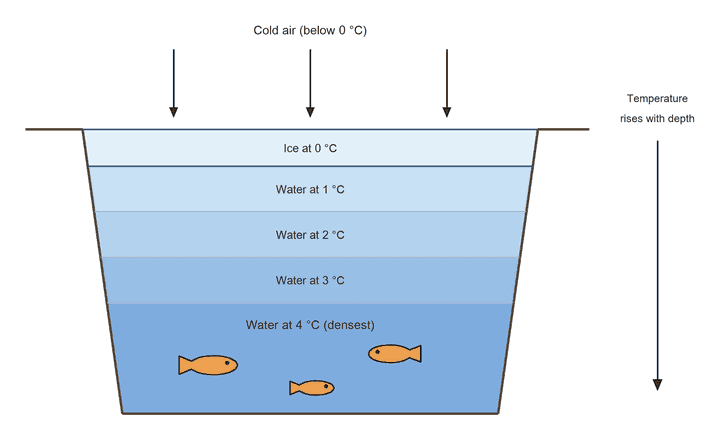
Watch out: The lake freezes from the TOP downwards, not from the bottom up, because water below 4 °C is lighter.
Therefore, anomalous expansion keeps the densest 4 °C water at the bottom and makes ice float as an insulating layer, so the water below stays liquid and aquatic organisms survive.