
Opening your dashboard
Class 8 Chemistry Chapter 8 Water: Competency-Based Questions (CBQ)
40 questions on Chapter 8, each worked through on its own page with the AI tutor. Class 8 Chemistry, ICSE 2026-27.
40 questions
1–5 marks · Mixed difficulty
- 11 mark
Question 1
Cognitive domain: Application
A kulfi seller packs his metal moulds in an earthen pot filled with crushed ice. Before closing the pot, he mixes a few handfuls of common salt into the ice. The kulfi sets much faster than it does in ice alone.
How does the salt help?
- 21 mark
Question 2
Cognitive domain: Analysis
Students of a coastal school collect four samples of water: rainwater (caught after an hour of steady rain), well water, filtered river water and sea water. The labels get mixed up, so they mark the samples W, X, Y and Z. They evaporate 50 mL of each sample to dryness in a weighed dish and find the mass of the solid left behind.
Sample W X Y Z Residue from 50 mL 0.00 g 0.03 g 0.02 g 1.75 g Which option identifies samples W and Z correctly?
- 31 mark
Question 3
Cognitive domain: Understanding
Rahul is making sugar syrup for a sherbet stall. He stirs sugar into a glass of cold water, spoon after spoon, until some sugar stays at the bottom however long he stirs. He then warms the glass, and the sugar at the bottom disappears.
Which statement explains what he saw?
- 41 mark
Question 4
Cognitive domain: Analysis
After a flood, Sana collects muddy water from the river and tests it in steps.
- She pours it through ordinary filter paper. Brown mud is left on the paper.
- The filtrate has no grit, but it is still faintly cloudy (translucent). It stays just as cloudy after standing for two days.
- She passes this filtrate through an ultra-fine filter in the laboratory. Now it comes out clear and transparent.
Which conclusion fits all three observations?
- 51 mark
Question 5
Cognitive domain: Understanding
Assertion (A): A moist gas can be dried by passing it through a tube packed with anhydrous calcium chloride.
Reason (R): Anhydrous calcium chloride is hygroscopic and takes up moisture without reacting chemically with the gas.
- 61 mark
Question 6
Cognitive domain: Understanding
Assertion (A): Hard water is not suitable for use in the boilers of factories.
Reason (R): Hard water contains salts of calcium and magnesium, which are needed for the healthy growth of bones and teeth.
- 71 mark
Question 7
Cognitive domain: Understanding
On a cold January morning, Farida cannot see the end of her lane because of fog. By ten o'clock the sun is out and the fog has gone. Fill in the blanks.
Fog forms when water vapour in the cold air ________ into tiny drops of water. When the sun warms the air, the drops ________ and the fog clears. These two changes, together with ________ (rainfall), keep water moving between the earth's surface and the atmosphere.
- 81 mark
Question 8
Cognitive domain: Recall
During a hockey match on a hot afternoon, Gurpreet sweats heavily. At the break, his coach makes him drink plenty of water.
Name the function of water in the body that sweating shows. Which ability of water allows it to carry digested food and minerals to every part of the body?
- 91 mark
Question 9
Cognitive domain: Application
Leaves give out water vapour through their surfaces. To check this, Dev clips a dry strip of blue (anhydrous) cobalt chloride paper to the lower side of a leaf on a potted plant and covers it with a glass slide.
Predict what he will observe after some time, and state what the observation shows.
- 102 marks
Question 10
Cognitive domain: Application
Meher puts two identical 500 mL glass bottles in the freezer. Bottle 1 is filled to the brim with water and tightly capped. Bottle 2 holds 375 mL of water and is also capped. Next morning bottle 1 has cracked, but bottle 2 is whole, with solid ice inside. It is known that 109 mL of ice is formed from every 100 mL of water.
(a) Explain why bottle 1 cracked.
(b) Show by calculation why bottle 2 did not crack.
- 112 marks
Question 11
Cognitive domain: Application
The labels have come off two jars in the school laboratory. Both contain colourless crystals. One is Glauber's salt and the other is potassium nitrate. You are given dry test tubes, a test tube holder, a burner and a little white anhydrous copper sulphate.
Describe how you would find out which jar holds Glauber's salt, and explain why your test works.
- 122 marks
Question 12
Cognitive domain: Evaluation
Several people in a village fall ill with cholera. All of them drink water straight from the river. At a meeting the sarpanch says, "Our river water is clear and has no smell. Clear water is safe water, so the river cannot be the cause."
Evaluate his statement, and suggest two steps the village should take.
- 134 marks
Question 13
Cognitive domain: Analysis
The science club of a school tests water from three places: P from a rainwater tank, Q from a hand pump and R from a tube well. To 10 mL of each sample, soap solution is added drop by drop, with shaking, until a lather forms that lasts for one minute. A fresh portion of each sample is then boiled, cooled and filtered, and the test is repeated. On boiling, a white solid appeared only in sample Q.
Sample Drops of soap solution needed (untreated) Drops needed (after boiling and filtering) P 2 2 Q 14 3 R 16 15 (a) Which sample is soft water? How do the results show it?
(b) What kind of hardness do Q and R have? Name one salt that could be present in each, and write an equation to explain the white solid seen in Q.
(c) A laundry near the school can get only water R. Suggest how this water can be softened, with an equation, and explain why soap will lather in it afterwards.
- 144 marks
Question 14
Cognitive domain: Application
A fishing village stands on an island. Its only well has dried up, and every summer drinking water has to be brought by boat. The children find this strange, since the sea is all around them. Their teacher explains that seas and oceans hold 97.4% of all the water on the earth, but each litre of sea water contains about 35 g of dissolved salts, mainly common salt. Only about 1% of the earth's water is fit for direct use by living beings.
(a) Why can the villagers not drink sea water, although there is so much of it?
(b) Calculate the mass of salts left behind when 20 litres of sea water are evaporated to dryness. How many litres of sea water must be evaporated to obtain 7 kg of salts?
(c) Bhavna suggests pouring sea water through several layers of fine cloth. Karan suggests boiling it in a covered pot and collecting the drops that form under the cool lid. Whose method will give water without salt? Explain, and name the process of removing dissolved salts from sea water.
- 155 marks
Question 15
Cognitive domain: Creativity
Ayesha says, "Hot water can dissolve more of a solid than the same amount of cold water." Design an investigation to test her statement for potassium nitrate, a salt that dissolves in water.
You are given potassium nitrate, a balance, a measuring cylinder, beakers, a glass rod, a thermometer, a burner with a stand, and water.
Your plan should show:
(a) what you will change, what you will measure, and what you will keep the same;
(b) the steps you will follow, and how you will know that a solution has become saturated;
(c) how you will record the readings, and what result will support Ayesha;
(d) what you expect to see when the hot saturated solution is left to cool, with the reason.
- 161 mark
Question 16
Cognitive domain: Analysis
Ria cools two 100 mL samples of a liquid, one after the other, in the same freezing mixture. One sample is pure water and the other is water with common salt dissolved in it. She records the temperature every 2 minutes and draws one graph for each sample. (Hypothetical data.)
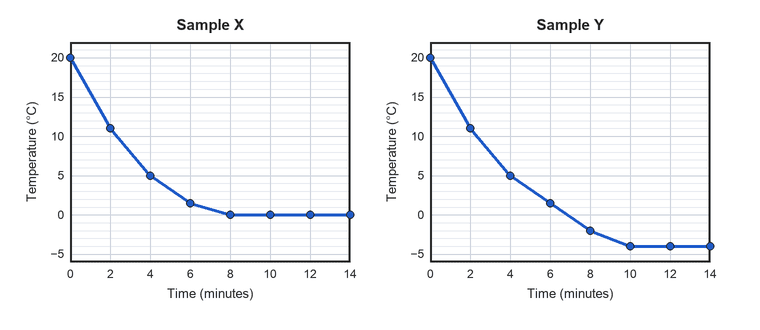
Which conclusion is correct?
- 171 mark
Question 17
Cognitive domain: Analysis
Zoya watches a kettle of boiling water on the stove. A white cloud rises from the spout, but the space of about 2 cm just next to the spout looks completely clear. The white cloud starts a little farther away and gets thinner as it rises.
Which statement explains what she sees?
- 181 mark
Question 18
Cognitive domain: Analysis
Four oxides, sodium oxide, potassium oxide, carbon dioxide and sulphur dioxide, are dissolved separately in water. The tubes are labelled P, Q, R and S, in no particular order. Each solution is tested with red and blue litmus paper.
Tube Red litmus Blue litmus P turns blue no change Q no change turns red R turns blue no change S no change turns red Which statement is correct?
- 191 mark
Question 19
Cognitive domain: Evaluation
Assertion (A): Common salt kept in an open jar becomes damp and lumpy during the rainy season.
Reason (R): Common salt is an efflorescent substance, so it takes up water from moist air.
- 201 mark
Question 20
Cognitive domain: Evaluation
Assertion (A): When milk is poured through ordinary filter paper, its colloidal particles are left behind on the paper.
Reason (R): The particles of a colloid are smaller than m, so they pass through ordinary filter paper.
- 211 mark
Question 21
Cognitive domain: Analysis
The graph shows how many grams of two salts, P and Q, dissolve in 100 g of water at different temperatures. Assume that both salts form crystals without water of crystallisation. (Hypothetical data.)
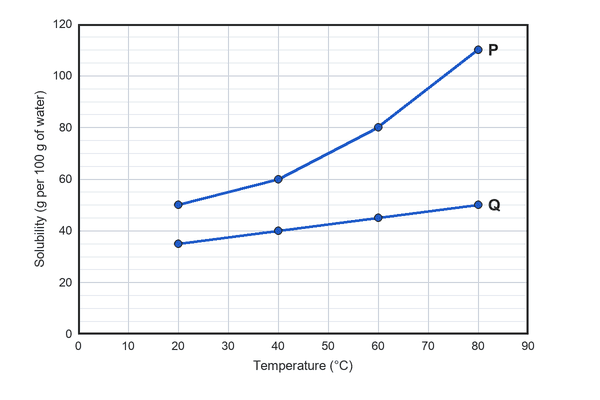
Two separate portions of 100 g of water are saturated, one with P and the other with Q, at 60 °C. Both are then cooled to 20 °C. What mass of crystals separates out from each?
- 221 mark
Question 22
Cognitive domain: Application
A row of laundries on a river bank washes clothes with detergent powder and lets the used water run straight into the river. A thick white foam floats on the river for many kilometres downstream. Tests show that the natural processes in the river do not break the detergent down.
Which statement about this pollution is correct?
- 231 mark
Question 23
Cognitive domain: Application
For a project, a class uses a 20-litre bucket of water to stand for all the water on the earth. The class knows that seas and oceans hold 97.4% of the water on the earth, and that only 1% of all the water on the earth is fit for direct use by living beings.
How much water in the model stands for the sea water, and how much stands for the water fit for direct use?
- 241 mark
Question 24
Cognitive domain: Application
Water is formed when hydrogen burns in oxygen. In water, hydrogen and oxygen are present in the ratio 1 : 8 by mass.
Which of these mixtures of hydrogen and oxygen can form water with nothing of either gas left over?
- 251 mark
Question 25
Cognitive domain: Analysis
Three white solids M, N and O, each of mass 10.00 g, are left in open dishes in a laboratory for a week. The masses and the appearance after a week are noted. (Hypothetical data.)
Solid Appearance at the start Mass after a week Appearance after a week M clear crystals 4.3 g dry white powder N pellets 14.2 g pellets have melted into a liquid O dry granules 12.1 g dry granules Which option names the property shown by M, N and O?
- 262 marks
Question 26
Cognitive domain: Evaluation
Ishaan lives in a desert town. There is no river, lake or pond anywhere near it, and no sea for hundreds of kilometres. In his project he writes: "Since there is no water on the surface of the land here, there is no water at all in or around our town."
Evaluate his statement. Name two places or forms in which water can still occur in and around the town.
- 272 marks
Question 27
Cognitive domain: Application
Three mixtures of a solid in water are examined with an instrument that measures the size of the particles. The average sizes are: mixture P, m; mixture Q, m; mixture R, m.
(a) Classify each mixture as a solution, a colloid or a suspension.
(b) Which mixture leaves a residue on ordinary filter paper, and which one needs an ultra-fine filter to stop its particles?
- 282 marks
Question 28
Cognitive domain: Evaluation
Neha writes in her notebook: "Copper sulphate crystals are white. On heating, they lose water of crystallisation and turn blue. When a few drops of water are added to the blue powder, it turns white again."
(a) Find the mistakes in her notes.
(b) Write the correct statements.
- 292 marks
Question 29
Cognitive domain: Understanding
On a hot, humid afternoon, Kabir fills a steel tumbler with ice-cold water. After a few minutes, small drops of water cover the outside of the tumbler, although it has no leak.
(a) Where does this water come from?
(b) Name the process, and name the step of the water cycle in the sky that is the same process.
- 302 marks
Question 30
Cognitive domain: Evaluation
While cooking, Aman adds a pinch of salt to a pan of boiling water and says, "Now the water is much hotter than 100 °C, so the potatoes will cook in half the time."
Evaluate his statement. Use the fact that a pinch of salt in a pan of water raises the boiling point by much less than 1 °C.
- 312 marks
Question 31
Cognitive domain: Creativity
The panchayat wants two short "Do not" notices for a board at the village pond, which is a source of water for the village. Write two notices. Each notice must give one instruction and a one-line reason that is based on what you have learnt about water pollution.
- 323 marks
Question 32
Cognitive domain: Application
Four unnamed metals W, X, Y and Z are the metals sodium, magnesium, iron and copper, in some order. Their reactions with water and steam are noted.
Metal In cold water In steam W no change no change, even when red hot X no visible change reacts when strongly heated, giving hydrogen and a white solid Y reacts fast, giving hydrogen, and the solution turns red litmus blue not needed Z no change reacts only when red hot, giving hydrogen and a black solid (a) Identify W, X, Y and Z.
(b) Write the balanced equation for the reaction of X with steam.
(c) Arrange the four metals in decreasing order of activity.
- 333 marks
Question 33
Cognitive domain: Application
Meena washes her school uniform in water from a hand pump. Her bar of soap forms a grey, sticky scum and gives very little lather. Her neighbour washes similar clothes with detergent powder in the same water and gets plenty of lather without any scum.
(a) What kind of water is the hand-pump water? Name the salts that cause this.
(b) Why does the detergent not form scum in this water, while the soap does?
(c) Meena decides to boil and filter the water before using soap. Will this always work? Give a reason.
- 343 marks
Question 34
Cognitive domain: Application
A food unit dries vegetables to make powder. The table gives the percentage of water in some vegetables, by mass.
Vegetable Proportion of water Tomatoes 95% Potatoes 80% Leafy vegetables 90% (a) How much dry matter is left when 400 kg of tomatoes are dried completely?
(b) How much dry matter is left when 400 kg of potatoes are dried completely?
(c) How many kilograms of fresh leafy vegetables are needed to get 30 kg of dry matter?
- 353 marks
Question 35
Cognitive domain: Analysis
Two sealed bottles of the same cold drink are bought on the same day. One is kept in a refrigerator. The other is left in the hot boot of a car for an afternoon. When both are opened, the bottle from the car sprays out much more froth than the bottle from the refrigerator.
(a) Explain why the bottle from the car froths more.
(b) Two more bottles of the same drink are opened, and half of each is poured out. Bottle X is capped tightly again at once. Bottle Y is left without its cap. Both are put back in the refrigerator overnight. Which bottle will still taste fizzy the next day? Give a reason.
(c) What should be done before opening the bottle that was kept in the car, so that less froth comes out? Give a reason.
- 363 marks
Question 36
Cognitive domain: Analysis
Aarav pours 50 mL of water into each of three identical dishes. Dish A is kept in a cool room with dry air, dish B in a warm room with dry air, and dish C in a warm room with damp air. After 6 hours he measures the water left. (Hypothetical data.)
Dish Water left after 6 hours A 44 mL B 36 mL C 42 mL (a) Find the volume of water that evaporated from each dish. Which dish lost the most?
(b) Compare dishes B and C. Which condition reduces evaporation? Relate it to the water cycle.
(c) Dish D is kept in a cool room with damp air. Will the water left in D be more than 44 mL or less than 44 mL? Give a reason.
- 374 marks
Question 37
Cognitive domain: Analysis
A town's river is tested at three sites on the same morning. Site S1 is above the town. Site S2 is just below the town's open drain, which carries untreated sewage. Site S3 is just below a thermal power plant, which uses river water for cooling and returns it hot. Fishermen say that fish are plentiful at S1 and fewer at S3, and that villagers who drink from the river near S2 fall ill more often. (Hypothetical data.)
Site Temperature (°C) Dissolved oxygen (mg per litre) Cases of stomach illness per 1000 people S1 22 8.7 4 S2 23 8.4 38 S3 33 7.3 5 (a) Which site shows thermal pollution? Give two readings from the table that support your answer.
(b) A kind of fish found in this river needs at least 7.5 mg of dissolved oxygen per litre of water. At which sites can this fish live? By how much does the oxygen at the remaining site fall short? Give the reason why the oxygen is lowest at that site.
(c) Name the kind of pollution at S2 and two diseases it can spread. State two steps the town should take.
- 384 marks
Question 38
Cognitive domain: Application
A small dyeing unit near a village uses borewell water to colour cotton cloth. The dye takes unevenly, and the cloth looks patchy. A chemist finds that the water forms very little lather with soap, and that boiling the water and filtering it makes no difference. Analysis shows that each litre of the water contains 0.68 g of calcium sulphate and no bicarbonates. The unit treats 100 litres of water in each batch. (Hypothetical data.)
(a) State the kind of hardness of this water. Why does boiling not help, and why is such water unsuitable for dyeing?
(b) Name the chemical that should be added and write the balanced equation.
(c) Calculate the mass of calcium sulphate in one batch of 100 litres, and the mass of anhydrous sodium carbonate that just reacts with it.
(Ca = 40, S = 32, O = 16, Na = 23, C = 12. In the equation, one formula mass of calcium sulphate reacts with one formula mass of sodium carbonate, so the masses react in the ratio of the formula masses.)
- 395 marks
Question 39
Cognitive domain: Analysis
A hill town lies downwind of a coal-burning power plant. The chimney releases sulphur dioxide gas. Rainwater collected in a clean bucket in the town turns blue litmus red, and the fish in a small lake nearby have almost disappeared. The municipal officer asks the plant to cut down the gas and adds a large amount of quicklime (calcium oxide) to the lake. Litmus tests are done. (Hypothetical case.)
Sample Blue litmus Red litmus Town rainwater turns red no change Pure water kept for comparison no change no change Lake water after adding quicklime no change turns blue (a) Write the balanced equation for the reaction of sulphur dioxide with water, and name the acid formed.
(b) What do the litmus results show for the town rainwater and for the lake water after adding quicklime? Write the equation that explains the lake result.
(c) The officer says, "Adding quicklime to the lake solves the pollution for good." Evaluate this statement and suggest what else is needed.
- 405 marks
Question 40
Cognitive domain: Application
Ravi, a labourer whose body mass is 60 kg, works in a field for a whole day in May. About 70% of the mass of a human body is water. Over the day he loses 2 litres of water as sweat (2 litres of water have a mass of 2 kg), but he drinks only half a litre. In the evening he feels dizzy, and his mother gives him three glasses of water of 250 mL each. (Hypothetical case.)
(a) Find the mass of water in Ravi's body at the start of the day.
(b) Find the net loss of water over the day, and express it as a percentage of the water in his body, correct to one decimal place.
(c) Do the three glasses of water make up the net loss? If not, how much more water, in litres, must he drink?