
Opening your dashboard
Class 8 Chemistry Chapter 4: Atomic Structure Solutions
36 textbook questions with step-by-step answers, free to read, for ICSE 2026-27.
Get talked through Ch 4, not just shown the answer
Reading a finished solution is not the same as being able to do it. The AI tutor takes one question at a time and works it with you, in your own words, until you can.
- Ask it out loud, in your own words
- It gives you the next step, not the answer
- Stuck on part (ii)? Start there
36 questions with solutions
1–5 marks · Mixed difficulty
- 11 mark
Question 1
The smallest particle of matter exhibiting all its properties is :
Solve with AIAnswer
(A) a radical
- Correct
(B) an atom
(C) a molecule
(D) an electron
Answer: (B) an atom
Concept: In this chapter an atom is defined as the smallest particle of an element that shows all the properties of that element and takes part in chemical reactions.
Step 1 — Recall the definition.
The chapter defines the atom as the smallest particle of matter (of an element) that still has all its properties.
Step 2 — Compare with the other particles.
A molecule is built from atoms, a radical is an ion or a group of atoms carrying a charge, and an electron is a part of every atom. None of these is the smallest particle that shows the element's properties.
Watch out: For a compound (such as water) the smallest particle that keeps its properties is a molecule; the book's definition here is for an element.
Why the other options are wrong:
- (A) a radical: This is wrong because a radical is a charged atom or group of atoms, which behaves differently from the element itself.
- (C) a molecule: This is wrong because a molecule is made of atoms, so it is not the smallest particle; it is the smallest particle that can exist independently.
- (D) an electron: This is wrong because an electron is a sub-atomic particle found in the atoms of every element, so it cannot show the properties of any one element.
Therefore, the smallest particle of matter exhibiting all its properties is an atom, option (B).
- 21 mark
Question 2
Rutherford's alpha-particle scattering experiment led to the discovery of :
Solve with AIAnswer
(A) electron
(B) proton
(C) neutron
- Correct
(D) nucleus
Answer: (D) nucleus
Concept: In 1911 Rutherford fired fast alpha particles at a very thin gold foil. A very few bounced back, which showed a tiny, heavy, positively charged centre in every atom: the nucleus.
Step 1 — Recall the result.
Most alpha particles passed straight through, so the atom is mostly empty space. A very few bounced back, which needs a small, dense, positive centre.
Step 2 — Name the discovery.
That small, dense, positive centre is the nucleus, so the experiment led to the discovery of the nucleus.
Why the other options are wrong:
- (A) electron: This is wrong because the electron was discovered earlier (1897) by J.J. Thomson, from cathode rays.
- (B) proton: This is wrong because positive (canal) rays were found by E. Goldstein in 1886, and the proton itself was identified by Rutherford later (about 1917–1920), in a different experiment.
- (C) neutron: This is wrong because the neutron was discovered by James Chadwick in 1932.
Therefore, Rutherford's alpha-particle scattering experiment led to the discovery of the nucleus, option (D).
- 31 mark
Question 3
The outermost shell of an atom is known as :
Solve with AIAnswer
(A) valency
(B) valence electrons
(C) nucleus
- Correct
(D) valence shell
Answer: (D) valence shell
Concept: Electrons move in shells (K, L, M, …) round the nucleus. The outermost shell is called the valence shell, and the electrons in it are the valence electrons.
Step 1 — Match the description.
The question asks for the name of a shell, the outermost one. Only one option is the name of a shell.
Watch out: Valence shell (a shell), valence electrons (the electrons in it) and valency (a number) are three different things.
Why the other options are wrong:
- (A) valency: This is wrong because valency is the combining capacity of an atom, a number, not a shell.
- (B) valence electrons: This is wrong because valence electrons are the electrons present in the valence shell, not the shell itself.
- (C) nucleus: This is wrong because the nucleus is the central part of the atom, not a shell.
Therefore, the outermost shell of an atom is the valence shell, option (D).
- 41 mark
Question 4
The number of valence electrons present in magnesium is :
Solve with AIAnswer
- Correct
(A) two
(B) three
(C) four
(D) five
Answer: (A) two
Concept: The valence electrons are the electrons in the outermost shell. Shells fill in order: K holds 2, L holds 8, and the rest go into M.
Step 1 — Write the configuration of magnesium.
Magnesium has atomic number 12, so a neutral atom has 12 electrons. Putting 2 in K and 8 in L leaves 2 for M, so the configuration is 2, 8, 2.
Step 2 — Count the outermost electrons.
The outermost (M) shell holds 2 electrons, so magnesium has two valence electrons.
Why the other options are wrong:
- (B) three: This is wrong because three valence electrons belong to aluminium (2, 8, 3).
- (C) four: This is wrong because four valence electrons belong to silicon (2, 8, 4).
- (D) five: This is wrong because five valence electrons belong to phosphorus (2, 8, 5).
Therefore, magnesium has two valence electrons, option (A).
- 51 mark
Question 5
The subatomic particle with positive charge is :
Solve with AIAnswer
- Correct
(A) proton
(B) neutron
(C) electron
(D) nucleon
Answer: (A) proton
Concept: An atom has a tiny central nucleus holding protons (charge +1) and neutrons (no charge), with electrons (charge −1) moving in shells around it.
Step 1 — Recall the charges.
A proton carries one unit of positive charge (+1), an electron one unit of negative charge (−1), and a neutron no charge.
Step 2 — Pick the positive particle.
Only the proton is positively charged.
Why the other options are wrong:
- (B) neutron: This is wrong because a neutron has no charge.
- (C) electron: This is wrong because an electron carries one unit of negative charge.
- (D) nucleon: This is wrong because nucleon is the common name for protons and neutrons together; since neutrons are uncharged, it does not name the positively charged particle.
Therefore, the sub-atomic particle with a positive charge is the proton, option (A).
- 61 mark
Question 6
If the atomic number of an atom is 17 and mass number is 35, then number of neutrons will be :
Solve with AIAnswer
(A) 35
(B) 17
- Correct
(C) 18
(D) 52
Answer: (C) 18
Concept: The mass number counts protons + neutrons, and the atomic number counts protons, so the number of neutrons is the mass number minus the atomic number.
Step 1 — Write what is given.
The atomic number is 17 (so 17 protons) and the mass number is 35.
Step 2 — Subtract to find the neutrons.
We take the protons away from the total number of nucleons:
Watch out: Do not add the two numbers; the mass number already includes the protons.
Why the other options are wrong:
- (A) 35: This is wrong because 35 is the mass number (protons + neutrons), not the number of neutrons.
- (B) 17: This is wrong because 17 is the atomic number, the number of protons.
- (D) 52: This is wrong because 52 is the sum 35 + 17, which has no meaning here.
Therefore, the atom has 18 neutrons, option (C).
- 71 mark
Question 7
The number of electrons in an atom is equal to the number of :
Solve with AIAnswer
- Correct
(A) protons in a neutral atom
(B) neutrons in a neutral atom
(C) nucleons in a neutral atom
(D) none of the above
Answer: (A) protons in a neutral atom
Concept: An atom is electrically neutral: the total positive charge of its protons equals the total negative charge of its electrons.
Step 1 — Use the charges.
Each proton carries +1 and each electron −1, so equal numbers of them cancel exactly.
Step 2 — Conclude.
In a neutral atom the number of electrons therefore equals the number of protons.
Why the other options are wrong:
- (B) neutrons in a neutral atom: This is wrong because the number of neutrons need not equal the number of electrons: sodium has 11 electrons but 12 neutrons.
- (C) nucleons in a neutral atom: This is wrong because nucleons are protons plus neutrons, which gives the mass number, not the number of electrons.
- (D) none of the above: This is wrong because option (A) is correct.
Therefore, the number of electrons equals the number of protons in a neutral atom, option (A).
- 81 mark
Question 8
The sum of number of protons and number of neutrons present in the nucleus of an atom is called its :
Solve with AIAnswer
- Correct
(A) mass number
(B) atomic number
(C) valency
(D) none of these
Answer: (A) mass number
Concept: The mass number (A) of an atom is the number of protons + the number of neutrons in its nucleus.
Step 1 — Match the definition.
The question describes protons + neutrons, which is exactly the mass number.
Why the other options are wrong:
- (B) atomic number: This is wrong because the atomic number is the number of protons only.
- (C) valency: This is wrong because valency is the combining capacity of an atom.
- (D) none of these: This is wrong because option (A) is correct.
Therefore, the sum of protons and neutrons is the mass number, option (A).
- 91 mark
Question 9
The correct electronic configuration of sodium is :
Solve with AIAnswer
- Correct
(A) 2, 8, 1
(B) 1, 2, 8
(C) 8, 2, 1
(D) 8, 1, 2
Answer: (A) 2, 8, 1
Concept: Electrons fill the shells from the nucleus outwards: K (at most 2), then L (at most 8), then M.
Step 1 — Count the electrons.
Sodium has atomic number 11, so a neutral atom has 11 electrons.
Step 2 — Fill the shells in order.
K takes 2, L takes 8, and the remaining 1 goes into M, giving 2, 8, 1.
Watch out: The first number is always the K shell, which can hold only 2 electrons.
Why the other options are wrong:
- (B) 1, 2, 8: This is wrong because it puts only 1 electron in K before filling the next shell; K must be full (2) first.
- (C) 8, 2, 1: This is wrong because it puts 8 electrons in the K shell, which can hold only 2.
- (D) 8, 1, 2: This is wrong because it also puts 8 electrons in the K shell.
Therefore, the electronic configuration of sodium is 2, 8, 1, option (A).
- 101 mark
Question 10
Assertion (A) : Matter consists of very small particles called atoms. Reason (R) : Atoms are indivisible.
Solve with AIAnswer
(A) Both A and R are true and R is the correct explanation of A.
(B) Both A and R are true but R is not the correct explanation of A.
- Correct
(C) A is true but R is false.
(D) A is false but R is true.
Answer: (C) A is true but R is false.
Concept: Judge the Assertion first, then the Reason, and only then ask whether the Reason explains the Assertion. Dalton thought atoms could not be divided; later experiments found particles inside them.
Step 1 — Judge the Assertion.
All matter is made of very small particles called atoms, so A is true.
Step 2 — Judge the Reason.
Atoms are made of smaller particles (electrons, protons and neutrons), so they can be divided. R is false.
Step 3 — Choose the option.
With A true and R false, the matching option is "A is true but R is false".
Watch out: The word "indivisible" was part of Dalton's theory but has been shown to be wrong.
Why the other options are wrong:
- (A): This is wrong because R is false, so it cannot explain A.
- (B): This is wrong because R is false, so "both A and R are true" does not hold.
- (D): This is wrong because A is true and R is false, the reverse of this option.
Therefore, A is true but R is false, option (C).
- 111 mark
Question 11
Assertion (A) : An atom is electrically neutral. Reason (R) : The number of protons and the number of electrons are equal in an atom.
Solve with AIAnswer
- Correct
(A) Both A and R are true and R is the correct explanation of A.
(B) Both A and R are true but R is not the correct explanation of A.
(C) A is true but R is false.
(D) A is false but R is true.
Answer: (A) Both A and R are true and R is the correct explanation of A.
Concept: Judge the Assertion first, then the Reason, and only then ask whether the Reason explains the Assertion. An atom has a tiny central nucleus holding protons (charge +1) and neutrons (no charge), with electrons (charge −1) moving in shells around it.
Step 1 — Judge the Assertion.
An atom as a whole has no charge, so A is true.
Step 2 — Judge the Reason.
A neutral atom has equal numbers of protons and electrons, so R is true.
Step 3 — Decide whether R explains A.
Each proton (+1) cancels one electron (−1), so equal numbers give zero total charge. R is exactly why the atom is neutral.
Why the other options are wrong:
- (B): This is wrong because R is exactly the reason the charges cancel, so R does explain A.
- (C): This is wrong because R is true.
- (D): This is wrong because A is true.
Therefore, both A and R are true and R is the correct explanation of A, option (A).
- 121 mark
Question 12
Assertion (A) : The nucleus of an atom is a centrally located mass containing protons only. Reason (R) : The nucleus of an atom is positively charged.
Solve with AIAnswer
(A) Both A and R are true and R is the correct explanation of A.
(B) Both A and R are true but R is not the correct explanation of A.
(C) A is true but R is false.
- Correct
(D) A is false but R is true.
Answer: (D) A is false but R is true.
Concept: Judge the Assertion first, then the Reason, and only then ask whether the Reason explains the Assertion. The nucleus contains protons and neutrons (only the ordinary hydrogen atom has no neutron).
Step 1 — Judge the Assertion.
The nucleus is indeed central and holds almost all the mass, but it contains neutrons as well as protons. "Protons only" makes A false.
Step 2 — Judge the Reason.
The protons give the nucleus a positive charge (the neutrons are neutral), so R is true.
Step 3 — Choose the option.
With A false and R true, the matching option is "A is false but R is true".
Watch out: A nucleus can be positive and still contain neutrons; the neutrons simply add no charge.
Why the other options are wrong:
- (A): This is wrong because A is false.
- (B): This is wrong because A is false.
- (C): This is wrong because it is the reverse of the facts: A is false and R is true.
Therefore, A is false but R is true, option (D).
- 131 mark
Question 13
Assertion (A) : The sum of the number of protons and neutrons present in the nucleus of an atom of an element is called its mass number. Reason (R) : The number of protons in the nucleus of an atom of an element is called its mass number.
Solve with AIAnswer
(A) Both A and R are true and R is the correct explanation of A.
(B) Both A and R are true but R is not the correct explanation of A.
- Correct
(C) A is true but R is false.
(D) A is false but R is true.
Answer: (C) A is true but R is false.
Concept: Judge the Assertion first, then the Reason, and only then ask whether the Reason explains the Assertion. Mass number = protons + neutrons; atomic number = protons only.
Step 1 — Judge the Assertion.
A defines the mass number as the number of protons + neutrons, which is correct. A is true.
Step 2 — Judge the Reason.
The number of protons alone is the atomic number, not the mass number. R is false.
Step 3 — Choose the option.
With A true and R false, the matching option is "A is true but R is false".
Watch out: Read each definition carefully: "protons" alone is the atomic number.
Note: The book's printed answer says both statements are true with R not explaining A. That is incorrect, because R describes the atomic number, not the mass number.
Why the other options are wrong:
- (A): This is wrong because R is false: it describes the atomic number.
- (B): This is wrong because R is false, so "both A and R are true" does not hold.
- (D): This is wrong because A is the correct definition of mass number and R is the false one.
Therefore, A is true but R is false, option (C).
- 141 mark
Question 14
Assertion (A) : The circular orbits surrounding the nucleus of an atom are also called as energy levels or shells. Reason (R) : These circular orbits are associated with a fixed amount of energy.
Solve with AIAnswer
- Correct
(A) Both A and R are true and R is the correct explanation of A.
(B) Both A and R are true but R is not the correct explanation of A.
(C) A is true but R is false.
(D) A is false but R is true.
Answer: (A) Both A and R are true and R is the correct explanation of A.
Concept: Judge the Assertion first, then the Reason, and only then ask whether the Reason explains the Assertion. In Bohr's model electrons move only in certain circular orbits, and each orbit has a fixed amount of energy.
Step 1 — Judge the Assertion.
Bohr's circular orbits are also called energy levels or shells, so A is true.
Step 2 — Judge the Reason.
Each orbit has a fixed energy, so R is true.
Step 3 — Decide whether R explains A.
The orbits are called energy levels because each has a fixed amount of energy, so R explains A.
Why the other options are wrong:
- (B): This is wrong because the fixed energy of each orbit is exactly why it is called an energy level.
- (C): This is wrong because R is true.
- (D): This is wrong because A is true.
Therefore, both A and R are true and R is the correct explanation of A, option (A).
- 155 marks
Question 15
Fill in the blanks :
(a) Dalton said that ________ could not be divided.
(b) The fundamental particle of an atom carrying a negative charge is called ________ .
(c) An ion which has a positive charge is called a ________ .
(d) The outermost shell of an atom is known as ________ .
(e) The ________ of an atom is very hard and dense.
(f) Neutrons are ________ particles having mass equal to that of protons.
(g) Isotopes are the atoms of ________ element having the ________ atomic number but ________ mass number.
Solve with AIWritten solution
Solution:
Concept: Each blank is a term from the chapter. An atom has a tiny central nucleus holding protons (charge +1) and neutrons (no charge), with electrons (charge −1) moving in shells around it.
Step 1 — Part (a), Dalton's view.
Dalton's theory said that atoms could not be divided.
Step 2 — Part (b), the negative particle.
The fundamental particle with a negative charge is the electron.
Step 3 — Part (c), a positive ion.
An atom that loses electrons becomes a positive ion, called a cation.
Step 4 — Part (d), the outermost shell.
The outermost shell of an atom is its valence shell.
Step 5 — Part (e), the hard, dense part.
Almost all the mass is packed into the tiny centre, so the nucleus is very hard and dense.
Step 6 — Part (f), neutrons.
Neutrons carry no charge, so they are neutral particles. Their mass is almost equal to that of a proton (neutron 1.0087 u, proton 1.0073 u).
Step 7 — Part (g), isotopes.
Isotopes are atoms of the same element with the same atomic number but different mass numbers.
Watch out: A cation is positive and an anion is negative.
Therefore, the blanks are (a) atoms, (b) electron, (c) cation, (d) valence shell, (e) nucleus, (f) neutral and (g) the same, same, different.
- 165 marks
Question 16
Write 'true' or 'false' for the following statements :
(a) An atom on the whole has a positive charge.
(b) The maximum number of electrons in the first shell can be 8.
(c) The central part of an atom is called nucleus.
(d) The cathode rays in the discharge tube consist of protons.
(e) The neutrons are neutral and have a mass equal to 1 amu.
Solve with AIWritten solution
Solution:
Concept: An atom has a tiny central nucleus holding protons (charge +1) and neutrons (no charge), with electrons (charge −1) moving in shells around it. The maximum number of electrons in shell number n is 2n².
Step 1 — Statement (a).
An atom has equal numbers of protons and electrons, so on the whole it is electrically neutral. The statement is false.
Step 2 — Statement (b).
The first (K) shell has n = 1, so it can hold at most:
It holds 2 electrons, not 8. The statement is false.
Step 3 — Statement (c).
The central part of an atom is indeed called the nucleus. The statement is true.
Step 4 — Statement (d).
Cathode rays are streams of electrons, which are negatively charged. The statement is false.
Step 5 — Statement (e).
Neutrons have no charge, and the mass of a neutron is about 1 u (1 amu; more exactly 1.0087 u). The statement is true.
Watch out: The limit of 8 is for the outermost shell of most atoms, not for the K shell.
Therefore, (a) false, (b) false, (c) true, (d) false and (e) true.
- 175 marks
Question 17
Match the following :
Column A Column B (a) John Dalton (i) Electronic configuration (b) J.J. Thomson (ii) Discovery of nucleus (c) Maharishi Kannada (iii) Atomic theory (d) James Chadwick (iv) Plum-pudding atomic model (e) Ernest Rutherford (v) Paramanus (f) Neil Bohr (vi) Neutrons Solve with AIWritten solution
Solution:
Concept: Each scientist is linked with his best-known contribution to the idea of the atom.
Step 1 — The early ideas.
The ancient Indian sage Kanada called the tiniest particles of matter paramanus, so (c) goes with (v). John Dalton gave the atomic theory (1808), so (a) goes with (iii).
Step 2 — The models of the atom.
J.J. Thomson pictured the atom as a positive sphere with electrons embedded in it, the plum-pudding model, so (b) goes with (iv). Rutherford's alpha-particle experiment led to the discovery of the nucleus, so (e) goes with (ii).
Step 3 — The remaining two.
James Chadwick discovered neutrons (1932), so (d) goes with (vi). Bohr's model of fixed shells (energy levels) is the basis of the arrangement of electrons in shells, the electronic configuration, so (f) goes with (i).
Note: The names are usually spelt Kanada (printed "Kannada") and Niels Bohr (printed "Neil Bohr").
Therefore, (a)–(iii), (b)–(iv), (c)–(v), (d)–(vi), (e)–(ii) and (f)–(i).
- 185 marks
Question 18
Name the following :
(a) The sub-atomic particle with negative charge and negligible mass.
(b) Protons and neutrons present in the nucleus.
(c) The electrons present in the outermost shell.
(d) Arrangement of electrons in the shells of an atom.
(e) The number of protons present in the nucleus of an atom.
(f) The sum of the number of protons and neutrons of an atom.
(g) Atoms of same element with same atomic number but a different mass number.
(h) The smallest unit of an element which takes part in a chemical reaction.
(i) The particle which is not present in an atom of hydrogen.
Solve with AIWritten solution
Solution:
Concept: Each description is a term defined in the chapter. An atom has a tiny central nucleus holding protons (charge +1) and neutrons (no charge), with electrons (charge −1) moving in shells around it.
Step 1 — Parts (a) to (c), particles and electrons.
The negatively charged particle with negligible mass is the electron (a). Protons and neutrons in the nucleus are together called nucleons (b). The electrons in the outermost shell are the valence electrons (c).
Step 2 — Parts (d) to (f), numbers and arrangement.
The arrangement of electrons in the shells is the electronic configuration (d). The number of protons in the nucleus is the atomic number (e). The sum of protons and neutrons is the mass number (f).
Step 3 — Parts (g) to (i), isotopes, atoms and hydrogen.
Atoms of the same element with the same atomic number but different mass numbers are isotopes (g). The smallest unit of an element that takes part in a chemical reaction is the atom (h). An ordinary hydrogen atom has one proton and one electron but no neutron (i).
Watch out: Part (i) is about ordinary hydrogen (protium); its isotopes deuterium and tritium do contain neutrons.
Therefore, (a) electron, (b) nucleons, (c) valence electrons, (d) electronic configuration, (e) atomic number, (f) mass number, (g) isotopes, (h) atom and (i) neutron.
- 195 marks
Question 19
Define the following terms :
(a) Atomic number
(b) Mass number
(c) Nucleons
(d) Valence shell
Solve with AIWritten solution
Solution:
Concept: These four terms describe the nucleus and the shells of an atom. An atom has a tiny central nucleus holding protons (charge +1) and neutrons (no charge), with electrons (charge −1) moving in shells around it.
Step 1 — Atomic number.
The number of protons in the nucleus of an atom is its atomic number (Z). In a neutral atom it also equals the number of electrons.
Step 2 — Mass number.
The number of protons + the number of neutrons in the nucleus of an atom is its mass number (A).
Step 3 — Nucleons.
The protons and neutrons present in the nucleus are together called nucleons.
Step 4 — Valence shell.
The outermost shell of an atom is called its valence shell.
Watch out: Atomic number counts protons only; mass number counts protons and neutrons.
Therefore, atomic number = protons, mass number = protons + neutrons, nucleons = protons and neutrons together, and the valence shell = the outermost shell.
- 202 marks
Question 20
Name the three fundamental particles of an atom. Give their symbols with the charge on each particle.
Solve with AIWritten solution
Solution:
Concept: An atom is made of three fundamental particles: electrons, protons and neutrons.
Step 1 — List the particles with their symbols and charges.
In the symbols, the lower number is the charge and the upper number is the mass in atomic mass units (0 for the electron, whose mass is negligible):
Particle Symbol Charge Electron or −1 unit Proton or +1 unit Neutron or 0 (no charge) Therefore, the three fundamental particles are the electron (e⁻, −1), the proton (p⁺, +1) and the neutron (n, no charge).
- 212 marks
Question 21
Which fundamental particle is present in anode rays ? Why anode rays are also called as canal rays.
Solve with AIWritten solution
Solution:
Concept: Anode rays are positively charged rays in a discharge tube that travel from the anode side towards the cathode. Goldstein (1886) used a cathode with small holes in it.
Step 1 — Name the particle.
Anode rays are streams of positive ions of the gas in the tube. When the tube contains hydrogen, these positive ions are protons, so the fundamental particle present is the proton.
Step 2 — Explain the name canal rays.
Goldstein used a perforated cathode, a cathode with very small holes or canals. The positive rays passed through these canals and produced a glow behind the cathode, so they are also called canal rays.
Watch out: Anode rays are made of protons only when the gas is hydrogen; with other gases they are heavier positive ions.
Therefore, anode rays contain protons (with hydrogen gas), and they are called canal rays because they pass through the holes (canals) of the perforated cathode.
- 222 marks
Question 22
What are cathode rays ? Which fundamental particle is present in these rays ?
Solve with AIWritten solution
Solution:
Concept: A discharge tube is a glass tube with a gas at very low pressure and two metal plates (electrodes), the cathode (−) and the anode (+), across which a high voltage is applied.
Step 1 — Describe cathode rays.
When a high voltage is applied across the tube, rays start from the cathode and travel towards the anode. These streams of negatively charged particles are called cathode rays.
Step 2 — Name the particle.
The negatively charged particles in cathode rays are electrons (J.J. Thomson, 1897).
Therefore, cathode rays are streams of negatively charged particles from the cathode of a discharge tube, and they consist of electrons.
- 232 marks
Question 23
The atom of an element is made up of 4 protons, 5 neutrons and 4 electrons. What is its atomic number and mass number ? Represent the atom with a symbol.
Solve with AIWritten solution
Solution:
Concept: The atomic number (Z) is the number of protons; the mass number (A) is protons + neutrons, so neutrons = A − Z. A neutral atom has Z electrons.
Step 1 — Find the atomic number.
The atomic number is the number of protons, so Z = 4.
Step 2 — Find the mass number.
The mass number is the number of protons + neutrons:
Step 3 — Write the symbol.
The element with atomic number 4 is beryllium (Be). The mass number goes at the top and the atomic number at the bottom, so the atom is written (also ).
Watch out: The electrons do not count towards the mass number.
Therefore, the atomic number is 4, the mass number is 9 and the atom is ⁹₄Be.
- 242 marks
Question 24
The atomic number and the mass number of sodium are 11 and 23 respectively. What information is conveyed by this statement ?
Solve with AIWritten solution
Solution:
Concept: The atomic number (Z) is the number of protons; the mass number (A) is protons + neutrons, so neutrons = A − Z. A neutral atom has Z electrons.
Step 1 — Read the atomic number.
Atomic number 11 means one sodium atom has 11 protons in its nucleus, and, being neutral, 11 electrons around it.
Step 2 — Find the neutrons from the mass number.
Mass number 23 means there are 23 nucleons in all, so the neutrons are:
Step 3 — Write the configuration.
The 11 electrons fill K with 2, L with 8 and M with 1, so the configuration is 2, 8, 1.
Therefore, a sodium atom has 11 protons, 11 electrons, 12 neutrons and 23 nucleons, with configuration 2, 8, 1.
- 255 marks
Question 25
Differentiate between the following :
(a) Protons and neutrons
(b) Nucleons and nucleus
(c) Atomic number and mass number
Solve with AIWritten solution
Solution:
Concept: Compare the two items in each pair point by point. An atom has a tiny central nucleus holding protons (charge +1) and neutrons (no charge), with electrons (charge −1) moving in shells around it.
Step 1 — Protons and neutrons.
Both are in the nucleus, but they differ in charge and in where they occur:
Protons Neutrons Carry one unit of positive charge (+1). Carry no charge (neutral). Symbol or . Symbol or . Positive rays found by E. Goldstein (1886); the proton was identified by Rutherford (about 1919). Discovered by James Chadwick (1932). Present in the nuclei of all atoms, including hydrogen. Absent in an ordinary hydrogen atom. Step 2 — Nucleons and nucleus.
Nucleons are the particles; the nucleus is the place that holds them:
Nucleons Nucleus The particles (protons and neutrons) present in the nucleus. The small, dense, positively charged central part of the atom. Their total number is the mass number of the atom. It contains all the nucleons, so it holds almost the entire mass of the atom. Step 3 — Atomic number and mass number.
One counts protons only; the other counts protons and neutrons:
Atomic number (Z) Mass number (A) Number of protons in the nucleus. Number of protons + number of neutrons in the nucleus. Same for all atoms (isotopes) of an element. Differs for the isotopes of an element. Written as a subscript on the left of the symbol, e.g. . Written as a superscript, e.g. . Therefore, protons are charged and neutrons are not, nucleons are the particles inside the nucleus, and the atomic number counts protons while the mass number counts protons and neutrons.
- 262 marks
Question 26
Why is Thomson's Atomic model called as Plum-Pudding model ?
Solve with AIWritten solution
Solution:
Concept: J.J. Thomson pictured the atom as a sphere of positive charge with electrons embedded in it.
Step 1 — Describe the model.
According to Thomson, an atom is a positively charged sphere in which electrons are embedded, so that the total positive and negative charges balance.
Step 2 — Explain the name.
The electrons sit in the positive sphere just as plums or dry fruits are spread through a pudding. Because of this likeness, the model is called the plum-pudding model.
Therefore, Thomson's model is called the plum-pudding model because its electrons are embedded in a positive sphere like plums in a pudding.
- 273 marks
Question 27
Mention briefly the salient features of Dalton's atomic theory (five points).
Solve with AIWritten solution
Solution:
Concept: John Dalton published his atomic theory in 1808, describing the atom as the smallest particle of an element.
Step 1 — List the five main points.
The salient features of Dalton's atomic theory are:
- Matter consists of very small and indivisible particles called atoms.
- Atoms can neither be created nor be destroyed.
- The atoms of an element are identical in all respects (size, mass and chemical properties), but they differ from the atoms of other elements.
- Atoms of different elements combine in a simple whole-number ratio to form compounds.
- Atoms are the smallest units that take part in chemical reactions, in which only a rearrangement of atoms takes place.
Watch out: Two of Dalton's points were later revised: atoms are divisible, and isotopes show that atoms of one element can differ in mass.
Therefore, Dalton said atoms are indivisible, cannot be created or destroyed, are identical for one element, combine in simple whole-number ratios and are only rearranged in reactions.
- 283 marks
Question 28
What are the observations of the alpha particle scattering experiment done by Rutherford in order to determine the structure of an atom ?
Solve with AIWritten solution
Solution:
Concept: Rutherford bombarded a very thin gold foil with fast-moving, positively charged alpha particles and watched where they went.
Step 1 — State the observations.
Three things were seen:
- Most of the alpha particles passed straight through the gold foil without being deflected.
- A small fraction of the alpha particles were deflected from their path through small angles.
- Only a very few alpha particles bounced back towards the source.
Step 2 — Say what they showed.
Straight paths mean the atom is mostly empty space; deflections and rebounds mean a tiny, heavy, positive centre (the nucleus).
Therefore, most alpha particles went straight through, a small fraction were deflected, and only a very few bounced back.
- 295 marks
Question 29
(a) What are the two main features of Rutherford's atomic model ?
(b) State its one drawback.
Solve with AIWritten solution
Solution:
Concept: Rutherford's model is like the solar system: a central nucleus with electrons revolving around it.
Step 1 — Feature 1: the centrally located nucleus.
The nucleus is a small, centrally located, positively charged mass containing the protons. Almost the entire mass of the atom is concentrated in it, and it is very small compared with the size of the atom.
Step 2 — Feature 2: the outer circular orbits.
Electrons revolve around the nucleus in circular orbits (shells) in the large empty space around it.
Step 3 — The drawback.
Rutherford's model could not explain the stability of the atom. By the physics known then, an electron moving in a circle should keep giving out energy, spiral closer to the nucleus and finally fall into it, so the atom should collapse. Atoms do not collapse, so the model is incomplete.
Therefore, the two features are a small, heavy, positive central nucleus and electrons revolving in orbits around it, and the drawback is that it cannot explain why the atom is stable.
- 305 marks
Question 30
(a) According to the modern atomic model, what are the two main parts of which an atom is made of ?
(b) Where is the nucleus of an atom situated ?
(c) What are energy levels or shells of an atom ?
Solve with AIWritten solution
Solution:
Concept: In the modern model the nucleus is at the centre and the electrons move in fixed shells around it.
Step 1 — Part (a), the two main parts.
An atom is made of (1) the nucleus, which contains the protons and neutrons, and (2) the orbits or shells (the extra-nuclear part) in the space around the nucleus, in which the electrons move.
Step 2 — Part (b), position of the nucleus.
The nucleus is situated at the centre of the atom.
Step 3 — Part (c), energy levels or shells.
Energy levels or shells are the fixed circular paths around the nucleus in which electrons revolve. Each shell has a fixed amount of energy. The shells are named K, L, M, N, … (or numbered 1, 2, 3, 4, …) from the nucleus outwards, and the energy of a shell increases with its distance from the nucleus.
Watch out: The K shell is nearest the nucleus and has the lowest energy.
Therefore, an atom is made of a nucleus at its centre and shells around it, and the shells are fixed-energy paths K, L, M, N, … in which electrons move.
- 315 marks
Question 31
(a) State the rule according to which electrons are filled in various energy levels.
(b) Give the number of electrons that can be present in the first four shells of an atom using this rule.
(c) What is the maximum number of electrons present in the outermost (valence) shell ?
Solve with AIWritten solution
Solution:
Concept: The Bohr–Bury rule: shell number n can hold at most 2n² electrons, the inner shells fill first, and the outermost shell holds at most 8 electrons.
Step 1 — Part (a), the rule.
The maximum number of electrons in a shell is 2n², where n is the serial number of the shell (K = 1, L = 2, M = 3, N = 4). Electrons fill the inner shells first, and the outermost shell cannot have more than 8 electrons.
Step 2 — Part (b), the first four shells.
We put n = 1, 2, 3 and 4 into 2n²:
Shell n Working Maximum electrons K 1 2 L 2 8 M 3 18 N 4 32 Step 3 — Part (c), the outermost shell.
Whatever the shell, when it is the outermost shell it can hold at most 8 electrons. (When K is the only shell, as in helium, it is full with 2.)
Watch out: The M shell can hold 18 electrons, but only 8 when it is the outermost shell.
Therefore, the rule is 2n², the first four shells hold 2, 8, 18 and 32 electrons, and the valence shell holds at most 8.
- 323 marks
Question 32
What are isotopes ? How does the existence of isotopes contradict Dalton's atomic theory ?
Solve with AIWritten solution
Solution:
Concept: Isotopes have the same atomic number (same number of protons) but different mass numbers (different numbers of neutrons).
Step 1 — Define isotopes.
Atoms of the same element with the same atomic number but different mass numbers are called isotopes. For example, hydrogen has protium , deuterium and tritium .
Step 2 — Recall Dalton's claim.
Dalton said that the atoms of an element are identical in all respects, including mass.
Step 3 — Show the contradiction.
Isotopes are atoms of one element with different masses: chlorine has atoms of mass 35 and 37. So the atoms of an element are not all identical in mass, and this part of Dalton's theory is incorrect.
Watch out: Isotopes have the same chemical properties; they differ only in mass and the properties that depend on it.
Therefore, isotopes are atoms of one element with the same atomic number but different mass numbers, and they contradict Dalton's claim that all atoms of an element have the same mass.
- 333 marks
Question 33
What is valency ? Name two elements having variable valency and state their valencies.
Solve with AIWritten solution
Solution:
Concept: Valency is the combining capacity of an atom. Some metals can combine in more than one ratio and so show more than one valency (variable valency).
Step 1 — Define valency.
The combining capacity of an atom of an element with the atoms of other elements to form molecules is called its valency.
Step 2 — Give two elements with variable valency.
Two such elements are:
- Iron (Fe): valencies 2 and 3 (ferrous or iron(II), and ferric or iron(III)).
- Copper (Cu): valencies 1 and 2 (cuprous or copper(I), and cupric or copper(II)).
Watch out: The lower valency takes the ending -ous and the higher one the ending -ic.
Therefore, valency is the combining capacity of an atom; iron shows valencies 2 and 3, and copper shows 1 and 2.
- 345 marks
Question 34
State the mass number, the atomic number, number of neutrons and electronic configuration of the following atoms.
Also, draw atomic diagrams for each of them.
Solve with AIWritten solution
Solution:
Concept: The atomic number (Z) is the number of protons; the mass number (A) is protons + neutrons, so neutrons = A − Z. A neutral atom has Z electrons. Electrons fill the shells from the nucleus outwards: K holds at most 2, L at most 8, then M.
Step 1 — Read Z and A from each symbol.
In each symbol the smaller number is the atomic number and the larger is the mass number, whichever side it is written on.
Step 2 — Work out neutrons and configurations.
We subtract Z from A for the neutrons, and fill Z electrons into K, L and M in turn:
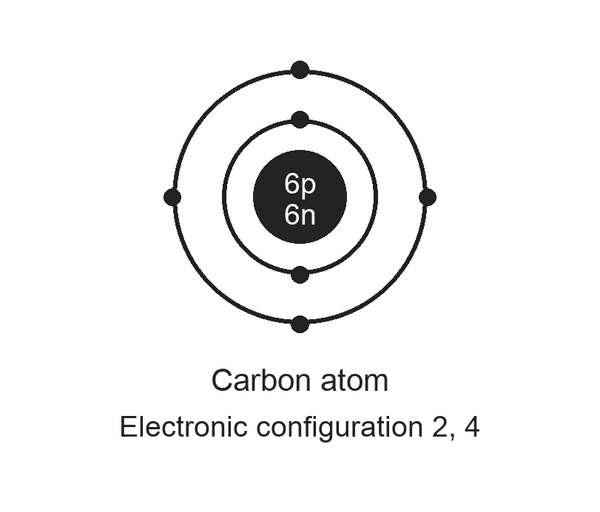
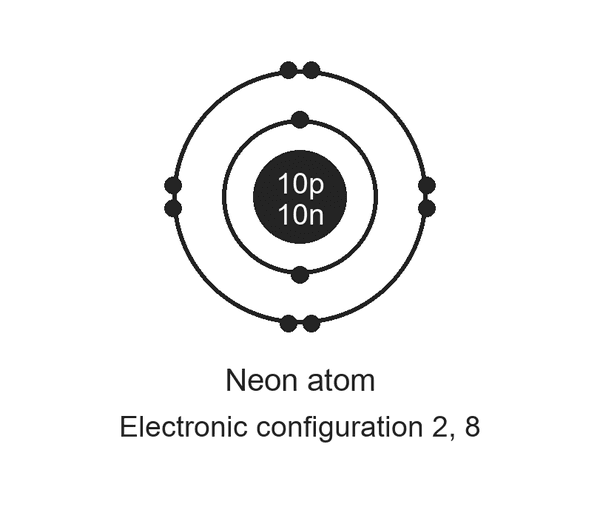
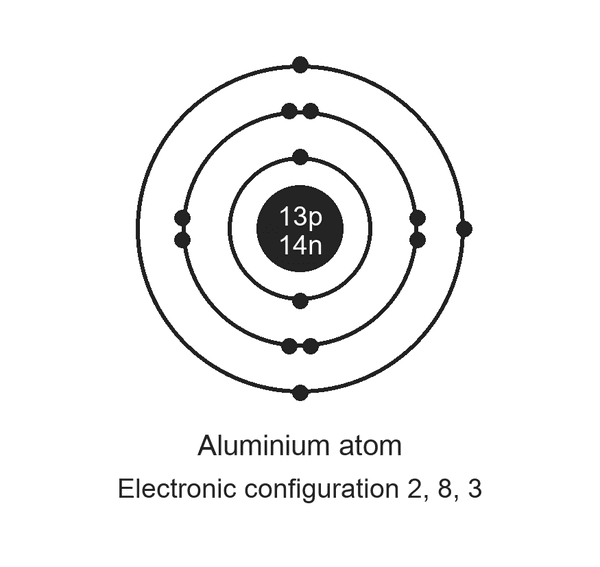
Atom Mass number (A) Atomic number (Z) Neutrons (A − Z) Electronic configuration Carbon (C) 12 6 6 2, 4 Oxygen (O) 16 8 8 2, 6 Fluorine (F) 19 9 10 2, 7 Neon (Ne) 20 10 10 2, 8 Aluminium (Al) 27 13 14 2, 8, 3 Chlorine (Cl) 35 17 18 2, 8, 7 Step 3 — Draw the atomic diagrams.
Each nucleus shows its protons (p) and neutrons (n); each dot on a shell is one electron.
Carbon
Oxygen

Fluorine

Neon
Aluminium
Chlorine

Watch out: For Al and Cl the mass number is written on the right as a superscript; it is still the larger number.
Therefore, the neutrons are C 6, O 8, F 10, Ne 10, Al 14 and Cl 18, and the configurations are 2, 4; 2, 6; 2, 7; 2, 8; 2, 8, 3 and 2, 8, 7.
- 355 marks
Question 35
Draw the diagrams representing the atomic structures of the following :
[At. No. N = 7, Ne = 10]
(a) Nitrogen
(b) Neon
Solve with AIWritten solution
Solution:
Concept: A neutral atom has as many electrons as its atomic number. Electrons fill the shells from the nucleus outwards: K holds at most 2, L at most 8, then M. Neutrons are shown for the common atoms and .
Step 1 — Nitrogen.
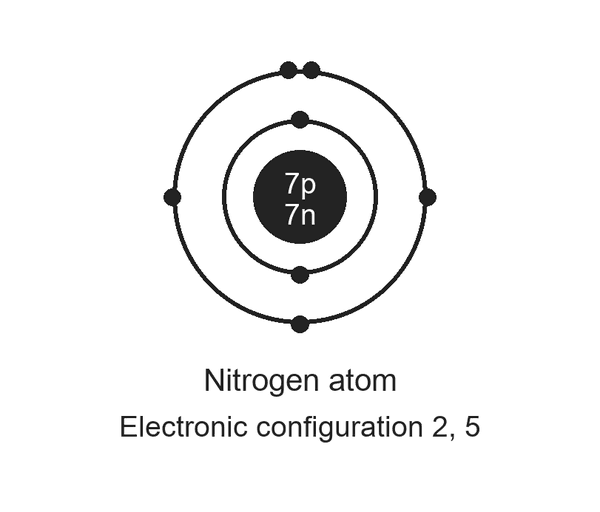
Atomic number 7 gives 7 protons and 7 electrons; mass number 14 gives 14 − 7 = 7 neutrons. The 7 electrons fill K with 2 and L with 5, so the configuration is 2, 5.
Step 2 — Neon.
Atomic number 10 gives 10 protons and 10 electrons; mass number 20 gives 20 − 10 = 10 neutrons. The 10 electrons fill K with 2 and L with 8, so the configuration is 2, 8.
Watch out: The stem gives only atomic numbers; the neutron numbers assume the commonest isotopes, nitrogen-14 and neon-20.
Therefore, nitrogen (2, 5) has 7p, 7n and 7 electrons, and neon (2, 8) has 10p, 10n and 10 electrons, as drawn.
- 365 marks
Question 36
Complete the table below by identifying A, B, C, D, E and F.
Element Symbol Number of protons Number of neutrons Number of electrons Fluorine 9 A B Aluminium C D 14 13 Potassium E F 19 Solve with AIWritten solution
Solution:
Concept: In a neutral atom the number of protons and the number of electrons both equal the atomic number (Z). The number of neutrons is the mass number minus the atomic number.
Step 1 — Fluorine (A and B).
For fluorine Z = 9 and the mass number is 19, so the neutrons are:
The electrons equal the protons, so B = 9.
Step 2 — Aluminium (C and D).
There are 13 electrons, so there are 13 protons and D = 13. The mass number is protons + neutrons:
So the symbol is C = .
Step 3 — Potassium (E and F).
For potassium Z = 19, so there are 19 protons and E = 19. The neutrons are:
Step 4 — Complete the table.
Putting the values in place:
Element Symbol Number of protons Number of neutrons Number of electrons Fluorine 9 10 9 Aluminium 13 14 13 Potassium 19 20 19 Watch out: Here the letters A to F name blanks in the table; do not confuse this A with the mass number.
Therefore, A = 10, B = 9, C = ₁₃Al²⁷, D = 13, E = 19 and F = 20.
What Class 8 Chemistry Ch 4 covers
The sections of the chapter, in the order the book takes them. Every question above comes from one of these.
- 01Atoms: Building Blocks of Matter
- 02Dalton's Atomic Theory
- 03Sub-atomic Particles of Atoms and Early Models of Matter
- 04Rutherford's Atomic Model
- 05Bohr's Atomic Model
- 06Atomic Number and Mass Number
More ways to study this chapter
The same chapter asked three other ways. Practise it, revise it, and see what the board has set on Ch 4 before.
Class 8 Chemistry Ch 4 questions students ask
How many questions are there in Class 8 Chemistry Ch 4?
36 questions. Every one is solved step by step on this page.
Are these Class 8 Chemistry solutions free?
Yes. Every question and its full working is free to read, with no account needed.
Can I download the Class 8 Chemistry Ch 4 solutions as a PDF?
There is no PDF to download. Every solution is on this page instead, which means it is searchable, always the current syllabus, and readable on a phone. Use your browser's print option if you want it on paper.