
Opening your dashboard
Class 8 Chemistry Chapter 4 Atomic Structure: Practice Questions
53 questions on Chapter 4, each worked through on its own page with the AI tutor. Class 8 Chemistry, ICSE 2026-27.
53 questions
1–5 marks · Mixed difficulty
- 11 mark
Question 1
Bloom's level: Remember
In ancient times, which were thought to be the five fundamental elements of which all matter is made?
- 21 mark
Question 2
Bloom's level: Remember
According to Maharshi Kanada, paramanus combine with each other to form a bigger particle called the:
- 31 mark
Question 3
Bloom's level: Understand
The discovery of isotopes shows that which statement of Dalton's atomic theory is not correct?
- 41 mark
Question 4
Bloom's level: Apply
A neutral atom has 15 electrons and 16 neutrons. It is correctly represented as:
- 51 mark
Question 5
Bloom's level: Analyse
Which of the following electronic configurations is not possible for a neutral atom?
- 61 mark
Question 6
Bloom's level: Apply
The electronic configuration of an element X is 2, 8, 5. The formula of the compound it forms with hydrogen is most likely:
- 71 mark
Question 7
Bloom's level: Apply
In sulphuric acid, , one sulphate radical combines with two hydrogen atoms, so its valency is 2. Using the same idea, the valency of the phosphate radical in phosphoric acid, , is:
- 81 mark
Question 8
Bloom's level: Understand
When an electric field was applied across the path of cathode rays, the rays bent towards the positive plate. This showed that cathode rays:
- 91 mark
Question 9
Bloom's level: Apply
Using the Bohr–Bury formula , the maximum number of electrons that the N shell can hold is:
- 101 mark
Question 10
Bloom's level: Understand
Assertion (A): Chlorine-35 and chlorine-37 have the same chemical properties.
Reason (R): Both have 17 electrons arranged as 2, 8, 7.
- 111 mark
Question 11
Bloom's level: Evaluate
Assertion (A): Rutherford's atomic model explained why an atom is stable.
Reason (R): In Rutherford's model, electrons revolve around a small, positively charged nucleus in circular orbits.
- 121 mark
Question 12
Bloom's level: Analyse
Assertion (A): No two elements have the same atomic number.
Reason (R): A sodium atom contains 11 protons and 11 electrons.
- 132 marks
Question 13
Bloom's level: Understand
Dalton said that (i) atoms are indivisible, (ii) the atoms of an element are identical in all respects, and (iii) atoms take part in chemical reactions.
For each statement, say whether it is still accepted today, and give the reason.
- 142 marks
Question 14
Bloom's level: Remember
Write the representation (with charge) and the valency of each radical:
(a) hydroxide
(b) bisulphate
(c) dichromate
(d) ammonium
- 152 marks
Question 15
Bloom's level: Apply
Find the atomic number, mass number and the numbers of protons, electrons and neutrons for each neutral atom, and write its symbol in the form :
(a) a sulphur atom with atomic number 16 and mass number 32;
(b) an atom with mass number 40 that has 20 neutrons;
(c) an atom with 12 electrons and 12 neutrons.
- 162 marks
Question 16
Bloom's level: Understand
"An atom is the smallest particle of an element that exhibits all the properties of that element. It may or may not exist independently, but it takes part in a chemical reaction."
Explain the second sentence using the examples of hydrogen and helium.
- 172 marks
Question 17
Bloom's level: Apply
Write the electronic configuration, the number of shells and the number of valence electrons of:
(a) an atom that has 9 electrons;
(b) an atom that has 16 protons;
(c) an atom of mass number 39 that has 20 neutrons.
- 182 marks
Question 18
Bloom's level: Evaluate
A student wrote these electronic configurations:
(a) Lithium (Z = 3): 3
(b) Oxygen (Z = 8): 2, 6
(c) Calcium (Z = 20): 2, 8, 10
(d) Chlorine (Z = 17): 2, 8, 7
Judge each one. Correct those that are wrong and state the rule that was broken.
- 192 marks
Question 19
Bloom's level: Understand
Protium, deuterium and tritium are the three isotopes of hydrogen. Explain why they have the same chemical properties but different densities.
- 202 marks
Question 20
Bloom's level: Apply
For the atoms with atomic numbers 7, 12, 17 and 18, write the electronic configuration, the number of valence electrons and the valency.
- 212 marks
Question 21
Bloom's level: Remember
(a) What is the smallest particle of matter called?
(b) Can it be seen with the naked eye? Through what can it be seen?
(c) Which particle of an element takes part in chemical reactions?
- 222 marks
Question 22
Bloom's level: Analyse
Three particles have the following make-up:
Particle Protons Neutrons Electrons P 11 12 10 Q 17 18 18 R 10 10 10 For each, decide whether it is a neutral atom, a cation or an anion, state its charge, and identify it.
- 234 marks
Question 23
Bloom's level: Apply
A museum guide tells visitors that scientists find the age of an old wooden boat by measuring how much carbon-14 is left in it. Ordinary carbon in living things is mostly carbon-12, with a little carbon-13 and carbon-14.
(a) Find the numbers of protons, neutrons and electrons in an atom of carbon-12, carbon-13 and carbon-14 (atomic number of carbon = 6).
(b) Write the electronic configuration and valency of each. Will wood made with carbon-14 burn any differently? Explain.
(c) Which statement of Dalton's atomic theory do these three atoms contradict? Explain.
- 244 marks
Question 24
Bloom's level: Analyse
A computer simulation of Rutherford's experiment fires 10 000 alpha particles at a very thin gold foil. The results are:
Path of alpha particles Number passed straight through 9978 deflected through small angles 20 bounced back 2 (a) Calculate the percentage of alpha particles in each group.
(b) For each group, state what Rutherford concluded about the atom.
(c) Predict how the results would change if the nucleus were much larger than it really is. Give a reason.
- 254 marks
Question 25
Bloom's level: Create
Design a 3-D model of an atom of silicon-28 (atomic number 14) using beads and wire rings, following Bohr's model.
(a) State what you will use for the protons, neutrons, electrons and shells, and how many of each you need.
(b) Describe how you will arrange the electrons, and how your model will show the energy of each shell.
(c) Explain how Bohr's idea, shown by your rings, keeps the electrons from falling into the nucleus, and give one way in which your model is not to scale.
- 264 marks
Question 26
Bloom's level: Analyse
Study the data for four particles W, X, Y and Z:
Particle Protons Neutrons Electrons W 17 18 17 X 18 22 18 Y 17 20 17 Z 20 20 18 (a) Find the atomic number and mass number of each.
(b) Which two particles are isotopes of the same element? Name the element.
(c) Which particle is not a neutral atom? State its charge and identify it.
(d) X and Z have the same mass number. Are they the same element? What does this show about which number identifies an element?
- 274 marks
Question 27
Bloom's level: Apply
Some elements show variable valency.
(a) Iron has valencies 2 and 3. Write the formulae of its two chlorides, and name each by the ous/ic method and by the Roman-numeral method.
(b) Copper has valencies 1 and 2. Write the formulae of its two oxides and name them in both ways.
(c) Phosphorus forms and . State the valency of phosphorus in each and explain how you found it.
- 285 marks
Question 28
Bloom's level: Evaluate
In a class debate on the structure of the atom:
- Team A: "Thomson's plum-pudding model is good enough, because it explains why an atom is electrically neutral."
- Team B: "Rutherford's gold-foil experiment proved that Thomson's model was wrong."
- Team C: "Electrons have negligible mass, so the mass of an atom is just the mass of its protons."
(a) Describe Thomson's model of the atom.
(b) Judge the claims of Teams A and B together, using the results of the gold-foil experiment.
(c) Judge Team C's claim, using the discovery made by James Chadwick.
- 294 marks
Question 29
Bloom's level: Understand
Explain how the idea of the atom changed from Dalton to Bohr. For each of the four models below, state its main idea and the problem that led to the next model.
(a) Dalton
(b) Thomson
(c) Rutherford
(d) Bohr
- 304 marks
Question 30
Bloom's level: Create
Design an "Atom ID card" — a table with at least eight headings that together describe an atom fully (for example, atomic number, numbers of particles, configuration, valency and the ion it forms).
Then fill in your card for an element X whose atom has 3 electrons in its M shell and 14 neutrons in its nucleus.
- 311 mark
Question 31
Which expression gives the greatest number of electrons that can be placed in the shell whose number is ?
- 321 mark
Question 32
The nucleus of a phosphorus atom is written as . How many protons does this nucleus contain?
- 331 mark
Question 33
The diagram shows the first four shells of an atom, marked P, Q, R and S, counted outwards from the nucleus.

Which label marks the shell with , and what is that shell called?
- 341 mark
Question 34
Four pictures of the atom, W, X, Y and Z, are shown below.
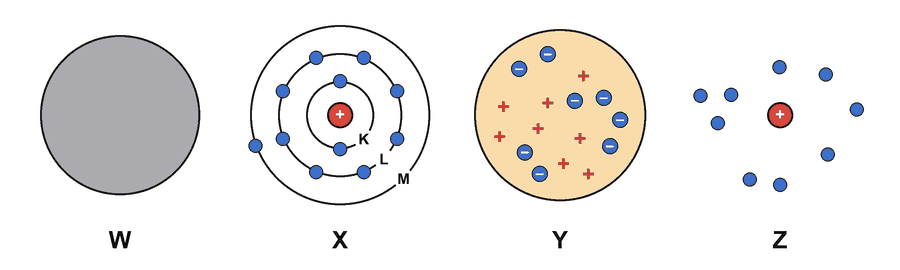
Which of them is the model of the atom put forward by Niels Bohr?
- 351 mark
Question 35
A magnesium atom has the electronic configuration 2, 8, 2. It changes into the magnesium ion by:
- 361 mark
Question 36
If the charge on a proton is taken as +1 unit, the charge on an electron is:
- 371 mark
Question 37
Is this statement true or false? If it is false, write the correct statement.
In a discharge tube, cathode rays start from the anode (the positive plate) and move towards the cathode (the negative plate).
- 381 mark
Question 38
Is this statement true or false? Give a reason.
An aluminium atom has 13 protons and 14 neutrons, so its atomic number is 13 and its mass number is 27.
- 391 mark
Question 39
Name the shell of an atom that lies farthest from the nucleus and whose electrons take part in chemical combination.
- 401 mark
Question 40
What is meant by an orbit (or shell) of an atom?
- 415 marks
Question 41
The numbers of protons (p) and neutrons (n) in the atoms of five elements are given below. For each atom, write its atomic number, its mass number and its electronic configuration.
(a) Lithium: p = 3, n = 4
(b) Nitrogen: p = 7, n = 7
(c) Silicon: p = 14, n = 14
(d) Phosphorus: p = 15, n = 16
(e) Calcium: p = 20, n = 20
- 425 marks
Question 42
Five atoms are labelled P, Q, R, S and T (these letters are not their symbols). Their atomic numbers are P = 5, Q = 9, R = 13, S = 18 and T = 19. Write the electronic configuration of each atom.
- 435 marks
Question 43
In Rutherford's experiment, a narrow beam of fast alpha particles was aimed at a very thin gold foil. A screen coated with zinc sulphide was placed around the foil.
(a) What was the job of the zinc sulphide screen?
(b) Write the three things Rutherford observed.
(c) What did he conclude from each of these observations?
- 441 mark
Question 44
Which of the following statements about a neutron is correct ?
- 451 mark
Question 45
The mass number of an atom is 31 and its nucleus contains 16 neutrons. The number of electrons present in the neutral atom is :
- 461 mark
Question 46
An atom of which of the following elements has three shells and four electrons in its outermost shell ?
- 471 mark
Question 47
Fill in the blank :
According to Bohr's atomic model, the shell lying closest to the nucleus has the ............... amount of energy.
- 481 mark
Question 48
Write true or false :
The ammonium radical is an acid radical.
- 492 marks
Question 49
In Rutherford's experiment, fast-moving alpha particles were directed at a very thin sheet of gold. Give a reason for each of the following observations :
(a) Most of the alpha particles passed straight through the gold sheet.
(b) Only a very few alpha particles bounced back.
- 502 marks
Question 50
The atomic number of an element E is 13.
(a) Write the electronic configuration of E and state the number of its valence electrons.
(b) State the valency of E. Will an atom of E form a cation or an anion ? Give a reason.
- 515 marks
Question 51
(a) Copy and complete the following table for the three sub-atomic particles of an atom.
Particle Charge Mass Location in the atom Discovered by Electron Proton Neutron (b) An atom contains charged particles, yet the atom as a whole is electrically neutral. Explain why.
(c) Why is almost the entire mass of an atom concentrated in its nucleus ?
- 525 marks
Question 52
The diagram below shows the structure of a neutral atom of an element X. The number of protons in the nucleus is not shown.
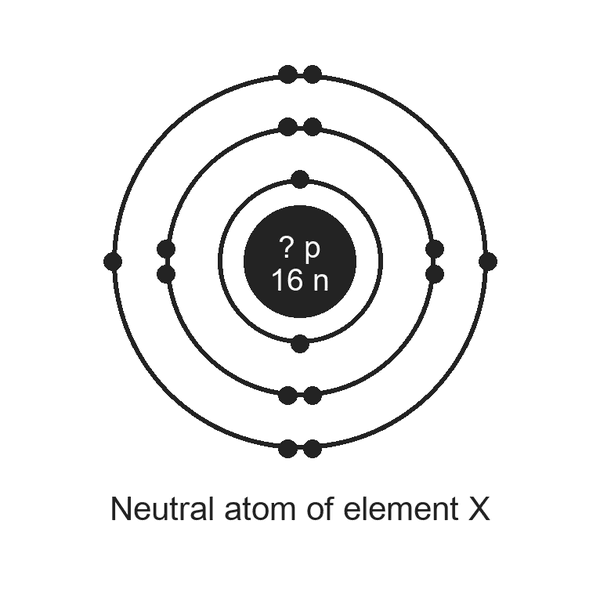
(a) Find the atomic number and the mass number of X. Show your working.
(b) Write the electronic configuration of X. Name its valence shell.
(c) State the number of valence electrons and the valency of X.
- 534 marks
Question 53
(a) What are isotopes ?
(b) Carbon (atomic number 6) has three isotopes with mass numbers 12, 13 and 14. Draw a table showing the number of protons, neutrons and electrons in one atom of each isotope.
(c) Write the electronic configuration of the three isotopes. What does it tell you about their chemical properties ?