
Opening your dashboard
Class 8 Chemistry Chapter 4 Atomic Structure: Competency-Based Questions (CBQ)
40 questions on Chapter 4, each worked through on its own page with the AI tutor. Class 8 Chemistry, ICSE 2026-27.
40 questions
1–5 marks · Mixed difficulty
- 11 mark
Question 1
Cognitive domain: Application
Cobalt-60 is used in hospitals to treat cancer. The atomic number of cobalt is 27. The atoms of ordinary cobalt have the mass number 59, while the atoms of cobalt-60 have the mass number 60.
Which statement about an atom of cobalt-60 and an atom of ordinary cobalt is correct?
- 21 mark
Question 2
Cognitive domain: Analysis
To explain Rutherford's experiment, a teacher hides an object under a large sheet of cardboard that rests on four books. The students cannot see the object. They roll 100 marbles under the sheet from one side. 96 marbles roll straight through, 3 come out turned a little to one side, and 1 comes straight back.
Which is the best conclusion about what lies under the sheet?
- 31 mark
Question 3
Cognitive domain: Understanding
In a science museum, a guide shows a discharge tube in which cathode rays are produced.
- Observation 1: The glowing beam bends towards a positively charged plate.
- Observation 2: The cathode is made of aluminium. When it is replaced by a cathode of iron and then by one of copper, the beam bends in the same way and shows the same properties each time.
What does Observation 2 show?
- 41 mark
Question 4
Cognitive domain: Application
In a card game played in a chemistry club, each card shows the electronic configuration of an atom.
Card P Q R S Electronic configuration 2, 8, 1 2, 8, 2 2, 8, 7 2, 8, 8 A player wins a point by picking two cards whose elements have the same valency. Which pair wins a point?
- 51 mark
Question 5
Cognitive domain: Understanding
Assertion (A): According to Bohr's atomic model, an electron revolving around the nucleus does not fall into the nucleus.
Reason (R): An electron revolving in a fixed shell neither loses nor gains energy.
- 61 mark
Question 6
Cognitive domain: Analysis
Assertion (A): The basic radical has 10 electrons.
Reason (R): A sodium atom (atomic number 11) forms this radical by gaining one electron.
- 71 mark
Question 7
Cognitive domain: Application
Bananas are rich in potassium. An atom of potassium is written as . Fill in the blanks.
The nucleus of this atom has ________ protons and ________ neutrons, and ________ electrons revolve around the nucleus.
- 81 mark
Question 8
Cognitive domain: Recall
In a school quiz on the history of science, this clue is read out:
"I was a Greek philosopher. Maharishi Kanada had called the smallest particle of matter the paramanu. I called it the atom, from a Greek word that means indivisible."
Name the philosopher, and write the Greek word.
- 91 mark
Question 9
Cognitive domain: Understanding
In a discharge tube with a perforated cathode, anode rays (canal rays) travel in the direction opposite to that of the cathode rays. Cathode rays bend towards a positively charged plate.
Predict the plate towards which a beam of anode rays will bend. Give a reason.
- 102 marks
Question 10
Cognitive domain: Application
Sneha weighs a piece of magnesium ribbon. Its mass is 2.4 g. She burns it in air and collects all the white ash that is formed. The mass of the ash is 4.0 g. She says, "New atoms were created in the flame. That is why the mass has gone up."
(a) Which statement of Dalton's atomic theory shows that Sneha is wrong?
(b) Use Dalton's atomic theory to explain where the extra mass has come from. Calculate this extra mass.
- 112 marks
Question 11
Cognitive domain: Application
For a Science Day rangoli, Tanvi makes a model of an atom. In the centre she keeps a plate with 16 red beads for protons and 16 white beads for neutrons. Around the plate she draws three rings and places diyas on them for electrons: 2 on the first ring, 8 on the second and 6 on the third.
(a) Identify the element, and state its mass number.
(b) Her brother moves two diyas from the second ring to the third, so that the outer ring has 8 diyas and "looks complete". The rings now have 2, 6 and 8 diyas. Explain why this arrangement is wrong.
- 122 marks
Question 12
Cognitive domain: Analysis
The table shows four compounds of hydrogen.
Compound Where it is met Formula Methane Biogas (gobar gas) Ammonia Making fertilisers Water Rivers and rain Hydrogen chloride Making hydrochloric acid (a) Use the definition of valency to find the valencies of carbon, nitrogen, oxygen and chlorine from these formulae.
(b) The atoms of nitrogen, oxygen and chlorine have 5, 6 and 7 valence electrons. Find the pattern that connects the number of valence electrons with the valency of these three elements, and explain it.
- 134 marks
Question 13
Cognitive domain: Evaluation
By 1920, scientists knew that an atom has protons in its nucleus and electrons around it. A proton has a mass of 1 amu. An electron has only about 1/1837 of the mass of a proton. But there was a puzzle. A helium atom has 2 protons, yet it is 4 times as heavy as a hydrogen atom, which has 1 proton. Rutherford predicted that the nucleus must hold one more kind of particle. In a class discussion on this puzzle, Rehan says, "The extra mass comes from extra electrons hidden inside the nucleus." Sara says, "It comes from particles that have mass but no charge."
Atom Number of protons Mass of the atom (amu) Hydrogen 1 1 Helium 2 4 Lithium 3 7 Carbon 6 12 (a) Name the particle that Sara is describing, and the scientist who discovered it.
(b) Each of these particles has a mass of 1 amu. Use the table to find how many of them are present in each of the four atoms.
(c) Evaluate Rehan's statement. Give two reasons for your answer.
- 144 marks
Question 14
Cognitive domain: Understanding
Hydrogen has three isotopes. Almost all hydrogen atoms are protium, . A very small number are deuterium, , which is also called heavy hydrogen. Water whose molecules contain deuterium in place of protium is called heavy water. It is used in some of India's nuclear power stations. Heavy water looks exactly like ordinary water and takes part in the same chemical reactions. But an ice cube made of heavy water sinks in a glass of ordinary water. Some properties of the two kinds of water are compared in the table.
Property Ordinary water Heavy water Density (g/cm³) 1.00 1.11 Melting point 0 °C 3.8 °C Boiling point 100 °C 101.4 °C (a) State the number of protons, neutrons and electrons in an atom of protium and in an atom of deuterium. Why are both of them atoms of hydrogen?
(b) Explain why the two kinds of water take part in the same chemical reactions but differ in the properties given in the table.
(c) An atom of oxygen is . A molecule of water has two atoms of hydrogen and one atom of oxygen. Find the total number of protons and neutrons in one molecule of ordinary water and in one molecule of heavy water. Use your answer to explain why the ice cube of heavy water sinks.
- 155 marks
Question 15
Cognitive domain: Creativity
You have to explain the arrangement of electrons in an atom to students of Class 7. You decide to compare an atom to a cinema hall. The rows of seats are named K, L, M and N, starting from the row nearest to the screen.
(a) Complete the design. Say what stands for the nucleus, the shells, the electrons and the energy of a shell. Use the formula to fix the number of seats in each of the four rows.
(b) Write two seating rules for the usher, so that people fill the rows in the way electrons fill the shells.
(c) Use your rules to seat the "electrons" of aluminium (atomic number 13) and of potassium (atomic number 19).
(d) State one way in which a cinema hall is not like an atom.
- 161 mark
Question 16
Cognitive domain: Understanding
To explain an early model of the atom, a teacher cuts open a watermelon. She says, "Think of the red flesh as a sphere of positive charge, and the black seeds scattered all through it as the electrons."
Which model of the atom is the teacher describing, and what showed that this model was not correct?
- 171 mark
Question 17
Cognitive domain: Analysis
Alpha particles carry a positive charge. A student draws four possible paths, P, Q, R and S, for alpha particles fired from the left at a thin gold foil, as shown in the figure below. The dot is the nucleus of one gold atom. The nucleus is positively charged, and like charges repel each other.
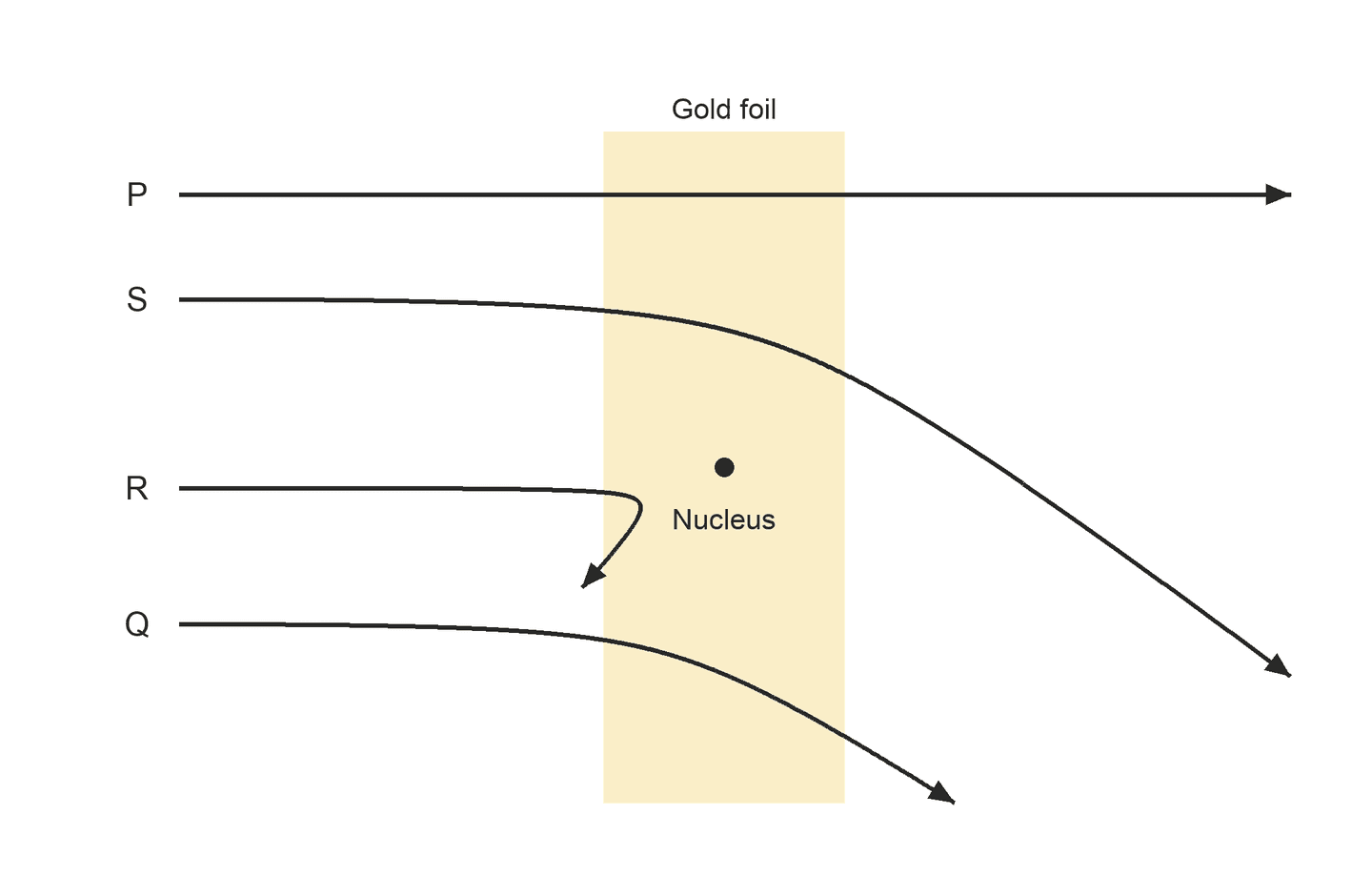
Which path is not possible for an alpha particle, and why?
- 181 mark
Question 18
Cognitive domain: Understanding
Priya makes a chart for a sodium atom (atomic number 11). She places its electrons in the shells K, L and M, and writes the energy order of the shells.
Which row of her chart is correct?
- 191 mark
Question 19
Cognitive domain: Analysis
In a quiz, a card carries this riddle about an atom.
- Clue 1: "I have three shells."
- Clue 2: "My outermost shell has two electrons fewer than the largest number of electrons that any outermost shell can hold."
Which atom is described by the riddle?
- 201 mark
Question 20
Cognitive domain: Analysis
Assertion (A): In a calcium atom (atomic number 20), the third shell holds only 8 electrons, although the formula allows 18 electrons in it.
Reason (R): The outermost shell of an atom cannot have more than 8 electrons.
- 211 mark
Question 21
Cognitive domain: Analysis
Assertion (A): The mass number of an atom is always greater than its atomic number.
Reason (R): The mass number of an atom is the sum of the number of its protons and the number of its neutrons.
- 221 mark
Question 22
Cognitive domain: Application
For centuries, alchemists in many countries tried to turn lead into gold. The atomic number of lead is 82 and the atomic number of gold is 79.
Which change to a lead atom would make it an atom of gold?
- 231 mark
Question 23
Cognitive domain: Application
Doctors advise some people to use a salt substitute made of potassium chloride, KCl, instead of common salt, NaCl. Sodium (atomic number 11) and potassium (atomic number 19) both combine with chlorine atoms in the ratio 1 : 1, and chlorine has a valency of 1.
Which statement explains why sodium and potassium have the same valency?
- 241 mark
Question 24
Cognitive domain: Analysis
A museum puts four cards about the atom in a box, and a visitor has to arrange them in the order in which the discoveries were made, starting with the earliest.
- P: An experiment with alpha particles and a gold foil shows that an atom has a small, dense, positively charged centre.
- Q: A scientist explains why electrons do not fall into the nucleus, by placing them in shells of fixed energy.
- R: A scientist discovers a particle with no charge inside the nucleus, which explains the extra mass of atoms.
- S: A scientist shows that cathode rays consist of negatively charged particles that are present in all atoms.
Which order of the cards is correct?
- 251 mark
Question 25
Cognitive domain: Application
Lithium (atomic number 3, mass number 7) is used in the rechargeable batteries of mobile phones. While the battery is in use, a lithium atom loses one electron and becomes a lithium ion, .
Which statement about this ion is correct?
- 262 marks
Question 26
Cognitive domain: Analysis
In Rutherford's experiment, the gold foil was 0.00004 cm thick. The diameter of one gold atom is about cm.
(a) Estimate how many gold atoms thick the foil was.
(b) Most of the alpha particles passed straight through the foil, so each of them crossed this many layers of gold atoms without being turned aside. What does this suggest about the inside of a gold atom?
- 272 marks
Question 27
Cognitive domain: Application
Before flat screens came into use, many television sets and computer monitors had a cathode ray tube. Inside the tube, a narrow beam of cathode rays travels from the cathode to the screen and makes it glow. When a student held a small magnet near the screen of an old set, the image on it became bent.
(a) Name the particles that make up the beam of cathode rays.
(b) Explain why the magnet bent the image.
- 282 marks
Question 28
Cognitive domain: Evaluation
Anil says, "A chloride ion, , and an argon atom are the same thing, because both have 18 electrons arranged as 2, 8, 8." The atomic number of chlorine is 17 and that of argon is 18.
(a) Is Anil right? Answer yes or no.
(b) Give two differences between a chloride ion and an argon atom.
- 292 marks
Question 29
Cognitive domain: Application
A farmer spreads a fertiliser containing ammonium sulphate, , on a paddy field. This compound is made of ammonium radicals, , and sulphate radicals, . In sulphuric acid, , one sulphate radical combines with two hydrogen atoms.
(a) Which of the two radicals is the basic radical and which is the acid radical? Give a reason.
(b) Explain why the formula of ammonium sulphate has two ammonium radicals for every sulphate radical.
- 302 marks
Question 30
Cognitive domain: Application
Alum (phitkari) is rubbed in muddy water to make it clear. Alum contains aluminium in the form of the ion . An aluminium atom has 13 protons, 14 neutrons and 13 electrons. It forms by losing three electrons. A proton carries a charge of C and an electron carries C.
(a) State the number of protons, neutrons and electrons in one ion.
(b) Find the total charge on one ion in coulombs.
- 312 marks
Question 31
Cognitive domain: Application
A bottling plant makes soft drinks by dissolving carbon dioxide in water. One molecule of carbon dioxide, , has 1 atom of carbon and 2 atoms of oxygen.
(a) Which feature of Dalton's atomic theory does the ratio of the atoms in illustrate?
(b) A student claims that a molecule of this compound could have 1 atom of carbon and 1.5 atoms of oxygen. Would Dalton's theory allow this? Give a reason.
- 323 marks
Question 32
Cognitive domain: Analysis
Plant scientists at an agricultural institute want to find out how fast a crop takes up phosphorus from the soil. They mix into the soil a fertiliser in which a small amount of the phosphorus is phosphorus-32, written . It is radioactive, so it can be detected in the plant by a counter. Ordinary phosphorus is . (Hypothetical experiment.)
(a) Find the number of protons, neutrons and electrons in an atom of each kind of phosphorus.
(b) Are the two kinds of atoms atoms of the same element? Give a reason.
(c) Explain why the scientists can use to follow the uptake of phosphorus by the plant.
- 333 marks
Question 33
Cognitive domain: Application
A student wants to test the claim that the mass of an atom lies almost entirely in its nucleus. She takes an atom of oxygen-16, which has 8 protons, 8 neutrons and 8 electrons. She uses these masses: proton kg, neutron kg and electron kg.
(a) Find the total mass of the 8 protons and 8 neutrons.
(b) Find the total mass of the 8 electrons.
(c) What percentage of the mass of the atom is the mass of its electrons? Does the result support the claim?
- 343 marks
Question 34
Cognitive domain: Evaluation
At a school science exhibition, a student writes three statements on a poster about the atom.
- Statement 1: "Most of the volume of an atom is taken up by its nucleus."
- Statement 2: "An atom can have the same number of neutrons as protons."
- Statement 3: "An atom with 2 electrons in its outermost shell always has a valency of 2."
Decide whether each statement is true or false. Give a reason for each.
- 353 marks
Question 35
Cognitive domain: Analysis
In a chemistry club puzzle, two atoms are called X and Y. (These letters are not their symbols.) Atom X loses one electron to form , whose electronic configuration is 2, 8. Atom Y gains two electrons to form , whose electronic configuration is 2, 8, 8.
(a) Find the number of electrons and the atomic number of atom X. Name the element.
(b) Find the number of electrons and the atomic number of atom Y. Name the element.
(c) State the valency of X and of Y.
- 363 marks
Question 36
Cognitive domain: Analysis
Rohan asks his teacher, "The nucleus of a calcium atom, , has 20 protons packed in a tiny space. All protons carry a positive charge. Why does the nucleus not fly apart?"
(a) What would you expect the protons to do to each other, and why?
(b) What holds the protons and the neutrons together in the nucleus?
(c) Name the common term for protons and neutrons, and find their total number in this nucleus.
- 375 marks
Question 37
Cognitive domain: Analysis
Meera is studying the first twenty elements. For each atom with an atomic number from 3 to 20, she writes the electronic configuration and counts the electrons in the outermost shell, which are the valence electrons. Then she plots a graph of the number of valence electrons against the atomic number, as shown in the graph below. She notices that the numbers rise, fall suddenly and rise again.

(a) Read from the graph the number of valence electrons in the atoms with atomic numbers 7 and 16, and state the valency of each of these atoms.
(b) The atoms with atomic numbers 3, 11 and 19 have the same number of valence electrons. Name the three elements, and state their common valency.
(c) The graph falls from 8 at atomic number 10 to 1 at atomic number 11. Explain this fall using the shells of the neon and sodium atoms. Also explain why atoms with 8 valence electrons, such as those with atomic numbers 10 and 18, do not combine with other atoms.
- 384 marks
Question 38
Cognitive domain: Analysis
While arranging cards of the first twenty elements on the wall of the classroom, Arjun notices that the mass number of argon is larger than that of potassium, although argon has fewer protons. He asks whether the cards should be arranged by mass number or by atomic number. Each card shows the atomic number and the mass number of the atoms of one element, as given in the table of the first twenty elements. Three of his cards are shown below.
Element Atomic number Mass number Argon 18 40 Potassium 19 39 Calcium 20 40 (a) Find the number of neutrons in an atom of each of these elements.
(b) A potassium atom and a calcium atom have the same number of neutrons. A classmate says, "So potassium and calcium must be isotopes." Is the classmate right? Give a reason.
(c) Should Arjun arrange the cards by atomic number or by mass number? Give a reason.
- 394 marks
Question 39
Cognitive domain: Evaluation
Rakesh works in a battery recycling unit. Old batteries and wires bring in many metal compounds, and the unit has to keep them apart. Rakesh sorts four oxides of metals into trays and writes the formula of each on its tray. He knows that oxygen has a valency of 2, as in water, , and he uses this to check each tray. (Hypothetical set-up.)
Tray Oxide Formula 1 Lead oxide 2 Lead oxide 3 Copper oxide 4 Copper oxide (a) Use the valency of oxygen to find the valency of the metal in each oxide.
(b) Name the two oxides of lead by the modern method, in which the valency of the metal is shown by a Roman numeral.
(c) Rakesh says, "The valency of an element is fixed, like its atomic number." Evaluate his statement using the table.
- 405 marks
Question 40
Cognitive domain: Creativity
Your class is building an "Atom Detective" chart for the science corner. A visitor writes the symbol of an atom in the form , and the chart helps the visitor to find the numbers of protons, neutrons and electrons, the electronic configuration, the number of valence electrons and the valency of the atom. The chart will be used by students of Class 7 who have not yet studied this chapter, so each step must be short, clear and written in plain words. (Hypothetical chart.)
(a) Design the chart as a list of at least five numbered steps that anyone can follow, starting from .
(b) Test your chart on and write the result of each step.
(c) Add one "safety check" step that catches a wrong configuration, and use it to show that the configuration 2, 7, 8 is wrong for chlorine.