
Opening your dashboard
Class 8 Biology Chapter 9: Food Production Solutions
29 textbook questions with step-by-step answers, free to read, for ICSE 2026-27.
Get talked through Ch 9, not just shown the answer
Reading a finished solution is not the same as being able to do it. The AI tutor takes one question at a time and works it with you, in your own words, until you can.
- Ask it out loud, in your own words
- It gives you the next step, not the answer
- Stuck on part (ii)? Start there
29 questions with solutions
1–18 marks · Mixed difficulty
- 11 mark
Question 1
Which one of the following is an indigenous breed of dairy cows ?
Solve with AIAnswer
(A) Jersey
(B) Frieswal
- Correct
(C) Sahiwal
(D) Dangi
Answer: (C) Sahiwal
Concept: Indian cattle are grouped as draught breeds (bullocks for work), dual-purpose breeds and dairy breeds (high milk yield). Dairy cows may be indigenous (Indian), exotic (foreign) or cross breeds.
Step 1 — Recall the indigenous dairy breeds.
The textbook names Red Sindhi, Sahiwal and Gir as the indigenous (Indian) dairy breeds; they give good milk yields.
Step 2 — Match with the options.
Sahiwal, which comes from the Punjab region, is the indigenous dairy breed in the list, option (C).
Watch out: The word 'indigenous' means native to India; Jersey is a dairy breed too, but it is foreign.
Why the other options are wrong:
- (A) Jersey: This is wrong because Jersey is an exotic (foreign) dairy breed, from the island of Jersey.
- (B) Frieswal: This is wrong because Frieswal is a cross breed, made by crossing exotic Holstein-Friesian bulls with Indian cows.
- (D) Dangi: This is wrong because Dangi is not a dairy breed: the textbook lists it as dual-purpose, and it is mainly used for draught work in hilly, heavy-rain areas.
Therefore, Sahiwal is the indigenous dairy breed, option (C).
- 21 mark
Question 2
Which one of the following is the common breed of buffalo found in Gujarat ?
Solve with AIAnswer
(A) Surti
(B) Murrah
(C) Gir
- Correct
(D) Mehsana
Answer: (D) Mehsana
Concept: Each buffalo breed comes from a particular region; the textbook describes Mehsana as the breed common in Gujarat, with an average milk yield of 1200–2500 litres a year.
Step 1 — Recall the buffalo breeds of the chapter.
Murrah is the breed of Haryana and Punjab, Mehsana is common in Gujarat, and Surti is native to the Kaira and Vadodara districts of Gujarat.
Step 2 — Pick the common Gujarat breed.
The breed described as common across Gujarat is Mehsana, option (D).
Watch out: Gir is a famous Gujarat breed of COW, not of buffalo.
Why the other options are wrong:
- (A) Surti: This is wrong because Surti, although also a Gujarat buffalo, is native only to the Kaira and Vadodara districts; the book's common Gujarat breed is Mehsana.
- (B) Murrah: This is wrong because Murrah is the buffalo breed of Haryana and Punjab.
- (C) Gir: This is wrong because Gir is a breed of cow, not of buffalo.
Therefore, the common buffalo breed of Gujarat is Mehsana, option (D).
- 31 mark
Question 3
Which of the following is an indigenous breed of poultry of India?
Solve with AIAnswer
(A) White Leghorn
(B) HH-260
- Correct
(C) Aseel
(D) B-77
Answer: (C) Aseel
Concept: Poultry breeds are indigenous (Indian), exotic (foreign) or improved hybrid varieties bred for eggs or meat.
Step 1 — Recall the Indian breed.
Aseel is the most popular indigenous poultry breed of India. It gives good meat but lays few eggs.
Step 2 — Match with the options.
The indigenous breed in the list is Aseel, option (C).
Why the other options are wrong:
- (A) White Leghorn: This is wrong because White Leghorn is an exotic (foreign) egg-laying breed.
- (B) HH-260: This is wrong because HH-260 is an improved hybrid layer variety, not an indigenous breed.
- (D) B-77: This is wrong because B-77 is also an improved hybrid layer variety, not an indigenous breed.
Therefore, Aseel is the indigenous breed of poultry, option (C).
- 41 mark
Question 4
Which one of the following is a rabi crop ?
Solve with AIAnswer
(A) Mustard
(B) Pea
(C) Rice
- Correct
(D) Wheat
Answer: (D) Wheat
Concept: Rabi crops are winter crops, sown in October–November and harvested in March–April. Kharif crops are rainy-season crops, sown in June–July.
Step 1 — Sort the options by season.
Wheat, mustard and pea are all sown in winter, so all three are rabi crops; rice needs the monsoon rain, so it is a kharif crop.
Step 2 — Pick the printed key.
The rabi crop the textbook names in this chapter is wheat, the most important rabi crop of India, so the printed key is option (D).
Watch out: Rice is the kharif crop here; do not pick it because it is a staple food.
Note: Mustard and pea are also rabi crops, so (A) and (B) are true as well; the printed key (D) is kept, because wheat is the chief rabi crop named in the chapter.
Why the other options are wrong:
- (A) Mustard: This option is not the printed key; mustard is in fact also a rabi crop, so it is not a wrong statement, but the book's intended answer is wheat.
- (B) Pea: This option is not the printed key; pea is in fact also a rabi crop, so it is not a wrong statement, but the book's intended answer is wheat.
- (C) Rice: This is wrong because rice is a kharif (rainy-season) crop.
Therefore, the intended rabi crop is wheat, option (D).
- 51 mark
Question 5
Among the following, a Kharif crop is :
Solve with AIAnswer
(A) Barley
(B) Mustard
- Correct
(C) Rice
(D) Wheat
Answer: (C) Rice
Concept: Kharif crops are grown in the rainy season (June to October); rabi crops are grown in winter.
Step 1 — Sort the options by season.
Barley, mustard and wheat are sown in winter, so they are rabi crops.
Step 2 — Pick the kharif crop.
Rice needs a lot of water and is grown in the monsoon, so it is the kharif crop, option (C).
Why the other options are wrong:
- (A) Barley: This is wrong because barley is a rabi (winter) crop.
- (B) Mustard: This is wrong because mustard is a rabi (winter) crop.
- (D) Wheat: This is wrong because wheat is a rabi (winter) crop.
Therefore, the kharif crop is rice, option (C).
- 61 mark
Question 6
Yeast is a kind of microscopic organism which readily grows in all kinds of sugary solutions and in plant exudations containing sugar. Yeast is economically important in many ways. Some are given below :
P. In breweries
Q. In bakeries
R. Curing of tobacco
In which of the following processes/ways does yeast not play an important role ?
Solve with AIAnswer
- Correct
(A) Only R
(B) Only P and Q
(C) Only P, Q and R
(D) None of the above
Answer: (A) Only R
Concept: Yeast is a one-celled fungus that ferments sugar into ethyl alcohol and carbon dioxide.
Step 1 — Check breweries (P).
In breweries yeast ferments sugar into alcohol, so yeast plays an important role in P.
Step 2 — Check bakeries (Q).
In bakeries the carbon dioxide made by yeast makes the dough rise, so yeast plays an important role in Q.
Step 3 — Check curing of tobacco (R).
Curing (fermenting) of tobacco leaves is done by bacteria, not yeast, so yeast has no role in R. The answer is only R, option (A).
Watch out: The question asks where yeast does NOT play a role.
Why the other options are wrong:
- (B) Only P and Q: This is wrong because yeast does play an important role in breweries and bakeries.
- (C) Only P, Q and R: This is wrong because P and Q depend on yeast, so they cannot be listed with R.
- (D) None of the above: This is wrong because there is one process, curing of tobacco, in which yeast has no role.
Therefore, yeast plays no role only in R, option (A).
- 71 mark
Question 7
Amit and Sumit studied different kinds of microbes like viruses, bacteria, algae, fungi and protozoa. Which of the following statements does not match with the characteristic features of fungi ?
Solve with AIAnswer
(A) Fungi may be unicellular or multicellular.
(B) They do not have chlorophyll and cannot prepare their own food.
- Correct
(C) Fungi help in biological nitrogen fixation and improve the soil fertility.
(D) They are saprophytic in nature.
Answer: (C) Fungi help in biological nitrogen fixation and improve the soil fertility.
Concept: Fungi have no chlorophyll, so they cannot make their own food; most live as saprophytes on dead and decaying matter. Nitrogen fixation is done only by certain bacteria and blue-green algae.
Step 1 — Check each statement against fungi.
Statement (A) is true (yeast is one-celled, mushrooms are many-celled), (B) is true (no chlorophyll) and (D) is true for most fungi (saprophytes).
Step 2 — Find the one that does not fit.
Fungi do not fix nitrogen. Nitrogen-fixing bacteria such as Rhizobium, in the root nodules of legumes, do that. So statement (C) does not match fungi, option (C).
Watch out: Do not confuse nitrogen-fixing bacteria with fungi that only rot dead matter.
Why the other options are wrong:
- (A): This is wrong because fungi may indeed be unicellular (yeast) or multicellular (bread mould, mushroom).
- (B): This is wrong because fungi indeed lack chlorophyll and cannot make their own food.
- (D): This is wrong because most fungi indeed live on dead and decaying matter as saprophytes.
Therefore, the statement that does not match fungi is the one about nitrogen fixation, option (C).
- 81 mark
Question 8
Assertion (A): Some bacterial cells have an outermost slimy gelatinous layer in the form of a capsule.
Reason (R): Capsule protects the bacterium from desiccation and toxic compounds.
Solve with AIAnswer
- Correct
(A) (1) Both A and R are true and R is the correct explanation of A
(B) (2) Both A and R are true but R is not the correct explanation of A
(C) (3) A is true but R is false
(D) (4) A is false but R is true
Answer: (A) (1) Both A and R are true and R is the correct explanation of A
Concept: An Assertion–Reason item is judged in three checks: is A true, is R true, and if both are true, does R give the reason for A?
Step 1 — Judge the Assertion.
Some bacteria have an outermost slimy, gelatinous layer called the slime capsule, outside the cell wall. So A is true.
Step 2 — Judge the Reason.
The capsule protects the bacterium from drying up (desiccation) and from harmful chemicals (and from being swallowed by white blood cells). So R is true.
Step 3 — Does R explain A?
R gives the job of the capsule, which is why such bacteria have it. So R is the correct explanation of A, option (A).
Why the other options are wrong:
- (B): This is wrong because R does explain A: it states the protective role of the capsule.
- (C): This is wrong because R is true: the capsule does protect against drying and harmful chemicals.
- (D): This is wrong because A is true: some bacteria do have a slime capsule.
Therefore, both A and R are true and R is the correct explanation of A, option (A).
- 91 mark
Question 9
Assertion (A): Lactobacillus is a kind of bacteria which can convert milk into curd and curd into cottage cheese.
Reason (R): Lactose (milk sugar) can be converted into lactic acid by the action of Lactobacillus and different types of milk products like curd and cheese can be prepared.
Solve with AIAnswer
- Correct
(A) (1) Both A and R are true and R is the correct explanation of A
(B) (2) Both A and R are true but R is not the correct explanation of A
(C) (3) A is true but R is false
(D) (4) A is false but R is true
Answer: (A) (1) Both A and R are true and R is the correct explanation of A
Concept: An Assertion–Reason item is judged in three checks: is A true, is R true, and if both are true, does R give the reason for A?
Step 1 — Judge the Assertion.
Lactobacillus (lactic acid bacteria) sets milk into curd, and the curd can be processed into cottage cheese. So A is true.
Step 2 — Judge the Reason.
These bacteria change lactose (milk sugar) into lactic acid; the acid makes the milk proteins set, which gives curd and is the first step of cheese making. So R is true.
Step 3 — Does R explain A?
R tells how Lactobacillus turns milk into curd and cheese, so R is the correct explanation of A, option (A).
Why the other options are wrong:
- (B): This is wrong because R does explain A: it gives the process behind A.
- (C): This is wrong because R is true: Lactobacillus does turn lactose into lactic acid.
- (D): This is wrong because A is true: Lactobacillus does turn milk into curd.
Therefore, both A and R are true and R is the correct explanation of A, option (A).
- 101 mark
Question 10
Assertion (A): Tea leaves and tobacco leaves are cured by bacteria to obtain specific flavours and aroma.
Reason (R): Bacteria play an important role in several industrial processes like vinegar and cheese production.
Solve with AIAnswer
(A) (1) Both A and R are true and R is the correct explanation of A
- Correct
(B) (2) Both A and R are true but R is not the correct explanation of A
(C) (3) A is true but R is false
(D) (4) A is false but R is true
Answer: (B) (2) Both A and R are true but R is not the correct explanation of A
Concept: An Assertion–Reason item is judged in three checks: is A true, is R true, and if both are true, does R give the reason for A?
Step 1 — Judge the Assertion.
The textbook states that tea and tobacco leaves are cured by bacteria, which removes bitterness and gives a special flavour and aroma. Taking the book's statement, A is true.
Step 2 — Judge the Reason.
Bacteria are used in industry, for example to make vinegar and cheese, so R is true.
Step 3 — Does R explain A?
R only lists other uses of bacteria; it does not say why curing gives flavour and aroma. So R is not the explanation of A, option (B).
Watch out: Two true statements about bacteria need not explain each other; check the link before choosing code (1).
Note: Today we know that the 'fermentation' of black tea is mainly oxidation by the leaf's own enzymes; microbes play a bigger part in the curing of tobacco. The printed key is kept.
Why the other options are wrong:
- (A): This is wrong because R does not explain A; it gives unrelated examples.
- (C): This is wrong because R is true: bacteria are used to make vinegar and cheese.
- (D): This is wrong because A is taken as true in the chapter.
Therefore, both A and R are true but R is not the correct explanation of A, option (B).
- 111 mark
Question 11
Assertion (A): The process of recovery of threads from the killed cocoons of silkworm is called as reeling.
Reason (R): Threads are recovered from the larval stages of silkworm because this stage is the most active and productive stage in its life-cycle.
Solve with AIAnswer
(A) (1) Both A and R are true and R is the correct explanation of A
(B) (2) Both A and R are true but R is not the correct explanation of A
- Correct
(C) (3) A is true but R is false
(D) (4) A is false but R is true
Answer: (C) (3) A is true but R is false
Concept: An Assertion–Reason item is judged in three checks: is A true, is R true, and if both are true, does R give the reason for A?
Step 1 — Judge the Assertion.
Cocoons are treated with boiling water (or steam), which kills the pupa inside and loosens the thread; the thread is then unwound. This process is called reeling, so A is true.
Step 2 — Judge the Reason.
The silk thread is recovered from the cocoon, which surrounds the pupa. The larva only spins the cocoon; the thread is not taken from the larval stage. So R is false.
Step 3 — Pick the code.
A is true and R is false, which is option (C).
Watch out: The larva makes the silk, but the thread is recovered from the cocoon around the pupa.
Why the other options are wrong:
- (A): This is wrong because R is false, so it cannot explain A.
- (B): This is wrong because R is false, so 'both A and R are true' does not hold.
- (D): This is wrong because A is true, not false.
Therefore, A is true but R is false, option (C).
- 128 marks
Question 12
Fill in the blanks :
(a) Cattle feed made from cereals and wheat is called ..........
(b) Rearing of birds for egg and meat is called ..........
(c) Animal food is rich in ..........
(d) .......... is an example of a root crop.
(e) Cereals are rich in .......... .
(f) .......... are chemical substances used to destroy pests.
(g) .......... is an example of a tuber crop.
(h) Pig farming is termed as ..........
Solve with AIWritten solution
Solution:
Concept: Food production uses special words for crops, animal feed and the rearing of animals.
Step 1 — Part (a): cattle feed.
Food given to cattle is called fodder.
Step 2 — Part (b): rearing birds.
Rearing of birds such as hens and ducks for eggs and meat is poultry farming.
Step 3 — Part (c): animal food.
Milk, eggs, meat and fish are rich in proteins.
Step 4 — Part (d): a root crop.
In a root crop the swollen root is eaten, e.g. carrot (also radish, turnip, sweet potato).
Step 5 — Part (e): cereals.
Cereals such as rice and wheat are rich in carbohydrates (starch).
Step 6 — Part (f): chemicals against pests.
Chemicals used to destroy pests are pesticides.
Step 7 — Part (g): a tuber crop.
In a tuber crop a swollen underground stem is eaten, e.g. potato.
Step 8 — Part (h): pig farming.
Pig farming is termed piggery.
Watch out: A potato is a stem tuber, not a root; a carrot is a root.
Note: Strictly, cattle feed made from grains, bran and oil cakes is called a concentrate; green fodder and hay are the other part of cattle feed.
Therefore, (a) fodder, (b) poultry farming, (c) proteins, (d) carrot, (e) carbohydrates, (f) pesticides, (g) potato, (h) piggery.
- 138 marks
Question 13
Match the terms given in column A with those in column B.
Column A Column B (a) Rabi crop (i) Transplantation (b) Rice crop (ii) Winter crop (c) Orchards (iii) Kharif crop (d) Apiculture (iv) Fishes (e) Sericulture (v) Cows (f) Pisciculture (vi) Honey bees (g) Livestock (vii) Dogs (h) Pet (viii) Silkworms Solve with AIWritten solution
Solution:
Concept: Each term in Column A has exactly one partner in Column B: a crop season, a practice or the animal reared.
Step 1 — Match the crop terms.
A rabi crop is a winter crop, so (a) goes with (ii). Rice is a kharif crop, so (b) goes with (iii). Fruit trees in orchards are raised as saplings in a nursery and then transplanted, so (c) goes with (i).
Step 2 — Match the animal practices.
Apiculture is rearing honey bees, (d)–(vi); sericulture is rearing silkworms, (e)–(viii); pisciculture is rearing fishes, (f)–(iv).
Step 3 — Match livestock and pets.
Cows are livestock, (g)–(v), and dogs are pets, (h)–(vii).
Watch out: Rice seedlings are also transplanted, but rice is the only item that fits 'kharif crop', so transplantation goes with orchards.
Therefore, (a)–(ii), (b)–(iii), (c)–(i), (d)–(vi), (e)–(viii), (f)–(iv), (g)–(v), (h)–(vii).
- 145 marks
Question 14
Name :
(a) The popular indigenous breed of poultry in India.
(b) The practice of rearing of honey bees.
(c) The architect of white revolution in India.
(d) A kashmiri goat which gives expensive wool.
(e) The scientist responsible for green revolution in India.
Solve with AIWritten solution
Solution:
Concept: These are the key breeds, practices and people named in the chapter.
Step 1 — Part (a): indigenous poultry breed.
The popular Indian poultry breed is Aseel.
Step 2 — Part (b): rearing honey bees.
The rearing of honey bees is apiculture (bee keeping).
Step 3 — Part (c): architect of the White Revolution.
Dr. Verghese Kurien led Operation Flood, which made India the largest milk producer in the world.
Step 4 — Part (d): Kashmiri goat.
The Kashmiri Pashmina goat gives the fine, expensive pashmina wool.
Step 5 — Part (e): Green Revolution scientist.
M.S. Swaminathan led the Green Revolution in India.
Therefore, (a) Aseel, (b) apiculture, (c) Dr. Verghese Kurien, (d) Kashmiri Pashmina, (e) M.S. Swaminathan.
- 153 marks
Question 15
Write the scientific names of :
(a) Common Indian honey bee
(b) Curd Bacteria
(c) A nitrogen fixing bacteria
Solve with AIWritten solution
Solution:
Concept: A scientific name has two parts, the genus (capital first letter) and the species, and is printed in italics.
Step 1 — Part (a): Indian honey bee.
The book gives Apis indica; today it is named Apis cerana indica.
Step 2 — Part (b): curd bacteria.
Lactobacillus bulgaricus (now named Lactobacillus delbrueckii subsp. bulgaricus) and Lactobacillus acidophilus turn milk into curd.
Step 3 — Part (c): a nitrogen-fixing bacterium.
Rhizobium, which lives in the root nodules of legumes, fixes nitrogen.
Watch out: Write the genus with a capital letter and the species with a small letter.
Therefore, (a) Apis indica, (b) Lactobacillus bulgaricus, (c) Rhizobium.
- 169 marks
Question 16
Name the following :
(a) Four animals which provide us food.
(b) Two dual purpose breeds of cattle.
(c) Two examples of milch animals.
(d) Two high-yielding indigenous breeds of cows.
(e) Four varieties of edible fishes in India.
(f) Two breeds of buffaloes.
(g) Two exotic breeds of Fowl
(h) Two exotic (Foreign) breeds of cows
(i) Two indigenous breeds of pigs
Solve with AIWritten solution
Solution:
Concept: The chapter groups food animals by use (milch, draught, dual-purpose) and by origin (indigenous, exotic).
Step 1 — Part (a): animals that give food.
Cow, buffalo, goat and hen (also fish, sheep, pig).
Step 2 — Part (b): dual-purpose cattle.
Haryana and Tharparkar: the cows give good milk and the bullocks do draught work (Kankrej is another).
Step 3 — Part (c): milch animals.
Cow and buffalo (also goat) are reared for milk.
Step 4 — Part (d): high-yielding Indian cows.
Sahiwal and Red Sindhi (also Gir).
Step 5 — Part (e): edible fishes.
Rohu, catla, hilsa and pomfret.
Step 6 — Part (f): buffalo breeds.
Murrah and Mehsana (also Surti).
Step 7 — Part (g): exotic fowl.
White Leghorn and Rhode Island Red.
Step 8 — Part (h): exotic cows.
Jersey and Holstein-Friesian (also Brown Swiss).
Step 9 — Part (i): indigenous pigs.
Desi and Ghori.
Watch out: Gir is a cow breed and Murrah a buffalo breed; keep cows and buffaloes apart.
Therefore, (a) cow, buffalo, goat, hen; (b) Haryana, Tharparkar; (c) cow, buffalo; (d) Sahiwal, Red Sindhi; (e) rohu, catla, hilsa, pomfret; (f) Murrah, Mehsana; (g) White Leghorn, Rhode Island Red; (h) Jersey, Holstein-Friesian; (i) Desi, Ghori.
- 1710 marks
Question 17
Define the terms :
(a) Microbes
(b) Agriculture
(c) Horticulture
(d) Poultry farming
(e) Mariculture
Solve with AIWritten solution
Solution:
Concept: A definition states exactly what a term means, in one or two clear sentences.
Step 1 — Part (a): microbes.
Microbes (microorganisms) are living things too small to be seen with the naked eye; they can be seen only under a microscope, e.g. bacteria, yeast and protozoa.
Step 2 — Part (b): agriculture.
Agriculture is the science and practice of growing crops and rearing animals for food and other human needs.
Step 3 — Part (c): horticulture.
Horticulture is the branch of agriculture that deals with growing fruits, vegetables, flowers, mushrooms, and medicinal and ornamental plants.
Step 4 — Part (d): poultry farming.
Poultry farming is raising domesticated birds such as chickens, ducks, turkeys and geese for eggs or meat.
Step 5 — Part (e): mariculture.
Mariculture is the branch of aquaculture in which marine (sea) organisms are reared in an enclosed part of the sea, or in tanks or ponds filled with sea water, for food and other products.
Watch out: Mariculture uses sea water; rearing fish in fresh-water ponds is pisciculture.
Therefore, the five terms are defined as above: microbes (seen only under a microscope), agriculture (crops and animals), horticulture (fruits, vegetables, flowers), poultry farming (birds for eggs and meat) and mariculture (rearing sea organisms).
- 181 mark
Question 18
Name the most important cereal plant of Kharif crops.
Solve with AIWritten solution
Solution:
Concept: Kharif crops are sown at the start of the monsoon (June–July) and harvested in autumn.
Step 1 — Recall the kharif cereals.
Rice, maize, jowar and bajra are kharif cereals.
Step 2 — Pick the most important.
Rice is the chief kharif cereal of India and the staple food of most of the country.
Therefore, rice is the most important kharif cereal.
- 191 mark
Question 19
Name any one variety of edible mushrooms.
Solve with AIWritten solution
Solution:
Concept: Mushrooms are fungi; only some kinds are safe to eat, and wild mushrooms may be poisonous.
Step 1 — Recall the cultivated edible mushrooms.
Edible mushrooms are grown on farms; the commonest is the button mushroom (Agaricus bisporus). Oyster and paddy-straw mushrooms are other examples.
Watch out: Never eat wild mushrooms; buy them only from a reliable shop.
Therefore, one edible mushroom is the button mushroom (Agaricus).
- 202 marks
Question 20
Name the two main crop seasons of India. Give three examples of the crops grown during each season.
Solve with AIWritten solution
Solution:
Concept: Indian crops are grouped by the season in which they are grown: kharif (rainy season) and rabi (winter).
Step 1 — Kharif season.
Kharif crops are sown in June–July with the monsoon and harvested by October, e.g. rice, maize and cotton (also jowar, groundnut).
Step 2 — Rabi season.
Rabi crops are sown in October–November and harvested in March–April, e.g. wheat, mustard and gram (also barley, pea).
Therefore, the two crop seasons are kharif (rice, maize, cotton) and rabi (wheat, mustard, gram).
- 212 marks
Question 21
What is organic farming ? What is the main aim of organic farming ?
Solve with AIWritten solution
Solution:
Concept: Organic farming grows crops without man-made chemicals, using natural manures and natural pest control.
Step 1 — Define organic farming.
Organic farming is raising crops without synthetic fertilisers and pesticides. Farmers use organic manure made from crop, animal, farm and other biological wastes.
Step 2 — State its main aim.
Its main aim is to keep the soil fertile and to grow crops in an eco-friendly, chemical-free way, so that the food is healthy and nutritious.
Therefore, organic farming is farming without synthetic chemicals, and its main aim is fertile soil and chemical-free, nutritious food.
- 2210 marks
Question 22
Distinguish between the following pairs:
(a) Eggers (or Layers) and Broilers
(b) Food crops and Cash crops
(c) Green revolution and White revolution
(d) Milch animals and Draught animals
(e) Kharif crops and Rabi crops
Solve with AIWritten solution
Solution:
Concept: To distinguish two things, compare them on the same points (what, why, examples) side by side.
Step 1 — Part (a): eggers (layers) and broilers.
Both are chickens, but they are reared for different products.
Eggers (Layers) Broilers Reared for eggs. Reared for meat. Step 2 — Part (b): food crops and cash crops.
The difference is the purpose of growing.
Food crops Cash crops Grown for food. Grown to sell for money (commercial purpose). e.g. cereals, pulses, oil-seeds e.g. rubber, tea, coffee, spices Step 3 — Part (c): Green Revolution and White Revolution.
Both raised food output, but of different products.
Green Revolution White Revolution Great increase in food grain production (wheat and rice). Great increase in milk production. Began in the 1960s; led by M.S. Swaminathan. Began in 1970 as Operation Flood; led by Dr. Verghese Kurien. Step 4 — Part (d): milch and draught animals.
The difference is the use the animal is put to.
Milch animals Draught animals Reared for milk. Used for heavy work such as ploughing and pulling carts. e.g. cows, buffaloes, goats e.g. bullocks, camels, horses, donkeys Step 5 — Part (e): kharif and rabi crops.
The difference is the season of growing.
Kharif crops Rabi crops Grown in the rainy season (June to October). Grown in winter (sown in October–November). e.g. rice, maize, cotton e.g. wheat, mustard, gram Therefore, the pairs differ as shown: eggs vs meat, food vs sale, grain vs milk, milk vs work, and rainy season vs winter.
- 2310 marks
Question 23
Briefly explain the following terms :
(a) Animal husbandry
(b) Sericulture
(c) Aquaculture
(d) Hatcheries
(e) Pisciculture
Solve with AIWritten solution
Solution:
Concept: Each term names one branch of food production from animals.
Step 1 — Part (a): animal husbandry.
Animal husbandry is the branch of agriculture that deals with the feeding, shelter, care and breeding of domesticated animals (livestock) for food and work.
Step 2 — Part (b): sericulture.
Sericulture is the rearing of silkworms and the production of silk from their cocoons.
Step 3 — Part (c): aquaculture.
Aquaculture is the farming of useful water animals such as fish, prawns, lobsters and molluscs in ponds, tanks, rivers or the sea.
Step 4 — Part (d): hatcheries.
Hatcheries are nurseries where eggs are hatched under controlled conditions. In fish farming, fish eggs are hatched there and the young fish (fish seed) are reared until they can be put into ponds.
Step 5 — Part (e): pisciculture.
Pisciculture is the breeding and rearing of fishes only, in ponds, tanks or enclosures, mainly for food.
Watch out: Aquaculture covers all water animals; pisciculture is fishes only.
Therefore, the five terms mean: care of livestock, rearing silkworms, farming water animals, nurseries for hatching eggs, and rearing fishes.
- 243 marks
Question 24
List the uses of bacteria in the food industry.
Solve with AIWritten solution
Solution:
Concept: Many foods are made with the help of useful bacteria, which change one substance into another (fermentation).
Step 1 — Curd.
Lactobacillus changes the lactose (milk sugar) of milk into lactic acid, which sets the milk into curd (yoghurt).
Step 2 — Cheese.
Lactic acid bacteria curdle milk; the curd is then pressed, salted and ripened into cheese.
Step 3 — Vinegar.
Yeast first turns sugar solution into alcohol; then acetic acid bacteria (Acetobacter) turn the alcohol into vinegar.
Step 4 — Fermented foods.
Bacteria (with yeast) ferment idli and dosa batter, and lactic acid bacteria sour pickles and sauerkraut.
Step 5 — Vitamins.
Some bacteria are grown in industry to make vitamin B12; bacteria in our intestine also make some B vitamins and vitamin K.
Watch out: The alcohol in vinegar making comes from yeast; the bacteria only change alcohol into vinegar.
Note: The textbook also lists the curing of tea by bacteria; today the 'fermentation' of black tea is known to be mainly oxidation by the leaf's own enzymes, so it is not listed here.
Therefore, bacteria are used in the food industry to make curd, cheese, vinegar, fermented foods and vitamins.
- 253 marks
Question 25
Mention the benefits of Green Revolution and White Revolution in our country.
Solve with AIWritten solution
Solution:
Concept: The Green Revolution raised food-grain output; the White Revolution (Operation Flood) raised milk output.
Step 1 — Benefits of the Green Revolution.
High-yielding seeds, fertilisers, pesticides and irrigation raised grain production:
- food grain production, mainly of wheat and rice, rose greatly;
- India became self-sufficient in wheat and could feed its growing population;
- farmers' incomes improved, and jobs grew in agriculture-related industries.
Step 2 — Benefits of the White Revolution.
Village dairy co-operatives were linked to the cities:
- milk production rose so much that India became the largest producer of milk in the world;
- dairy farmers earned more, as co-operatives linked them directly to city buyers;
- milk became easily available at a fair price.
Therefore, the Green Revolution made India self-sufficient in food grains, and the White Revolution made it the largest milk producer, raising farmers' incomes.
- 2612 marks
Question 26
Draw a neat and labeled diagram of the life cycle of a silk moth and answer the following questions.
(a) What are the four stages in the life cycle of a silk moth?
(b) Write the specific names for the larva and pupa of the silk moth.
(c) Name the process of recovering threads from the killed cocoons.
(d) Name a suitable plant on which these insects grow and develop successfully.
(e) Which kind of fibres can be made by using the threads from the cocoons ?
Solve with AIWritten solution
Solution:
Concept: The silk moth (Bombyx mori) passes through four stages: egg → larva → pupa → adult. The larva spins a silk cocoon around itself and becomes a pupa inside it; the silk comes from this cocoon.
Step 1 — Draw the life cycle.
The diagram shows the four stages in a cycle, with arrows from the adult moth to the eggs, the larva, the pupa and back to the adult:

Step 2 — Part (a): the four stages.
The stages are egg, larva (caterpillar), pupa and adult moth.
Step 3 — Part (b): names for larva and pupa.
The larva is the caterpillar (silkworm), and the pupa is called the chrysalis in the textbook; it lies inside the silk cocoon.
Step 4 — Part (c): recovering the thread.
Cocoons are put into boiling water, which kills the pupa and loosens the thread; unwinding the thread is called reeling.
Step 5 — Part (d): food plant.
The larvae feed on mulberry leaves, so the mulberry plant is used.
Step 6 — Part (e): fibres from the cocoon.
The threads are spun into silk fibres (mulberry silk).
Watch out: The larva makes the silk, but the thread is taken from the cocoon around the pupa, not from the larva.
Therefore, (a) egg, larva, pupa, adult; (b) caterpillar and chrysalis; (c) reeling; (d) mulberry; (e) silk.
- 2716 marks
Question 27
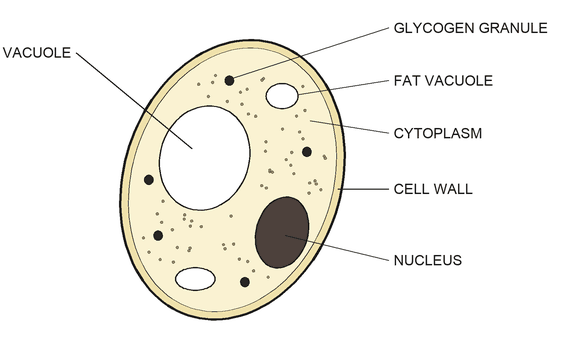
Draw a neat and labeled diagram of the 'Internal structure of yeast'. Answer the following questions.
(a) Name the kingdom to which the yeast belongs.
(b) Is it unicellular or multicellular?
(c) Write the specific mode of nutrition in this organism.
(d) What are the suitable medium/places where yeast can grow successfully?
(e) Name two vitamins which are found in yeast.
(f) Write the economic importance of yeasts in two points.
Solve with AIWritten solution
Solution:
Concept: Yeast is a one-celled fungus. Its oval cell has a cell wall, cytoplasm, a nucleus and one or more vacuoles; it feeds on sugar and ferments it into alcohol and carbon dioxide.
Step 1 — Draw the yeast cell.
The labelled diagram of a single yeast cell is:
Step 2 — Part (a): kingdom.
Yeast belongs to the kingdom Fungi.
Step 3 — Part (b): unicellular or multicellular?
A yeast is a single cell, so it is unicellular.
Step 4 — Part (c): mode of nutrition.
Yeast has no chlorophyll and absorbs food from sugary organic matter, so its nutrition is saprophytic.
Step 5 — Part (d): where yeast grows.
Yeast grows in sugary solutions and in plant exudations containing sugar, e.g. on grapes, in the nectar of flowers and in sugarcane juice.
Step 6 — Part (e): vitamins in yeast.
Yeast is rich in the B-group vitamins, such as vitamin B1 (thiamine) and vitamin B2 (riboflavin).
Step 7 — Part (f): economic importance.
Two uses are:
- breweries: yeast ferments sugar into ethyl alcohol and carbon dioxide, used to make wine and beer;
- bakeries: the carbon dioxide made by yeast makes the dough rise, so bread is soft and spongy.
Watch out: Yeast is a fungus, not a bacterium; it has a true nucleus.
Note: The textbook says yeast contains vitamins of the B and E groups. Yeast is rich in B vitamins, but it is not a source of vitamin E, which only plants and other photosynthetic organisms make.
Therefore, (a) Fungi, (b) unicellular, (c) saprophytic, (d) sugary solutions such as fruit juice and nectar, (e) vitamins B1 and B2, (f) alcohol making in breweries and dough rising in bakeries.
- 2818 marks
Question 28
Draw a neat and labelled diagram of a bacterium showing its internal structure. Answer the following questions.
(a) Name the kingdom to which bacteria belongs.
(b) Are they prokaryotes/eukaryotes?
(c) What are the four kinds of bacteria on the basis of their shape? Write the specific terms with their shapes.
(d) Name the outermost protective covering of a bacterium.
(e) What are the four suitable conditions required for the growth and development of bacteria?
(f) Name two kinds of respiration which can take place in bacteria.
(g) Mention the locomotory structure of bacteria which can help them to move.
Solve with AIWritten solution
Solution:
Concept: A bacterium is a single, very simple cell with no true nucleus: its DNA (the 'chromatin fibres', one coiled strand) lies free in the cytoplasm, with no nuclear membrane.
Step 1 — Draw the bacterium.
The labelled diagram of a rod-shaped bacterium (highly magnified) is:

Step 2 — Part (a): kingdom.
Bacteria belong to the kingdom Monera (in the five-kingdom classification).
Step 3 — Part (b): prokaryote or eukaryote?
Their nuclear material has no nuclear membrane, so bacteria are prokaryotes.
Step 4 — Part (c): shapes.
Bacteria are named by their shape:
Term Shape Coccus round Bacillus rod-shaped Spirillum helical (spiral) Vibrio comma-shaped Step 5 — Part (d): outermost covering.
The outermost protective layer is the slime capsule, a slimy, gelatinous layer (present in some bacteria).
Step 6 — Part (e): conditions for growth.
Bacteria grow well with enough water (moisture), food, a suitable temperature and air (oxygen for some; others grow without it).
Step 7 — Part (f): kinds of respiration.
Bacteria may respire aerobically (using oxygen) or anaerobically (without oxygen).
Step 8 — Part (g): locomotory structure.
Bacteria move with the help of a thread-like flagellum (plural flagella).
Watch out: The slime capsule lies outside the cell wall, and the cell membrane lies inside it.
Therefore, (a) Monera, (b) prokaryotes, (c) coccus, bacillus, spirillum, vibrio, (d) slime capsule, (e) water, food, suitable temperature, air, (f) aerobic and anaerobic, (g) flagellum.
- 294 marks
Question 29
In the 1960s, India introduced the Green Revolution to boost the production of food grains. This was made possible through chemical fertilisers, pesticides and better irrigation facilities among other things. This revolution helped our country move closer to self-sufficiency in food production. Around the same time, India also strengthened its dairy sector through the White Revolution (also called as Operation Flood), which focused on increasing milk production in India. It organised dairy cooperatives, improved milk collection, storage and transportation and encouraged better breeding and feeding practices for cattle. Together, these two revolutions transformed India's agricultural and dairy landscape and greatly improved the nation's food security.
(a) Which two crops were mainly produced during the Green Revolution ?
(b) In addition to the application of chemicals to the crops for a higher yield, specific types of crops were also developed and introduced. What are such crops referred to as ?
(c) Name the dairy cooperative that played a major role in the White Revolution. Where in India was it originally established ?
(d) Name any two high milk-yielding cow breeds commonly reared in India.
Solve with AIWritten solution
Solution:
Concept: The Green Revolution raised grain output with high-yielding seeds and chemicals; the White Revolution raised milk output through dairy co-operatives.
Step 1 — Part (a): crops of the Green Revolution.
Production rose mainly for wheat and rice.
Step 2 — Part (b): specially developed crops.
Crop varieties bred to give much more grain are called High Yielding Varieties (HYV).
Step 3 — Part (c): the dairy co-operative.
Amul (Anand Milk Union Limited) led the White Revolution; it began at Anand, in Gujarat.
Step 4 — Part (d): high milk-yielding cows.
Sahiwal and Red Sindhi (also Gir, and cross breeds such as Karan-Fries) are high milk-yielding breeds.
Therefore, (a) wheat and rice, (b) High Yielding Varieties (HYV), (c) Amul, at Anand in Gujarat, (d) Sahiwal and Red Sindhi.
What Class 8 Biology Ch 9 covers
The sections of the chapter, in the order the book takes them. Every question above comes from one of these.
- 01Microorganisms
- 02Bacteria
- 03Fungi
- 04Agriculture – Primary Food Source
- 05Green Revolution
- 06Animal Husbandry
More ways to study this chapter
The same chapter asked three other ways. Practise it, revise it, and see what the board has set on Ch 9 before.
Class 8 Biology Ch 9 questions students ask
How many questions are there in Class 8 Biology Ch 9?
29 questions. Every one is solved step by step on this page.
Are these Class 8 Biology solutions free?
Yes. Every question and its full working is free to read, with no account needed.
Can I download the Class 8 Biology Ch 9 solutions as a PDF?
There is no PDF to download. Every solution is on this page instead, which means it is searchable, always the current syllabus, and readable on a phone. Use your browser's print option if you want it on paper.