Solution:
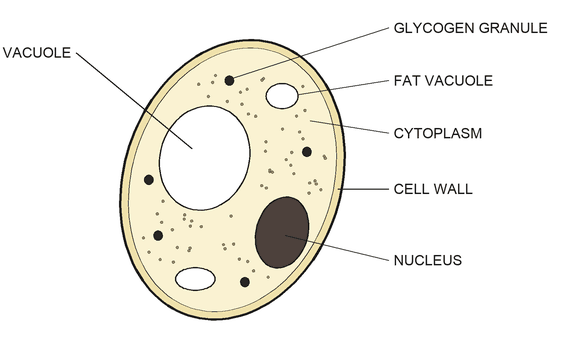
Concept: Yeast is a one-celled fungus. Its oval cell has a cell wall, cytoplasm, a nucleus and one or more vacuoles; it feeds on sugar and ferments it into alcohol and carbon dioxide.
Step 1 — Draw the yeast cell.
The labelled diagram of a single yeast cell is:
Step 2 — Part (a): kingdom.
Yeast belongs to the kingdom Fungi.
Step 3 — Part (b): unicellular or multicellular?
A yeast is a single cell, so it is unicellular.
Step 4 — Part (c): mode of nutrition.
Yeast has no chlorophyll and absorbs food from sugary organic matter, so its nutrition is saprophytic.
Step 5 — Part (d): where yeast grows.
Yeast grows in sugary solutions and in plant exudations containing sugar, e.g. on grapes, in the nectar of flowers and in sugarcane juice.
Step 6 — Part (e): vitamins in yeast.
Yeast is rich in the B-group vitamins, such as vitamin B1 (thiamine) and vitamin B2 (riboflavin).
Step 7 — Part (f): economic importance.
Two uses are:
- breweries: yeast ferments sugar into ethyl alcohol and carbon dioxide, used to make wine and beer;
- bakeries: the carbon dioxide made by yeast makes the dough rise, so bread is soft and spongy.
Watch out: Yeast is a fungus, not a bacterium; it has a true nucleus.
Note: The textbook says yeast contains vitamins of the B and E groups. Yeast is rich in B vitamins, but it is not a source of vitamin E, which only plants and other photosynthetic organisms make.
Therefore, (a) Fungi, (b) unicellular, (c) saprophytic, (d) sugary solutions such as fruit juice and nectar, (e) vitamins B1 and B2, (f) alcohol making in breweries and dough rising in bakeries.
