
Opening your dashboard
Class 8 Biology Chapter 9 Food Production: Competency-Based Questions (CBQ)
40 questions on Chapter 9, each worked through on its own page with the AI tutor. Class 8 Biology, ICSE 2026-27.
40 questions
1–5 marks · Mixed difficulty
- 11 mark
Question 1
Cognitive domain: Application
A buffalo on Harpal's farm eats mostly straw and green fodder, which are rich in cellulose. The veterinary doctor gives the buffalo a medicine that kills bacteria. He warns Harpal that for a few days the buffalo may not digest its fodder as well as before. What is the most likely reason ?
- 21 mark
Question 2
Cognitive domain: Application
Students looked at four slides of bacteria under a microscope and drew what they saw. The drawings are numbered 1 to 4.

One slide was made from a drop of curd. Their teacher said, "The bacterium that sets curd is Lactobacillus. The second half of its name tells you its shape." Which drawing was made from the curd slide ?
- 31 mark
Question 3
Cognitive domain: Application
Shalini owns a nursery near Pune. She grows croton, coleus, rose and jasmine plants and sells them to housing societies. Her brother says, "You do not grow any food, so your work is not a part of agriculture." Which statement about Shalini's work is correct ?
- 41 mark
Question 4
Cognitive domain: Analysis
An officer of the animal husbandry department noted these points about three breeds of cattle, X, Y and Z, kept in a village.
Breed Milk given by the cows Work done by the bullocks X Very high Poor at ploughing and pulling carts Y Quite good Good at ploughing and pulling carts Z Low Very good at ploughing and pulling carts Which conclusion can be drawn from the table ?
- 51 mark
Question 5
Cognitive domain: Understanding
Assertion (A): A person who eats a slice of freshly baked bread takes in hardly any alcohol, although the yeast in the dough had produced alcohol.
Reason (R): When the dough is baked in a hot oven, the heat kills the yeast and drives off almost all of the alcohol.
- 61 mark
Question 6
Cognitive domain: Analysis
Assertion (A): Buffalo milk contains less fat than cow milk.
Reason (R): Cow milk is quite nourishing and easy to digest.
- 71 mark
Question 7
Cognitive domain: Application
A juice seller left a covered jar of fresh sugarcane juice on his cart overnight in warm weather. Next morning, bubbles of gas were rising in the juice and it smelt of alcohol. No one had added anything to the jar.
The sugar in the juice was fermented by ______, a fungus found freely in the atmosphere, and the gas in the bubbles was ______.
- 81 mark
Question 8
Cognitive domain: Understanding
Salim rears only rohu and catla in his village pond. His cousin Farida lives on the coast. She rears prawns in tanks filled with sea water.
Salim's work is best called ______, while Farida's work is the branch of aquaculture called ______.
- 91 mark
Question 9
Cognitive domain: Understanding
On a sericulture farm in Karnataka, most of the cocoons are put into boiling water. But the farmer always keeps a few cocoons aside, untouched, so that he has silkworms for the next season.
From the cocoons kept aside, adult ______ will come out, and the females will lay ______ on mulberry leaves.
- 102 marks
Question 10
Cognitive domain: Evaluation
In a class debate, Ravi said, "The green revolution succeeded for one reason only — farmers started using chemical fertilisers." Do you agree with Ravi ? Justify your answer with two points.
- 112 marks
Question 11
Cognitive domain: Application
Mrs Thakur lives in Shimla. On a very cold winter night, she added a spoonful of curd to a bowl of milk and left it near an open window. In the morning the milk had not set. The next night she did the same, but wrapped the bowl in a thick woollen cloth and kept it in a warm corner of the kitchen. This time the curd set well. Give a reason for the difference.
- 122 marks
Question 12
Cognitive domain: Analysis
A bee-keeper counts the bees in one of his hives every month. The queen of this hive died in March and was not replaced.
Month March April May Number of bees (approx.) 45,000 31,000 18,000 The hive still had thousands of workers and some drones. Explain why the number of bees kept falling.
- 135 marks
Question 13
Cognitive domain: Analysis
Case: To find out what makes dough rise, Anika set up four flasks, P, Q, R and S. She fixed a limp balloon over the mouth of each flask. Three flasks were kept in a warm water bath and one in an ice-cold water bath. She measured the distance round each balloon at the start and again after 45 minutes.
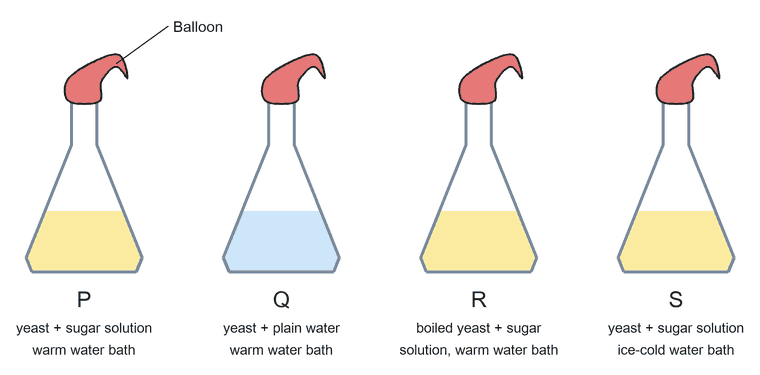
Flask Contents Water bath Round the balloon at the start Round the balloon after 45 minutes P Living yeast + sugar solution Warm (30 °C) 10 cm 28 cm Q Living yeast + plain water Warm (30 °C) 10 cm 10 cm R Boiled yeast + sugar solution Warm (30 °C) 10 cm 10 cm S Living yeast + sugar solution Ice-cold (5 °C) 10 cm 12 cm (a) By how many centimetres did the balloon of flask P grow ? Name the gas that filled it and the process that produced the gas.
(b) Compare flask P with flask Q. What does this pair tell you ?
(c) Compare flask P with flask R. Why did the balloon of flask R not grow at all ?
(d) Use the result of flask S to explain why a baker leaves the dough in a warm place, and not in a refrigerator, before baking.
- 144 marks
Question 14
Cognitive domain: Evaluation
Case: A village in Madhya Pradesh, far from the sea, has a large freshwater pond. The gram panchayat wants to start fish farming in it. At the meeting, three suggestions were made.
- Suggestion 1: "Let us rear pomfret and sardine, because they sell at a high price."
- Suggestion 2: "Let us buy fish eggs and put them straight into the big pond. A hatchery is a waste of money."
- Suggestion 3: "Fish farming will only bring us money. It will not improve the food of our villagers."
(a) Is suggestion 1 a good one ? Give a reason, and name two fishes that would suit this pond.
(b) Judge suggestion 2. What is the use of a hatchery ?
(c) Do you agree with suggestion 3 ? Justify your answer.
(d) Will the panchayat's work be called pisciculture or mariculture ? Why ?
- 155 marks
Question 15
Cognitive domain: Creativity
Case: The Eco Club of a school in Jaipur has been given a small plot behind the playground. The members want to turn it into an organic kitchen garden and to put up a board that tells visitors what makes the garden organic. The school canteen throws away vegetable peels every day, and dry leaves collect under the trees.
(a) Choose four crops for the garden: two vegetables, one pulse and one flower. Say what each will give the school.
(b) Plan how the club will feed the soil and keep the garden organic. Say what will be used, what will not be used, and how the pulse crop will help the soil.
(c) Design the board: write a title and three short lines that explain to visitors the aim of organic farming.
- 161 mark
Question 16
Cognitive domain: Analysis
Anita wants to find out where bacteria multiply fastest. She sets up four dishes and leaves each one for a day. In which dish are the bacteria most likely to multiply the fastest ?
- 171 mark
Question 17
Cognitive domain: Application
The diagram shows a bacterium as seen under a very powerful microscope. Five parts are marked P, Q, R, S and T.

Which option names the part that helps certain bacteria to move and the part that is the nuclear material, the chromatin fibres (the single coiled-up DNA strand) ?
- 181 mark
Question 18
Cognitive domain: Understanding
In a brewery, yeast ferments a sugar solution (glucose) in large closed tanks, and two products are formed. Which statement tells correctly what the brewery does with the two products ?
- 191 mark
Question 19
Cognitive domain: Application
Meena has a 2-hectare farm on which she grows wheat, gram and mustard. Her family eats most of the produce, and she sells only a small surplus. Her neighbour Tarun grows coffee and rubber on his 2-hectare farm. He sells the whole produce to companies and buys his family's grain from the market. Which statement about the two farms is correct ?
- 201 mark
Question 20
Cognitive domain: Analysis
The bar chart shows the milk given in one day by four kinds of milch animals of a district. (Hypothetical data.)

What percentage of the milk of the district comes from goats and camels together ?
- 211 mark
Question 21
Cognitive domain: Application
Sunita's family keeps five animals: a rabbit and a parrot that the children keep for company, two buffaloes whose milk the family sells, and a camel that carries loads for a trader. Which option lists all the animals that are livestock, as the chapter uses the word ?
- 221 mark
Question 22
Cognitive domain: Application
A school hostel needs a steady supply of eggs for breakfast every day. A restaurant in the same town needs chickens for its meat. Which row shows the kind of birds each of them should buy from a poultry farm ?
- 231 mark
Question 23
Cognitive domain: Application
A wheat farmer in Punjab in the early 1960s has four problems.
P. Weeds are crowding out his crop.
Q. Insects are eating the leaves and spreading diseases among the plants.
R. The soil is short of nutrients.
S. The old seeds give a low yield even when everything else is right.
Which option matches each problem with the measure that the green revolution brought for it ?
- 241 mark
Question 24
Cognitive domain: Analysis
Assertion (A): Pigs give the largest share of the meat that is produced in India.
Reason (R): Pig is a rich source of protein, and that too at a low cost.
- 251 mark
Question 25
Cognitive domain: Understanding
Assertion (A): Curd is considered to be a healthy food because it is high in calcium.
Reason (R): Curd is formed by the action of bacteria on the lactose present in milk.
- 262 marks
Question 26
Cognitive domain: Evaluation
Rahul says, "Human beings have always grown crops and kept animals for food, right from the beginning of their life on the earth." Do you agree with him ? Support your answer with two points from the chapter.
- 272 marks
Question 27
Cognitive domain: Understanding
Rani looks at a drop of curd and sees only a smooth white substance. Her teacher says that the drop holds millions of living Lactobacillus bacteria.
(a) Why can Rani not see these bacteria with her eyes ?
(b) Name the instrument that she needs, and the branch of science that studies such organisms.
- 282 marks
Question 28
Cognitive domain: Understanding
An apiary sells two products from its hives. Jar P holds a thick, sweet liquid, and block Q is a pale yellow solid that is used to make candles.
(a) Name P and Q.
(b) Which of the two is rich in carbohydrates, and what is the use of Q inside the hive ?
- 292 marks
Question 29
Cognitive domain: Application
A farmer grows button mushrooms in a dark shed, on beds of rotting straw and farm waste. A visitor asks, "Plants need sunlight, but these mushrooms grow in the dark. How is that possible ?"
(a) Answer the visitor, using what the chapter says about how fungi obtain their food.
(b) The farmer's son wants to use the same dark shed to grow spinach on the same straw beds. Will the spinach grow well there ? Give a reason.
- 302 marks
Question 30
Cognitive domain: Analysis
A hostel cook has planned the food of one day.
Meal Foods Breakfast Puffed rice and banana Lunch Wheat chapati, boiled potato and steamed spinach Dinner Rice, steamed cabbage and raw onion No oil, ghee or butter is used in any of the cooking.
Use what the chapter says about the nutrients in crops. (a) Which two nutrient groups are missing from the day's food ? (b) Suggest one crop from the chapter to add for each missing group.
- 312 marks
Question 31
Cognitive domain: Evaluation
Lakshmi is a landless labourer. She has saved enough money to buy either one buffalo or a few goats, and she wants milk for her two small children and a little income. One neighbour says, "Buy goats. They are cheaper to keep, their milk is good for children, and goats give meat too." Another neighbour says, "Buy a buffalo, because it gives far more milk."
Evaluate the two suggestions, and give your own advice.
- 323 marks
Question 32
Cognitive domain: Application
A feed mill packs poultry feed in 100 kg bags. The recipe is given below. (Hypothetical data.)
Ingredient Mass in each 100 kg bag Maize 40 kg Bajra 25 kg Rice bran 15 kg Groundnut cake 12 kg Fish meal 8 kg (a) What percentage of each bag is the cereal feed (maize, bajra and rice bran) ?
(b) How much fish meal is needed to make a lot of 250 kg of the feed ?
(c) Fish meal is one of the ingredients. From what is it prepared ?
- 333 marks
Question 33
Cognitive domain: Application
The garden department of a city grows these crops in its nursery and parks : rose, cabbage, mushroom, croton, jasmine, mango, spinach and lawn grass.
(a) Group them into vegetables, fruits, flowers, ornamental plants and others (horticulture crops that are neither of the first four).
(b) Is horticulture only about the crops that we eat ? Give one example from the list to support your answer.
- 343 marks
Question 34
Cognitive domain: Analysis
A student studies three specimens, X, Y and Z, and writes these notes.
X : A tiny ovoid body made of a single cell, with a cell wall, a nucleus and vacuoles. It grows readily on grapes.
Y : A blackish, cottony growth on a stale slice of bread.
Z : A white, umbrella-like body growing on decaying wood.
(a) Name X, Y and Z.
(b) Which specimen is unicellular ?
(c) Give one feature that is common to all three and one reason for it.
- 353 marks
Question 35
Cognitive domain: Analysis
A health worker noted five events in a town.
Event What was seen P Many cases of cholera after a flood Q Milk set into curd in a dairy R Cases of tetanus after deep wounds from nails dirty with soil S Dough rising in a bakery T Cases of dysentery in a hostel (a) Which events show the harm done by microbes, and which show the benefit ?
(b) Name the microbe at work in Q and in S.
(c) Name two places where, according to the chapter, microbes are found.
- 363 marks
Question 36
Cognitive domain: Creativity
Your class will visit a bee-keeping centre (an apiary) next week. Prepare a short observation sheet for the visit.
(a) Write three things that you will try to observe.
(b) Write two questions that you will ask the bee-keeper.
- 375 marks
Question 37
Cognitive domain: Analysis
Case: In the early 1960s, a research farm in Punjab grew two kinds of wheat on identical plots. One was a local variety and the other was a High Yielding Variety (HYV). The plots were given different amounts of chemical fertiliser. The graph shows the yield of each variety. (Hypothetical data.)

(a) Read from the graph the yield of each variety at kg of fertiliser per hectare. How many times as large is the yield of the HYV as that of the local variety ?
(b) By what percentage did the yield of the HYV rise when the fertiliser was increased from to kg per hectare ?
(c) A farmer says, "The new HYV seeds alone raised my yield, so I need not buy fertiliser." Use the graph to evaluate his statement, and advise on the amount of fertiliser that the farm should use.
- 384 marks
Question 38
Cognitive domain: Evaluation
Case: Bhola keeps three buffaloes in a village in Gujarat. Before his village formed a dairy co-operative society, he sold his milk to a local trader at ₹30 per litre, while consumers in the nearby city paid ₹60 per litre. After the society was formed and linked to a city dairy, Bhola gets ₹48 per litre, while the city consumers still pay ₹60 per litre. (Hypothetical data.)
(a) What part of the price paid by the consumers did Bhola get before the society was formed, and what part does he get now ? Give each as a percentage.
(b) Name the programme that India started in 1970 with the aim of linking the rural milk producer with the urban consumer, and the person called its main architect.
(c) Bhola's neighbour says, "This programme helped only the dairy farmers. It did nothing for milk consumers." Use the data and the chapter to evaluate this statement.
- 394 marks
Question 39
Cognitive domain: Evaluation
Case: An agriculture officer collects these notes about three villages. (Hypothetical data.)
Village Rainfall in a year Climate and land P 170 cm, almost all from June to October Hot and humid; the fields can be flooded Q 70 cm, mostly as winter showers Alluvial soil of the northern plains; wheat is grown; monthly average temperature about 12 °C in late October, when the seed is sown, and about 24 °C in March, when the grain ripens R Water from a tube-well A few small plots at the edge of a big city (a) Check whether the temperatures of Q at sowing and at ripening suit wheat. Name the crop season of wheat.
(b) The farmers of R want quick income from the city market. Suggest two horticulture crops for them, with a reason.
(c) The panchayat of P proposes, "Let us stop growing rice and grow wheat instead, because wheat needs less water." Evaluate the proposal.
- 404 marks
Question 40
Cognitive domain: Analysis
Case: A sericulture farm keeps this record of the life cycle of its silk moths. The caterpillars are fed on mulberry leaves. (Hypothetical data.)
Stage Number of days Eggs on mulberry leaves 10 Caterpillar (larva) 26 Chrysalis (pupa) inside a cocoon 12 Adult moth 3 (a) For how many days does the whole life cycle last ? The cocoons must be put into boiling water while the pupa is still alive inside, before the adult moth comes out. By the end of which day, counted from the day the eggs are laid, must this be done at the latest ?
(b) The farm has caterpillars, and each one eats g of mulberry leaves a day on average. How many kilograms of leaves are needed in one day, and in the whole caterpillar stage ?
(c) Name the four varieties of silk that are produced in India. Which one does this farm produce ?