
Opening your dashboard
Class 8 Biology Chapter 7: Nervous System Solutions
22 textbook questions with step-by-step answers, free to read, for ICSE 2026-27.
Get talked through Ch 7, not just shown the answer
Reading a finished solution is not the same as being able to do it. The AI tutor takes one question at a time and works it with you, in your own words, until you can.
- Ask it out loud, in your own words
- It gives you the next step, not the answer
- Stuck on part (ii)? Start there
22 questions with solutions
1–13 marks · Mixed difficulty
- 11 mark
Question 1
Medulla oblongata controls :
Solve with AIAnswer
(A) Smelling
- Correct
(B) Beating of heart and respiratory movement
(C) Intelligence and will power
(D) Balancing of the body
Answer: (B) Beating of heart and respiratory movement
Concept: The brain has three main parts. The cerebrum does thinking and voluntary actions, the cerebellum keeps balance, and the medulla oblongata controls the involuntary work of the internal organs.
Step 1 — Recall the job of the medulla.
The medulla oblongata joins the brain to the spinal cord and controls involuntary activities that go on all the time, such as the beating of the heart and breathing.
Step 2 — Match with the options.
That is option (B).
Watch out: The cerebellum (balance) and the medulla (heart and breathing) both lie at the back of the brain; do not mix up their jobs.
Why the other options are wrong:
- (A) Smelling: This is wrong because smell is picked up by the nose and sensed by the cerebrum, through the olfactory nerve.
- (C) Intelligence and will power: This is wrong because intelligence and will power are functions of the cerebrum.
- (D) Balancing of the body: This is wrong because balancing of the body is the job of the cerebellum.
Therefore, the medulla oblongata controls the beating of the heart and respiratory movements, option (B).
- 21 mark
Question 2
Balance of body is controlled by :
Solve with AIAnswer
(A) Spinal cord
- Correct
(B) Cerebellum
(C) Cerebrum
(D) Medulla
Answer: (B) Cerebellum
Concept: The cerebellum, the small, folded part at the back of the brain below the cerebrum, keeps the body balanced and makes muscle movements smooth and well coordinated.
Step 1 — Recall which part keeps balance.
Messages from the inner ears, eyes and muscles reach the cerebellum, which adjusts the muscles so that we stay upright and steady.
Step 2 — Match with the options.
So balance is controlled by the cerebellum, option (B).
Why the other options are wrong:
- (A) Spinal cord: This is wrong because the spinal cord controls reflexes of the trunk and limbs and carries messages to and from the brain.
- (C) Cerebrum: This is wrong because the cerebrum is the seat of intelligence, memory and will power.
- (D) Medulla: This is wrong because the medulla controls heartbeat, breathing and other involuntary activities.
Therefore, balance of the body is controlled by the cerebellum, option (B).
- 31 mark
Question 3
The smell of good food causes watering of your mouth. It is :
Solve with AIAnswer
(A) Natural reflex
- Correct
(B) Acquired reflex
(C) Inborn reflex
(D) Ordinary reflex
Answer: (B) Acquired reflex
Concept: A natural (inborn) reflex is present from birth and needs no learning. An acquired (conditioned) reflex develops through experience: the body learns to link a signal with something that follows it.
Step 1 — Ask why the mouth waters.
The mouth waters at the smell of good food because we have eaten such food before. The brain has learnt to link this smell with the taste of the food.
Step 2 — Name the reflex.
A response that comes from earlier experience is an acquired (conditioned) reflex, option (B).
Watch out: Saliva flowing when food is actually in the mouth is a natural reflex; saliva flowing at only the smell or sight of a familiar food is an acquired one.
Why the other options are wrong:
- (A) Natural reflex: This is wrong because a natural reflex, such as blinking or sneezing, needs no earlier experience.
- (C) Inborn reflex: This is wrong because 'inborn reflex' is another name for a natural reflex.
- (D) Ordinary reflex: This is wrong because 'ordinary reflex' is not one of the two types of reflexes.
Therefore, watering of the mouth at the smell of good food is an acquired reflex, option (B).
- 41 mark
Question 4
The structural and functional unit of nervous system is :
Solve with AIAnswer
(A) Axon
(B) Nephron
- Correct
(C) Neuron
(D) Dendron
Answer: (C) Neuron
Concept: The structural and functional unit of a system is the smallest part that is built like the system and does its work. For the nervous system this is the nerve cell, called the neuron.
Step 1 — Recall what the nervous system is made of.
The brain, spinal cord and nerves are all made of nerve cells (neurons), and each neuron can receive and pass on messages (impulses).
Step 2 — Match with the options.
So the unit is the neuron, option (C).
Watch out: Do not confuse the neuron (nervous system) with the nephron (kidney).
Why the other options are wrong:
- (A) Axon: This is wrong because the axon is only one part of a neuron, its long fibre.
- (B) Nephron: This is wrong because the nephron is the structural and functional unit of the kidney.
- (D) Dendron: This is wrong because a dendron is only a branch of the cell body of a neuron.
Therefore, the structural and functional unit of the nervous system is the neuron, option (C).
- 51 mark
Question 5
Peripheral nervous system consists of different types of nerves which connect the central nervous system to all parts of the body. Cranial nerves, spinal nerves, sympathetic and parasympathetic nerves are all connected to different parts of the body. Which of the following does not belong to cranial nerves ?
Solve with AIAnswer
(A) Olfactory nerves
(B) Auditory nerves
(C) Optic nerves
- Correct
(D) Sympathetic nerves
Answer: (D) Sympathetic nerves
Concept: Cranial nerves (12 pairs) arise from the brain and serve mainly the head and face. The sympathetic nerves belong to the autonomic nervous system; they come from the spinal cord in the chest and lower back.
Step 1 — Check each option against the brain.
The olfactory nerve (smell), the auditory nerve (hearing) and the optic nerve (sight) all come straight from the brain, so all three are cranial nerves.
Step 2 — Find the odd one.
The sympathetic nerves come from the spinal cord and form chains beside the backbone, so they are not cranial nerves. This is option (D).
Watch out: The auditory nerve is today called the vestibulocochlear nerve; it is still a cranial nerve.
Why the other options are wrong:
- (A) Olfactory nerves: This is wrong because the olfactory nerve, from the nose, is a cranial nerve.
- (B) Auditory nerves: This is wrong because the auditory nerve, from the ear, is a cranial nerve.
- (C) Optic nerves: This is wrong because the optic nerve, from the eye, is a cranial nerve.
Therefore, the sympathetic nerves do not belong to the cranial nerves, option (D).
- 61 mark
Question 6
Ayush, a student of class 8 was preparing for his biology annual exam but could not understand the terms Receptor, Effector, Stimulus and Response. Which of the following statements explains 'receptor' ?
P. Receptors are sense organs.
Q. Receptors send impulses to CNS through sensory nerves.
R. Receptors receive messages from the central nervous system.
Solve with AIAnswer
(A) Only R
(B) Only Q
(C) Only P and R
- Correct
(D) Only P and Q
Answer: (D) Only P and Q
Concept: A receptor is a sense organ (or sense cell) that receives a stimulus and sends an impulse to the central nervous system (CNS) along a sensory nerve. An effector (muscle or gland) receives commands from the CNS along a motor nerve.
Step 1 — Check statement P.
Receptors such as the eyes, ears, nose, tongue and skin are sense organs, so P is correct.
Step 2 — Check statement Q.
Impulses from receptors travel to the brain or spinal cord along sensory nerves, so Q is correct.
Step 3 — Check statement R.
Messages from the CNS go out along motor nerves to the effectors, not to the receptors, so R is wrong.
Step 4 — Pick the option.
P and Q only describe receptors, which is option (D).
Watch out: A 'receptor' receives the stimulus from outside; it never receives orders from the brain.
Why the other options are wrong:
- (A) Only R: This is wrong because R describes an effector, not a receptor, and P and Q are left out.
- (B) Only Q: This is wrong because P is also correct, so 'only Q' is incomplete.
- (C) Only P and R: This is wrong because R is wrong and Q, which is correct, is left out.
Therefore, receptors are explained by P and Q only, option (D).
- 71 mark
Question 7
Assertion (A): Neurons are the basic structural unit of nervous system, located in the brain and spinal cord only.
Reason (R): Brain and spinal cords are the parts of central nervous system which coordinate all external and internal activities of human body.
Solve with AIAnswer
(A) (1) Both A and R are true and R is the correct explanation of A.
(B) (2) Both A and R are true but R is not the correct explanation of A.
(C) (3) A is true but R is false.
- Correct
(D) (4) A is false but R is true.
Answer: (D) (4) A is false but R is true.
Concept: An Assertion–Reason item is judged in three checks: is A true, is R true, and, if both are true, does R give the reason for A?
Step 1 — Judge the Assertion.
Neurons are indeed the basic unit of the nervous system, but they are not only in the brain and spinal cord. The nerves that run through the whole body (the peripheral nervous system) are made of the fibres of neurons, and some neuron cell bodies lie in ganglia outside the CNS. So A is false.
Step 2 — Judge the Reason.
The brain and spinal cord form the central nervous system, which coordinates the external and internal activities of the body. So R is true.
Step 3 — Pick the code.
A is false and R is true, which is option (D).
Watch out: The word 'only' makes A false; always test such words.
Why the other options are wrong:
- (A): This is wrong because A is false, so it cannot be explained by R.
- (B): This is wrong because A is false, so 'both A and R are true' does not hold.
- (C): This is wrong because it calls A true and R false, the reverse of the truth.
Therefore, A is false but R is true, option (D).
- 81 mark
Question 8
Assertion (A): Synapse is the junction between two neurons which communicates impulses/messages.
Reason (R): Neurons must be connected with each other through some means in order to transmit the unidirectional flow of impulses.
Solve with AIAnswer
- Correct
(A) (1) Both A and R are true and R is the correct explanation of A.
(B) (2) Both A and R are true but R is not the correct explanation of A.
(C) (3) A is true but R is false.
(D) (4) A is false but R is true.
Answer: (A) (1) Both A and R are true and R is the correct explanation of A.
Concept: An Assertion–Reason item is judged in three checks: is A true, is R true, and, if both are true, does R give the reason for A?
Step 1 — Judge the Assertion.
A synapse is the junction between the axon endings of one neuron and the dendrites of the next. The two cells do not touch; a chemical messenger carries the message across the tiny gap. So A is true.
Step 2 — Judge the Reason.
For a message to travel from a sense organ to the brain and from the brain to a muscle, neurons must be linked in a chain, and the message must pass one way only. So R is true.
Step 3 — Does R explain A?
The synapse is exactly the link that R says is needed, and it lets impulses pass in one direction only. So R is the correct explanation of A, option (A).
Watch out: Neurons are linked at synapses but do not physically join; there is always a tiny gap.
Why the other options are wrong:
- (B): This is wrong because R does explain A: synapses exist because neurons must be linked to pass impulses.
- (C): This is wrong because R is true: neurons must be linked for one-way flow of impulses.
- (D): This is wrong because A is true: a synapse is the junction that passes messages between neurons.
Therefore, both A and R are true and R is the correct explanation of A, option (A).
- 91 mark
Question 9
Assertion (A): The glands and muscles are considered as effector organs.
Reason (R): Muscles and glands are highly affected by the impulses carried through the sensory nerves from sense organs to the central nervous system (brain/spinal cord).
Solve with AIAnswer
(A) (1) Both A and R are true and R is the correct explanation of A.
(B) (2) Both A and R are true but R is not the correct explanation of A.
- Correct
(C) (3) A is true but R is false.
(D) (4) A is false but R is true.
Answer: (C) (3) A is true but R is false.
Concept: An Assertion–Reason item is judged in three checks: is A true, is R true, and, if both are true, does R give the reason for A?
Step 1 — Judge the Assertion.
Effectors are the organs that carry out a response. Muscles contract and glands secrete, so they are the effector organs. A is true.
Step 2 — Judge the Reason.
Sensory nerves carry impulses from the sense organs to the brain or spinal cord; they do not reach the muscles and glands. Muscles and glands act on impulses brought by motor nerves. So R is false.
Step 3 — Pick the code.
A is true and R is false, which is option (C).
Watch out: Sensory nerves go IN to the CNS; motor nerves go OUT to the muscles and glands.
Why the other options are wrong:
- (A): This is wrong because R is false, so it cannot explain A.
- (B): This is wrong because R is false, so 'both A and R are true' does not hold.
- (D): This is wrong because A is true: muscles and glands are the effectors.
Therefore, A is true but R is false, option (C).
- 101 mark
Question 10
Assertion (A): The sympathetic and parasympathetic nervous systems are antagonistic (opposite) in their actions.
Reason (R): Both systems are parts of the autonomic nervous system that function without conscious control.
Solve with AIAnswer
(A) (1) Both A and R are true and R is the correct explanation of A.
- Correct
(B) (2) Both A and R are true but R is not the correct explanation of A.
(C) (3) A is true but R is false.
(D) (4) A is false but R is true.
Answer: (B) (2) Both A and R are true but R is not the correct explanation of A.
Concept: An Assertion–Reason item is judged in three checks: is A true, is R true, and, if both are true, does R give the reason for A?
Step 1 — Judge the Assertion.
The sympathetic system prepares the body for emergencies (it speeds up the heart and widens the pupils), while the parasympathetic system calms it (it slows the heart and narrows the pupils). They act opposite to each other, so A is true.
Step 2 — Judge the Reason.
Both are parts of the autonomic nervous system, which works without our conscious control. So R is true.
Step 3 — Does R explain A?
Being parts of the autonomic system tells us where they belong and that they work on their own, but not why their actions are opposite. So R is not the correct explanation of A, option (B).
Watch out: Two true statements on the same topic are not enough; R must give the reason for A.
Why the other options are wrong:
- (A): This is wrong because R does not give the reason for their opposite actions.
- (C): This is wrong because R is true: both systems are parts of the autonomic nervous system.
- (D): This is wrong because A is true: the two systems have opposite effects on the same organs.
Therefore, both A and R are true but R is not the correct explanation of A, option (B).
- 111 mark
Question 11
Assertion (A): The arrangement of white and grey matter is reversed in spinal cord from that in the brain.
Reason (R): In brain, the outer portion is white and the inner portion is grey. In spinal cord, the outer portion consists of cytons of neurons whereas the inner portion contains the axons of neurons.
Solve with AIAnswer
(A) (1) Both A and R are true and R is the correct explanation of A.
(B) (2) Both A and R are true but R is not the correct explanation of A.
- Correct
(C) (3) A is true but R is false.
(D) (4) A is false but R is true.
Answer: (C) (3) A is true but R is false.
Concept: An Assertion–Reason item is judged in three checks: is A true, is R true, and, if both are true, does R give the reason for A?
Step 1 — Recall the two kinds of matter.
Grey matter is made mostly of the cell bodies (cytons) of neurons; white matter is made of their axons, which look white because of the fatty myelin sheath.
Step 2 — Judge the Assertion.
In the brain (cerebrum) the grey matter is outside and the white matter inside; in the spinal cord the grey matter is inside and the white matter outside. The arrangement is reversed, so A is true.
Step 3 — Judge the Reason.
R gets both parts the wrong way round: it says the brain is white outside, and that the outer part of the spinal cord has the cytons. In fact the brain is grey outside, and the spinal cord's outer part has the axons. So R is false, which gives option (C).
Watch out: Grey = cell bodies, white = myelinated axons; then just remember: brain grey OUTSIDE, spinal cord grey INSIDE.
Why the other options are wrong:
- (A): This is wrong because R is false, so it cannot explain A.
- (B): This is wrong because R is false, so 'both A and R are true' does not hold.
- (D): This is wrong because A is true: the arrangement in the spinal cord is the reverse of that in the brain.
Therefore, A is true but R is false, option (C).
- 128 marks
Question 12
Name :
(a) The long, extended process of a neuron.
(b) The point of contact between two neurons.
(c) The kind of nerve which carries both sensory and motor neurons.
(d) The nerve which connects the eyes to the brain.
(e) The nerve which connects the nose to the brain.
(f) The nerve which connects the ears to the brain.
(g) Two sub-divisions of the peripheral nervous system.
(h) Two parts of the autonomic nervous system.
Solve with AIWritten solution
Solution:
Concept: A neuron has a cell body, short branches (dendrites) and one long fibre (the axon). Neurons meet at synapses, and bundles of their fibres form nerves. The nervous system outside the brain and spinal cord is the peripheral nervous system.
Step 1 — Part (a).
The long, extended process of a neuron is the axon.
Step 2 — Part (b).
The point of contact between two neurons is the synapse.
Step 3 — Part (c).
A nerve that has both sensory and motor fibres is a mixed nerve.
Step 4 — Parts (d), (e) and (f).
The eyes are joined to the brain by the optic nerve, the nose by the olfactory nerve and the ears by the auditory nerve (today called the vestibulocochlear nerve).
Step 5 — Part (g).
The peripheral nervous system has two sub-divisions: the somatic nervous system (cranial and spinal nerves, serving the skin and skeletal muscles) and the autonomic nervous system (serving the internal organs).
Step 6 — Part (h).
The autonomic nervous system has two parts: the sympathetic and the parasympathetic nervous systems.
Therefore, (a) axon, (b) synapse, (c) mixed nerve, (d) optic nerve, (e) olfactory nerve, (f) auditory nerve, (g) somatic and autonomic nervous systems, (h) sympathetic and parasympathetic nervous systems.
- 131 mark
Question 13
You are driving your bicycle at a fast speed. Suddenly, a small boy comes in front of your cycle and without wasting any time in thinking, you immediately apply the brakes and the accident is avoided. What name is given to such an action ?
Solve with AIWritten solution
Solution:
Concept: An action done automatically and very quickly in response to a stimulus, without stopping to think, is a reflex action. Reflexes learnt through practice are called conditioned (acquired) reflexes.
Step 1 — Look at what happened.
The sight of the boy (the stimulus) led at once to pressing the brakes (the response), with no time spent deciding what to do.
Step 2 — Name the action.
A quick, automatic response made without conscious thought is a reflex action. Because braking a bicycle is learnt while learning to ride, it is a conditioned (acquired) reflex.
Watch out: The stimulus here is something seen, so the message from the eyes does reach the brain; what is skipped is the conscious decision.
Therefore, such an action is called a reflex action (here a conditioned, learnt reflex).
- 145 marks
Question 14
Name the following :
(a) Three kinds of neurons
(b) Three kinds of nerves
(c) Three main parts of the brain
(d) Two types of reflexes
(e) Two types of effectors
Solve with AIWritten solution
Solution:
Concept: These are the basic groups used to describe the nervous system: kinds of nerve cells, kinds of nerves, parts of the brain, kinds of reflexes and kinds of effector organs.
Step 1 — Part (a): neurons.
By their work, neurons are sensory neurons (carry impulses to the CNS), motor neurons (carry impulses from the CNS) and association (relay) neurons (link the two inside the CNS).
Step 2 — Part (b): nerves.
Nerves are sensory nerves, motor nerves and mixed nerves (with both kinds of fibres).
Step 3 — Part (c): brain.
The three main parts of the brain are the cerebrum, the cerebellum and the medulla oblongata.
Step 4 — Part (d): reflexes.
Reflexes are natural (inborn) reflexes and conditioned (acquired) reflexes.
Step 5 — Part (e): effectors.
The effectors are muscles (which contract) and glands (which secrete).
Therefore, (a) sensory, motor and association neurons; (b) sensory, motor and mixed nerves; (c) cerebrum, cerebellum, medulla oblongata; (d) natural and conditioned reflexes; (e) muscles and glands.
- 1510 marks
Question 15
Define the terms :
(a) Coordination
(b) Synapse
(c) Impulse
(d) Reflex action
(e) Reflex arc
Solve with AIWritten solution
Solution:
Concept: A definition says exactly what a term means, in one or two clear sentences.
Step 1 — Part (a): coordination.
Coordination is the working together of the different organs and activities of the body in a proper order, according to the body's needs and to changes outside or inside it.
Step 2 — Part (b): synapse.
A synapse is the junction between the axon endings of one neuron and the dendrites of the next, where the impulse passes from one neuron to the other across a tiny gap with the help of a chemical messenger.
Step 3 — Part (c): impulse.
An impulse is a wave of electrical (electrochemical) change that travels along a nerve fibre, carrying a message.
Step 4 — Part (d): reflex action.
A reflex action is a quick, automatic and involuntary response to a stimulus, made without conscious thought. Most reflexes are controlled by the spinal cord; some, such as blinking, sneezing and coughing, by the lower part of the brain.
Step 5 — Part (e): reflex arc.
A reflex arc is the shortest pathway of a nerve impulse in a reflex action: from the receptor, along a sensory neuron, through the spinal cord (relay neuron) and along a motor neuron to the effector.
Watch out: A reflex is not done 'without any nerves'; it uses a short nerve pathway, but no conscious decision.
Therefore, the five terms are defined as in Steps 1 to 5.
- 1610 marks
Question 16
Write one important role of each of the following :
(a) Cerebrum
(b) Cerebellum
(c) Medulla oblongata
(d) Receptors
(e) Spinal cord
Solve with AIWritten solution
Solution:
Concept: Each part of the nervous system has its own main job: thinking (cerebrum), balance (cerebellum), internal organs (medulla), sensing (receptors) and reflexes plus message-carrying (spinal cord).
Step 1 — Part (a): cerebrum.
The cerebrum is the seat of intelligence, memory, consciousness and will power, and it controls all voluntary actions.
Step 2 — Part (b): cerebellum.
The cerebellum keeps the balance of the body and coordinates muscular movements, making them smooth.
Step 3 — Part (c): medulla oblongata.
The medulla controls involuntary activities of the internal organs, such as the heartbeat, breathing, swallowing and coughing.
Step 4 — Part (d): receptors.
Receptors (sense organs) receive stimuli from the surroundings and start an impulse in the sensory nerve.
Step 5 — Part (e): spinal cord.
The spinal cord controls reflex actions of the trunk and limbs (below the neck) and carries messages between the body and the brain.
Therefore, (a) cerebrum: intelligence, memory and voluntary actions; (b) cerebellum: balance and coordination of muscles; (c) medulla: heartbeat, breathing and other involuntary actions; (d) receptors: receive stimuli; (e) spinal cord: reflexes and carrying messages to and from the brain.
- 172 marks
Question 17
Write the specific terms/structures for the 'pathway of a reflex arc' in a proper logical sequence, starting with stimulus and ending with response/reflex action.
Solve with AIWritten solution
Solution:
Concept: A reflex arc is the path a nerve impulse takes in a reflex action, from the sense organ that picks up the stimulus to the muscle or gland that responds.
Step 1 — Start with the stimulus and the receptor.
A stimulus is picked up by a receptor (sense organ), which starts an impulse.
Step 2 — Carry the impulse to the spinal cord and back out.
A sensory nerve carries the impulse to the spinal cord, where a relay neuron passes it to a motor nerve, which carries it to the effector.
Step 3 — Write the whole sequence.
In logical order, the reflex arc is:
- Stimulus (a change, such as heat or a sudden sight)
- Receptor (the sense organ that picks up the stimulus)
- Sensory nerve (sensory neuron, carrying the impulse to the spinal cord)
- Spinal cord (relay or association neuron, passing the impulse on)
- Motor nerve (motor neuron, carrying the command out)
- Effector (the muscle or gland that acts)
- Response (the reflex action)
Watch out: The impulse goes IN by the sensory nerve and OUT by the motor nerve; do not swap them.
Therefore, stimulus → receptor → sensory nerve → spinal cord → motor nerve → effector → response.
- 1812 marks
Question 18
Differentiate between the following pairs of terms on the basis of what is indicated within the brackets :
(a) Stimulus and response (definition)
(b) Receptor and effector (examples)
(c) Motor nerve and sensory nerve (function)
(d) Cranial and spinal nerves (number in pairs)
(e) Cerebrum and medulla oblongata (function)
(f) Cerebrum and spinal cord (arrangement of white and grey matter)
Solve with AIWritten solution
Solution:
Concept: To differentiate, give the point asked for in brackets for each member of the pair, side by side.
Step 1 — Part (a): definition.
A stimulus comes first and causes the response.
Stimulus Response Any change in the surroundings (or inside the body) that brings about a change in the activity of the body. The activity of the body produced by a stimulus. Step 2 — Part (b): examples.
Receptors pick up stimuli; effectors act on commands.
Receptor Effector Sense organs such as the eye, ear, nose, tongue and skin. Muscles (e.g. muscles of the arm) and glands (e.g. tear glands, salivary glands). Step 3 — Part (c): function.
The two kinds of nerves carry impulses in opposite directions.
Motor nerve Sensory nerve Carries impulses from the brain or spinal cord to muscles and glands. Carries impulses from the sense organs to the brain or spinal cord. Step 4 — Part (d): number in pairs.
Cranial nerves come from the brain, spinal nerves from the spinal cord.
Cranial nerves Spinal nerves 12 pairs, arising from the brain. 31 pairs, arising from the spinal cord. Step 5 — Part (e): function.
One part thinks; the other runs the internal organs.
Cerebrum Medulla oblongata Seat of intelligence, memory, consciousness and will power; controls voluntary actions. Controls involuntary activities of internal organs, such as heartbeat, breathing and swallowing. Step 6 — Part (f): arrangement of white and grey matter.
Grey matter is cell bodies; white matter is myelinated axons.
Cerebrum Spinal cord Grey matter outside (cortex), white matter inside. Grey matter inside (H-shaped), white matter outside. Watch out: In (d), count pairs: 12 pairs means 24 cranial nerves and 31 pairs means 62 spinal nerves.
Therefore, the six pairs differ as shown in the tables above.
- 1913 marks
Question 19
Draw a neat and labeled diagram of a neuron and answer the following questions:
(a) What are the two main parts of a neuron?
(b) Is this structure unicellular or multicellular?
(c) Which part of the neuron contains nucleus?
(d) Name the two parts of the human body where neurons are found abundantly.
(e) How are neurons significant to us?
Solve with AIWritten solution
Solution:
Concept: A neuron (nerve cell) is the structural and functional unit of the nervous system. It has a cell body (cyton) with the nucleus, short branched dendrites that bring impulses in, and one long axon that carries impulses away.
Step 1 — Draw and label the neuron.
The diagram shows the dendrites, cyton (cell body) with its nucleus, the axon wrapped in a myelin sheath with gaps called nodes of Ranvier, and the terminal branches at the end.
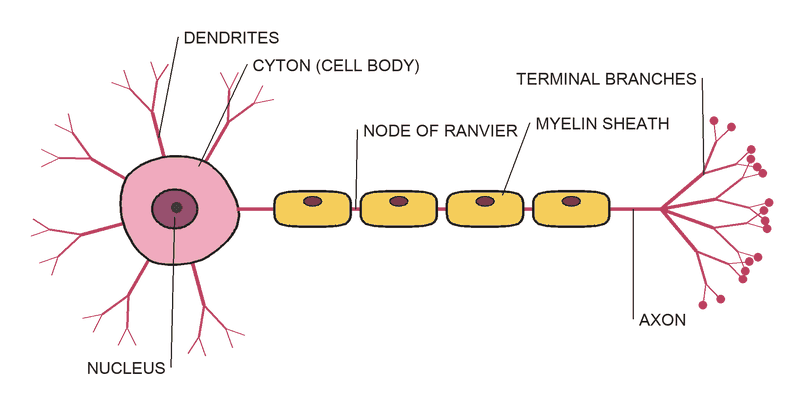
Step 2 — Part (a): two main parts.
The two main parts of a neuron are the cyton (cell body) and the axon (its long fibre).
Step 3 — Part (b): unicellular or multicellular.
A neuron is one single cell, so it is a unicellular structure, though it is very long.
Step 4 — Part (c): part with the nucleus.
The nucleus lies in the cyton (cell body).
Step 5 — Part (d): where neurons are found abundantly.
Neurons are packed most densely in the brain and the spinal cord.
Step 6 — Part (e): why neurons matter.
Neurons carry messages (impulses) from the sense organs to the brain and spinal cord, and from them to the muscles and glands. So they let us feel, think, remember and move, and they keep all the body's activities coordinated.
Watch out: The impulse travels from the dendrites through the cyton and along the axon, never the other way.
Therefore, (a) cyton and axon, (b) a single cell (unicellular), (c) the cyton, (d) the brain and spinal cord, (e) neurons carry the messages that let the body sense, think, act and stay coordinated.
- 203 marks
Question 20
With the help of a suitable example, describe a reflex action.
Solve with AIWritten solution
Solution:
Concept: A reflex action is a quick, automatic response to a stimulus, made without conscious thought. In a simple spinal reflex the impulse travels along a reflex arc through the spinal cord.
Step 1 — Choose the example.
When we accidentally touch a hot object, we pull the hand away at once, before we even feel the pain.
Step 2 — Stimulus and receptor.
The heat is the stimulus. It is picked up by the receptors in the skin of the finger, which start an impulse.
Step 3 — Into the spinal cord.
The impulse travels along a sensory neuron to the spinal cord, where a relay (association) neuron passes it straight to a motor neuron.
Step 4 — Out to the effector.
The motor neuron carries the impulse to the muscles of the arm (the effector), which contract and withdraw the hand. This is the response.
Step 5 — Why it is so fast.
The impulse turns back at the spinal cord, without waiting for the brain to decide, so the hand moves within a fraction of a second and is saved from a burn. A message also goes up to the brain, which is why we feel the pain a moment later.
Watch out: In a spinal reflex the brain is told about the action, but it does not control it.
Therefore, withdrawing the hand from a hot object is a reflex action: stimulus → skin receptor → sensory neuron → spinal cord → motor neuron → arm muscles → hand pulled away.
- 214 marks
Question 21
Briefly differentiate between the following by giving examples :
(a) Voluntary and involuntary action
(b) Inborn and acquired reflexes.
Solve with AIWritten solution
Solution:
Concept: Voluntary actions are done by our own will and are controlled by the cerebrum. Involuntary actions happen without our will. Reflexes are involuntary; they may be inborn (natural) or acquired (learnt).
Step 1 — Part (a): voluntary and involuntary action.
The difference is whether we decide to do the action.
Voluntary action Involuntary action Done consciously, by our will, under the control of the cerebrum. Done without our will; includes reflexes and the working of internal organs. Example: switching on the TV with the remote, picking up an apple and eating it. Example: tears flowing when a dust particle falls into the eye, withdrawing the hand from a hot iron, the beating of the heart. Step 2 — Part (b): inborn and acquired reflexes.
The difference is whether the reflex had to be learnt.
Inborn (natural) reflex Acquired (conditioned) reflex Present from birth, inherited; needs no learning or experience. Develops during life through experience, practice or learning. Example: blinking, coughing, sneezing, swallowing. Example: mouth watering at the sight of a favourite food, fast typing by a trained typist, playing a musical instrument. Watch out: An action learnt by practice (typing, cycling) is voluntary while it is being learnt and becomes a conditioned reflex once it is automatic.
Therefore, voluntary actions are willed and involuntary ones are not, and inborn reflexes are present from birth while acquired reflexes are learnt, as in the tables above.
- 225 marks
Question 22
Christopher was cycling downhill at a good speed when a cat suddenly came in front of him out of nowhere. Before he could even think, he hit the brake and stopped just in time. No harm was done to the cat. Later he wondered how his body reacted so quickly even though he didn't make a conscious decision.
(a) What is the term used for such an immediate, automatic action?
(b) Which part of the central nervous system controls this action?
(c) Which major organ of the nervous system is not involved in such actions?
(d) Enlist the correct pathway of the action through which Christopher's body responded so quickly.
Solve with AIWritten solution
Solution:
Concept: A reflex action is a quick, automatic response to a stimulus, made without conscious thought. Simple reflexes (such as pulling the hand from a hot object) are run by the spinal cord; reflexes learnt by practice, such as braking a bicycle, are conditioned reflexes.
Step 1 — Part (a): the term.
Christopher braked before he could think, so his action was a reflex action. Since braking is learnt while learning to cycle, it is a conditioned (acquired) reflex.
Step 2 — Part (b): the part of the CNS.
The textbook's answer is the spinal cord, which controls reflex actions and carries the command down to the muscles of the legs and hands. Strictly, the stimulus here is something seen, so the message first travels from the eyes along the optic nerve to the brain, and the brain sends the quick command down the spinal cord without any conscious decision.
Step 3 — Part (c): the organ not involved.
The textbook's answer is the brain, meaning its thinking, deciding part. As Step 2 shows, the brain does receive the sight of the cat, but Christopher made no conscious decision; that is why the action was so quick.
Step 4 — Part (d): the pathway.
The reflex arc of the action, in order, is:
- Stimulus (a change, such as heat or a sudden sight)
- Receptor (the sense organ that picks up the stimulus)
- Sensory nerve (sensory neuron, carrying the impulse to the spinal cord)
- Spinal cord (relay or association neuron, passing the impulse on)
- Motor nerve (motor neuron, carrying the command out)
- Effector (the muscle or gland that acts)
- Response (the reflex action)
Here the stimulus is the sight of the cat, the receptors are the eyes, and the effectors are the muscles of his hands and legs that applied the brake.
Watch out: A reflex is fast because it skips the conscious decision, not because it uses no nerves.
Therefore, (a) reflex action (a conditioned reflex), (b) the spinal cord, as the textbook expects (a response to a sight also passes through the brain, with no conscious decision), (c) the brain's conscious, deciding part, (d) stimulus → receptor → sensory nerve → spinal cord → motor nerve → effector → response.
What Class 8 Biology Ch 7 covers
The sections of the chapter, in the order the book takes them. Every question above comes from one of these.
- 01Coordination
- 02Functions of the Nervous System
- 03Neuron – Structural and Functional Unit
- 04Nerve
- 05Human Nervous System
- 06Central Nervous System
More ways to study this chapter
The same chapter asked three other ways. Practise it, revise it, and see what the board has set on Ch 7 before.
Class 8 Biology Ch 7 questions students ask
How many questions are there in Class 8 Biology Ch 7?
22 questions. Every one is solved step by step on this page.
Are these Class 8 Biology solutions free?
Yes. Every question and its full working is free to read, with no account needed.
Can I download the Class 8 Biology Ch 7 solutions as a PDF?
There is no PDF to download. Every solution is on this page instead, which means it is searchable, always the current syllabus, and readable on a phone. Use your browser's print option if you want it on paper.