Solution:
Concept: A neuron (nerve cell) is the structural and functional unit of the nervous system. It has a cell body (cyton) with the nucleus, short branched dendrites that bring impulses in, and one long axon that carries impulses away.
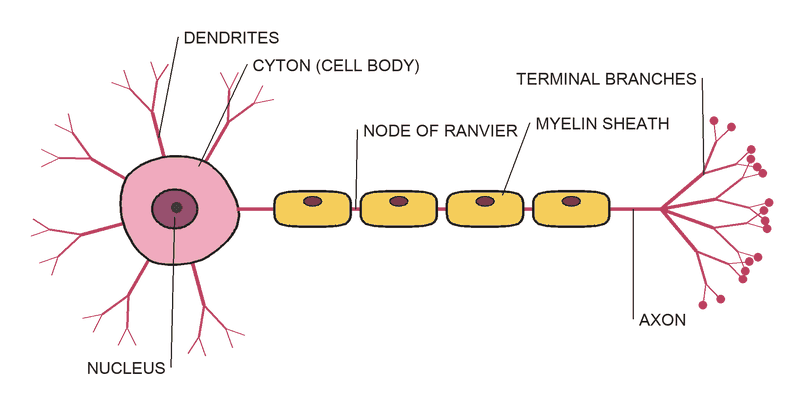
Step 1 — Draw and label the neuron.
The diagram shows the dendrites, cyton (cell body) with its nucleus, the axon wrapped in a myelin sheath with gaps called nodes of Ranvier, and the terminal branches at the end.
Step 2 — Part (a): two main parts.
The two main parts of a neuron are the cyton (cell body) and the axon (its long fibre).
Step 3 — Part (b): unicellular or multicellular.
A neuron is one single cell, so it is a unicellular structure, though it is very long.
Step 4 — Part (c): part with the nucleus.
The nucleus lies in the cyton (cell body).
Step 5 — Part (d): where neurons are found abundantly.
Neurons are packed most densely in the brain and the spinal cord.
Step 6 — Part (e): why neurons matter.
Neurons carry messages (impulses) from the sense organs to the brain and spinal cord, and from them to the muscles and glands. So they let us feel, think, remember and move, and they keep all the body's activities coordinated.
Watch out: The impulse travels from the dendrites through the cyton and along the axon, never the other way.
Therefore, (a) cyton and axon, (b) a single cell (unicellular), (c) the cyton, (d) the brain and spinal cord, (e) neurons carry the messages that let the body sense, think, act and stay coordinated.
