
Opening your dashboard
Class 8 Biology Chapter 7 Nervous System: Competency-Based Questions (CBQ)
40 questions on Chapter 7, each worked through on its own page with the AI tutor. Class 8 Biology, ICSE 2026-27.
40 questions
1–5 marks · Mixed difficulty
- 11 mark
Question 1
Cognitive domain: Analysis
The figure shows the pathway that makes a person pull the hand away from a hot object. Its parts are numbered 1 to 5, and the arrows show the direction of the impulse.
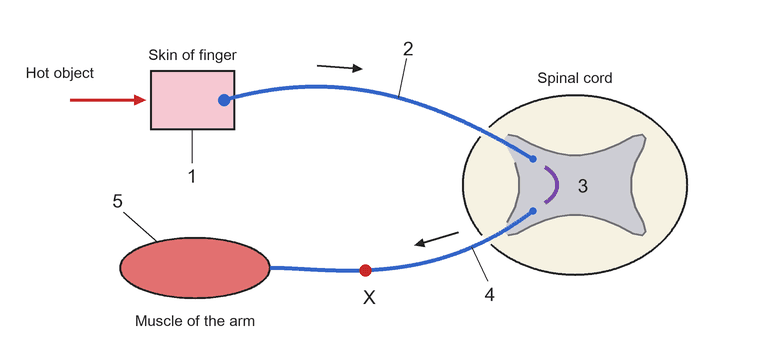
In an injury, part 4 of a man's arm gets cut at the point marked X. Parts 1, 2 and 3 are healthy. By mistake, his finger touches a hot pan. What will happen ?
- 21 mark
Question 2
Cognitive domain: Application
After a road accident, a young woman is brought to a hospital. She is awake. She can recognise her family, answer questions and move her arms and legs steadily. But her breathing and the beating of her heart have become very irregular, and the doctors say her life is in danger. Which part of her central nervous system is most likely injured ?
- 31 mark
Question 3
Cognitive domain: Analysis
A scientist tests three nerves, P, Q and R, to see which way they carry impulses.
Nerve Carries impulses from a sense organ to the brain or spinal cord Carries impulses from the brain or spinal cord to muscles or glands P Yes Yes Q Yes No R No Yes Which of these could be a typical spinal nerve ?
- 41 mark
Question 4
Cognitive domain: Application
Mitali, who is 13, loves raw mango with salt. When she sees a picture of a sliced raw mango in a magazine, her mouth waters. Her one-year-old brother has never tasted raw mango. He looks at the same picture, and his mouth does not water. What is the best explanation ?
- 51 mark
Question 5
Cognitive domain: Understanding
Assertion (A): The extra energy and strength with which a person runs away from an attacking bull is an example of chemical coordination.
Reason (R): Chemical coordination is brought about through chemical messengers called hormones, which are released into the blood.
- 61 mark
Question 6
Cognitive domain: Analysis
Assertion (A): All the twelve pairs of cranial nerves are sensory nerves.
Reason (R): The olfactory, optic and auditory nerves are cranial nerves that are sensory.
- 71 mark
Question 7
Cognitive domain: Application
In Sana's school, the bell for the lunch break rings at 12.30 p.m. every day. Sana has noticed that her mouth starts watering as soon as she hears this bell, even before she opens her lunch box. This did not happen in her first week at the school.
Complete the sentence :
In Sana's response the effector is not a muscle but a ______, and because the response developed through experience it is a ______ reflex.
- 81 mark
Question 8
Cognitive domain: Understanding
Vivek is sitting in the examination hall. He is holding his pen and writing an answer. All this while he is breathing steadily and his heart is beating, though he is not thinking about either of them.
Complete the sentence :
Holding the pen and writing is a ______ muscular activity, while breathing and the beating of the heart are ______ activities ; the nervous system looks after both kinds.
- 91 mark
Question 9
Cognitive domain: Application
A doctor examines a patient's right eye. The patient can see and read clearly with this eye. But he cannot turn the eyeball to the left or to the right, and has to turn his whole head to look sideways.
Complete the sentence :
The optic nerve of this eye, which is a ______ nerve, is working well, but the ______ nerves going to the muscles of the eyeball are not.
- 102 marks
Question 10
Cognitive domain: Evaluation
During a class discussion, Kunal says, "Reflex actions are a weakness of our body. In a reflex the body acts on its own, without the brain being involved. It would be much safer if the brain thought about every action first."
Do you agree with Kunal ? Justify your answer with two points.
- 112 marks
Question 11
Cognitive domain: Understanding
To explain what a nerve is, a teacher holds up a thick electric cable. She cuts it across and shows that it has many thin wires inside, each wire covered with its own plastic coating.
Explain how this cable is like a nerve. What do the wires and the plastic coating stand for, and what would go wrong in a nerve without the part that the coating stands for ?
- 122 marks
Question 12
Cognitive domain: Evaluation
In her first week of computer class, Jaya looked for every key and typed 8 words per minute. After six months of daily practice, she types 40 words per minute without looking at the keyboard. Her cousin says, "Fast typing is a gift you are born with. It is a natural reflex, just like blinking."
Use Jaya's record to judge the cousin's statement.
- 135 marks
Question 13
Cognitive domain: Analysis
Case: A doctor has three patients, K, L and M. Each has an injury to a different part of the central nervous system. Her notes are given below.
Patient What the patient can do What the patient cannot do K Breathes normally ; stands and walks steadily Cannot remember recent events ; cannot think out simple problems L Thinks, remembers and speaks clearly ; moves the arms well Cannot feel a touch on the legs ; cannot move the legs M Thinks and remembers clearly ; feels a touch on the legs Sways while walking ; the hand shakes while lifting a cup (a) Name the part of the central nervous system that is injured in each patient.
(b) Give the reason for your answer for patient K and for patient M.
(c) Explain why patient L can neither feel a touch on the legs nor move them, although the brain is healthy.
(d) By mistake, patient K's hand touches a hot cup of tea, and K pulls the hand away at once. Explain why this action is still normal, although K's cerebrum is injured.
- 145 marks
Question 14
Cognitive domain: Application
Case: Kavya had to give a speech in the school assembly. The science club noted three things about her at three different times.
Time Heart beats per minute Pupils of the eyes Skin of the face Sitting calmly behind the stage 76 Normal size Normal colour Her name is called ; she is very frightened 118 Very wide Pale 15 minutes after her speech 78 Normal size Normal colour (a) By how many beats per minute did her heart beat rise when her name was called ? Name the system of nerves that brought about the three changes seen at that time.
(b) Explain what this system did to make her pupils very wide and her face pale.
(c) Fifteen minutes after the speech, all three readings were almost back to where they started. Explain how this happened. Why are the two systems involved called antagonistic ?
(d) Kavya says, "I made my heart beat faster so that I could speak loudly." Is she right ? Give a reason.
- 155 marks
Question 15
Cognitive domain: Creativity
Case: For the science exhibition, Class 8 wants to act out how a message travels when a person's foot steps on a sharp pebble and is pulled back at once. Five students and one tennis ball are available. The ball stands for the impulse. The audience must be able to see that neurons do not touch each other, and that the message travels only one way.
(a) Give a role to each of the five students, in the order in which the ball will reach them, and say what each one does.
(b) How will your act show that the neurons do not touch each other, and that the impulse moves in one direction only ?
(c) A sixth student now joins as the "brain". Suggest how she can be added to show the difference between this reflex action and a voluntary action, such as kicking a football.
- 161 mark
Question 16
Cognitive domain: Analysis
The figure shows a motor neuron and the muscle it supplies. Three parts of the neuron are marked P, Q and R, and the muscle is marked S. In an accident, the axon of this neuron is cut at the place marked X. The cell body and the dendrites are not harmed. After the accident, a message arrives at P from another neuron. (Hypothetical case.)
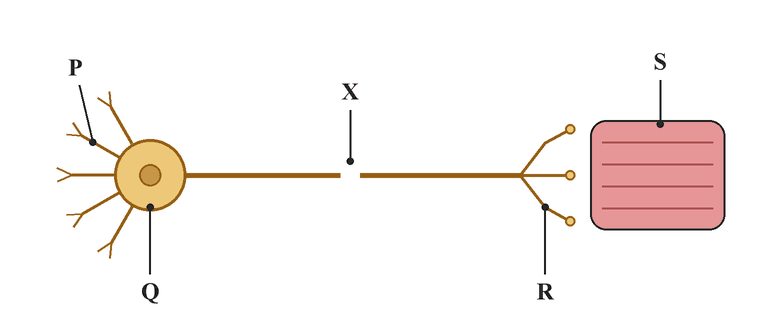
What is the most likely result ?
- 171 mark
Question 17
Cognitive domain: Application
Rohit is hungry. He sees a plate of hot idlis on the table, picks one up with his fingers and puts it into his mouth. The first stimulus he receives is the sight of the food.
Which row correctly names the receptor for this stimulus, the part that records the information and gives the orders, and the effectors that carry out the action ?
- 181 mark
Question 18
Cognitive domain: Analysis
A student cuts a thin slice from a cerebral hemisphere, a thin slice from the spinal cord and a thin slice from a nerve of an adult person. She sketches the three slices as S1, S2 and S3, in a random order. In the sketches, the dark parts are crowded with cell bodies and the pale parts are made of axons.
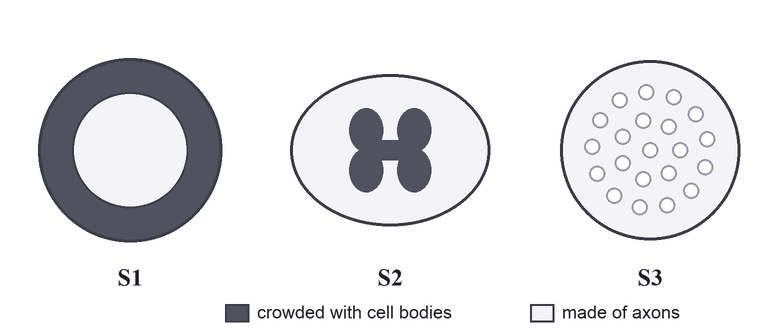
Which row matches the sketches correctly ?
- 191 mark
Question 19
Cognitive domain: Analysis
An engineering club builds a toy robot (hypothetical). It has three control units :
- P stores information, plans each action and decides what the robot will do.
- Q receives the decided action and keeps the robot balanced and its movements smooth while it carries the action out.
- R runs the battery, the cooling fan and the water pump automatically, without any plan from P.
The club compares P, Q and R with three parts of the human brain. Which row is correct ?
- 201 mark
Question 20
Cognitive domain: Analysis
Assertion (A): A nerve impulse passes from the axon terminal of one neuron to the dendrite of the next neuron, but never in the reverse direction.
Reason (R): Neurons do not actually touch each other; there is a small gap between the axon terminal of one neuron and the dendrite of the next.
- 211 mark
Question 21
Cognitive domain: Application
While reading, Mehul feels a mosquito biting the skin of his right foot. He looks down and then knowingly slaps the mosquito with his right hand.
Which statement best describes the part played by the spinal cord in this action ?
- 221 mark
Question 22
Cognitive domain: Understanding
Assertion (A): Swallowing food and the peristalsis of the alimentary canal are natural (inborn) reflexes.
Reason (R): Natural reflexes develop in a person only after repeated experience or learning.
- 231 mark
Question 23
Cognitive domain: Application
Asha is knitting a sweater and listening to the radio. At the same time her heart is beating and the food of her lunch is moving along her alimentary canal.
Which row correctly names the part of the peripheral nervous system that mainly looks after each of these activities ?
- 241 mark
Question 24
Cognitive domain: Application
On the school sports day, Kabir writes down four things that happen near the running track. Three of them are stimuli for the runners.
Which one is not a stimulus ?
- 251 mark
Question 25
Cognitive domain: Analysis
Raju falls from his bicycle and hits his head hard. A week later he can see and hear normally, and he can move his eyes, his face and his tongue. But he cannot smell the jasmine flowers in the garden or the onions being fried in the kitchen. His doctor finds that his nose is clear and that one cranial nerve has been damaged. (Hypothetical case.)
Which nerve is most likely damaged, and what kind of nerve is it ?
- 262 marks
Question 26
Cognitive domain: Evaluation
Anil said, "Reflexes are the body's alarm system, so every reflex protects us from danger."
His teacher listed four reflexes : blinking when a mosquito flies close to the eye, sneezing when pepper enters the nose, swallowing food, and peristalsis of the alimentary canal.
Use the list to judge Anil's statement.
- 272 marks
Question 27
Cognitive domain: Understanding
A motorcyclist wears a helmet, because a fall can injure the head. Even without a helmet, however, the brain and the spinal cord of a person already have some protection inside the body.
(a) Name the part of the body that protects the brain and the part that protects the spinal cord.
(b) Why is it especially important to protect the lowest part of the brain, the medulla oblongata ?
- 282 marks
Question 28
Cognitive domain: Analysis
Neelam wrote these notes for her test :
- Stimulus : any change in the environment that usually results in a change in the activity of the body.
- Response : a wave of electrical disturbance that runs through the nerves.
- Impulse : the activity of the body due to the stimulus.
- Receptor : the sense organs which receive the stimulus.
- Effector : any muscle or gland where the response occurs.
Two of her five definitions are wrong. Find the two and correct them. What kind of mistake has she made ?
- 292 marks
Question 29
Cognitive domain: Application
For a science exhibition, Vikram builds a model of a part of the nervous system on a toy skeleton. A string of beads is fixed along each side of the backbone. Thin threads from the beads go to a toy heart, a toy stomach and a toy pair of lungs. (Hypothetical model.)
(a) Which system of the human body does this model show ? What do the strings and the beads stand for ?
(b) This system works through two sub-systems. Name them and say what they are to each other.
- 302 marks
Question 30
Cognitive domain: Analysis
A student crumples a flat sheet of cloth and fits it into a small box. She says, "This is how the outer part of the cerebrum fits inside the skull."
(a) What does the cloth stand for in this model ?
(b) Explain her statement.
- 312 marks
Question 31
Cognitive domain: Application
During a health check-up, a doctor gently taps Meera's leg just below the knee cap with a small rubber hammer. Her lower leg kicks forward at once, before she can decide anything. Meera says, "I noticed the tap only just after my leg had already moved."
(a) Which part of the central nervous system controls this kick ? Why is the kick so quick ?
(b) Explain how Meera is still able to notice the tap.
- 323 marks
Question 32
Cognitive domain: Analysis
A scientist tests a drug on neurons in a laboratory. The drug stops the axon terminals of a neuron from secreting the neurotransmitter. It does not harm the way in which an impulse travels along an axon. (Hypothetical drug.)
Neuron P ends near neuron Q at a synapse. The axon of neuron Q ends at a muscle. A message starts in neuron P.
(a) Will the impulse travel along the axon of P to its terminal branches ? Give a reason.
(b) What will happen at the synapse between P and Q ?
(c) Will the muscle at the end of Q contract ? Explain.
- 333 marks
Question 33
Cognitive domain: Application
The cell body of a motor neuron lies in the spinal cord, in the lower back of a man who is 1.6 m tall. Its axon runs down the leg to a muscle that moves the big toe, a distance of about 0.9 m. An impulse travels along this axon at about 90 metres per second. (Hypothetical data.)
(a) Which part of the neuron is about 0.9 m long ? Is such a length possible in a single cell ? Use your chapter.
(b) How long does the impulse take to travel along this axon ? Use time = distance ÷ speed, and give the answer in seconds.
(c) In which portion of the spinal cord, the grey matter or the white matter, does the cell body of this neuron lie ? Give a reason.
- 343 marks
Question 34
Cognitive domain: Analysis
A teacher shows the pathway of a reflex action on cards, but one card is missing :
Stimulus, then Receptor in the skin, then Sensory neuron, then ( ? ), then Motor neuron, then Effector muscle, then Response.
(a) Name the missing part. Which of the three kinds of neurons in your chapter is it ?
(b) What is its job in the pathway ?
(c) The sensory neuron and the motor neuron of a person are healthy, but this part is damaged. Predict whether the muscle contracts in a reflex action, and give a reason.
- 353 marks
Question 35
Cognitive domain: Evaluation
Mohan said, "The nervous system is only needed for thinking and studying. A person whose nervous system stopped working could still stay alive, though he would not score marks."
Evaluate Mohan's statement. Use three different functions of the nervous system from your chapter.
- 363 marks
Question 36
Cognitive domain: Evaluation
A science club has a special shield for one part of a model brain. Three members argue about which part to shield.
- Ayaan : "The cerebrum, because it makes me intelligent."
- Zoya : "The cerebellum, because it keeps my balance."
- Reena : "The medulla oblongata, because it controls the heart and breathing."
Write one important function of each of the three parts. Then judge who gives the best reason if the shield must protect the part that is most important for life, and explain why.
- 375 marks
Question 37
Cognitive domain: Analysis
Case: In a school laboratory, a sensor measured how long volunteers took to respond in three different tests. The table gives the average time for the volunteers. (Hypothetical data.)
Test Stimulus Response Average time 1 A gentle puff of air on the open eye The eyelid closes 0.05 s 2 A green light flashes on the table The volunteer presses a buzzer 0.25 s 3 The question "What is 7 times 8 ?" is spoken The volunteer speaks the answer 1.5 s (a) Which test shows a reflex action ? Give two reasons for your answer.
(b) How many times as long as test 1 does test 2 take ? Explain why it takes longer, using the parts of the nervous system through which the message passes in each test.
(c) How many times as long as test 2 does test 3 take ? Give one reason, using a function of the cerebrum.
- 384 marks
Question 38
Cognitive domain: Application
Case: Sana runs the third leg of a m relay race. Her team-mate Divya runs towards her with the baton. When Divya is close, she shouts "Hand !", and Sana, who is already running, stretches her right hand back, and Divya puts the baton in it. Sana has practised this exchange many hundreds of times. Now she does not need to look back or think about it. A beginner in the same team has to turn round, look and think, and often drops the baton.
(a) Name the stimulus, the receptor and the effectors in Sana's action of stretching her hand back.
(b) Which part of Sana's brain decided to start running, and which part keeps her balanced and her movements smooth while she runs ?
(c) Is Sana's practised exchange a natural reflex or a conditioned reflex ? Give a reason, using the beginner for comparison.
- 394 marks
Question 39
Cognitive domain: Creativity
Task: Your school wants a poster named "A day in the life of the nervous system" for the notice board of Class 8. You are asked to design it in three strips.
(a) Strip 1 shows what happens when Priya reads a quiz notice on the board and walks towards it. Write the strip as a set of numbered boxes of at least six steps, naming the receptor, the nerves, the parts of the brain and the effectors.
(b) Strip 2 shows that, while she pins up the notice, a drawing pin pricks her finger and she pulls the hand back at once. Show how the boxes differ from strip 1.
(c) Strip 3 shows two activities that go on in the background the whole time. Name them and the part of the brain that controls them.
- 404 marks
Question 40
Cognitive domain: Analysis
Case: In a clinic, an eye doctor checks the pupils of three patients in a dim room. She then shines a small torch on one eye for a few seconds and notes the diameter of the pupil. The doctor finds that each patient has damage at one place only. Patient C's eye cannot detect light at all. (Hypothetical data.)
Patient Pupil in the dim room Pupil with torch light Can the patient read a printed card with that eye ? A 6 mm 3 mm Yes B 6 mm 6 mm Yes C 6 mm 6 mm No (a) By how many millimetres did the pupil of patient A narrow ? Name the stimulus and the effector in this response.
(b) For patients B and C, say whether the damage is more likely on the sensory side (receptor and sensory nerve) or on the motor side. Give a reason for each.
(c) A student says, "The pupil narrows because the patient decides to narrow it." Evaluate the statement, naming the part of the nervous system that does this work.