
Opening your dashboard
Class 8 Biology Chapter 6: The Circulatory System Solutions
22 textbook questions with step-by-step answers, free to read, for ICSE 2026-27.
Get talked through Ch 6, not just shown the answer
Reading a finished solution is not the same as being able to do it. The AI tutor takes one question at a time and works it with you, in your own words, until you can.
- Ask it out loud, in your own words
- It gives you the next step, not the answer
- Stuck on part (ii)? Start there
22 questions with solutions
1–12 marks · Mixed difficulty
- 11 mark
Question 1
The vein which brings oxygenated blood to the heart from the lungs :
Solve with AIAnswer
(A) Renal vein
(B) Superior vena cava
- Correct
(C) Pulmonary vein
(D) Coronary vein
Answer: (C) Pulmonary vein
Concept: Veins carry blood towards the heart. Most veins carry deoxygenated blood; the pulmonary veins are the one exception, because they bring blood that has just picked up oxygen in the lungs.
Step 1 — Find where oxygen is picked up.
Blood takes in oxygen in the lungs, so the vein we want must come from the lungs.
Step 2 — Name the vein from the lungs.
The veins that carry this oxygen-rich blood from the lungs to the left atrium of the heart are the pulmonary veins, which is option (C).
Watch out: Do not choose a vein just because it is large; the superior vena cava is large, but it carries deoxygenated blood.
Why the other options are wrong:
- (A) Renal vein: This is wrong because the renal vein brings deoxygenated blood from the kidney, not from the lungs.
- (B) Superior vena cava: This is wrong because the superior vena cava brings deoxygenated blood from the head, neck and arms to the right atrium.
- (D) Coronary vein: This is wrong because the coronary veins drain deoxygenated blood from the wall of the heart itself into the right atrium.
Therefore, the vein that brings oxygenated blood from the lungs to the heart is the pulmonary vein, option (C).
- 21 mark
Question 2
The path which the blood flows through during pulmonary circulation is :
Solve with AIAnswer
- Correct
(A) RA RV Pulmonary arteries Lungs Pulmonary veins LA
(B) LA LV Pulmonary veins Lungs Pulmonary arteries RA
(C) LA LV Aorta Body Vena Cavae RA
(D) RA RV Vena Cavae Body Aorta LA
Answer: (A) RA RV Pulmonary arteries Lungs Pulmonary veins LA
Concept: Pulmonary circulation is the short circuit between the heart and the lungs: deoxygenated blood goes from the right side of the heart to the lungs, and oxygenated blood comes back to the left side.
Step 1 — Start in the right side of the heart.
Deoxygenated blood from the body enters the right atrium (RA) and passes down into the right ventricle (RV).
Step 2 — Follow the blood to the lungs.
The right ventricle pumps it into the pulmonary arteries, which take it to the lungs, where it gives out carbon dioxide and picks up oxygen.
Step 3 — Follow the blood back.
The pulmonary veins bring the oxygenated blood back to the left atrium (LA). This order, RA → RV → pulmonary arteries → lungs → pulmonary veins → LA, is option (A).
Watch out: The pulmonary circuit starts in the RIGHT ventricle and ends in the LEFT atrium; the systemic circuit is the reverse, from the left ventricle to the right atrium.
Why the other options are wrong:
- (B): This is wrong because the left ventricle pumps blood into the aorta, not into the pulmonary veins; the vessels are also in the reverse order.
- (C): This is wrong because this is the systemic circulation (heart to body and back), which ends in the right atrium, not the left atrium.
- (D): This is wrong because the venae cavae bring blood to the heart and the aorta takes it away, so this order is impossible.
Therefore, the path of pulmonary circulation is RA → RV → pulmonary arteries → lungs → pulmonary veins → LA, option (A).
- 31 mark
Question 3
Karl Landsteiner classified human blood into four categories on the basis of proteins (antigens) found on the surface of the RBCs. Compatibility of blood groups must be checked during blood transfusion. Which of the following statements are incorrect ?
P. Blood group 'AB' is the universal donor as it does not contain any antibodies.
Q. Blood group 'AB' is the universal recipient as it contains both the antigens 'A' and 'B'.
R. Blood group 'O' is the universal recipient as it does not contain any antigens.
Solve with AIAnswer
(A) Only R
- Correct
(B) Only P and R
(C) Only P and Q
(D) Only Q and R
Answer: (B) Only P and R
Concept: In blood transfusion, the donor's red blood cells must not carry an antigen (A or B) that the receiver's plasma reacts against. Group O has neither antigen, so it can be given to every group (universal donor). Group AB has both antigens and no anti-A or anti-B antibodies, so it can receive every group (universal recipient).
Step 1 — Check statement P.
P calls AB the universal donor. AB is in fact the universal recipient; AB blood can be given only to an AB person. So P is incorrect.
Step 2 — Check statement Q.
Q calls AB the universal recipient because its RBCs carry both antigens A and B. This is right: having both antigens, an AB person makes neither anti-A nor anti-B antibodies, so blood of any group can be received. So Q is correct.
Step 3 — Check statement R.
R calls O the universal recipient. O is in fact the universal donor; an O person can receive only O blood. So R is incorrect.
Step 4 — Pick the option.
The incorrect statements are P and R only, which is option (B).
Watch out: The question asks for the INCORRECT statements; do not pick the correct one (Q).
Why the other options are wrong:
- (A) Only R: This is wrong because P is also incorrect, so 'only R' leaves P out.
- (C) Only P and Q: This is wrong because Q is a correct statement and R, which is incorrect, is left out.
- (D) Only Q and R: This is wrong because Q is a correct statement and P, which is incorrect, is left out.
Therefore, the incorrect statements are P and R only, option (B).
- 41 mark
Question 4
Geetika's mother has certain ailments of the heart. She is often very stressed and has anxiety. Sometimes, she experiences her heart beating too hard or too fast and occasionally even skipping a beat. Which of the following heart-related conditions explains her problem ?
Solve with AIAnswer
(A) Hypertension
(B) Heart attack
- Correct
(C) Palpitations
(D) Cardiac arrest
Answer: (C) Palpitations
Concept: Palpitations are the feeling that the heart is beating too hard, too fast or unevenly (for example, skipping a beat). They are most often brought on by stress or anxiety, and also by caffeine or hard exercise.
Step 1 — Pick out the symptoms.
Geetika's mother feels her heart beating too hard or too fast and sometimes skipping a beat, and she is often stressed and anxious.
Step 2 — Match them with a condition.
These are exactly the signs of palpitations, and stress and anxiety are their commonest cause. So the answer is option (C).
Watch out: Palpitations are usually harmless, but if they come with chest pain, breathlessness or fainting a doctor must be seen at once.
Why the other options are wrong:
- (A) Hypertension: This is wrong because hypertension is high blood pressure, blood pushing on the artery walls with more force than normal; it usually causes no feeling of a racing or skipping heart.
- (B) Heart attack: This is wrong because a heart attack is a sudden block in the blood supply to part of the heart muscle, felt as crushing chest pain, not as an occasional skipped beat.
- (D) Cardiac arrest: This is wrong because in cardiac arrest the heart suddenly stops pumping and the person collapses unconscious within seconds.
Therefore, her problem is palpitations, option (C).
- 51 mark
Question 5
Assertion (A): Veins carry blood away from the heart to different organs of the body.
Reason (R): Veins carry oxygenated blood from most organs of the body except lungs.
Solve with AIAnswer
(A) (1) Both A and R are true and R is the correct explanation of A.
(B) (2) Both A and R are true but R is not the correct explanation of A.
(C) (3) A is true but R is false.
- Correct
(D) (4) A is false but R is true.
Answer: (D) (4) A is false but R is true.
Concept: An Assertion–Reason item is judged in three checks: is A true, is R true, and, if both are true, does R give the reason for A?
Step 1 — Judge the Assertion.
Arteries carry blood away from the heart; veins carry blood towards the heart. A says veins carry blood away from the heart, so A is false.
Step 2 — Judge the Reason.
Veins from all organs except the lungs carry deoxygenated blood; only the pulmonary veins (from the lungs) carry oxygenated blood. As printed, R says 'oxygenated', so as worded R is false. Read with 'deoxygenated', which is clearly what is meant, R is true.
Step 3 — Pick the code.
There is no code for 'both false', so the printed key reads R as intended: A is false and R is true, which is option (D).
Watch out: An artery is named by the direction of flow (away from the heart), not by whether its blood is oxygenated.
Note: As printed, R says veins carry 'oxygenated' blood from most organs; that is true only when read as 'deoxygenated', the reading the printed key uses.
Why the other options are wrong:
- (A): This is wrong because A is false, so it cannot be explained by R.
- (B): This is wrong because A is false, so 'both A and R are true' does not hold.
- (C): This is wrong because it calls A true; veins carry blood towards the heart, so A is false.
Therefore, A is false but R (read as 'deoxygenated') is true, option (D).
- 61 mark
Question 6
Assertion (A): None of the arteries carry deoxygenated blood in the human body.
Reason (R): Pulmonary artery carries deoxygenated blood from the right ventricle of the heart to the lungs.
Solve with AIAnswer
(A) (1) Both A and R are true and R is the correct explanation of A.
(B) (2) Both A and R are true but R is not the correct explanation of A.
(C) (3) A is true but R is false.
- Correct
(D) (4) A is false but R is true.
Answer: (D) (4) A is false but R is true.
Concept: An Assertion–Reason item is judged in three checks: is A true, is R true, and, if both are true, does R give the reason for A?
Step 1 — Judge the Assertion.
Most arteries carry oxygenated blood, but the pulmonary artery is an artery that carries deoxygenated blood. So A, which says no artery carries deoxygenated blood, is false.
Step 2 — Judge the Reason.
The pulmonary artery does carry deoxygenated blood from the right ventricle to the lungs, where the blood picks up oxygen. So R is true.
Step 3 — Pick the code.
A is false and R is true; R is in fact the very exception that makes A false. This is option (D).
Watch out: The word 'artery' does not mean 'oxygenated'; it means 'carries blood away from the heart'.
Why the other options are wrong:
- (A): This is wrong because A is false, so R cannot be its correct explanation.
- (B): This is wrong because A is false, so 'both A and R are true' does not hold.
- (C): This is wrong because it calls A true and R false, the reverse of the truth.
Therefore, A is false but R is true, option (D).
- 71 mark
Question 7
Assertion (A): The walls of the atria are thinner as compared to those of the ventricles.
Reason (R): The atria are the 'receiving chambers' and need to pump blood a short distance i.e. into the ventricles, while ventricles are the 'distributing chambers' and they must pump blood with much greater force to the lungs and the rest of the body.
Solve with AIAnswer
- Correct
(A) (1) Both A and R are true and R is the correct explanation of A.
(B) (2) Both A and R are true but R is not the correct explanation of A.
(C) (3) A is true but R is false.
(D) (4) A is false but R is true.
Answer: (A) (1) Both A and R are true and R is the correct explanation of A.
Concept: An Assertion–Reason item is judged in three checks: is A true, is R true, and, if both are true, does R give the reason for A?
Step 1 — Judge the Assertion.
The atria have thin walls, while the ventricles have thick, muscular walls (the left ventricle thickest of all). So A is true.
Step 2 — Judge the Reason.
The atria receive blood and only push it a short way down into the ventricles. The ventricles must pump blood out to the lungs (right ventricle) and to the whole body (left ventricle), which needs much more force. So R is true.
Step 3 — Does R explain A?
A wall that must pump with more force needs more muscle, so R tells us exactly why the atrial walls are thinner. R is the correct explanation of A, option (A).
Watch out: The same idea explains why the left ventricle's wall is thicker than the right ventricle's: it pumps blood to the whole body, not just to the nearby lungs.
Why the other options are wrong:
- (B): This is wrong because R does explain A: less pumping force needs a thinner, less muscular wall.
- (C): This is wrong because R is true: the ventricles do pump with much greater force than the atria.
- (D): This is wrong because A is true: the atrial walls are thinner than the ventricular walls.
Therefore, both A and R are true and R is the correct explanation of A, option (A).
- 81 mark
Question 8
Assertion (A): Capillaries are the finest blood vessels in the body, interconnecting arteries and veins.
Reason (R): The interconnection between arteries and veins is very significant because the exchange of water, nutrients, waste materials and respiratory gases occurs from arteries to veins and vice-versa through the capillaries only.
Solve with AIAnswer
(A) (1) Both A and R are true and R is the correct explanation of A.
- Correct
(B) (2) Both A and R are true but R is not the correct explanation of A.
(C) (3) A is true but R is false.
(D) (4) A is false but R is true.
Answer: (B) (2) Both A and R are true but R is not the correct explanation of A.
Concept: An Assertion–Reason item is judged in three checks: is A true, is R true, and, if both are true, does R give the reason for A?
Step 1 — Judge the Assertion.
Capillaries are the finest blood vessels, with walls only one cell thick, and they join the smallest arteries (arterioles) to the smallest veins (venules). So A is true.
Step 2 — Judge the Reason.
Water, nutrients, wastes and gases pass between the blood and the body cells only through the thin walls of the capillaries, as blood flows from the arteries into the veins. So R is true.
Step 3 — Does R explain A?
R explains why the capillaries are important (they are where exchange happens). It does not explain what A states, that they are the finest vessels and that they link arteries with veins. So R is not the correct explanation of A, which is option (B), the printed key.
Watch out: Exchange takes place between the blood and the tissue cells; arteries and veins themselves have walls too thick for it.
Why the other options are wrong:
- (A): This is wrong because R gives the importance of the capillaries, not the reason for the facts stated in A.
- (C): This is wrong because R is true: all exchange between blood and tissues happens through capillary walls.
- (D): This is wrong because A is true: capillaries are the finest vessels and they join arteries to veins.
Therefore, both A and R are true but R is not the correct explanation of A, option (B).
- 95 marks
Question 9
Match the items in Column A with those in Column B.
Column A Column B (a) Sino atrial node. (i) Deoxygenated blood (b) Pulmonary veins (ii) Between right atrium and ventricle (c) Pulmonary artery (iii) Pacemaker (d) Tricuspid valve (iv) Between left atrium and ventricle (e) Biscuspid valve (v) Oxygenated blood Solve with AIWritten solution
Solution:
Concept: Each part of the heart has one job: the SA node starts each heartbeat, the pulmonary vessels link the heart with the lungs, and the valves between the atria and ventricles let blood flow only one way.
Step 1 — Match (a) Sino atrial node.
The SA node sends out the electrical impulse that starts every heartbeat, so it is the heart's natural (iii) pacemaker.
Step 2 — Match (b) Pulmonary veins.
The pulmonary veins bring blood from the lungs, where it has just taken in oxygen, so they carry (v) oxygenated blood.
Step 3 — Match (c) Pulmonary artery.
The pulmonary artery takes blood from the right ventricle to the lungs to be oxygenated, so it carries (i) deoxygenated blood.
Step 4 — Match (d) Tricuspid valve.
The tricuspid valve has three flaps and lies on the right side, (ii) between the right atrium and ventricle.
Step 5 — Match (e) Bicuspid valve.
The bicuspid (mitral) valve has two flaps and lies on the left side, (iv) between the left atrium and ventricle.
Step 6 — Write the matched table.
Putting the matches together gives:
Column A Column B (a) Sino atrial node (iii) Pacemaker (b) Pulmonary veins (v) Oxygenated blood (c) Pulmonary artery (i) Deoxygenated blood (d) Tricuspid valve (ii) Between right atrium and ventricle (e) Bicuspid valve (iv) Between left atrium and ventricle Watch out: Remember 'tri' on the right: the TRIcuspid valve is on the RIGHT side; the bicuspid is on the left.
Therefore, (a)–(iii), (b)–(v), (c)–(i), (d)–(ii), (e)–(iv).
- 103 marks
Question 10
Name :
(a) The membranous structure which divides the heart into a right and a left portion.
(b) The structure responsible for starting electrical impulses that cause the heart to contract and relax in order to keep pumping blood.
(c) The scientist who identified different types of blood groups.
Solve with AIWritten solution
Solution:
Concept: The heart is divided lengthwise into a right half and a left half, and its beat is started by a special patch of tissue in the right atrium. Human blood groups were discovered at the start of the 20th century.
Step 1 — Part (a): the dividing wall.
The wall that separates the right side of the heart from the left side is the septum. It keeps deoxygenated blood (right side) from mixing with oxygenated blood (left side).
Step 2 — Part (b): the starter of the beat.
The sinoatrial node (SA node), a small patch of special muscle in the wall of the right atrium, sends out the electrical impulses that make the heart contract and relax. It is the heart's natural pacemaker.
Step 3 — Part (c): the scientist.
The Austrian scientist Karl Landsteiner discovered the blood groups A, B and O in 1900–1901 (group AB was found by his co-workers in 1902), for which he later received the Nobel Prize.
Watch out: The SA node is not a nerve from the brain; the heart starts its own beat.
Therefore, (a) septum, (b) sinoatrial (SA) node, (c) Karl Landsteiner.
- 116 marks
Question 11
Name the following :
(a) Three components of circulatory system
(b) Four blood groups on the basis of antigens
(c) Two phases of double circulation
(d) Three principal fluids of human body
(e) Three kinds of blood vessels
(f) Two types of blood circulation in the human body.
Solve with AIWritten solution
Solution:
Concept: The circulatory system carries materials round the body. It is made of a pump, a fluid and tubes, and in humans the blood passes through the heart twice in each round (double circulation).
Step 1 — Part (a): components of the circulatory system.
The three components are the heart (the pump), blood (the fluid) and the blood vessels (the tubes).
Step 2 — Part (b): blood groups by antigens.
By the antigens on the red blood cells, the four groups are A, B, AB and O.
Step 3 — Part (c): phases of double circulation.
The two phases are pulmonary circulation (heart → lungs → heart) and systemic circulation (heart → body → heart).
Step 4 — Part (d): principal body fluids.
The three principal fluids are blood, tissue fluid (which bathes the cells) and lymph.
Step 5 — Part (e): kinds of blood vessels.
The three kinds are arteries, veins and capillaries.
Step 6 — Part (f): types of blood circulation.
The two types of circulation in the human body are the same two circuits: pulmonary circulation (right ventricle to the lungs and back to the left atrium) and systemic circulation (left ventricle to all parts of the body and back to the right atrium).
Watch out: In (b), O is a blood group with neither antigen A nor antigen B; it is not 'zero'.
Therefore, (a) heart, blood, blood vessels; (b) A, B, AB, O; (c) pulmonary and systemic circulation; (d) blood, tissue fluid, lymph; (e) arteries, veins, capillaries; (f) pulmonary and systemic circulation.
- 128 marks
Question 12
Define the following terms :
(a) Circulatory system
(b) Blood
(c) Lymph
(d) Artificial pacemaker
Solve with AIWritten solution
Solution:
Concept: A definition says clearly what a thing is and what it does, in one or two sentences.
Step 1 — Part (a): circulatory system.
The circulatory system is the system made up of the heart, blood and blood vessels that circulates blood through the body, carrying oxygen, food materials, hormones, carbon dioxide and other wastes to and from all the cells.
Step 2 — Part (b): blood.
Blood is a red, fluid connective tissue, made of plasma with red cells, white cells and platelets, that flows in the heart and blood vessels and transports oxygen, nutrients, hormones and wastes throughout the body.
Step 3 — Part (c): lymph.
Lymph is the part of the tissue fluid that drains into the lymph vessels. It is a pale yellow fluid like plasma, with many lymphocytes (white cells) but no red cells and no platelets.
Step 4 — Part (d): artificial pacemaker.
An artificial pacemaker is a small battery-powered electronic device, placed under the skin of the chest with wires to the heart, that sends regular electrical impulses to keep the heart beating in rhythm when the person's own SA node or conduction system does not work properly.
Watch out: An artificial pacemaker is electronic, not mechanical; it does not pump blood, it only gives the beat its timing.
Therefore, (a) the circulatory system is the heart, blood and blood vessels that circulate blood through the body; (b) blood is the red fluid connective tissue that transports materials; (c) lymph is tissue fluid inside lymph vessels, with lymphocytes but no red cells or platelets; (d) an artificial pacemaker is an implanted electronic device that keeps the heartbeat regular.
- 131 mark
Question 13
In which organ of our body does blood get oxygenated ?
Solve with AIWritten solution
Solution:
Concept: Blood takes in oxygen where it comes very close to fresh air, across very thin walls.
Step 1 — Find where air and blood meet.
Air we breathe in reaches tiny air sacs (alveoli) in the lungs, which are wrapped in a dense net of blood capillaries.
Step 2 — Say what happens there.
Oxygen passes from the air in the alveoli into the blood, and carbon dioxide passes out, so the blood becomes oxygenated in the lungs.
Therefore, blood gets oxygenated in the lungs.
- 141 mark
Question 14
Which side of the heart (left or right) contains oxygenated blood ?
Solve with AIWritten solution
Solution:
Concept: The two sides of the heart are kept apart by the septum: the right side handles blood coming from the body, the left side handles blood coming from the lungs.
Step 1 — Trace the blood from the lungs.
Oxygenated blood from the lungs enters the left atrium through the pulmonary veins and then passes into the left ventricle.
Step 2 — Conclude.
So the left atrium and left ventricle, the left side of the heart, contain oxygenated blood, while the right side contains deoxygenated blood.
Watch out: The word 'left' means the person's own left side, which appears on the RIGHT of a diagram of the heart seen from the front.
Therefore, the left side of the heart contains oxygenated blood.
- 156 marks
Question 15
Write important role(s) of each :
(a) Pericardial fluid
(b) Aorta
(c) Vena cavae
Solve with AIWritten solution
Solution:
Concept: The pericardium is the double membrane round the heart. The aorta is the main artery leaving the heart, and the venae cavae are the main veins entering it.
Step 1 — Part (a): pericardial fluid.
Pericardial fluid fills the narrow space between the two layers of the pericardium. It lets the beating heart slide without friction and protects it from shocks and jerks.
Step 2 — Part (b): aorta.
The aorta is the largest artery. It leaves the left ventricle and, through its branches, carries oxygenated blood to all parts of the body.
Step 3 — Part (c): venae cavae.
The two venae cavae bring deoxygenated blood from the body to the right atrium: the superior vena cava from the head, neck and arms, and the inferior vena cava from the trunk and legs.
Watch out: The aorta leaves the LEFT ventricle; the pulmonary artery leaves the right ventricle.
Therefore, (a) pericardial fluid cushions the heart and reduces friction, (b) the aorta carries oxygenated blood from the left ventricle to the whole body, (c) the venae cavae return deoxygenated blood from the body to the right atrium.
- 162 marks
Question 16
Give the functions of lymph.
Solve with AIWritten solution
Solution:
Concept: Lymph is tissue fluid that has drained into the lymph vessels. It flows slowly back into the blood, and on the way it passes through lymph nodes, which are full of white cells.
Step 1 — Nourishing the cells.
Together with tissue fluid, lymph bathes the body cells and supplies them with food materials and oxygen, including cells with few or no capillaries close by.
Step 2 — Draining.
It drains away the extra tissue fluid, with the wastes and proteins in it, and returns it to the blood, so fluid does not collect in the tissues.
Step 3 — Absorbing fat.
In the small intestine, digested fats are absorbed into lymph vessels (lacteals) and carried to the blood.
Step 4 — Defending the body.
Its lymphocytes make antibodies and destroy germs, and the lymph nodes filter out bacteria, which stops an infection from spreading.
Therefore, lymph nourishes the cells, drains extra tissue fluid back to the blood, absorbs fats from the intestine and defends the body against germs.
- 1710 marks
Question 17
Differentiate between the following pairs on the basis of what is indicated within the brackets:
(a) Pulmonary artery and pulmonary vein (kind of blood)
(b) Artery and vein (direction of blood flow)
(c) Closed and open vascular system (definition)
(d) Bicuspid and tricuspid valve (location)
(e) Blood and lymph (composition)
Solve with AIWritten solution
Solution:
Concept: To differentiate, give the point asked for in brackets for each member of the pair, side by side.
Step 1 — Part (a): kind of blood.
The pulmonary artery and vein are the two exceptions to the usual rule for arteries and veins.
Pulmonary artery Pulmonary vein Carries deoxygenated blood (right ventricle to the lungs). Carries oxygenated blood (lungs to the left atrium). Step 2 — Part (b): direction of blood flow.
Arteries and veins are named by which way blood flows in them.
Artery Vein Carries blood away from the heart to the organs. Carries blood towards the heart from the organs. Step 3 — Part (c): definition.
The two systems differ in whether blood always stays inside vessels.
Closed vascular system Open vascular system Blood flows all the time inside blood vessels and reaches the cells only through capillary walls, e.g. humans and other vertebrates. The heart pumps blood into vessels that open into body spaces (sinuses), where blood bathes the organs directly, e.g. insects such as the cockroach. Step 4 — Part (d): location.
Both valves lie between an atrium and a ventricle, on opposite sides.
Bicuspid valve Tricuspid valve Between the left atrium and left ventricle (two flaps). Between the right atrium and right ventricle (three flaps). Step 5 — Part (e): composition.
Lymph is formed from blood plasma, so it lacks some of blood's parts.
Blood Lymph Plasma (rich in proteins) with red blood cells, white blood cells and platelets; red in colour. Plasma-like fluid with fewer proteins, no red cells and no platelets, and many white cells (mostly lymphocytes); pale yellow. Watch out: In (c), the open system still has a heart and some vessels; what makes it 'open' is that blood leaves the vessels and flows through body spaces.
Therefore, the five pairs differ as shown in the tables above.
- 1812 marks
Question 18
Name any four heart-related conditions that occur commonly in humans. Briefly explain the cause and symptoms of each of them.
Solve with AIWritten solution
Solution:
Concept: Four common heart-related conditions are palpitations, hypertension, heart attack and cardiac arrest. For each, the cause says why it happens and the symptoms say what the person feels or shows.
Step 1 — Palpitations.
Cause: most often stress, anxiety or fear; also caffeine (tea, coffee), nicotine or hard exercise, and rarely an abnormal heart rhythm.
Symptoms: the heart feels as if it is beating too hard or too fast, fluttering or skipping a beat. They are usually harmless, but need a doctor if they come with chest pain, breathlessness, dizziness or fainting.
Step 2 — Hypertension (high blood pressure).
Cause: blood presses on the artery walls with more force than normal, often because the arteries are narrowed or stiff; it is made more likely by too much salt, being overweight, lack of exercise, smoking, stress, ageing and a family history.
Symptoms: usually none, which is why it is called a 'silent killer'; some people get headaches or dizziness. Over years it strains the heart and damages arteries, raising the risk of a heart attack or stroke.
Step 3 — Heart attack.
Cause: the blood supply to part of the heart muscle is suddenly blocked, usually by a blood clot in a coronary artery already narrowed by fatty deposits (plaque); that part of the muscle starts to die.
Symptoms: pressure, tightness or squeezing pain in the centre of the chest, often spreading to the arm, shoulder, neck or jaw, with shortness of breath, sweating, nausea and dizziness.
Step 4 — Cardiac arrest.
Cause: the heart's electrical rhythm suddenly fails, so the heart stops pumping blood. Common causes are coronary artery disease and heart attack; others are heavy blood loss, lack of oxygen, very low potassium and heart failure, and rarely very hard exercise in a person with hidden heart disease.
Symptoms: sudden collapse, loss of consciousness, no pulse and no normal breathing. Without CPR and an electric shock from a defibrillator within minutes, the person dies.
Watch out: A heart attack and cardiac arrest are not the same: in a heart attack the heart usually keeps beating while part of its muscle is starved of blood; in cardiac arrest the heart stops pumping altogether.
Therefore, the four conditions are palpitations (stress; racing or skipping beat), hypertension (high pressure in the arteries; often no symptoms), heart attack (clot blocking a coronary artery; chest pain) and cardiac arrest (the heart stops pumping; sudden collapse).
- 196 marks
Question 19
Explain : (a) Universal donor
(b) Universal recipient
Solve with AIWritten solution
Solution:
Concept: In the ABO system the blood group depends on the antigens (A, B) on the red blood cells. Blood can be given safely only if the donor's red cells carry no antigen that the receiver's plasma antibodies attack.
Step 1 — Part (a): universal donor.
A person of blood group O is called a universal donor. His red cells have neither antigen A nor antigen B, so the antibodies in any receiver's plasma find nothing to attack. His blood can therefore be given to persons of all groups: A, B, AB and O.
Step 2 — Part (b): universal recipient.
A person of blood group AB is called a universal recipient. His red cells carry both antigens, so his plasma has no anti-A and no anti-B antibodies. He can therefore receive blood of all groups, A, B, AB and O, but his own blood can be given only to another AB person.
Watch out: In hospitals, blood of the patient's own group (and Rh type) is given whenever possible; 'universal' blood is used mainly in emergencies.
Therefore, a universal donor (group O) can give blood to all groups, and a universal recipient (group AB) can receive blood from all groups.
- 205 marks
Question 20
During surgical operations or during accidents, the patient may be given blood from outside to save his life. What is the technical name of this process ? Briefly explain the precautions to be observed and taken in this process.
Solve with AIWritten solution
Solution:
Concept: Giving blood from a healthy person (the donor) into a patient (the recipient) is called blood transfusion. If the groups do not match, the patient's antibodies make the donor's red cells clump together, which can kill the patient.
Step 1 — Name the process.
Giving blood from outside to a patient after an accident or during surgery is called blood transfusion.
Step 2 — Match the blood groups.
The blood groups of the donor and the recipient must be tested and must be compatible; for example, a group A person may receive only A or O blood. The Rh factor (positive or negative) is matched too.
Step 3 — Test the donor's blood.
The donor must be healthy, and the blood is tested to make sure it is free from infections such as HIV, hepatitis B and C, syphilis and malaria.
Step 4 — Use a blood bank.
The blood should come from a licensed blood bank, where it is stored cold with an anticoagulant and used before its expiry date.
Step 5 — Use sterile equipment.
Only new, sterile, disposable needles and bags are used, so no infection is passed on.
Step 6 — Take a safe amount.
Only a limited amount, about 350–450 mL (one unit), is taken from a donor at a time, and the donor waits at least about three months before giving blood again.
Watch out: A pint is about 470–570 mL, more than a donor normally gives; one unit of donated blood is 350–450 mL.
Therefore, the process is blood transfusion; the main precautions are matching the blood groups (and Rh), using healthy, infection-free donor blood from a blood bank, sterile equipment and a limited amount from each donor.
- 217 marks
Question 21
Given below is a diagram of the human heart showing its internal structure. Label the parts marked 1 to 6, and answer the following questions.
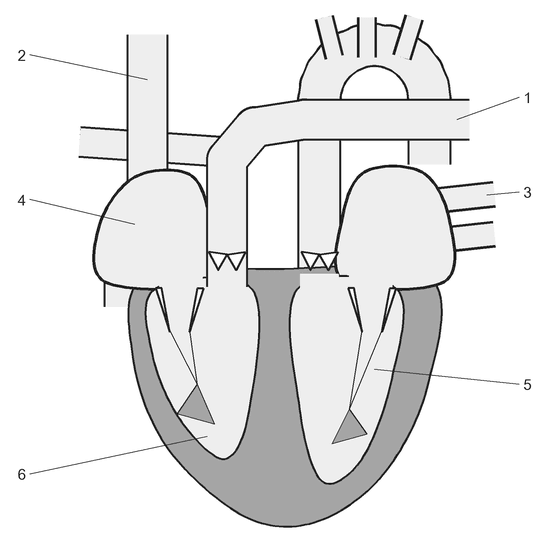
(a) Which type of blood is carried by the blood vessel marked 2 ?
(b) Name the main artery which takes the blood from heart to different parts of the body.
(c) Which chamber of the heart receives deoxygenated blood from the body ?
Solve with AIWritten solution
Solution:
Concept: In a diagram of the heart seen from the front, the person's right side is on the viewer's left. Blood from the body enters the right atrium; blood from the lungs enters the left atrium; the ventricles pump it out.
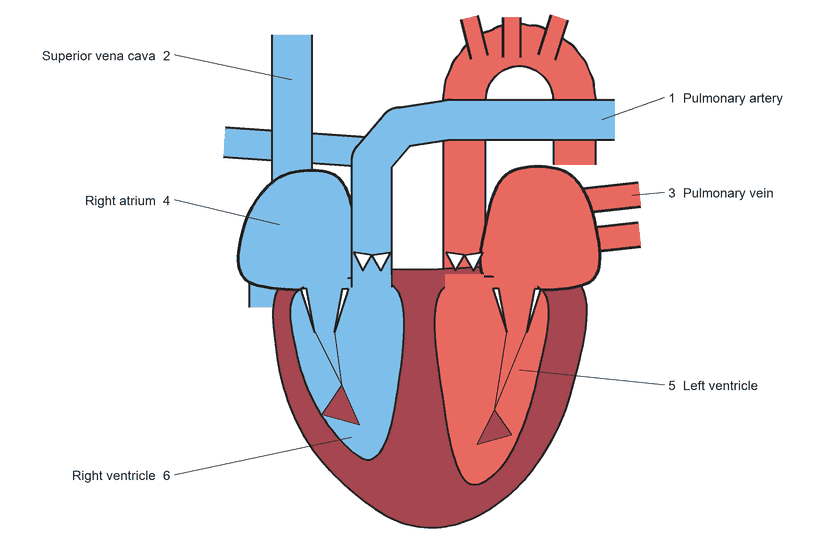
Step 1 — Label the parts.
Following each vessel and chamber in the figure:
- 1 – pulmonary artery (leaves the right ventricle, goes to the lungs)
- 2 – superior vena cava (brings blood from the head and arms into the right atrium)
- 3 – pulmonary vein (brings blood from the lungs into the left atrium)
- 4 – right atrium
- 5 – left ventricle
- 6 – right ventricle
Step 2 — Part (a): blood in vessel 2.
Vessel 2, the superior vena cava, returns blood from the upper body after the cells have used its oxygen, so it carries deoxygenated blood.
Step 3 — Part (b): the main artery.
The aorta, the largest artery, leaves the left ventricle and its branches carry oxygenated blood to all parts of the body.
Step 4 — Part (c): chamber receiving blood from the body.
The venae cavae empty deoxygenated blood from the body into the right atrium.
Watch out: The vessel leaving the right ventricle (1) is an artery even though its blood is deoxygenated.
Therefore, 1 pulmonary artery, 2 superior vena cava, 3 pulmonary vein, 4 right atrium, 5 left ventricle, 6 right ventricle; (a) deoxygenated blood, (b) aorta, (c) right atrium.
- 224 marks
Question 22
Rohit, Rohan's elder brother, met with an accident on his way back from school and lost a significant amount of blood. At the hospital the doctor said he needed an immediate blood transfusion.
Rohan overheard the doctor asking about everyone's blood group in the family. Their father's blood group is O and their mother's blood group is AB. Based on the information given above, answer the questions that follow :
(a) Suppose Rohit's blood group is B. Which parent can give blood to him — his mother or his father ?
(b) If Rohan's blood group is A, can he donate blood to his brother ?
(c) Blood groups are said to be differentiated based on the presence of certain antigens. What are antigens and where are they found in the blood ?
Solve with AIWritten solution
Solution:
Concept: A person can safely receive blood only if the donor's red cells carry no antigen that the person's own blood lacks. Group B can receive B or O; group O, with no A or B antigen, can give to every group.
Step 1 — Part (a): which parent can give to Rohit (group B).
The father is group O: his red cells have neither antigen, so his blood is safe for Rohit. The mother is group AB: her red cells carry antigen A, which Rohit's anti-A antibodies would attack, so AB blood can be given only to an AB person. So the father can give blood, assuming their Rh types also match.
Step 2 — Part (b): can Rohan (group A) give to Rohit (group B)?
Rohan's red cells carry antigen A. Rohit's plasma has anti-A antibodies, which would make those cells clump together. So no, Rohan cannot give blood to his brother; group A blood can be given only to A and AB persons.
Step 3 — Part (c): what antigens are and where they are.
Antigens are substances that, when foreign to a person, make the body produce antibodies against them. The blood-group antigens A and B are found on the surface of the red blood cells (RBCs); their presence or absence decides the blood group.
Step 4 — Check with inheritance.
A father of group O and a mother of group AB can have children of group A or B only, which agrees with Rohit (B) and Rohan (A).
Watch out: An O person can give blood to all groups but can receive only O blood.
Note: The textbook calls these antigens proteins; strictly, the A and B antigens are short sugar chains attached to proteins and fats of the red-cell membrane.
Therefore, (a) the father (group O) can give blood to Rohit, (b) no, Rohan cannot donate to his brother, (c) antigens are substances that stimulate antibody formation; the A and B antigens are on the surface of the red blood cells.
What Class 8 Biology Ch 6 covers
The sections of the chapter, in the order the book takes them. Every question above comes from one of these.
- 01Human Circulatory System
- 02Fluids in Our Body
- 03Heart – The Pumping Organ
- 04Pacemaker
- 05Blood Vessels
- 06Blood Circulation
More ways to study this chapter
The same chapter asked three other ways. Practise it, revise it, and see what the board has set on Ch 6 before.
Class 8 Biology Ch 6 questions students ask
How many questions are there in Class 8 Biology Ch 6?
22 questions. Every one is solved step by step on this page.
Are these Class 8 Biology solutions free?
Yes. Every question and its full working is free to read, with no account needed.
Can I download the Class 8 Biology Ch 6 solutions as a PDF?
There is no PDF to download. Every solution is on this page instead, which means it is searchable, always the current syllabus, and readable on a phone. Use your browser's print option if you want it on paper.