Solution:
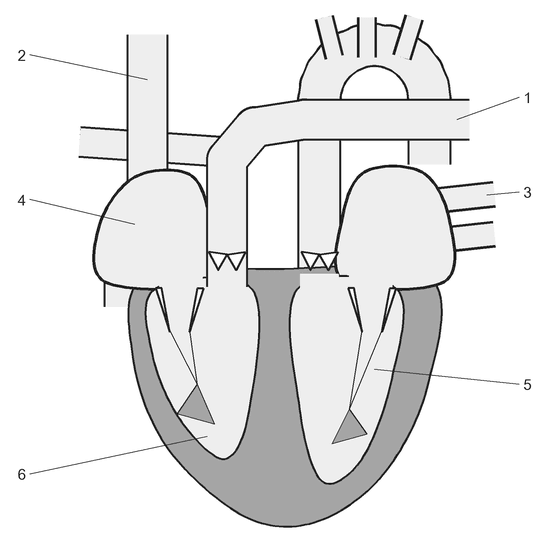
Concept: In a diagram of the heart seen from the front, the person's right side is on the viewer's left. Blood from the body enters the right atrium; blood from the lungs enters the left atrium; the ventricles pump it out.
Step 1 — Label the parts.
Following each vessel and chamber in the figure:
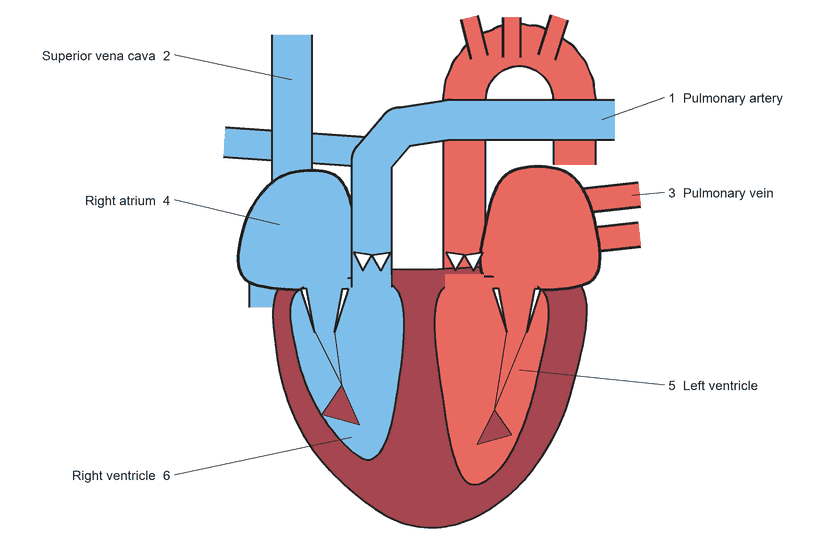
- 1 – pulmonary artery (leaves the right ventricle, goes to the lungs)
- 2 – superior vena cava (brings blood from the head and arms into the right atrium)
- 3 – pulmonary vein (brings blood from the lungs into the left atrium)
- 4 – right atrium
- 5 – left ventricle
- 6 – right ventricle
Step 2 — Part (a): blood in vessel 2.
Vessel 2, the superior vena cava, returns blood from the upper body after the cells have used its oxygen, so it carries deoxygenated blood.
Step 3 — Part (b): the main artery.
The aorta, the largest artery, leaves the left ventricle and its branches carry oxygenated blood to all parts of the body.
Step 4 — Part (c): chamber receiving blood from the body.
The venae cavae empty deoxygenated blood from the body into the right atrium.
Watch out: The vessel leaving the right ventricle (1) is an artery even though its blood is deoxygenated.
Therefore, 1 pulmonary artery, 2 superior vena cava, 3 pulmonary vein, 4 right atrium, 5 left ventricle, 6 right ventricle; (a) deoxygenated blood, (b) aorta, (c) right atrium.