
Opening your dashboard
Class 8 Biology Chapter 6 The Circulatory System: Competency-Based Questions (CBQ)
40 questions on Chapter 6, each worked through on its own page with the AI tutor. Class 8 Biology, ICSE 2026-27.
40 questions
1–5 marks · Mixed difficulty
- 11 mark
Question 1
Cognitive domain: Analysis
The figure is a simple plan of the circulation of blood in the human body. The four main blood vessels joined to the heart are lettered W, X, Y and Z. The arrows show the direction in which the blood flows.
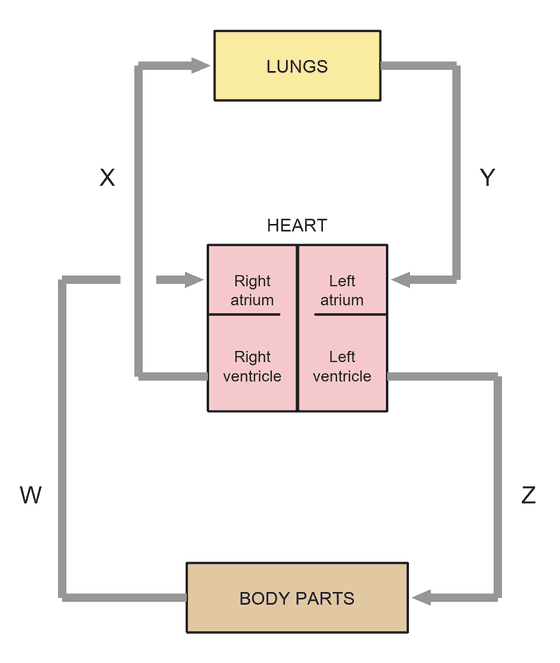
A little blood is tested from each of the four vessels. In which two vessels will the blood be rich in oxygen ?
- 21 mark
Question 2
Cognitive domain: Application
A carpenter's arm was cut deeply by a machine. The blood came out of the wound very fast and with great force, and he was rushed to a hospital. The doctor said that a blood vessel lying deep inside the arm had been cut. Which blood vessel was most likely cut, and why ?
- 31 mark
Question 3
Cognitive domain: Analysis
A patient whose blood group is B needs blood. Six volunteers come forward. Their blood groups are given in the table.
Volunteer Blood group Amit A Bela B Chirag O Deepa AB Esha O Faiz B How many of these six volunteers have blood that matches the patient's blood ?
- 41 mark
Question 4
Cognitive domain: Application
In a laboratory, a pale yellow body fluid is examined under a microscope. It has leukocytes, mostly lymphocytes, but it has no red blood cells and no blood platelets. From where was this fluid most likely taken ?
- 51 mark
Question 5
Cognitive domain: Understanding
Assertion (A): In the heart of a healthy adult, the blood in the right half never mixes with the blood in the left half.
Reason (R): Internally, the heart is divided vertically into a left and a right portion by a muscular wall called the septum.
- 61 mark
Question 6
Cognitive domain: Analysis
Assertion (A): A person who has had hypertension for many years is at a greater risk of having a heart attack.
Reason (R): In hypertension, the heart suddenly stops pumping blood around the body.
- 71 mark
Question 7
Cognitive domain: Application
A doctor places a stethoscope on the chest of a healthy man who is resting. With every heart beat she hears two sounds, one after the other. The man's heart is beating 72 times per minute.
Complete the sentence :
In one minute the doctor hears ______ sounds, and the first sound of each heart beat is made when the ______ valves close.
- 81 mark
Question 8
Cognitive domain: Understanding
A cell lying deep inside a muscle does not touch any blood capillary. Yet it gets oxygen all the time. As the blood flows through the capillaries, the plasma and the leukocytes leak out through the capillary walls and bathe the cells.
Complete the sentence :
The muscle cell absorbs oxygen from the ______ fluid around it, and in turn it gives out ______ and other wastes back into this fluid.
- 91 mark
Question 9
Cognitive domain: Application
Every day Rohan carries puris and potato chips in his lunch box, and he eats two or three sweets after school. He does not play any outdoor game. His weight is now much more than it should be for his age and height.
Complete the sentence :
Rohan's oily and fried foods contain a lot of ______, and his excessive weight, called ______, is the cause of many diseases, especially heart diseases.
- 102 marks
Question 10
Cognitive domain: Evaluation
Meera is very anxious on the morning of her board examination. She feels her heart beating too hard and too fast, and once or twice it seems to skip a beat. She has no chest pain, no dizziness and no shortness of breath. Her cousin says, "This is a heart attack !" Her grandmother says, "Such a thing must always be ignored, whatever else happens with it."
Evaluate the two statements.
- 112 marks
Question 11
Cognitive domain: Understanding
Arjun carried a heavy bucket of water up three floors. The muscles of his arm were so tired that he had to put the bucket down and rest. But his heart, which is also made of muscle, has been working since before he was born and has never stopped to rest.
Explain what is special about the muscles of the heart, and what keeps them working in a regular rhythm.
- 122 marks
Question 12
Cognitive domain: Evaluation
Arnav writes in his notebook : "A blood vessel is an artery if it carries oxygenated blood, and it is a vein if it carries deoxygenated blood. So the pulmonary artery has been given the wrong name. It should be called a vein."
Is Arnav's rule correct ? Judge his conclusion about the pulmonary artery and give the correct rule.
- 135 marks
Question 13
Cognitive domain: Application
Case: After a bus accident, four injured persons P, Q, R and S are brought to a small hospital. All of them need blood. The hospital's blood bank has only the units of blood shown in the first table.
Blood group in stock A B AB O Units 3 0 2 5 Patient Blood group Units needed P B 2 Q AB 2 R O 3 S A 2 (a) There is no blood of group B in stock. Which blood can still be given to patient P ? Give a reason.
(b) Patient R can be given blood of only one group. Which group is it, and why ?
(c) Draw up a plan showing which blood group each patient should get, so that all four get the units they need. How many units of group O are used up ?
(d) A relative of patient S has blood group AB and offers to give blood to S. Should the doctor accept this blood for S ? Why ?
- 145 marks
Question 14
Cognitive domain: Analysis
Case: On the school sports day, the school nurse counted the heart beats of Ishaan, a Class 8 student, four times.
When the count was taken Heart beats per minute Sitting quietly before the race 72 Just after the 400 m race 132 2 minutes after the race 102 6 minutes after the race 74 (a) By how many beats per minute did Ishaan's heart beat go up because of the race ? How many times does his heart beat in 5 minutes when he is sitting quietly ?
(b) Suggest why his heart beat faster during the race, and why the count came down again after it. Use the work of the circulatory system in your answer.
(c) Name the chamber of the heart that pumps blood towards the muscles of his legs, and the artery it pumps the blood into. Why is this blood pumped with great pressure ?
(d) The blood coming back from his leg muscles has lost its oxygen. Describe the path this blood takes from the right ventricle to get oxygen and return to the heart. Name this part of the circulation.
- 155 marks
Question 15
Cognitive domain: Creativity
Case: Many grown-ups in Diya's housing society sit at a desk all day and order fried snacks and sweets almost every evening. The society has asked the Class 8 students who live there to plan a two-hour "Healthy Heart Sunday" in the society park.
(a) Plan three activities for the morning. Say why each one is good for the heart.
(b) Design the menu of a snack stall for the event. List three items you would serve and two items you would keep out, with a reason for each choice.
(c) Write a catchy slogan for the event, and suggest one simple way to find out, a month later, whether the event has changed people's habits.
- 161 mark
Question 16
Cognitive domain: Analysis
A student studies a model of the human heart. She measures the thickness of the wall of its four chambers, P, Q, R and S, and notes the vessels from which each chamber receives blood. (Hypothetical data.)
Chamber Thickness of wall (mm) Receives blood from P The right atrium Q The left atrium R The superior and inferior venae cavae S The pulmonary veins Which option names the four chambers correctly ?
- 171 mark
Question 17
Cognitive domain: Analysis
A student writes four lines of a table to describe what happens inside a healthy heart at four different moments of one heart beat. Exactly one line cannot be correct.
Line What the chambers are doing Atrio-ventricular valves Semi-lunar valves (A) Atria contract, ventricles fill with blood Open Closed (B) Ventricles contract and push blood into the arteries Closed Open (C) Ventricles relax after pushing blood into the arteries Open Closed (D) Ventricles contract and push blood into the arteries Open Open Which line cannot be correct ?
- 181 mark
Question 18
Cognitive domain: Application
A red blood cell is moving in the superior vena cava. It goes through the heart and the lungs, then through the heart again and the body, and finally comes back to the superior vena cava. How many valves of the heart does it pass through in this one complete round ?
- 191 mark
Question 19
Cognitive domain: Analysis
A blood bank keeps a record of the patients to whom the blood of a donor named Ravi can be given safely under the ABO system. (Hypothetical record.)
Blood group of the patient Can Ravi's blood be given safely ? A Yes B No AB Yes O No What is the blood group of Ravi ?
- 201 mark
Question 20
Cognitive domain: Application
After a meal with a lot of butter and cream, the fats of the food are absorbed in the small intestine. Which of the following takes up the absorbed fats and carries them on ?
- 211 mark
Question 21
Cognitive domain: Analysis
The bar chart shows the habits of two friends, Meera and Mohan, in one week. (Hypothetical data.)
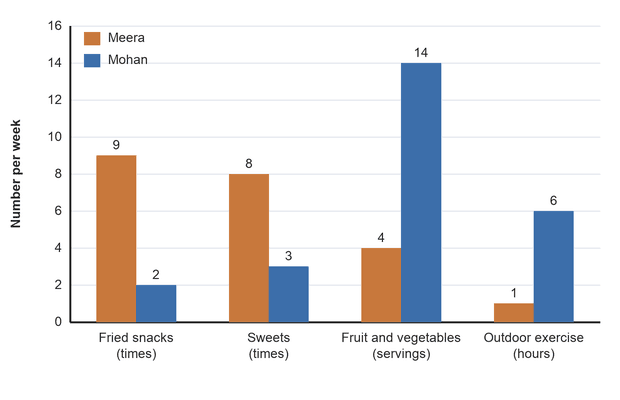
Which conclusion is best supported by the chart ?
- 221 mark
Question 22
Cognitive domain: Application
At a bus stop, a middle-aged man suddenly falls down. He does not respond when he is shaken, and he is not breathing normally. A crowd gathers around him. Which of the following should the bystanders do first ?
- 231 mark
Question 23
Cognitive domain: Understanding
Oxygen reaches the cells of the muscles of the leg through the walls of the capillaries, and not through the wall of the aorta, although the aorta also carries oxygen-rich blood. Which statement gives the best reason ?
- 241 mark
Question 24
Cognitive domain: Analysis
Assertion (A): The inferior vena cava brings oxygenated blood from the lower parts of the body to the right atrium.
Reason (R): The superior vena cava brings deoxygenated blood from the head and shoulders to the right atrium.
- 251 mark
Question 25
Cognitive domain: Understanding
Assertion (A): The lymph that drains out of the tissue spaces is not lost; it gets back into the blood.
Reason (R): The lymph channels pour the lymph into the major veins that lie close to the right atrium.
- 262 marks
Question 26
Cognitive domain: Analysis
The report of a patient says that the bicuspid valve of his heart does not close fully when the left ventricle contracts.
(a) Into which chamber will a part of the blood flow back ?
(b) Why will less blood reach the body in each heart beat ?
- 272 marks
Question 27
Cognitive domain: Evaluation
Kabir's grandfather has had an artificial pacemaker fitted. Kabir says, "The pacemaker pumps the blood, so now the muscles of my grandfather's heart do not have to contract."
Evaluate Kabir's statement.
- 282 marks
Question 28
Cognitive domain: Application
Pooja puts her hand on her chest and feels her heart beat most strongly on the left side. She says, "My heart lies on the left side of my body."
Is she fully right ? Explain with the position of the heart.
- 292 marks
Question 29
Cognitive domain: Analysis
Two animals are described. In animal X, blood flows from the heart through blood vessels to every part of the body all the time, and its flow is regulated by the heart. In animal Y, blood flows from the heart into open spaces between the body tissues, without vessels. (Hypothetical animals.)
(a) Which animal has a closed vascular system ?
(b) In which animal can the heart and the vessels direct the blood to the organs in a better-controlled way ? Give a reason.
- 302 marks
Question 30
Cognitive domain: Understanding
Name the job of the circulatory system that is being done in each case :
(a) While Dev plays football, the blood carries the heat made by the working muscles of his legs to all parts of his body.
(b) The glucose from his breakfast, absorbed in his small intestine, is carried by the blood to the working muscles of his legs.
- 312 marks
Question 31
Cognitive domain: Understanding
Meera's donor card says that her blood group is "B (+)".
(a) The sign (+) is not a part of the names A, B, AB and O. To which other blood group system does it refer ?
(b) Using only the ABO system, from which blood groups can Meera receive blood ?
- 323 marks
Question 32
Cognitive domain: Evaluation
Three students describe the path of a drop of blood that has just left the left ventricle.
- Arun: Left ventricle aorta body vena cavae right atrium.
- Bela: Left ventricle pulmonary artery lungs pulmonary veins left atrium.
- Chetna: Left ventricle aorta body pulmonary veins left atrium.
Evaluate each description, and correct the ones that are wrong.
- 333 marks
Question 33
Cognitive domain: Understanding
Ria writes nine terms on cards : aorta, lymph node, SA node, tissue fluid, tricuspid valve, blood capillary, spleen, pericardium and pericardial fluid. She wants to sort them under four headings : Heart and its covering, Blood vessels, Lymphatic system and Fluids of the body. Each card goes under one heading only, and every fluid goes under Fluids of the body.
(a) Write the cards that go under each heading.
(b) Give a reason for placing the spleen where you did.
- 343 marks
Question 34
Cognitive domain: Analysis
Two patients are examined by a doctor. In patient X a clot has blocked a coronary artery. In patient Y one of the pulmonary veins bringing blood from the right lung is completely blocked.
(a) Which part of patient X's body is short of oxygen-rich blood because of the clot, and what could be the result ?
(b) In patient Y, into which chamber of the heart would the blocked vein normally pour its blood, and what kind of blood is held back in the lung by the block ?
(c) In which patient is the muscle of the heart itself directly starved of blood, and why ?
- 353 marks
Question 35
Cognitive domain: Evaluation
Read the three statements about the fluids of the body.
- (i) Tissue fluid is red because it is blood that has left the blood vessels.
- (ii) Intercellular fluid and extracellular fluid are two different fluids of the body.
- (iii) Blood, tissue fluid and lymph are the three principal fluids of the human body.
Say whether each statement is true or false, and correct the false ones.
- 363 marks
Question 36
Cognitive domain: Creativity
Anita wants a quick way to remember how arteries and veins differ.
(a) Write a rhyme of four lines that states correctly at least three differences between arteries and veins.
(b) Under your rhyme, list the differences that your rhyme states, in the order in which they come.
- 375 marks
Question 37
Cognitive domain: Analysis
Case: The figure shows a small part of the body. Blood flows from left to right through the vessel marked P. The vessel marked T is a large vein close to the heart. The arrows show the direction of the flow. The figure is a simplified plan, not to scale: the smaller vessels that lead from P to T are not shown.
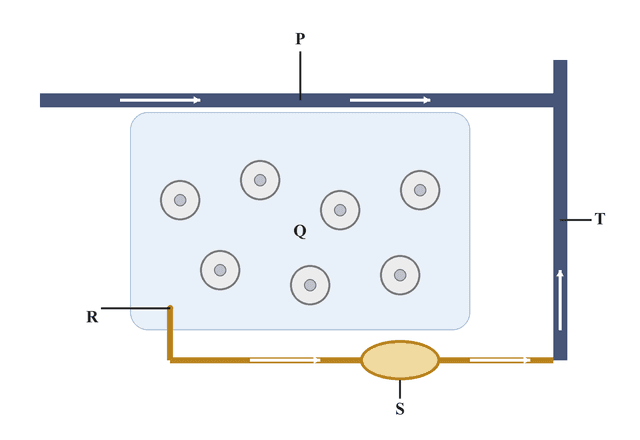
(a) Name the structures marked P, Q, R, S and T.
(b) Suppose the vessel R becomes blocked on its way to S, so that no fluid can flow along it, while blood keeps flowing through P as before. Predict what will happen to the amount of the fluid Q around the cells, and explain why.
(c) A thorn pricks the skin near the region shown and bacteria enter the tissue. Say what the structure S does about it, and name one more function of the fluid in R, other than draining away the fluid Q.
- 384 marks
Question 38
Cognitive domain: Analysis
Case: In a laboratory, four samples of blood were tested for the antigens on their red blood cells. (Hypothetical data.)
Sample Antigen A present Antigen B present S1 Yes No S2 No No S3 Yes Yes S4 No Yes (a) Name the blood group of each sample.
(b) For each sample, write the number of the four ABO groups to which its blood can be safely given.
(c) In an emergency a patient whose blood group is not yet known needs blood at once, and only these four samples are available. Which sample would be used, and why ? Which sample is the least useful as a donor ?
- 395 marks
Question 39
Cognitive domain: Creativity
Case: Rahul says, "The circulatory system is like the water supply of a colony." The class decides to test his idea.
(a) Make a table with two columns. In the first column write the heart, the arteries, the capillaries, the veins and the valves of the heart, and in the second column write the matching part of a colony's water supply. Give a reason for each match.
(b) Give one way in which the water supply does not match the circulatory system.
(c) Add one more part to the model to stand for the lymph vessels, and say what it would do.
- 404 marks
Question 40
Cognitive domain: Application
Case: A health club chart says that the heart of a healthy adult at rest beats times in a minute, and that at every beat the left ventricle pushes out about mL of blood into the aorta. The adult body has about litres of blood. (Hypothetical data for an adult at rest.)
(a) How much blood does the left ventricle pump in one minute, in mL and in litres ?
(b) How many litres does it pump in one hour ?
(c) About how many times in one hour does the whole blood of the body pass through the left ventricle ?