
Opening your dashboard
Class 8 Biology Chapter 1: Transport in Plants Solutions
38 textbook questions with step-by-step answers, free to read, for ICSE 2026-27.
Get talked through Ch 1, not just shown the answer
Reading a finished solution is not the same as being able to do it. The AI tutor takes one question at a time and works it with you, in your own words, until you can.
- Ask it out loud, in your own words
- It gives you the next step, not the answer
- Stuck on part (ii)? Start there
38 questions with solutions
1–14 marks · Mixed difficulty
- 11 mark
Question 1
Diffusion occurs when molecules move :
Solve with AIAnswer
(A) from lower concentration to higher concentration.
(B) from higher concentration to lower concentration through a membrane.
- Correct
(C) from higher concentration to lower concentration.
(D) when energy is used.
Answer: (C) from higher concentration to lower concentration.
Concept: Diffusion is the spreading of molecules (of a gas, liquid or dissolved solid) from where they are more concentrated to where they are less concentrated, until they are evenly spread. It needs no energy and no membrane.
Step 1 — Recall the direction of diffusion.
Molecules always diffuse down the concentration difference, that is, from a region of higher concentration to a region of lower concentration.
Step 2 — Check what else is needed.
Diffusion happens on its own, for example the smell of a perfume spreading through a room. No membrane and no energy are needed, so the complete answer is option (C).
Watch out: A membrane is not part of the definition of diffusion; water moving through a semi-permeable membrane is the special case called osmosis.
Why the other options are wrong:
- (A) from lower concentration to higher concentration: movement from a lower to a higher concentration is active transport, which uses energy.
- (B) from higher concentration to lower concentration through a membrane: diffusion does not need a membrane; adding "through a membrane" makes this describe only a special case such as osmosis.
- (D) when energy is used: diffusion uses no energy; using energy to move molecules is active transport.
Therefore, in diffusion, molecules move from a higher concentration to a lower concentration, option (C).
- 21 mark
Question 2
Ascent of sap in plants takes place through :
Solve with AIAnswer
(A) Cortex
(B) Epidermis
- Correct
(C) Xylem
(D) Phloem
Answer: (C) Xylem
Concept: The ascent of sap is the upward movement of water and dissolved minerals (sap) from the roots to the leaves. It takes place through the xylem (its vessels and tracheids).
Step 1 — Name the tissue that carries water.
The plant has two conducting tissues: xylem carries water and minerals, and phloem carries food.
Step 2 — Pick the option.
Since sap is water with minerals moving upwards, it travels through the xylem, option (C).
Watch out: Do not mix up xylem (water, upwards) and phloem (food, both ways).
Why the other options are wrong:
- (A) Cortex: the cortex only passes water across the root from the root hairs to the xylem; it does not carry water up the plant.
- (B) Epidermis: the epidermis is the outer covering layer; in the root it bears root hairs that absorb water, but it does not conduct water upwards.
- (D) Phloem: phloem carries food made in the leaves, not water and minerals.
Therefore, the ascent of sap takes place through the xylem, option (C).
- 31 mark
Question 3
If the xylem vessels of a plant are plugged :
Solve with AIAnswer
(A) The leaves will turn yellow
(B) No food will be made
- Correct
(C) The plant will wilt (shrivel)
(D) The plant will continue to grow
Answer: (C) The plant will wilt (shrivel)
Concept: The xylem is the only pipeline that takes water up to the leaves. The leaves keep losing water by transpiration, and their cells stay firm only while this water is replaced.
Step 1 — Work out what plugging the xylem stops.
If the xylem vessels are plugged, water from the roots can no longer reach the stem and leaves.
Step 2 — See what happens to the leaves.
The leaves go on losing water by transpiration, but nothing replaces it. Their cells lose water and become soft, so the leaves and stem droop: the plant wilts. This is option (C).
Watch out: Wilting is the first and most visible effect of a water shortage; other effects come later.
Why the other options are wrong:
- (A) The leaves will turn yellow: yellowing of leaves is mainly a sign of a mineral shortage (such as nitrogen or iron) and takes a long time; it is not the effect of a blocked water supply.
- (B) No food will be made: food-making does slow down as the wilting leaves close their stomata, but the leaves still hold some water and food at first, so "no food will be made" is not what we see; the clear effect is wilting.
- (D) The plant will continue to grow: a plant cut off from water cannot keep growing.
Therefore, if the xylem is plugged, the plant will wilt, option (C).
- 41 mark
Question 4
Force responsible for the ascent of sap is :
Solve with AIAnswer
(A) Capillary force
(B) Root pressure
(C) Transpirational pull
- Correct
(D) All the three
Answer: (D) All the three
Concept: Water rises in the xylem because of three forces acting together: root pressure pushes it up from below, capillary force draws it up the very narrow xylem tubes, and the transpirational pull sucks it up from the leaves.
Step 1 — List the forces the chapter gives.
The chapter names root pressure, capillary force and transpirational pull as the forces responsible for the ascent of sap.
Step 2 — Pick the option.
All three of them help to raise the water, so the answer is option (D).
Watch out: Transpirational pull is the strongest force in tall trees, but the question asks for the force responsible, and the book's answer counts all three.
Why the other options are wrong:
- (A) Capillary force: capillary force helps, but on its own it can raise water only a short distance, not to the top of a tree.
- (B) Root pressure: root pressure pushes water up only a few metres and is weak when transpiration is fast.
- (C) Transpirational pull: transpirational pull is the most important force, but it acts together with the other two.
Therefore, the ascent of sap is due to all the three forces, option (D).
- 51 mark
Question 5
Raisins swell when put in :
Solve with AIAnswer
- Correct
(A) Rain water
(B) Saline water
(C) Mustard oil
(D) Saturated sugar solution
Answer: (A) Rain water
Concept: A raisin is a dried grape whose cells hold a concentrated sugary sap. Water moves into it by osmosis only when the outside liquid is more dilute than this sap.
Step 1 — Compare each liquid with the raisin's sap.
Rain water is almost pure water, so it is far more dilute than the sugary sap inside the raisin.
Step 2 — Decide the direction of water flow.
Water therefore enters the raisin by osmosis (endosmosis), and the raisin swells. This is option (A).
Watch out: Water always moves towards the more concentrated solution, so a raisin swells only in a dilute liquid.
Why the other options are wrong:
- (B) Saline water: saline (salt) water is concentrated, so water would move out of the raisin, or at least not into it.
- (C) Mustard oil: mustard oil contains no water, so there is no water to enter the raisin.
- (D) Saturated sugar solution: a saturated sugar solution is more concentrated than the raisin's sap, so the raisin would lose water and stay shrunken.
Therefore, raisins swell when put in rain water, option (A).
- 61 mark
Question 6
The root hairs are suited for absorbing water from the soil because :
Solve with AIAnswer
(A) They have a large surface area.
(B) They have a semi-permeable membrane.
(C) They contain a solution of higher concentration than the surrounding water.
- Correct
(D) All the three.
Answer: (D) All the three.
Concept: A root hair is a long, thin outgrowth of a single epidermal cell of the root. Its shape and contents make it very good at taking in water by osmosis.
Step 1 — Check feature (A).
Thousands of long root hairs give a very large surface area in contact with the soil water. This is true.
Step 2 — Check feature (B).
Its cell membrane is semi-permeable, so water can pass in by osmosis. This is true.
Step 3 — Check feature (C).
Its cell sap is more concentrated than the soil water, so water moves into it. This is true.
Step 4 — Pick the option.
All three features help, so the answer is option (D).
Watch out: When every statement is true, choose "all the three", not just one of them.
Why the other options are wrong:
- (A) They have a large surface area: this is true, but it is only one of the three features.
- (B) They have a semi-permeable membrane: this is true, but it is only one of the three features.
- (C) They contain a solution of higher concentration than the surrounding water: this is true, but it is only one of the three features.
Therefore, root hairs are suited for absorbing water because of all the three features, option (D).
- 71 mark
Question 7
Transpiration is defined as
Solve with AIAnswer
(A) the rise of water up to the stem of a plant.
(B) the elimination of water with dissolved water products.
- Correct
(C) the loss of water as water vapour from the aerial parts of a plant.
(D) the loss of water as water vapour from the roots as well as the leaves of the plant.
Answer: (C) the loss of water as water vapour from the aerial parts of a plant.
Concept: Transpiration is the loss of water as water vapour from the aerial parts of a plant, mainly through the stomata of the leaves. Anything that speeds up evaporation, or keeps the stomata open, makes it faster.
Step 1 — Recall the definition.
Transpiration is the loss of water in the form of water vapour from the parts of the plant that are above the ground (the aerial parts), mainly the leaves.
Step 2 — Match with the options.
Option (C) says exactly this, so it is the answer.
Watch out: Transpiration happens only from the aerial parts; the roots take water in, they do not give off vapour.
Why the other options are wrong:
- (A) the rise of water up to the stem of a plant: the rise of water up the stem is the ascent of sap, not transpiration.
- (B) the elimination of water with dissolved water products: transpiration removes water as vapour; it is not the removal of water carrying dissolved waste.
- (D) the loss of water as water vapour from the roots as well as the leaves of the plant: the roots absorb water from the soil; they do not lose water vapour into the air.
Therefore, transpiration is the loss of water as water vapour from the aerial parts of a plant, option (C).
- 81 mark
Question 8
Which one of the following favours the fastest transpiration rate ?
Solve with AIAnswer
(A) A cool, humid, windy day
(B) A hot, humid, windy day
(C) A hot, humid, still day
- Correct
(D) A hot, dry, windy day
Answer: (D) A hot, dry, windy day
Concept: Transpiration is the loss of water as water vapour from the aerial parts of a plant, mainly through the stomata of the leaves. Anything that speeds up evaporation, or keeps the stomata open, makes it faster.
Step 1 — Think about each weather factor.
Heat makes water evaporate faster. Dry air can take in much more water vapour than humid air. Wind blows away the moist air next to the leaves, so fresh dry air keeps arriving.
Step 2 — Pick the day with all three.
A hot, dry, windy day has all three conditions that speed up transpiration, so it gives the fastest rate. This is option (D).
Watch out: Humid air slows transpiration even on a hot day, because the air is already nearly full of water vapour.
Why the other options are wrong:
- (A) A cool, humid, windy day: cool air slows evaporation and humid air takes in little vapour, so transpiration is slow.
- (B) A hot, humid, windy day: the heat and wind help, but the humid air slows transpiration down.
- (C) A hot, humid, still day: humid air and still air both slow transpiration, even though it is hot.
Therefore, transpiration is fastest on a hot, dry, windy day, option (D).
- 91 mark
Question 9
Vinay has kept a small herbaceous plant in a test tube containing water. The surface of the water is covered by a layer of oil. After three hours, he observed that the level of water in the test tube has decreased. This is due to:
Solve with AIAnswer
(A) Absorption
(B) Transpiration
(C) Wilting
- Correct
(D) Both (a) and (b)
Answer: (D) Both (a) and (b)
Concept: A layer of oil on water stops the water from evaporating. So if the water level falls, the water must have gone through the plant: the roots absorb it and the leaves lose it by transpiration.
Step 1 — Rule out evaporation.
The oil layer covers the water surface, so no water can evaporate from the test tube directly.
Step 2 — Follow the path of the water.
The roots absorb water from the test tube. This water rises up the stem and is lost from the leaves as vapour by transpiration, and the loss keeps pulling more water into the roots.
Step 3 — Pick the option.
Both absorption and transpiration together lower the water level, so the answer is option (D).
Watch out: The oil is there to show that the water was not lost by evaporation from the surface.
Why the other options are wrong:
- (A) Absorption: absorption takes the water out of the tube, but it goes on only because the leaves keep losing water by transpiration.
- (B) Transpiration: transpiration is the loss from the leaves, but the water first leaves the tube by absorption through the roots.
- (C) Wilting: wilting is the drooping of a plant short of water; it does not lower the water level.
Therefore, the water level falls due to both absorption and transpiration, option (D).
- 101 mark
Question 10
Root hairs are the epidermal outgrowths of the outermost layer of roots. They are well-suited for absorption of water from soil due to which of the following features ?
P. Large surface area.
Q. Lower concentration of cell sap.
R. Semi permeable nature of the cell membrane.
Solve with AIAnswer
(A) Only P
(B) Only Q
(C) Only P and Q
- Correct
(D) Only P and R
Answer: (D) Only P and R
Concept: Osmosis is the movement of water from a dilute solution to a more concentrated solution through a semi-permeable membrane; a root hair takes in water this way because its cell sap is more concentrated than the soil water.
Step 1 — Judge statement P.
Root hairs are long and very many, so they give a large surface area. Statement P is correct.
Step 2 — Judge statement Q.
For water to enter by osmosis, the cell sap must be more concentrated than the soil water, not less. Statement Q is wrong.
Step 3 — Judge statement R.
The cell membrane is semi-permeable, which is needed for osmosis. Statement R is correct.
Step 4 — Pick the option.
Only P and R are correct, so the answer is option (D).
Watch out: A root hair's sap is more concentrated than the soil water; if it were less concentrated, water would flow out.
Why the other options are wrong:
- (A) Only P: P is correct, but R is also correct, so "only P" is incomplete.
- (B) Only Q: Q is wrong: with a less concentrated sap, water would leave the root hair instead of entering it.
- (C) Only P and Q: Q is wrong, so the pair P and Q cannot be the answer.
Therefore, root hairs are suited for absorption because of P and R only, option (D).
- 111 mark
Question 11
Xylem tissue forms a tubular passage to transport water and mineral salts from the roots to the aerial parts of a plant. It consists of different types of cells.
P. Sieve tubes and companion cells
Q. Wood parenchyma and wood fibres
R. Tracheids and vessels
Which of the following are xylem components ?
Solve with AIAnswer
(A) Only P
(B) Only P and R
- Correct
(C) Only Q and R
(D) All P, Q and R
Answer: (C) Only Q and R
Concept: Xylem is made of four kinds of cells: tracheids, vessels, xylem (wood) parenchyma and xylem (wood) fibres. Phloem is made of sieve tubes, companion cells, phloem parenchyma and phloem fibres.
Step 1 — Judge group P.
Sieve tubes and companion cells carry food; they belong to the phloem. So P is not a xylem component.
Step 2 — Judge groups Q and R.
Wood parenchyma and wood fibres (Q), and tracheids and vessels (R), are all parts of the xylem.
Step 3 — Pick the option.
Only Q and R are xylem components, so the answer is option (C).
Watch out: "Wood" in wood parenchyma and wood fibres means xylem, since wood is mostly xylem.
Why the other options are wrong:
- (A) Only P: sieve tubes and companion cells are parts of the phloem, not the xylem.
- (B) Only P and R: P is a phloem group, so the pair P and R is wrong.
- (D) All P, Q and R: P is not a xylem component, so "all" is wrong.
Therefore, the xylem components are Q and R only, option (C).
- 121 mark
Question 12
Assertion (A): The food prepared by leaves is transported to all parts of the plant.
Reason (R): Roots are the underground parts of the plant which absorb food material from the soil.
Solve with AIAnswer
(A) (1) Both A and R are true and R is the correct explanation of A.
(B) (2) Both A and R are true but R is not the correct explanation of A.
- Correct
(C) (3) A is true but R is false.
(D) (4) A is false but R is true.
Answer: (C) (3) A is true but R is false.
Concept: In an assertion-reason item, first judge the Assertion (A) and the Reason (R) separately as true or false; only when both are true do we ask whether R correctly explains A.
Step 1 — Judge the Assertion.
A is true. Food made in the leaves is carried by the phloem to all parts of the plant, including the roots and growing tips.
Step 2 — Judge the Reason.
R is false. Roots are underground parts, but they absorb water and mineral salts from the soil, not food. Plants make their own food in the leaves.
Step 3 — Pick the option.
A is true and R is false, so the answer is option (C).
Watch out: Roots absorb water and minerals, never ready-made food.
Why the other options are wrong:
- (A) (1) Both A and R are true and R is the correct explanation of A: R is false, so it cannot explain A.
- (B) (2) Both A and R are true but R is not the correct explanation of A: R is false, so both cannot be true.
- (D) (4) A is false but R is true: A is true, not false.
Therefore, A is true but R is false, option (C).
- 131 mark
Question 13
Assertion (A): In plants, the transportation of water from roots to leaves is carried out by a conducting tissue called phloem.
Reason (R): Roots absorb water and minerals from the soil which are transported to leaves for various metabolic activities like photosynthesis, transpiration, respiration, etc.
Solve with AIAnswer
(A) (1) Both A and R are true and R is the correct explanation of A.
(B) (2) Both A and R are true but R is not the correct explanation of A.
(C) (3) A is true but R is false.
- Correct
(D) (4) A is false but R is true.
Answer: (D) (4) A is false but R is true.
Concept: In an assertion-reason item, first judge the Assertion (A) and the Reason (R) separately as true or false; only when both are true do we ask whether R correctly explains A.
Step 1 — Judge the Assertion.
A is false. Water is carried from the roots to the leaves by the xylem, not the phloem. Phloem carries food.
Step 2 — Judge the Reason.
R is true. Water and minerals absorbed by the roots are taken to the leaves, where they are used for photosynthesis and other activities, and water is also lost by transpiration.
Step 3 — Pick the option.
A is false and R is true, so the answer is option (D).
Watch out: Xylem carries water up; phloem carries food. Swapping them makes the statement false.
Why the other options are wrong:
- (A) (1) Both A and R are true and R is the correct explanation of A: A is false, so both cannot be true.
- (B) (2) Both A and R are true but R is not the correct explanation of A: A is false, so both cannot be true.
- (C) (3) A is true but R is false: this says A is true and R is false; in fact A is false and R is true.
Therefore, A is false but R is true, option (D).
- 141 mark
Question 14
Assertion (A): The movement of molecules from their lower concentration to a higher concentration requires energy in the form of ATP.
Reason (R): Active transport is the process during which root hairs of a plant absorb minerals from the soil.
Solve with AIAnswer
(A) (1) Both A and R are true and R is the correct explanation of A.
- Correct
(B) (2) Both A and R are true but R is not the correct explanation of A.
(C) (3) A is true but R is false.
(D) (4) A is false but R is true.
Answer: (B) (2) Both A and R are true but R is not the correct explanation of A.
Concept: In an assertion-reason item, first judge the Assertion (A) and the Reason (R) separately as true or false; only when both are true do we ask whether R correctly explains A.
Step 1 — Judge the Assertion.
A is true. Moving molecules from a lower to a higher concentration is moving them "uphill", against the concentration difference. This needs energy, which the cell supplies as ATP.
Step 2 — Judge the Reason.
R is true. Root hairs take in many minerals from the soil by active transport, because the minerals are often more concentrated inside the root than in the soil.
Step 3 — Does R explain A?
No. R only says where active transport happens (in root hairs). It does not say why uphill movement needs energy. So the answer is option (B).
Watch out: R being an example of A's process does not make it the reason for A.
Why the other options are wrong:
- (A) (1) Both A and R are true and R is the correct explanation of A: R gives an example of active transport, not the reason why energy is needed.
- (C) (3) A is true but R is false: R is true: root hairs do take in minerals by active transport.
- (D) (4) A is false but R is true: A is true: moving against the concentration difference does need energy (ATP).
Therefore, both A and R are true but R is not the correct explanation of A, option (B).
- 151 mark
Question 15
Assertion (A): Nitrogen is the main constituent of all proteins which helps in the growth and development of plants.
Reason (R): Nitrogen is a micronutrient, which means it is required in very small amounts by the plants. It is absorbed from the soil as a nutrient element or mineral.
Solve with AIAnswer
(A) (1) Both A and R are true and R is the correct explanation of A.
(B) (2) Both A and R are true but R is not the correct explanation of A.
- Correct
(C) (3) A is true but R is false.
(D) (4) A is false but R is true.
Answer: (C) (3) A is true but R is false.
Concept: In an assertion-reason item, first judge the Assertion (A) and the Reason (R) separately as true or false; only when both are true do we ask whether R correctly explains A.
Step 1 — Judge the Assertion.
A is true. Nitrogen is a part of every protein, and proteins are needed to build new cells, so nitrogen is essential for growth.
Step 2 — Judge the Reason.
R is false. Nitrogen is needed in large amounts, so it is a macronutrient, not a micronutrient. (It is absorbed from the soil, mostly as nitrates.)
Step 3 — Pick the option.
A is true and R is false, so the answer is option (C).
Watch out: N, P and K are the main macronutrients; iron, manganese and zinc are examples of micronutrients.
Why the other options are wrong:
- (A) (1) Both A and R are true and R is the correct explanation of A: R is false, so it cannot explain A.
- (B) (2) Both A and R are true but R is not the correct explanation of A: R is false, so both cannot be true.
- (D) (4) A is false but R is true: A is true, not false.
Therefore, A is true but R is false, option (C).
- 161 mark
Question 16
Assertion (A): Plants absorb water from the soil through a semi permeable membrane. The process is termed as osmosis.
Reason (R): The outermost layer of a root hair cell is the cell wall which is semi permeable in nature, so it helps in the process of osmosis.
Solve with AIAnswer
(A) (1) Both A and R are true and R is the correct explanation of A.
(B) (2) Both A and R are true but R is not the correct explanation of A.
- Correct
(C) (3) A is true but R is false.
(D) (4) A is false but R is true.
Answer: (C) (3) A is true but R is false.
Concept: In an assertion-reason item, first judge the Assertion (A) and the Reason (R) separately as true or false; only when both are true do we ask whether R correctly explains A.
Step 1 — Judge the Assertion.
A is true. Water enters the root hair through its semi-permeable cell membrane from the dilute soil water to the more concentrated cell sap. This is osmosis.
Step 2 — Judge the Reason.
R is false. The outermost layer of the root hair cell is indeed the cell wall, but the cell wall is freely permeable: it lets almost everything through. The semi-permeable layer is the cell membrane just inside it.
Step 3 — Pick the option.
A is true and R is false, so the answer is option (C).
Watch out: Cell wall = freely permeable; cell membrane = semi-permeable.
Why the other options are wrong:
- (A) (1) Both A and R are true and R is the correct explanation of A: R is false, so it cannot explain A.
- (B) (2) Both A and R are true but R is not the correct explanation of A: R is false, so both cannot be true.
- (D) (4) A is false but R is true: A is true, not false.
Therefore, A is true but R is false, option (C).
- 175 marks
Question 17
Fill in the blanks with suitable terms given below :
(fast, leaves, conducting, ascent, humid)
(a) Transportation in plants is carried out by a .......... system.
(b) The upward movment of sap that contains water and minerals is called .......... of sap.
(c) Transpiration is more when the wind is blowing .......... .
(d) Most water gets evaporated from the plant from its .......... .
(e) Transpiration is reduced if the air is .......... .
Solve with AIWritten solution
Solution:
Concept: Fill each blank with the one word from the box that makes the statement true: the conducting system moves materials, the rising sap is the ascent of sap, and fast wind, dry air and leaves control transpiration.
Step 1 — (a) What moves materials.
Water, minerals and food are carried by the xylem and phloem, which together form the conducting system.
Step 2 — (b) The upward movement of sap.
The rise of water with minerals from the roots to the leaves is called the ascent of sap.
Step 3 — (c) Effect of wind.
Wind carries away the moist air near the leaves, so transpiration is more when the wind is blowing fast.
Step 4 — (d) Where most water is lost.
Most water evaporates through the stomata, which are mainly on the leaves.
Step 5 — (e) Effect of moist air.
Moist air can take in little more vapour, so transpiration is reduced if the air is humid.
Watch out: Each word from the box is used exactly once; check that the five words fill the five blanks.
Therefore, (a) conducting, (b) ascent, (c) fast, (d) leaves, (e) humid.
- 185 marks
Question 18
Match the terms given in Column A with those given in Column B.
Column A Column B (a) Phloem parenchyma (i) Cylindrical cells devoid of a nucleus (b) Tracheids (ii) Tubular cells forming long channels (c) Xylem vessels (iii) Cells attached to sieve tubes (d) Sieve tubes (iv) Elongated dead cells (e) Companion cells (v) Cells storing food Solve with AIWritten solution
Solution:
Concept: Xylem is made of tracheids, vessels, xylem parenchyma and fibres; phloem is made of sieve tubes, companion cells, phloem parenchyma and fibres. Each kind of cell has its own shape and job.
Step 1 — (a) Phloem parenchyma.
These are living cells of the phloem that store food, so (a) matches (v).
Step 2 — (b) Tracheids.
Tracheids are long, narrow cells that are dead when mature, so (b) matches (iv).
Step 3 — (c) Xylem vessels.
Vessels are cells joined end to end whose cross walls have broken down, forming long tubular channels, so (c) matches (ii).
Step 4 — (d) Sieve tubes.
Sieve tubes are long cylindrical living cells that have no nucleus when mature, so (d) matches (i).
Step 5 — (e) Companion cells.
Companion cells lie beside the sieve tubes and control them, so (e) matches (iii).
Watch out: Sieve tubes are living but have no nucleus; tracheids and vessels are dead.
Therefore, (a)–(v), (b)–(iv), (c)–(ii), (d)–(i), (e)–(iii).
- 196 marks
Question 19
State whether the following statements are True or False. Rewrite the false statements correctly.
(a) Water absorption mainly occurs through the root-hair.
(b) Water enters the root-hair by osmosis.
(c) Water absorbed by the roots reaches the leaves and is used in producing food for the entire plant.
(d) A semi-permeable membrane allows larger molecules to pass through, but prevents the smaller ones.
(e) Transpiration is the loss of water from the roots of the plant.
(f) Transpiration cools the plant when it is hot outside.
Solve with AIWritten solution
Solution:
Concept: Water enters the root hairs by osmosis, rises in the xylem, is partly used in the leaves to make food, and most of it is lost as vapour from the aerial parts by transpiration.
Step 1 — (a) Where water is absorbed.
Most water is taken in by the root hairs, which give a huge surface area. The statement is True.
Step 2 — (b) How water enters.
Water passes from the dilute soil water into the more concentrated cell sap through the semi-permeable membrane, which is osmosis. The statement is True.
Step 3 — (c) Use of the water.
Water absorbed by the roots does reach the leaves, and the water used in photosynthesis comes from it. The statement is True. (Only a small part is used this way; most of the water is lost by transpiration.)
Step 4 — (d) What a semi-permeable membrane lets through.
False. It is the other way round. Correct statement: A semi-permeable membrane allows smaller molecules (such as water) to pass through, but prevents the larger ones (such as sugar).
Step 5 — (e) Where transpiration happens.
False. The roots absorb water; they do not transpire. Correct statement: Transpiration is the loss of water as water vapour from the aerial parts (mainly the leaves) of the plant.
Step 6 — (f) Cooling.
Evaporating water takes heat away from the leaves, so transpiration cools the plant on hot days. The statement is True.
Watch out: In (d) only the words "larger" and "smaller" need swapping; the rest of the sentence stays.
Therefore, (a) True, (b) True, (c) True, (d) False, (e) False, (f) True, with (d) and (e) rewritten as above.
- 201 mark
Question 20
Name the plant tissue which helps in carrying food to different parts of a plant.
Solve with AIWritten solution
Solution:
Concept: Plants have two conducting tissues: xylem carries water and minerals, and phloem carries food.
Step 1 — Recall which tissue carries food.
Food made in the leaves (as sugar solution) moves through the sieve tubes of the phloem to every part of the plant, upwards and downwards.
Watch out: Xylem carries water, not food.
Therefore, the tissue that carries food is the phloem.
- 216 marks
Question 21
Name the following:
(a) Two conducting tissues of the plants
(b) Four components of Xylem tissue
(c) Four components of Phloem tissue
(d) Three factors which increase the rate of transpiration
(e) Three macronutrients
(f) Three micronutrients
Solve with AIWritten solution
Solution:
Concept: The conducting system (xylem and phloem), the weather factors that affect transpiration, and the mineral nutrients a plant needs in large and small amounts.
Step 1 — (a) Conducting tissues.
The two conducting tissues are xylem and phloem.
Step 2 — (b) Parts of xylem.
Xylem has tracheids, vessels, xylem parenchyma and xylem fibres.
Step 3 — (c) Parts of phloem.
Phloem has sieve tubes, companion cells, phloem parenchyma and phloem fibres.
Step 4 — (d) Factors that increase transpiration.
Transpiration is faster with high temperature, bright sunlight and wind (dry air also increases it).
Step 5 — (e) Macronutrients.
Nutrients needed in large amounts include nitrogen (N), phosphorus (P) and potassium (K).
Step 6 — (f) Micronutrients.
Nutrients needed in very small amounts include iron (Fe), manganese (Mn) and zinc (Zn).
Watch out: Sieve tubes and companion cells are phloem, never xylem.
Therefore, (a) xylem, phloem; (b) tracheids, vessels, xylem parenchyma, xylem fibres; (c) sieve tubes, companion cells, phloem parenchyma, phloem fibres; (d) high temperature, bright light, wind; (e) N, P, K; (f) Fe, Mn, Zn.
- 2214 marks
Question 22
Define the following terms :
(a) Semi-permeable membrane
(b) Osmosis
(c) Diffusion
(d) Transpiration
(e) Ascent of sap
(f) Translocation of food
(g) Root hairs
Solve with AIWritten solution
Solution:
Concept: These seven terms describe how water, minerals and food move into, through and out of a plant. A good definition says what moves, from where to where, and through what.
Step 1 — (a) Semi-permeable membrane.
A semi-permeable membrane is a membrane that lets small molecules such as water pass through it but stops larger molecules such as sugar. Example: the cell membrane.
Step 2 — (b) Osmosis.
Osmosis is the movement of water molecules from a dilute solution to a concentrated solution through a semi-permeable membrane.
Step 3 — (c) Diffusion.
Diffusion is the movement of molecules of a gas, liquid or dissolved solid from a region of their higher concentration to a region of their lower concentration.
Step 4 — (d) Transpiration.
Transpiration is the loss of water as water vapour from the aerial parts of a plant, mainly through the stomata of the leaves.
Step 5 — (e) Ascent of sap.
The ascent of sap is the upward movement of water with dissolved minerals from the roots, through the xylem, to the leaves.
Step 6 — (f) Translocation of food.
Translocation of food is the movement of food (mainly as a sucrose solution) through the phloem, upwards and downwards, from the leaves to all parts of the plant.
Step 7 — (g) Root hairs.
Root hairs are fine, long outgrowths of the epidermal cells of the root, just behind the root tip, that absorb water and minerals from the soil.
Watch out: Osmosis is only about water and always needs a semi-permeable membrane; diffusion needs neither.
Therefore, the seven terms are defined as in (a) to (g) above.
- 236 marks
Question 23
Write two important functions of each of the following:
(a) Xylem
(b) Phloem
(c) Root
Solve with AIWritten solution
Solution:
Concept: Xylem and phloem are the plant's conducting tissues, and the root holds the plant and takes in what it needs from the soil. Each has more than one job.
Step 1 — (a) Xylem.
Xylem has two main jobs:
- It conducts water and mineral salts from the roots up to the leaves.
- Its thick-walled tracheids, vessels and fibres give mechanical strength and support to the plant.
Step 2 — (b) Phloem.
Phloem has two main jobs:
- It transports food made in the leaves to all parts of the plant.
- Its phloem parenchyma stores food, and its fibres give support.
Step 3 — (c) Root.
The root has two main jobs:
- It fixes (anchors) the plant firmly in the soil.
- It absorbs water and minerals from the soil through its root hairs.
Watch out: For xylem, give its own jobs (water and support); carrying food is phloem's job.
Therefore, xylem conducts water and gives support; phloem carries and stores food; the root anchors the plant and absorbs water and minerals.
- 242 marks
Question 24
How are roots useful to the plants ? Give any two points.
Solve with AIWritten solution
Solution:
Concept: Roots are the underground part of the plant. They hold the plant in place and take in materials from the soil.
Step 1 — First use.
Roots anchor (fix) the plant firmly in the soil, so it is not blown over or washed away.
Step 2 — Second use.
Roots absorb water and minerals from the soil through their root hairs.
Therefore, roots anchor the plant and absorb water and minerals from the soil.
- 251 mark
Question 25
What do xylem vessels carry ?
Solve with AIWritten solution
Solution:
Concept: Xylem is the plant's water-conducting tissue, and its vessels are its main pipes.
Step 1 — Recall what flows in the vessels.
Xylem vessels carry water and dissolved mineral salts from the roots upwards to the stem and leaves.
Watch out: Xylem vessels do not carry food; that is the job of the phloem.
Therefore, xylem vessels carry water and mineral salts from the roots up to the leaves.
- 264 marks
Question 26
Under what conditions do a plant transpire (a) more quickly and (b) most slowly ?
Solve with AIWritten solution
Solution:
Concept: Transpiration is the loss of water as water vapour from the aerial parts of a plant, mainly through the stomata of the leaves. Anything that speeds up evaporation, or keeps the stomata open, makes it faster.
Step 1 — (a) Conditions for fast transpiration.
A plant transpires most quickly on a hot, sunny, dry and windy day. Sunlight keeps the stomata open, heat speeds up evaporation, dry air takes in more vapour, and wind carries the vapour away.
Step 2 — (b) Conditions for slow transpiration.
A plant transpires most slowly at night or on a cool, humid and still day. The stomata are closed in the dark, evaporation is slow in the cold, and moist, still air cannot take in much more vapour.
Watch out: Light acts mainly by opening the stomata; at night they close, so transpiration almost stops.
Therefore, (a) most quickly on a hot, sunny, dry, windy day; (b) most slowly at night or on a cool, humid, still day.
- 272 marks
Question 27
Mention two ways in which transpiration helps the plants.
Solve with AIWritten solution
Solution:
Concept: Transpiration loses water, but this loss is also useful to the plant.
Step 1 — Cooling.
Water needs heat to evaporate. As it evaporates from the leaves it takes heat away, so the plant cools itself on hot days.
Step 2 — Transpirational pull.
The loss of water from the leaves creates a suction that pulls water and minerals up through the xylem from the roots (ascent of sap).
Therefore, transpiration cools the plant and pulls water and minerals up from the roots.
- 282 marks
Question 28
Write three important uses of water in the plants.
Solve with AIWritten solution
Solution:
Concept: Water is the medium in which a plant moves materials, a raw material for making food, and a coolant.
Step 1 — Transport.
Water carries dissolved minerals in the xylem and dissolved food in the phloem from one part of the plant to another.
Step 2 — Food making.
In photosynthesis, water combines with carbon dioxide, using sunlight absorbed by chlorophyll, to make glucose.
Step 3 — Cooling.
Evaporation of water from the leaves during transpiration cools the plant.
Therefore, water is used for transport, for making food (photosynthesis) and for cooling.
- 292 marks
Question 29
What are the three special features of root hairs which make them suitable for the absorption of water from the soil?
Solve with AIWritten solution
Solution:
Concept: Osmosis is the movement of water from a dilute solution to a more concentrated solution through a semi-permeable membrane; a root hair takes in water this way because its cell sap is more concentrated than the soil water.
Step 1 — Large surface.
The root hairs are very many and long, so they give a large surface area for absorption.
Step 2 — Concentrated sap.
Their cell sap is more concentrated than the surrounding soil water, so water moves into them by osmosis.
Step 3 — Suitable boundaries.
Their cell wall is freely permeable and their cell membrane is semi-permeable, so water can pass in while the cell's own contents stay inside.
Therefore, root hairs have a large surface area, a concentrated cell sap, and a freely permeable wall with a semi-permeable membrane.
- 304 marks
Question 30
Give reasons:
(a) Transpiration is reduced if the air is humid
(b) Transpiration, despite resulting in loss of water from the plant, remains a crucial process for its overall well-being.
Solve with AIWritten solution
Solution:
Concept: Transpiration is the loss of water as water vapour from the aerial parts of a plant, mainly through the stomata of the leaves. Anything that speeds up evaporation, or keeps the stomata open, makes it faster.
Step 1 — (a) Humid air.
Humid air is already full of moisture, so it can take in very little more water vapour. Water therefore evaporates slowly from the leaves, and transpiration is reduced.
Step 2 — (b) Why transpiration is still useful.
Although water is lost, transpiration cools the plant on hot days. It also creates the transpirational pull, which lifts water and the minerals dissolved in it from the roots to the leaves. Without it, the leaves would not get enough water and minerals.
Therefore, (a) humid air takes in little vapour, so transpiration slows; (b) transpiration cools the plant and pulls water and minerals up, so it is crucial despite the water loss.
- 316 marks
Question 31
Distinguish between the following pairs on the basis of words indicated in the brackets [ ]
(a) Diffusion and Active transport [concentration gradient]
(b) Nitrogen and Potassium [role in plant]
(c) Xylem and Phloem [direction of conduction]
Solve with AIWritten solution
Solution:
Concept: Compare each pair only on the basis given in the brackets, and write the two sides as matching points.
Step 1 — Set out the comparison.
The table compares the two terms of each pair on the given basis.
Basis First term Second term (a) Concentration gradient Diffusion: molecules move from higher to lower concentration (along the gradient), with no energy used. Active transport: molecules move from lower to higher concentration (against the gradient), using energy. (b) Role in plant Nitrogen: a part of all proteins, so it is needed for growth. Potassium: plentiful in growing tissues; needed for the opening and closing of stomata. (c) Direction of conduction Xylem: one way, upwards from the roots to the leaves. Phloem: both ways, upwards and downwards from the leaves to all parts. Therefore, (a) diffusion goes down the gradient, active transport up it; (b) nitrogen builds proteins, potassium works the stomata; (c) xylem conducts one way (up), phloem both ways.
- 323 marks
Question 32
An experiment was set up as shown in the figure alongside. After some time, the water level in test tube A fell down but not in test tube B.

Why was there a fall in the water level of test tube A but not in that of test tube B ?
Solve with AIWritten solution
Solution:
Concept: A layer of oil on water stops evaporation from the water surface. So any water that disappears from under the oil must have been taken in by a plant.
Step 1 — What the oil does.
Both test tubes have oil over the water, so no water can evaporate from either water surface.
Step 2 — Test tube A.
The plant's roots absorb water from test tube A. This water rises up the stem and is lost from the leaves by transpiration, which keeps pulling more water in. So the water level in A falls.
Step 3 — Test tube B.
Test tube B has no plant to absorb water, and the oil stops evaporation, so its water level stays the same. B is the control: it shows that the fall in A is caused by the plant.
Watch out: The fall in A is not due to evaporation; the oil prevents that.
Therefore, the level in A fell because the roots absorbed water that the leaves lost by transpiration, while B had no plant and the oil stopped evaporation.
- 337 marks
Question 33
Given below is an experimental set up. Study the figure and answer the following questions :

(a) What is the main objective of the experiment?
(b) Name the tissue which is responsible for the process shown in the figure.
(c) Name two dyes which can be used in the above experiment to make a coloured solution.
Solve with AIWritten solution
Solution:
Concept: If a cut shoot stands in coloured water, the dye travels with the water. Cutting the stem later shows which tissue the water went up.
Step 1 — (a) Aim of the experiment.
The aim is to show that water with dissolved minerals is conducted upwards through the stem, that is, to demonstrate the ascent of sap through the xylem. A thin cross-section of the stem later shows only the xylem stained.
Step 2 — (b) The tissue responsible.
The coloured water rises through the xylem.
Step 3 — (c) Dyes.
Two dyes that can colour the water are red ink and carmine (eosin or safranin can also be used).
Watch out: The stained tissue is the xylem, not the phloem, because the dye moves with the water.
Therefore, (a) to show the ascent of sap (water conduction) through the stem; (b) xylem; (c) red ink and carmine.
- 349 marks
Question 34
The set up shown below was kept in sunlight for an hour. It was observed that drops of water appeared on the inside surface of the polythene bag.
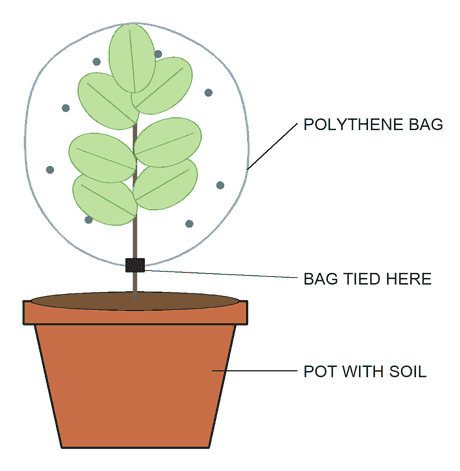
(a) Name the process which is being demonstrated.
(b) Why was the pot with its soil left uncovered by the polythene bag ?
(c) Why was the pot left in sunlight ?
(d) Suppose that the pot in this experiment was placed inside a dark room instead of placing it in sunlight for some time. What difference would be noticed ?
Solve with AIWritten solution
Solution:
Concept: Transpiration is the loss of water as water vapour from the aerial parts of a plant, mainly through the stomata of the leaves. Anything that speeds up evaporation, or keeps the stomata open, makes it faster.
Step 1 — (a) The process.
Water drops form on the inside of the bag because water vapour given out by the leaves condenses on the cool polythene. The process is transpiration.
Step 2 — (b) Why the pot was left uncovered.
If the pot and soil were inside the bag, water evaporating from the soil and the pot would also collect as drops. Leaving them out makes sure the drops can come only from the leafy shoot.
Step 3 — (c) Why sunlight.
In sunlight the stomata open and the warmth speeds up evaporation, so transpiration is faster and the drops appear quickly.
Step 4 — (d) In a dark room.
In the dark the stomata close, so transpiration is very slow. Very few or no water drops would appear inside the bag.
Watch out: The bag covers only the shoot; covering the soil would spoil the experiment.
Therefore, (a) transpiration; (b) so that drops come only from the shoot; (c) to make transpiration fast; (d) few or no drops, as the stomata close in the dark.
- 353 marks
Question 35
Briefly explain, how transpiration helps in the upward conduction of water in plants?
Solve with AIWritten solution
Solution:
Concept: The transpirational pull is the suction set up in the xylem when the leaves lose water by transpiration. It is the main force that lifts water in tall plants.
Step 1 — Water is lost from the leaves.
During transpiration, water evaporates from the leaf cells and escapes through the stomata.
Step 2 — A suction is created.
The leaf cells replace this water from the xylem in the veins, which creates a suction (pull) in the xylem vessels.
Step 3 — The water column is pulled up.
This pull is passed down through the xylem of the stem to the roots, so water rises continuously from the roots to the leaves. This is the transpirational pull.
Step 4 — Why the column does not break.
Water molecules stick to one another (cohesion) and to the walls of the xylem (adhesion), so the thin column of water stays unbroken. In this way water reaches the tops of the tallest trees, more than 100 m high.
Watch out: The pull starts at the leaves, not in the roots; root pressure is a separate, weaker push.
Therefore, transpiration creates a suction in the xylem that pulls an unbroken column of water up from the roots to the leaves.
- 363 marks
Question 36
How does temperature, light intensity and wind affect transpiration ?
Solve with AIWritten solution
Solution:
Concept: Transpiration is the loss of water as water vapour from the aerial parts of a plant, mainly through the stomata of the leaves. Anything that speeds up evaporation, or keeps the stomata open, makes it faster.
Step 1 — Temperature.
Transpiration is faster on hot days, because water evaporates faster when it is warm. It is slower when it is cool.
Step 2 — Light intensity.
In bright light the stomata open to take in carbon dioxide for photosynthesis, so more water vapour escapes and transpiration is faster. At night the stomata are closed, so transpiration almost stops.
Step 3 — Wind.
Transpiration is more when the wind blows fast, because the wind carries the water vapour away from the leaf surface and brings drier air. In still air it is slower.
Therefore, transpiration increases with higher temperature, brighter light and faster wind.
- 3711 marks
Question 37
Draw a magnified view of the root hair and label all its parts neatly. From the parts labelled by you, name the parts matching the description given below:
(a) Outermost layer of the root
(b) Unicellular outgrowth
(c) Part that is freely permeable
(d) Part that is semi-permeable
Solve with AIWritten solution
Solution:
Concept: A root hair is a long outgrowth of a single epidermal cell of the root. Like any plant cell it has a freely permeable cell wall, a semi-permeable cell membrane, cytoplasm, a nucleus and a large vacuole of cell sap.
Step 1 — Draw and label the root hair.
The diagram shows a magnified root hair growing out of one epidermal cell, with its neighbouring epidermal cells.
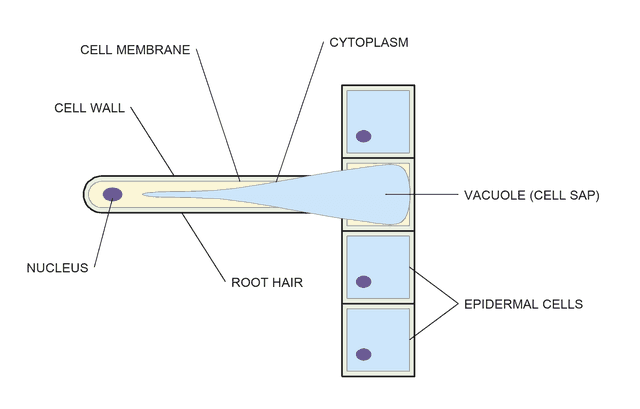
Labels: cell wall, cell membrane, cytoplasm, nucleus, vacuole (cell sap), root hair, epidermal cells.
Step 2 — (a) Outermost layer of the root.
The outermost layer of the root is the epidermis (the layer of epidermal cells).
Step 3 — (b) Unicellular outgrowth.
The root hair is an outgrowth of a single epidermal cell.
Step 4 — (c) Freely permeable part.
The cell wall lets almost everything through.
Step 5 — (d) Semi-permeable part.
The cell membrane lets water through but stops many larger molecules.
Watch out: A root hair is part of one cell, not a separate cell or a many-celled structure.
Therefore, (a) epidermis, (b) root hair, (c) cell wall, (d) cell membrane.
- 388 marks
Question 38
After playing outside on a hot sunny afternoon, Aarav came home sweating and drank a lot of water. Later in the evening, he noticed that the plant on his study table looked dull and droopy. Wondering if plants also "get hot" in summer, he asked his mother what was wrong. She told him that just like humans sweat to cool down, plants also lose water through a process that helps them stay cool. But when too much water is lost, the plant starts to droop.
(a) What is the process by which plants lose water through their leaves?
(b) Through which part of the leaf does this water loss mainly happen?
(c) Besides cooling the plant, how else does transpiration help the plant?
(d) In transpiration, water is lost from the plant in the form of .......... (water vapour / water droplets).
(e) Draw a simple flow chart showing water movement from roots to leaves and then out of the plant.
(f) Aarav's mother said that once he waters the plant, it will look fresh again. What is the process by which roots absorb water from the soil?
Solve with AIWritten solution
Solution:
Concept: Water enters the root hairs by osmosis, rises in the xylem, and leaves the plant as water vapour through the stomata by transpiration. If more water is lost than taken in, the plant droops (wilts).
Step 1 — (a) The process.
Plants lose water through their leaves by transpiration.
Step 2 — (b) Where it happens.
Most of the water escapes through the stomata, the tiny pores in the epidermis of the leaf.
Step 3 — (c) Another use of transpiration.
It creates the transpirational pull, which lifts water and minerals up from the roots through the xylem.
Step 4 — (d) The form of the water.
The water is lost as water vapour, not as droplets.
Step 5 — (e) Flow chart.
The water follows this path:
Soil water → root hairs (by osmosis) → cortex of the root → xylem of the root → xylem of the stem → veins (xylem) of the leaf → leaf cells → stomata → air (as water vapour)
Step 6 — (f) How roots take in water.
When the soil is watered, the root hairs absorb water by osmosis, the cells become firm again and the plant looks fresh.
Watch out: The plant drooped because it lost more water than its roots could take in, not because it was "too hot" itself.
Therefore, (a) transpiration; (b) stomata; (c) it pulls water and minerals up the xylem; (d) water vapour; (e) soil → root hairs → cortex → xylem (root, stem, leaf) → leaf cells → stomata → air; (f) osmosis.
What Class 8 Biology Ch 1 covers
The sections of the chapter, in the order the book takes them. Every question above comes from one of these.
- 01Transport in Plants
- 02The Conducting or Transporting Tissues
- 03Transport of Food
- 04Water Absorption by the Roots
- 05Ascent of Sap
- 06Transpiration
More ways to study this chapter
The same chapter asked three other ways. Practise it, revise it, and see what the board has set on Ch 1 before.
Class 8 Biology Ch 1 questions students ask
How many questions are there in Class 8 Biology Ch 1?
38 questions. Every one is solved step by step on this page.
Are these Class 8 Biology solutions free?
Yes. Every question and its full working is free to read, with no account needed.
Can I download the Class 8 Biology Ch 1 solutions as a PDF?
There is no PDF to download. Every solution is on this page instead, which means it is searchable, always the current syllabus, and readable on a phone. Use your browser's print option if you want it on paper.