
Opening your dashboard
Class 8 Biology Chapter 1 Transport in Plants: Competency-Based Questions (CBQ)
40 questions on Chapter 1, each worked through on its own page with the AI tutor. Class 8 Biology, ICSE 2026-27.
40 questions
1–5 marks · Mixed difficulty
- 11 mark
Question 1
Cognitive domain: Application
A florist in Pune wants blue flowers for a wedding. She stands freshly cut stalks of white tuberose (rajnigandha) in a jar of water mixed with a harmless blue food colour. By the next morning the white petals have turned bluish. She cuts a thin slice across one stalk and looks at it under a microscope. What is she most likely to see ?
- 21 mark
Question 2
Cognitive domain: Analysis
A glass trough is divided into two parts, X and Y, by a semi-permeable membrane. Sugar solutions are poured into the two parts up to the same level, as shown in the figure.

The trough is left undisturbed for two hours. Which change will be seen ?
- 31 mark
Question 3
Cognitive domain: Understanding
On a hot May afternoon, Ishaan touches the leaves of a well-watered hibiscus plant on his balcony. Beside it stands an artificial plant with green plastic leaves. Both have been in the same sunlight since morning. The real leaves feel much cooler than the plastic ones. What is the best explanation ?
- 41 mark
Question 4
Cognitive domain: Analysis
A scientist compared the soil water around a root hair with the cell sap inside the root hair.
Substance In the soil water In the cell sap of the root hair Water molecules more less Potassium (a mineral) less more The root hair keeps on taking in both water and potassium from the soil. Which row correctly names the way each of them enters ?
Row Water enters by Potassium enters by P active transport osmosis Q osmosis osmosis R osmosis active transport S active transport active transport - 51 mark
Question 5
Cognitive domain: Understanding
Assertion (A): Food can pass along a sieve tube from one cell to the next, even though the cells are separate and are joined end to end.
Reason (R): The end walls of the sieve tube cells are perforated and form sieve plates.
- 61 mark
Question 6
Cognitive domain: Analysis
Assertion (A): A plant growing in soil that is short of potassium loses less water by transpiration than a healthy plant of the same kind.
Reason (R): Potassium is a micronutrient, so a plant needs it only in very small amounts.
- 71 mark
Question 7
Cognitive domain: Application
An old neem tree in a school in Jaipur fell in a storm in 2024. The school records show that it had grown from a seed that sprouted in 1979. The gardener sawed the trunk straight across, and the students of Class 8 counted the rings on the cut surface.
Complete the sentence :
The students should count about ______ rings, because the rings seen in the trunk of an old tree are rings of ______ tissue.
- 81 mark
Question 8
Cognitive domain: Application
The leaves of a farmer's wheat crop are turning yellow. A neighbour says, "Yellow leaves mean the soil has too little iron." But the farmer also notices that the wheat grains are wrinkled.
Complete the sentence :
Yellow leaves together with wrinkled cereal grains show that the soil is short of ______, which is a ______-nutrient needed by the plant to make all its proteins.
- 91 mark
Question 9
Cognitive domain: Understanding
Rohan dips two clean glass tubes, both open at the two ends, into a bowl of coloured water. One tube is very narrow and the other is wide. Water rises on its own inside both tubes, but not to the same height. His teacher says that the xylem vessels of a plant behave like such tubes.
Complete the sentence :
The water rises higher in the ______ tube, and the force that makes water rise like this in the xylem vessels is called ______ force.
- 102 marks
Question 10
Cognitive domain: Evaluation
While revising, Nikhil tells his friend, "Food moves in a plant just like water flows down a pipe. It only goes downwards from the leaves, and the plant does not have to spend any energy on it."
Is Nikhil right ? Judge his statement and correct it, giving two points.
- 112 marks
Question 11
Cognitive domain: Application
Meenal's mother bought a bunch of coriander leaves in the morning. By evening the leaves had become limp. She dipped the bunch in a bowl of plain water, and in about an hour the leaves were firm and fresh again. Meenal asked, "Would the leaves freshen up faster if we add a lot of salt to the water ?"
(a) Explain how the limp leaves became firm in plain water.
(b) Answer Meenal's question, with a reason.
- 122 marks
Question 12
Cognitive domain: Application
For a science exhibition, Arjun keeps a potted tomato plant inside a closed glass case. The soil is kept wet, and the air inside the case soon becomes very humid. He expects the plant to grow very well because it has plenty of water. But after some weeks the plant looks weak and is growing poorly.
Using what you know about transpiration, explain why plenty of water has not helped the plant.
- 135 marks
Question 13
Cognitive domain: Analysis
Case: Sana wrapped the pot and soil of a well-watered potted balsam plant in polythene, so that water could be lost only from the plant. She kept the plant on an open terrace on a clear summer day and weighed it at the start and at the end of some one-hour periods. The loss in mass is the mass of water lost by the plant in that hour.
One-hour period Water lost by the plant 6 a.m. to 7 a.m. 4 g 9 a.m. to 10 a.m. 9 g 12 noon to 1 p.m. 16 g 3 p.m. to 4 p.m. 12 g 6 p.m. to 7 p.m. 5 g 9 p.m. to 10 p.m. 1 g (a) In which period did the plant lose water the fastest ? How many times as much water did it lose in this period as in the period from 6 a.m. to 7 a.m. ?
(b) Give two reasons why the loss of water went up from early morning to midday.
(c) Explain why the plant lost only 1 g of water between 9 p.m. and 10 p.m.
(d) The next day was cloudy and very humid, with no wind. Would the reading for 12 noon to 1 p.m. be more than, equal to or less than 16 g ? Give a reason.
- 145 marks
Question 14
Cognitive domain: Evaluation
Case: Kavya filled four test tubes P, Q, R and S with water up to the same mark. She set them up as shown in the figure. The two balsam plants were of the same size and had their roots fully dipped in water. She kept all four tubes side by side near a sunny window. After 24 hours she measured how far the water level had fallen in each tube. Both plants were still fresh.
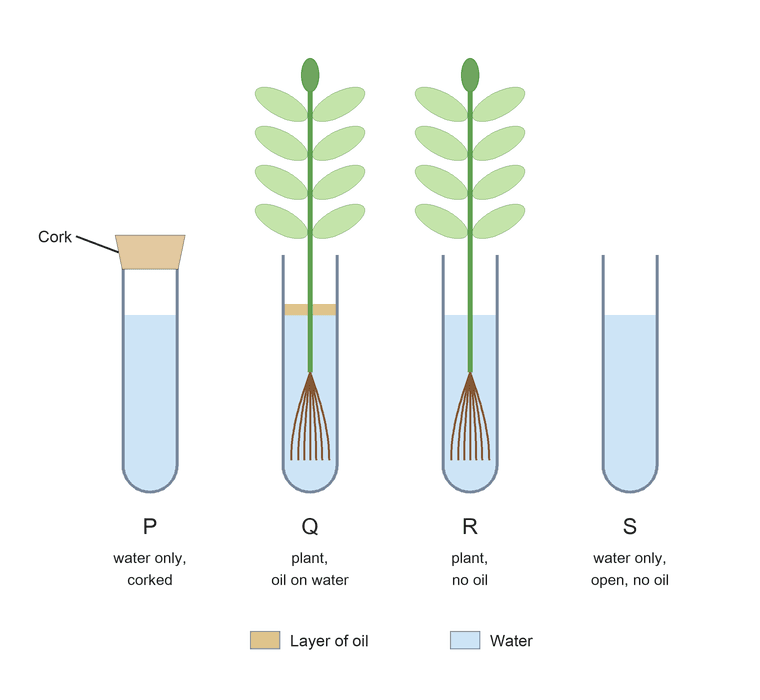
Test tube What it contains Fall in water level P water only, mouth closed with a cork 0 mm Q plant, layer of oil on the water 14 mm R plant, no oil 19 mm S water only, open, no oil 5 mm (a) The water level did not fall in P but it fell in S. Why ?
(b) Kavya writes, "The plant in R absorbed more water than the plant in Q, because the level fell more in R." Use the readings to judge whether she is right.
(c) Her friend says, "Tubes P and S have no plant, so they were a waste of time." Do you agree ? Give a reason.
(d) The plant in Q took in water, yet it did not grow heavier by that much. Where did most of this water finally go ? Name the tissue that carried it up.
- 154 marks
Question 15
Cognitive domain: Creativity
Case: The Science Club of a school wants to check the statement, "A plant that does not get nitrogen shows yellowing of leaves." The lab has two ready-made nutrient solutions. Solution 1 has all the minerals a plant needs. Solution 2 has all the minerals except nitrogen. The club also has ten healthy maize seedlings of the same size, two glass jars and cotton wool.
(a) Plan how the club should set up the experiment. State the one thing that must be different between the two jars and two things that must be kept the same.
(b) What should the club observe, and for how long ? Draw a table in which the observations can be recorded.
(c) What result would support the statement ? Explain, from the role of nitrogen in a plant, why such a result is expected.
- 161 mark
Question 16
Cognitive domain: Understanding
Ananya listed four movements that go on in a mustard plant growing in a field.
P. Water moves from the roots to the leaves.
Q. Sucrose solution moves from the leaves to the roots.
R. Oxygen moves from the leaf cells into the air in the daytime.
S. Carbon dioxide moves from the air into the leaf cells in the daytime.
Which of these movements are carried out by the conducting system of the plant ?
- 171 mark
Question 17
Cognitive domain: Analysis
(Hypothetical experiment.) A student wants to find out which kind of transport in a stem needs energy from the living cells. She treats a short length of the stem of a leafy potted plant with a chemical that stops the living cells there from releasing energy. The chemical does not harm dead cells and does not block any tube. Which result is the most likely ?
- 181 mark
Question 18
Cognitive domain: Application
(Hypothetical data.) A potted bean plant absorbed mL of water through its roots in one hot day. The plant kept or used up only mL of this water, for example in photosynthesis. What percentage of the absorbed water left the plant as water vapour ?
- 191 mark
Question 19
Cognitive domain: Analysis
The figure shows the soil water and a row of touching cells of a root: a root hair cell P, whose hair reaches into the soil water, and two inner root cells, Q and R. The number in each shows the amount of dissolved substances in the soil water or in the cell sap. (Hypothetical units.)

All the cell membranes are semi-permeable. Which statement correctly describes the movement of water in this row ?
- 201 mark
Question 20
Cognitive domain: Application
Assertion (A): On a dry, windy afternoon, wheat plants on an open hilltop lose water by transpiration faster than similar wheat plants in a sheltered valley nearby, where the air is still. The temperature, the humidity and the sunlight are the same in both places.
Reason (R): When the wind is blowing faster, the water vapour moves away faster from the surface of the leaves.
- 211 mark
Question 21
Cognitive domain: Analysis
Assertion (A): Water enters the root hairs faster from a very dilute soil solution than from a more concentrated soil solution.
Reason (R): A root hair has a large surface area, because it is a long outgrowth of an epidermal cell of the root.
- 221 mark
Question 22
Cognitive domain: Application
A farmer cuts a young maize plant close to the ground one evening, so that only the stump and the roots are left in the moist soil. Next morning a clear liquid is seen oozing out of the cut surface of the stump, though no leaf is left on it. Which force mainly pushes this liquid out ?
- 231 mark
Question 23
Cognitive domain: Analysis
The graph shows the water lost by the same potted plant in each hour on three different days. (Hypothetical data.)
Day 1 was hot, dry and sunny.
Day 2 was hot and sunny, but the air was very humid.
Day 3 was cool, cloudy and humid.
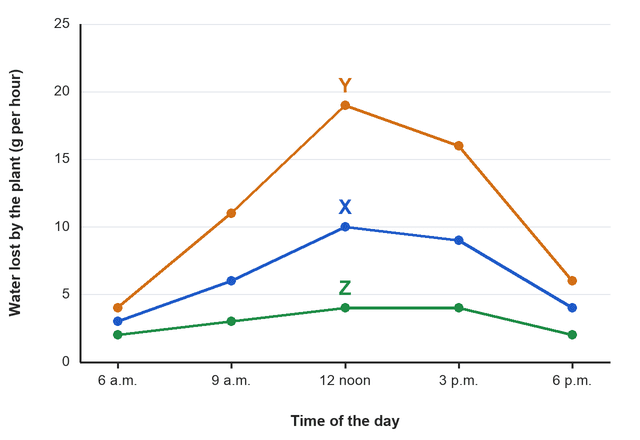
Which row correctly matches the curves X, Y and Z to the days ?
- 241 mark
Question 24
Cognitive domain: Analysis
A school garden has three pots, P, Q and R, of the same plant. The soil of each pot is short of one nutrient, and each pot is short of a different one. The nutrients are iron, manganese and potassium. The table shows what the students saw. (Hypothetical data.)
Pot What was seen P Yellowing of leaves, with grey spots Q Poor growth, with a reduced rate of transpiration R Yellowing of leaves Which row correctly names the nutrient that each pot is short of ?
- 251 mark
Question 25
Cognitive domain: Analysis
(Hypothetical data.) A student kept the same well-watered potted plant, with its pot and soil wrapped in polythene, in a plant room for one hour at each of three temperatures. The light, the humidity and the still air were kept the same each time. The table shows the loss in mass of the plant in each hour.
Temperature of the room Loss in mass in one hour °C g °C g °C g Which conclusion is best supported by these results ?
- 262 marks
Question 26
Cognitive domain: Evaluation
Dev's potted plant looks dry. He says, “A plant can take in water through its leaves and stem just as it does through its roots. So I will sprinkle water on the leaves every day and not water the soil.”
Is Dev's plan sound ? Judge it and give two points to support your answer.
- 272 marks
Question 27
Cognitive domain: Analysis
Two kinds of cells, M and N, are seen in a long section of a xylem. Both conduct water upwards.
Cell M is a tube-like structure that is open at both ends and is placed one above the other with similar cells to form a long channel.
Cell N is an elongated dead cell with tapering ends, and its walls have thickenings with lateral pores.
(a) Name the cells M and N.
(b) Through which of the two can water move upwards more directly ? Give a reason.
- 282 marks
Question 28
Cognitive domain: Understanding
At night the stomata of a m tall tree are closed and transpiration almost stops. Yet the water in the xylem vessels of the tree does not break up into pieces or slide back down to the roots.
Explain this, using the two properties of water molecules that help in the ascent of sap.
- 292 marks
Question 29
Cognitive domain: Understanding
Priya dips one end of a strip of blotting paper in a bowl of water, and in another bowl she dips the roots of a young balsam plant. In both bowls the water is taken up. Her friend says, “The same process is taking up the water in both bowls.”
Is the friend right ? Name the process in each case.
- 302 marks
Question 30
Cognitive domain: Application
(Hypothetical data.) Seedlings of the same kind and size were grown in the same moist soil. The table shows the number of root hairs per square millimetre of the root surface of each seedling and the volume of water absorbed in one hour by a cm length of its main root.
Seedling Root hairs per square millimetre Water absorbed in one hour A mL B mL C mL (a) State how the volume of water absorbed changes as the number of root hairs increases.
(b) Name the feature of the root hairs that explains this, and predict the volume of water absorbed in one hour by a seedling of the same kind with root hairs per square millimetre, if the pattern goes on.
- 312 marks
Question 31
Cognitive domain: Evaluation
Rani's brother says, “A plant makes its own food by photosynthesis, so it needs only water, carbon dioxide and sunlight. The minerals of the soil are not needed.”
Evaluate this statement and give two points to support your answer.
- 323 marks
Question 32
Cognitive domain: Application
(Hypothetical data.) Two identical potted balsam plants, L and D, were kept at the same temperature in a room with the same humidity. Plant L was kept in bright light and plant D in a dark cupboard. The pot and the soil of each plant were wrapped in polythene, and the loss in mass of each plant was measured for one hour.
Plant Condition Loss in mass in one hour L bright light g D dark cupboard g (a) How many times as much water did plant L lose as plant D ?
(b) Explain why plant L lost more water.
(c) Plant D is then taken out of the cupboard and kept beside L in the same bright light. After two hours in the light, its loss in mass is measured for one more hour. Predict whether D will now lose about g, about g or much more than g. Give a reason.
- 333 marks
Question 33
Cognitive domain: Analysis
(Hypothetical data.) A farmer grew maize in four identical plots. Plot 1 got all the nutrients. Each of the other plots got all the nutrients except one. The table shows what the farmer found after six weeks.
Plot Nutrient left out What was found Height of the plants 1 none healthy plants cm 2 nitrogen yellowing of leaves cm 3 potassium poor growth, reduced rate of transpiration cm 4 iron yellowing of leaves cm (a) Which missing nutrient reduced the height the most ? By what percentage, to the nearest whole number, was the height reduced compared with plot 1 ?
(b) Classify nitrogen, potassium and iron as macronutrients or micronutrients.
(c) Rohit says, “Iron is a micronutrient, needed only in very small amounts, so leaving it out cannot matter much.” Use the data for plot 4 to judge his statement.
- 343 marks
Question 34
Cognitive domain: Application
(Hypothetical data.) The cell sap of the root hairs of a seedling has units of dissolved substances. The seedling is tested in four soils, A, B, C and D. The table shows the amount of dissolved substances in the water of each soil.
Soil Dissolved substances in the soil water A units B units C units D unit (a) In which of the soils will water enter the root hairs ? Give a reason.
(b) In which soil will the seedling lose water to the soil ? What will happen to the seedling ?
(c) What will you expect in soil B ?
- 353 marks
Question 35
Cognitive domain: Application
Before moving a young guava sapling from a nursery bag to a field, a gardener digs out a large ball of soil around its roots and carries the sapling with this soil. He plants it in the field with the soil ball, waters it well and keeps it shaded for a few days.
(a) Name the part of the root that absorbs water. Why is it useful to keep the soil ball around the roots ?
(b) If the sapling is pulled out of the soil and left with bare roots in the sun, it wilts. Explain why.
(c) Why does shading the sapling help it in the first few days ?
- 363 marks
Question 36
Cognitive domain: Evaluation
Aarav copied three statements from a poster into his notebook. For each statement, say whether it is correct or not, and correct it if it is wrong.
1. Transpiration is only a waste of water, so a plant would be better off without it.
2. Transpiration goes on at the same rate in dry air and in humid air.
3. The cool air near a tree rises up and goes away, so its cooling effect is soon lost.
- 374 marks
Question 37
Cognitive domain: Analysis
Case: A farmer near Meerut wanted to know how long the leafy shoots of his potato plants should be left on the plants. He cut the shoots of different plants at ground level on different days after planting, and weighed the tubers (potatoes) of each plant at the end. (Hypothetical data.)
Shoots were cut after Yield of tubers per plant days g days g days g (a) By how many grams was the yield higher when the shoots were cut after days than after days ? How many times as much was it ?
(b) Explain why the yield rises the longer the leafy shoots are left on the plants.
(c) Name the tissue that carries the food to the tubers, and the form in which the food is carried.
- 384 marks
Question 38
Cognitive domain: Analysis
Case: Aman cut three leafy twigs of a balsam plant under water and stood them in red-coloured water, as shown. Twig A kept all its leaves. Twig B had all its leaves removed. Twig C kept its leaves, but vaseline was smeared on both surfaces of every leaf. He kept all three in the same sunny place. After minutes he cut the stems to measure how far the red water had risen above the water level. (Hypothetical data.)

Twig Rise of the red water in minutes A cm B cm C cm (a) Name the tissue through which the red water rose. How many times as high did the red water rise in A as in B ?
(b) Explain why the red water rose much less in B and in C than in A.
(c) The twigs have no roots. Which force raised the red water in A ? Explain why root pressure cannot be the cause.
- 394 marks
Question 39
Cognitive domain: Creativity
Case: To help younger students remember transport in plants, a class compares the plant with a town that gets its water and food through pipes and delivery vans.
(a) Make a table with three rows, Xylem, Phloem and Root hair. For each, name one thing in a town that it is like and give one feature of the plant part that makes the comparison fit.
(b) Every comparison has its limits. Give one way in which the xylem is not like a water pipe that is filled by a pump, and one way in which the phloem is not like a one-way road.
(c) Invent your own comparison for transpiration, and say one thing that it shows correctly.
- 405 marks
Question 40
Cognitive domain: Evaluation
Case: In the forests of Madhya Pradesh, teak trees shed all their leaves in the dry months of March and April. New leaves grow when the rains return in June. A forest officer measured the water lost in one day by the same teak tree at two times of the year. (Hypothetical data.)
Time of the year State of the tree Water lost in one day August, in the rains full of leaves litres April, in the dry season no leaves litres (a) How many times as much water did the tree lose when it was full of leaves as when it had no leaves ?
(b) Explain why the tree without leaves loses so much less water.
(c) A student says, “Shedding the leaves is a waste, because a tree without leaves cannot make food. A tree that keeps its leaves in the dry season would be better off.” Evaluate this statement.