
Opening your dashboard
Class 8 Biology Chapter 1 Transport in Plants: Practice Questions
47 questions on Chapter 1, each worked through on its own page with the AI tutor. Class 8 Biology, ICSE 2026-27.
47 questions
1–5 marks · Mixed difficulty
- 11 mark
Question 1
Bloom's level: Remember
In a green plant, water and minerals are taken in by the ______, while food is made by the ______.
- 21 mark
Question 2
Bloom's level: Remember
Which of the following cells of the xylem tissue are living ?
- 31 mark
Question 3
Bloom's level: Remember
The mineral nutrient that is involved in the opening and closing of stomata is :
- 41 mark
Question 4
Bloom's level: Remember
Xylem and phloem together form the :
- 51 mark
Question 5
Bloom's level: Understand
Water moves from the soil into a root hair mainly because :
- 61 mark
Question 6
Bloom's level: Understand
Starch stored in a leaf is changed into sucrose before it is moved to the roots, because :
- 71 mark
Question 7
Bloom's level: Understand
Transpiration hardly takes place at night mainly because :
- 81 mark
Question 8
Bloom's level: Apply
A eucalyptus tree is about 60 m tall. The force mainly responsible for lifting water up to its topmost leaves is :
- 91 mark
Question 9
Bloom's level: Apply
A farmer finds purple and red spots on the leaves of his maize plants, and the seeds he sowed from the last crop were slow to germinate. The soil is most likely short of :
- 101 mark
Question 10
Bloom's level: Analyse
Assertion (A): Tracheids and vessels give mechanical strength and support to the plant.
Reason (R): The walls of tracheids and vessels have thickenings.
- 111 mark
Question 11
Bloom's level: Evaluate
Assertion (A): On a hot afternoon, it feels cooler under a big leafy tree than under a tin shed.
Reason (R): The leaves give out drops of cold liquid water that fall on the people below.
- 121 mark
Question 12
Bloom's level: Analyse
Assertion (A): Fresh grapes kept in a strong sugar solution for two hours shrink.
Reason (R): Root hairs take in minerals from the soil by active transport, using energy.
- 132 marks
Question 13
Bloom's level: Understand
Tracheids and xylem fibres are both dead, thick-walled cells of the xylem. Explain how their jobs differ.
- 142 marks
Question 14
Bloom's level: Understand
What is root pressure? Explain how it helps in the ascent of sap.
- 152 marks
Question 15
Bloom's level: Understand
Give two differences between diffusion and osmosis.
- 162 marks
Question 16
Bloom's level: Apply
A gardener carefully removes a narrow ring of the outer tissues, including the phloem, all round the stem of a young tree, but leaves the xylem untouched. After a few weeks, the stem just above the ring swells. Explain why.
- 172 marks
Question 17
Bloom's level: Apply
Two identical potted plants are kept at the same temperature in the same light. Plant P stands in front of a fan in a dry room; plant Q stands in a closed bathroom just after a hot shower. Which plant will transpire faster? Give two reasons.
- 182 marks
Question 18
Bloom's level: Apply
Ravi poured a large amount of chemical fertiliser around the base of a small plant and watered it lightly. Next day the plant had wilted. Explain this using osmosis.
- 192 marks
Question 19
Bloom's level: Apply
A leafy shoot is placed in a measuring cylinder of water, and a thin layer of oil is poured on the water. The reading is at 8 a.m. and at 2 p.m.
Find the volume of water taken up by the shoot and the average rate per hour. Why was the oil added?
- 202 marks
Question 20
Bloom's level: Analyse
Under a microscope, a student sees long cylindrical cells without a nucleus, placed end to end, with perforated end walls. A thin cell with a nucleus lies along the side of each one. Identify the tissue and the two kinds of cells, and state what passes through the perforations.
- 212 marks
Question 21
Bloom's level: Evaluate
Riya says, "Water rises to the top of a tree only because the roots push it up." Do you agree? Justify your answer.
- 221 mark
Question 22
Bloom's level: Understand
If the roots of a potted plant are badly damaged, its leaves soon stop making food. Why?
- 234 marks
Question 23
Bloom's level: Apply
Case: In a school garden, the tomato plants of one bed have yellow leaves, small deshaped leaves and stunted growth. A soil test shows that the bed is short of nitrogen and zinc.
(a) Which of these two nutrients is a macronutrient and which is a micronutrient? What do these terms mean?
(b) State the role of each nutrient in the plant.
(c) The gardener says, "Zinc is needed in such tiny amounts that its lack cannot matter." Explain why he is wrong, using the symptoms in this bed.
- 244 marks
Question 24
Bloom's level: Apply
A well-watered potted plant has its pot and soil fully wrapped in polythene, leaving only the shoot open. A second pot with the same soil but no plant is wrapped the same way. Both are weighed :
Time Pot with plant Pot without plant 9 a.m. 3 p.m. (a) How much water did the plant lose, and what was the average rate per hour?
(b) Name the process and the main part of the plant through which the water was lost.
(c) Why was the soil wrapped, and why was the second pot used?
- 254 marks
Question 25
Bloom's level: Apply
Case: A nursery owner has to send 200 young mango saplings by open truck to a town 300 km away. It is a hot, sunny, windy summer day. His helper cuts off about half the leaves of each sapling, covers the saplings with wet sacking, and suggests driving at night.
(a) Which conditions of the day would make the saplings lose water fast? Name three.
(b) How does cutting off some leaves help the saplings?
(c) Explain how the wet sacking and the night journey each reduce the loss of water.
- 264 marks
Question 26
Bloom's level: Analyse
Three bowls each received raisins of mass . After two hours the raisins were drained, dried on the outside and weighed :
Bowl Liquid Final mass of raisins A Tap water B Weak sugar solution C Very strong sugar solution (a) Find the percentage change in mass in bowls A and C.
(b) Explain the results of bowls A and C, naming the process in each.
(c) Why did the raisins in bowl B gain less mass than those in bowl A?
- 273 marks
Question 27
Bloom's level: Analyse
In an experiment, vaseline is smeared on both surfaces of every leaf of a potted plant, which is then kept in sunlight. An untreated plant of the same kind is kept beside it.
(a) What happens to transpiration in the treated plant, and why?
(b) Analyse how this affects the absorption of water and minerals by its roots.
(c) Analyse why the treated plant may get hotter in the sun than the untreated plant.
- 284 marks
Question 28
Bloom's level: Evaluate
Kabir wrote this summary of transport in plants:
- Soil water enters the root hair by active transport.
- Water then moves up the stem through the phloem.
- Food made in the leaves moves only downwards, as starch.
- Most of the water reaching the leaves leaves the plant as liquid water through the stomata.
Check each statement. Say whether it is correct, and rewrite any incorrect one correctly.
- 295 marks
Question 29
Bloom's level: Create
Design an experiment to show that wind increases the rate of transpiration. You may use two similar leafy shoots, two measuring cylinders, water, oil, a table fan and a clock.
(a) Describe your set-up, including what you will keep the same.
(b) Draw up a table to record your readings for three hours, and fill it with the kind of result you expect.
(c) State your conclusion and one precaution.
- 305 marks
Question 30
Bloom's level: Create
Construct two flow charts for a green plant :
(a) The path of a water molecule from the soil to the air, naming the process or force at each step.
(b) The path of food from a leaf to a root, naming the tissue and the form in which it moves.
(c) Add one line under each chart stating whether that movement is one-way or two-way in the plant.
- 311 mark
Question 31
In which one of the following pairs are both the cells dead ?
- 321 mark
Question 32
Which one of the following nutrient elements is needed to make plant hormones and also activates enzymes ?
- 331 mark
Question 33
Water rises in the xylem vessels as an unbroken column. The tendency of the water molecules to remain joined to one another is called :
- 341 mark
Question 34
Fill in the blank :
The food stored in the leaves as starch is carried through the phloem to the other parts of the plant in the form of a .......... solution.
- 351 mark
Question 35
Write true or false :
Transpiration is the loss of water in the form of liquid drops from the roots of a plant.
- 362 marks
Question 36
A root hair has an outer cell wall and an inner cell membrane. How do these two layers differ in the substances they allow to pass through them ? Which of the two makes it possible for the root hair to take in water by osmosis ?
- 372 marks
Question 37
Suppose a plant went on absorbing water from the soil but lost none of it by transpiration. What would happen to the concentration of the sap inside the plant ? How would this affect the plant ?
- 384 marks
Question 38
A trough is divided into two sides, A and B, by a membrane M. Side A is filled with water and side B with a strong sugar solution, up to the same level. The membrane M has pores through which the water molecules can pass but the sugar molecules cannot.
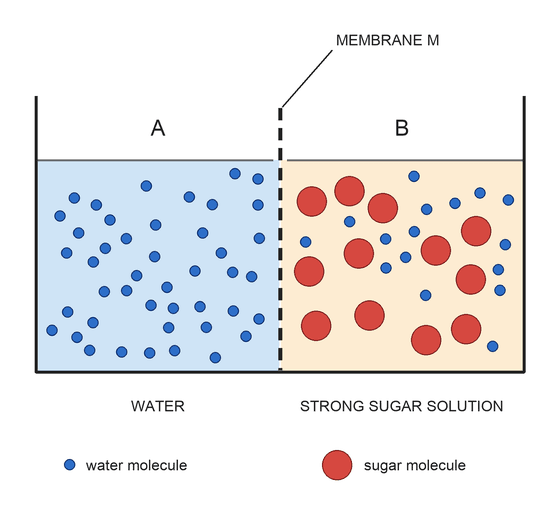
(a) What is a membrane like M called ? Name the process by which water molecules move across it.
(b) State what will be seen in the levels of the liquids on the two sides after some time. Give a reason for your answer.
(c) In a root hair growing in moist soil, name the part that acts like the membrane M, and the liquid that takes the place of the strong sugar solution.
- 394 marks
Question 39
Two young balsam plants of the same size were washed and placed in two test tubes, P and Q, as shown. In P the roots dip fully in water coloured with a red dye, and a few drops of oil float on the water. In Q there is only a little water, and the roots hang well above it. The level of the water in P was marked, and both test tubes were left for 24 hours.
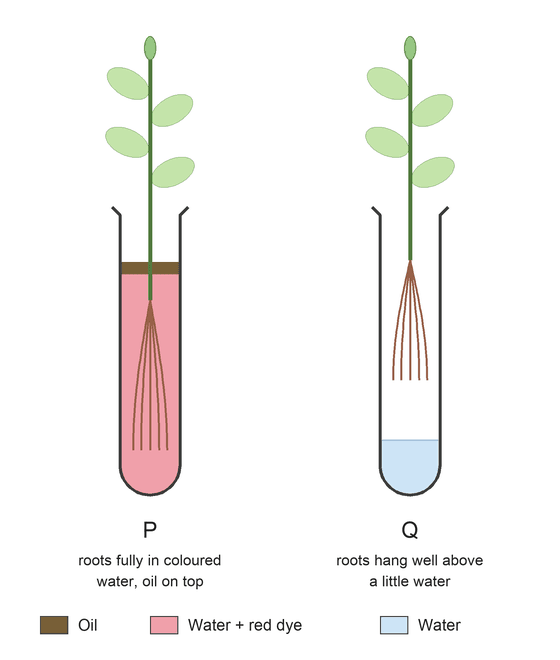
(a) State two changes that will be seen in test tube P after 24 hours. Name the tissue that carries the coloured water to the leaves.
(b) What will happen to the leaves of the plant in test tube Q ? Explain why.
(c) Why was oil put on the water in test tube P ?
- 405 marks
Question 40
Four potted plants of the same kind and size, with the same number of leaves, were watered equally. The pot and the soil of each were wrapped in a polythene sheet so that water could escape only from the shoot. Each plant was weighed, kept for 3 hours in the condition shown in the table below, and weighed again.
Plant Condition Loss in mass in 3 hours W sunlight, still air 12 g X sunlight, under a fan 21 g Y dark cupboard, still air 1.5 g Z sunlight, inside a closed glass case with wet cloth hung in it 4.5 g (a) Which factor is being studied by comparing plants W and X ? What does the result show, and why does this happen ?
(b) Explain why plant Y lost the least water.
(c) Calculate the average mass of water lost per hour by plant W and by plant Z. Give a reason for the difference.
- 411 mark
Question 41
Class 8 Sample Paper 1 · Section A
What are the functions of phloem?
- 421 mark
Question 42
Class 8 Sample Paper 1 · Section A
When is transpiration reduced?
- 433 marks
Question 43
Class 8 Sample Paper 1 · Section C
What are the factors affecting transpiration?
- 445 marks
Question 44
Class 8 Sample Paper 1 · Section E
Write an experiment to show that a plant loses water from its leaves.
- 451 mark
Question 45
Class 8 Sample Paper 2 · Section A
Why does transpiration reduce on humid days?
- 462 marks
Question 46
Class 8 Sample Paper 2 · Section B
Define the following:
Semipermeable membrane
- 473 marks
Question 47
Class 8 Sample Paper 2 · Section C
How does upward conduction of water take place?