
Opening your dashboard
Class 7 Physics Chapter 7: Electricity and Magnetism Solutions
76 textbook questions with step-by-step answers, free to read, for ICSE 2026-27.
Get talked through Ch 7, not just shown the answer
Reading a finished solution is not the same as being able to do it. The AI tutor takes one question at a time and works it with you, in your own words, until you can.
- Ask it out loud, in your own words
- It gives you the next step, not the answer
- Stuck on part (ii)? Start there
76 questions with solutions
1–4 marks · Mixed difficulty
- 11 mark
Question 1
Choose the correct answer from the multiple choices given below.
A freely suspended magnet rests in :
Solve with AIAnswer
(A) east-west direction
- Correct
(B) north-south direction
(C) north-east direction
(D) north-west direction.
Answer: (B) north-south direction
Concept: The earth behaves like a huge magnet, and its magnetic field acts everywhere on its surface. A freely suspended magnet lines up with this field, so it rests along the magnetic north-south line, which is very nearly the geographic north-south line.
Step 1 — See what the question asks.
A freely suspended magnet is one hung by a thread so that it can turn in a horizontal plane. We must find the direction in which it finally comes to rest.
Step 2 — Use the directive property.
The earth's magnetic field acts on the two poles of the suspended magnet and turns it until it lies along that field. So the magnet always settles with its north pole towards the north and its south pole towards the south.
Step 3 — Choose the direction.
So a freely suspended magnet rests in the north-south direction. If we turn it away and let go, it swings back to the same direction.
Watch out: Strictly the magnet points to the magnetic north, which differs from the geographic north by a small angle (the declination); it is still described as the north-south direction.
Why the other options are wrong:
- (A) east-west direction: East-west is at right angles to the earth's magnetic field, so the magnet does not stay in that direction.
- (C) north-east direction: North-east is not along the earth's magnetic field, so the magnet turns away from it.
- (D) north-west direction: North-west is not along the earth's magnetic field, so the magnet turns away from it.
Therefore, a freely suspended magnet rests in the north-south direction, option (B).
- 21 mark
Question 2
Choose the correct answer from the multiple choices given below.
Electromagnets are made up of :
Solve with AIAnswer
(A) steel
(B) copper
(C) brass
- Correct
(D) soft iron.
Answer: (D) soft iron
Concept: An electromagnet is a coil of insulated copper wire wound on a soft iron core. When current flows in the coil, the core becomes a strong magnet. When the current is switched off, the soft iron loses almost all its magnetism, so an electromagnet is a temporary magnet.
Step 1 — See what is needed.
An electromagnet must become a magnet when the current is switched on and lose its magnetism when the current is switched off. So its core must be a material that is magnetised and demagnetised very easily.
Step 2 — Choose the material.
Soft iron becomes a strong magnet as soon as current flows round it and loses almost all its magnetism as soon as the current stops. So electromagnets are made of soft iron.
Watch out: Copper is used in an electromagnet too, but only for the coil of wire; the magnet itself is the soft iron core.
Why the other options are wrong:
- (A) steel: Steel keeps its magnetism after the current stops, so it is used to make permanent magnets, not electromagnets.
- (B) copper: Copper is used for the wire of the coil, but copper is not a magnetic material, so it cannot be the core.
- (C) brass: Brass is an alloy of copper and zinc and is non-magnetic, so a magnet does not even attract it.
Therefore, electromagnets are made of soft iron, option (D).
- 31 mark
Question 3
Choose the correct answer from the multiple choices given below.
An electromagnet is used in :
Solve with AIAnswer
(A) electric oven
(B) ammeter
- Correct
(C) electric bell
(D) radio set.
Answer: (C) electric bell
Concept: An electric bell works on the magnetic effect of current. Its horse-shoe electromagnet pulls a soft iron armature, so the hammer fixed to the armature strikes the gong. The armature then breaks the circuit at the contact screw, and a spring brings it back, so the circuit is made and broken again and again.
Step 1 — See what the question asks.
We must find the device whose main working part is an electromagnet.
Step 2 — Recall the electric bell.
In an electric bell, current through a horse-shoe electromagnet makes it pull a soft iron armature. The hammer on the armature strikes the gong, and the bell rings. Without the electromagnet the bell cannot work.
Step 3 — Choose the device.
So an electromagnet is used in the electric bell.
Why the other options are wrong:
- (A) electric oven: An electric oven works on the heating effect of current, not on an electromagnet.
- (B) ammeter: An ammeter measures current; the common moving-coil ammeter uses a permanent magnet, so it is not the use of an electromagnet that the chapter describes.
- (D) radio set: A radio set does contain a loudspeaker that uses the magnetic effect of current, but its magnet is a permanent one; the electric bell is the device built around an electromagnet, so (C) is the better answer.
Therefore, an electromagnet is used in an electric bell, option (C).
- 41 mark
Question 4
Choose the correct answer from the multiple choices given below.
The purpose of armature in an electric bell is :
Solve with AIAnswer
- Correct
(A) to make and break the circuit
(B) to produce sound
(C) to produce magnetic field
(D) to provide spring action.
Answer: (A) to make and break the circuit
Concept: An electric bell works on the magnetic effect of current. Its horse-shoe electromagnet pulls a soft iron armature, so the hammer fixed to the armature strikes the gong. The armature then breaks the circuit at the contact screw, and a spring brings it back, so the circuit is made and broken again and again.
Step 1 — Recall where the armature is.
The armature is a piece of soft iron fixed on a springy metal strip, just in front of the poles of the electromagnet. At rest, the strip touches the contact screw, so the circuit is complete.
Step 2 — Follow what happens when it is pulled.
When current flows, the electromagnet pulls the armature. The strip leaves the contact screw, so the circuit is broken and the electromagnet loses its magnetism.
Step 3 — Follow what happens when it springs back.
The springy strip brings the armature back. It touches the contact screw again, so the circuit is made again and the whole cycle repeats.
Step 4 — State its purpose.
So the purpose of the armature is to make and break the circuit. This repeated make and break keeps the hammer striking the gong.
Watch out: The armature carries the hammer, but the sound itself comes from the gong being struck.
Why the other options are wrong:
- (B) to produce sound: The sound is produced when the hammer strikes the gong, not by the armature.
- (C) to produce magnetic field: The magnetic field is produced by the electromagnet (the coil on the U-shaped core), not by the armature.
- (D) to provide spring action: The spring action comes from the springy metal strip on which the armature is fixed.
Therefore, the armature in an electric bell makes and breaks the circuit, option (A).
- 51 mark
Question 5
Choose the correct answer from the multiple choices given below.
In a torch, the source of electricity is :
Solve with AIAnswer
(A) the bulb
(B) the switch
- Correct
(C) the cell
(D) the mains.
Answer: (C) the cell
Concept: A source of electricity supplies electrical energy to a circuit. Small, portable gadgets that need little electricity use cells, while heavy appliances use the mains supply (230 V a.c. in India), which comes from generators at a power station.
Step 1 — See what the question asks.
The source of electricity is the part that supplies the electrical energy to the circuit. The other parts only use or control it.
Step 2 — Look inside a torch.
A torch has dry cells, a switch and a bulb. If the cells are taken out, the bulb does not light even when the switch is pressed.
Step 3 — Choose the source.
So the source of electricity in a torch is the cell.
Why the other options are wrong:
- (A) the bulb: The bulb uses electrical energy to give light; it does not supply it.
- (B) the switch: The switch only puts the circuit on and off; it supplies no energy.
- (D) the mains: A torch is portable and is not plugged into the mains.
Therefore, in a torch the source of electricity is the cell, option (C).
- 61 mark
Question 6
Choose the correct answer from the multiple choices given below.
Electricity can flow through :
Solve with AIAnswer
(A) wood
(B) rubber
(C) plastic
- Correct
(D) copper wire.
Answer: (D) copper wire
Concept: Substances that allow electricity to flow through them are conductors: all metals, the human body and impure (ordinary) water. Substances that do not allow electricity to flow are insulators: rubber, plastic, dry wood, glass, paper, cotton, silk, wool and pure (distilled) water.
Step 1 — Sort the four materials.
Wood, rubber and plastic are insulators. Copper is a metal, and all metals are conductors.
Step 2 — Choose the conductor.
So electricity can flow through copper wire. This is why connecting wires are made of copper.
Why the other options are wrong:
- (A) wood: Dry wood is an insulator, so electricity does not flow through it.
- (B) rubber: Rubber is an insulator, so electricity does not flow through it.
- (C) plastic: Plastic is an insulator; it is used to cover wires for this reason.
Therefore, electricity can flow through copper wire, option (D).
- 71 mark
Question 7
Choose the correct answer from the multiple choices given below.
Electricity does not flow through :
Solve with AIAnswer
(A) human body
(B) animal's body
- Correct
(C) rubber
(D) silver.
Answer: (C) rubber
Concept: Substances that allow electricity to flow through them are conductors: all metals, the human body and impure (ordinary) water. Substances that do not allow electricity to flow are insulators: rubber, plastic, dry wood, glass, paper, cotton, silk, wool and pure (distilled) water.
Step 1 — Sort the four materials.
The human body and an animal's body are conductors. Silver is a metal and a very good conductor. Rubber is an insulator.
Step 2 — Choose the insulator.
So electricity does not flow through rubber. Electricians wear rubber gloves and rubber-soled shoes for this reason.
Why the other options are wrong:
- (A) human body: The human body is a conductor, which is why touching a live wire gives a shock.
- (B) animal's body: An animal's body, like the human body, is a conductor.
- (D) silver: Silver is a metal and one of the best conductors of electricity.
Therefore, electricity does not flow through rubber, option (C).
- 81 mark
Question 8
Choose the correct answer from the multiple choices given below.
We should not touch the switch with wet hands, otherwise :
Solve with AIAnswer
- Correct
(A) electricity may pass through our body
(B) electricity may not pass through the appliance
(C) circuit may break
(D) the switch may get off
Answer: (A) electricity may pass through our body
Concept: Water that has impurities in it (tap water, sweat) is a conductor, and so is the human body. Touching a switch with wet hands lets electricity pass through the water into the body and can give a dangerous electric shock.
Step 1 — See what wet hands do.
The water on wet hands is not pure; it has dissolved impurities, so it conducts electricity. It can make a path between the switch and our skin.
Step 2 — Follow the path of the current.
Our body is also a conductor. So electricity can pass from the switch through the water into our body and give us an electric shock.
Step 3 — Choose the danger.
So we must not touch a switch with wet hands, otherwise electricity may pass through our body.
Why the other options are wrong:
- (B) electricity may not pass through the appliance: Wet hands do not stop the appliance from working; the danger is to us, not to the appliance.
- (C) circuit may break: Touching the switch with wet hands does not break the circuit.
- (D) the switch may get off: The switch does not turn itself off because our hands are wet.
Therefore, electricity may pass through our body, option (A).
- 91 mark
Question 9
Choose the correct answer from the multiple choices given below.
The strength of an electromagnet can be increased :
Solve with AIAnswer
(A) by increasing the number of turns in the coil.
(B) by decreasing the number of turns in the coil.
(C) by inserting a soft iron core in the coil.
- Correct
(D) both (A) and (C)
Answer: (D) both (A) and (C)
Concept: The magnetic field of an electromagnet becomes stronger when the number of turns of the coil is increased and when the current in the coil is increased. A soft iron core placed inside the coil also makes the field much stronger.
Step 1 — Check option (A).
More turns of wire add up more magnetic field, so increasing the number of turns makes the electromagnet stronger. Option (A) is a correct way.
Step 2 — Check option (C).
A soft iron core inside the coil becomes strongly magnetised and adds its own field to that of the coil. Option (C) is also a correct way.
Step 3 — Choose the answer.
Both (A) and (C) are correct ways, so the answer is both (A) and (C). Increasing the current in the coil is a third way, but it is not among the options.
Watch out: When two separate options are both correct, choose the option that includes both.
Why the other options are wrong:
- (A) by increasing the number of turns in the coil: This is a correct way, but it is only one of the two correct ways given.
- (B) by decreasing the number of turns in the coil: Fewer turns make the electromagnet weaker, not stronger.
- (C) by inserting a soft iron core in the coil: This is a correct way, but it is only one of the two correct ways given.
Therefore, the strength is increased by more turns and by a soft iron core, option (D).
- 101 mark
Question 10
Choose the correct answer from the multiple choices given below.
Identify the correct advantages of dry cells:
Solve with AIAnswer
(A) Dry cells are light in weight and small in size.
(B) There is no fear of leakage in dry cells.
(C) Dry cells can be easily carried from one place to another.
- Correct
(D) All of the above
Answer: (D) All of the above
Concept: A source of electricity supplies electrical energy to a circuit. Small, portable gadgets that need little electricity use cells, while heavy appliances use the mains supply (230 V a.c. in India), which comes from generators at a power station.
Step 1 — Check each statement.
Dry cells are light and small. Their paste does not spill like a liquid, so there is no fear of leakage in normal use. Being small and light, they are easily carried from place to place.
Step 2 — Choose the answer.
All three statements are advantages of dry cells, so the answer is all of the above.
Why the other options are wrong:
- (A) Dry cells are light in weight and small in size: This is a true advantage, but it is only one of the three.
- (B) There is no fear of leakage in dry cells: This is a true advantage, but it is only one of the three.
- (C) Dry cells can be easily carried from one place to another: This is a true advantage, but it is only one of the three.
Therefore, all three are advantages of dry cells, option (D).
- 111 mark
Question 11
The following question is Assertion-Reason based. Choose the answer based on the codes given below.
Assertion (A) : A freely suspended magnet rests in north-east direction.
Reason (R) : Earth has its own magnetic field and the suspended magnet aligns with it.
Solve with AIAnswer
(A) Both A and R are true and R is the correct explanation of A
(B) Both A and R are true and R is not the correct explanation of A
(C) A is true but R is false
- Correct
(D) A is false but R is true
Answer: (D) A is false but R is true
Concept: The earth behaves like a huge magnet, and its magnetic field acts everywhere on its surface. A freely suspended magnet lines up with this field, so it rests along the magnetic north-south line, which is very nearly the geographic north-south line.
Step 1 — Judge the Assertion.
A freely suspended magnet rests in the north-south direction, not in the north-east direction. So the Assertion is false.
Step 2 — Judge the Reason.
The earth has its own magnetic field, and a freely suspended magnet turns until it lies along that field. So the Reason is true.
Step 3 — Choose the code.
The Assertion is false and the Reason is true. In fact the Reason explains why the magnet points north-south, not north-east.
Why the other options are wrong:
- (A): This needs both statements to be true, but the Assertion is false.
- (B): This needs both statements to be true, but the Assertion is false.
- (C): It is the other way round: the Assertion is false and the Reason is true.
Therefore, the Assertion is false but the Reason is true, option (D).
- 121 mark
Question 12
The following question is Assertion-Reason based. Choose the answer based on the codes given below.
Assertion (A) : In a simple closed circuit made using a torch bulb and an electric cell, electric current flows because tiny particles move inside the wire.
Reason (R) : These tiny particles are electrons that drift from the negative terminal of the cell towards the positive terminal outside the cell.
Solve with AIAnswer
- Correct
(A) Both A and R are true and R is the correct explanation of A
(B) Both A and R are true and R is not the correct explanation of A
(C) A is true but R is false
(D) A is false but R is true
Answer: (A) Both A and R are true and R is the correct explanation of A
Concept: Current is the flow of charge. In a metal wire the moving charges are free electrons, which drift from the negative terminal to the positive terminal outside the cell. By convention, the direction of current is taken from the positive terminal to the negative terminal outside the cell.
Step 1 — Judge the Assertion.
When a torch bulb is joined to a cell in a closed circuit, current flows because tiny charged particles move through the wire. So the Assertion is true.
Step 2 — Judge the Reason.
In a metal wire these particles are free electrons. Outside the cell they drift from the negative terminal, which has extra electrons, towards the positive terminal. So the Reason is true.
Step 3 — Decide whether R explains A.
The Reason names the moving particles and the direction in which they move, which is exactly what makes the current in the Assertion. So the Reason correctly explains the Assertion.
Watch out: The electrons drift from − to + outside the cell, but the conventional current is taken the opposite way, from + to −.
Why the other options are wrong:
- (B): The Reason does explain the Assertion, so this code is wrong.
- (C): The Reason is true, so this code is wrong.
- (D): The Assertion is true, so this code is wrong.
Therefore, both are true and the Reason correctly explains the Assertion, option (A).
- 131 mark
Question 13
Fill in the blanks :
A magnet has ...................... poles.
Solve with AIWritten solution
Solution:
Concept: A magnet has two main properties. Its attractive property is that it attracts iron and other magnetic substances, most strongly near its ends (the poles). Its directive property is that, when suspended so that it can swing freely, it comes to rest in the north-south direction.
Step 1 — Recall the poles.
The attraction of a magnet is greatest near its two ends. These two places are its poles: the north pole (N) and the south pole (S).
Step 2 — Fill the blank.
Every magnet has both of them, so a magnet has two poles.
Therefore, a magnet has two poles.
- 141 mark
Question 14
Fill in the blanks :
Like poles ...................... each other and unlike poles ......................
Solve with AIWritten solution
Solution:
Concept: The law of magnetism says that like poles repel each other and unlike poles attract each other. A north pole repels a north pole, a south pole repels a south pole, and a north pole attracts a south pole.
Step 1 — Apply the law of magnetism.
Two north poles, or two south poles, push each other away. A north pole and a south pole pull each other together.
Step 2 — Fill the blanks.
So like poles repel each other and unlike poles attract.
Therefore, like poles repel each other and unlike poles attract.
- 151 mark
Question 15
Fill in the blanks :
An electromagnet is used to separate large mass of ...................... scrap.
Solve with AIWritten solution
Solution:
Concept: An electromagnet is a coil of insulated copper wire wound on a soft iron core. When current flows in the coil, the core becomes a strong magnet. When the current is switched off, the soft iron loses almost all its magnetism, so an electromagnet is a temporary magnet.
Step 1 — Recall what an electromagnet attracts.
An electromagnet attracts magnetic substances such as iron, and it drops them when the current is switched off.
Step 2 — Fill the blank.
So a crane with an electromagnet picks up the iron pieces from a heap of scrap and leaves the non-magnetic materials behind.
Therefore, an electromagnet is used to separate large mass of iron scrap.
- 161 mark
Question 16
Fill in the blanks :
The strength of magnetic field of an electromagnet is increased by inserting a core of .................. .
Solve with AIWritten solution
Solution:
Concept: The magnetic field of an electromagnet becomes stronger when the number of turns of the coil is increased and when the current in the coil is increased. A soft iron core placed inside the coil also makes the field much stronger.
Step 1 — Recall the effect of a core.
A soft iron core inside the coil becomes strongly magnetised by the current and adds its own field to the field of the coil.
Step 2 — Fill the blank.
So the field is increased by inserting a core of soft iron.
Therefore, the strength is increased by inserting a core of soft iron.
- 171 mark
Question 17
Fill in the blanks :
In a torch, we use ...................... as the source of electricity.
Solve with AIWritten solution
Solution:
Concept: A source of electricity supplies electrical energy to a circuit. Small, portable gadgets that need little electricity use cells, while heavy appliances use the mains supply (230 V a.c. in India), which comes from generators at a power station.
Step 1 — See what a torch needs.
A torch must be small and portable, and it needs only a little electricity.
Step 2 — Fill the blank.
So in a torch we use the dry cell as the source of electricity. Usually two or more dry cells are joined one after the other inside the torch.
Therefore, in a torch we use dry cells as the source of electricity.
- 181 mark
Question 18
Fill in the blanks :
To light a table lamp and to run a refrigerator, we use ...................... as the source of electricity.
Solve with AIWritten solution
Solution:
Concept: A source of electricity supplies electrical energy to a circuit. Small, portable gadgets that need little electricity use cells, while heavy appliances use the mains supply (230 V a.c. in India), which comes from generators at a power station.
Step 1 — See what these gadgets need.
A table lamp and a refrigerator stay in one place and need much more electricity than cells can give.
Step 2 — Fill the blank.
So they are run from the mains, the supply that comes to our homes from the power station.
Therefore, to light a table lamp and to run a refrigerator we use the mains as the source of electricity.
- 191 mark
Question 19
Fill in the blanks :
A group of two or more cells is called a .................. .
Solve with AIWritten solution
Solution:
Concept: A source of electricity supplies electrical energy to a circuit. Small, portable gadgets that need little electricity use cells, while heavy appliances use the mains supply (230 V a.c. in India), which comes from generators at a power station.
Step 1 — Recall how cells are combined.
When more electricity is needed than one cell can give, two or more cells are joined together, the positive terminal of one to the negative terminal of the next.
Step 2 — Fill the blank.
Such a group of cells is called a battery.
Therefore, a group of two or more cells is called a battery.
- 201 mark
Question 20
Fill in the blanks :
...................... pass electricity through them.
Solve with AIWritten solution
Solution:
Concept: Substances that allow electricity to flow through them are conductors: all metals, the human body and impure (ordinary) water. Substances that do not allow electricity to flow are insulators: rubber, plastic, dry wood, glass, paper, cotton, silk, wool and pure (distilled) water.
Step 1 — Recall the two groups.
Materials are sorted by whether or not they let electricity flow through them.
Step 2 — Fill the blank.
The materials that pass electricity are conductors, for example copper, aluminium, silver, iron, the human body and impure water.
Therefore, conductors pass electricity through them.
- 211 mark
Question 21
Fill in the blanks :
.......... do not pass electricity through them.
Solve with AIWritten solution
Solution:
Concept: Substances that allow electricity to flow through them are conductors: all metals, the human body and impure (ordinary) water. Substances that do not allow electricity to flow are insulators: rubber, plastic, dry wood, glass, paper, cotton, silk, wool and pure (distilled) water.
Step 1 — Recall the two groups.
Materials are sorted by whether or not they let electricity flow through them.
Step 2 — Fill the blank.
The materials that do not pass electricity are insulators, for example rubber, plastic, dry wood, glass, cotton, paper and pure (distilled) water.
Therefore, insulators do not pass electricity through them.
- 221 mark
Question 22
Write true or false for the statement :
A current carrying coil when suspended freely can rest in any direction.
Solve with AIWritten solution
Solution:
Concept: A coil carrying current behaves like a magnet: one face acts as a north pole and the other as a south pole. Like a bar magnet, it is turned by the earth's magnetic field.
Step 1 — See what the current does.
While current flows, the coil has a north pole at one face and a south pole at the other, just like a bar magnet.
Step 2 — Apply the directive property.
A freely suspended magnet always comes to rest in the north-south direction. So a freely suspended current-carrying coil also comes to rest with its axis in the north-south direction, not in any direction.
Step 3 — Correct the statement.
The correct statement is: a current carrying coil, when suspended freely, rests in the north-south direction. Only when the current is switched off can it rest in any direction.
Therefore, the statement is False, because the coil rests in the north-south direction.
- 231 mark
Question 23
Write true or false for the statement :
A coil carrying current behaves like a magnet.
Solve with AIWritten solution
Solution:
Concept: An electric current produces a magnetic field around it. In a coil, the fields of all the turns add up.
Step 1 — See what the current does.
A coil carrying current produces a magnetic field around it, like the field of a bar magnet.
Step 2 — Judge the statement.
One face of the coil behaves as a north pole and the other as a south pole, and the coil attracts iron. So the statement is true.
Therefore, the statement is True, because a current-carrying coil has a north pole and a south pole.
- 241 mark
Question 24
Write true or false for the statement :
In an electromagnet, the core is made up of copper.
Solve with AIWritten solution
Solution:
Concept: An electromagnet is a coil of insulated copper wire wound on a soft iron core. When current flows in the coil, the core becomes a strong magnet. When the current is switched off, the soft iron loses almost all its magnetism, so an electromagnet is a temporary magnet.
Step 1 — See what the core must do.
The core must become a strong magnet when current flows and lose its magnetism when the current stops. Only a magnetic material such as soft iron can do this.
Step 2 — Judge the statement.
Copper is non-magnetic, so it cannot be the core. Copper is used only for the insulated wire of the coil.
Step 3 — Correct the statement.
The correct statement is: in an electromagnet, the core is made up of soft iron.
Therefore, the statement is False, because the core is made of soft iron.
- 251 mark
Question 25
Write true or false for the statement :
An electric bell uses an electromagnet.
Solve with AIWritten solution
Solution:
Concept: An electric bell works on the magnetic effect of current. Its horse-shoe electromagnet pulls a soft iron armature, so the hammer fixed to the armature strikes the gong. The armature then breaks the circuit at the contact screw, and a spring brings it back, so the circuit is made and broken again and again.
Step 1 — Recall the parts of a bell.
An electric bell has a horse-shoe electromagnet, a soft iron armature with a hammer, a gong, a contact screw and a bell push.
Step 2 — Judge the statement.
The electromagnet pulls the armature so that the hammer strikes the gong. So an electric bell does use an electromagnet.
Therefore, the statement is True, because its electromagnet pulls the armature and hammer.
- 261 mark
Question 26
Write true or false for the statement :
An electromagnet with soft iron core is a temporary magnet.
Solve with AIWritten solution
Solution:
Concept: An electromagnet is a coil of insulated copper wire wound on a soft iron core. When current flows in the coil, the core becomes a strong magnet. When the current is switched off, the soft iron loses almost all its magnetism, so an electromagnet is a temporary magnet.
Step 1 — See how soft iron behaves.
Soft iron is magnetised strongly while current flows in the coil round it, and it loses almost all its magnetism when the current is switched off.
Step 2 — Judge the statement.
A magnet that lasts only while the current flows is a temporary magnet. So an electromagnet with a soft iron core is a temporary magnet.
Therefore, the statement is True, because it is a magnet only while current flows.
- 271 mark
Question 27
Write true or false for the statement :
We use cell as the source of electricity to run an electric immersion rod.
Solve with AIWritten solution
Solution:
Concept: A source of electricity supplies electrical energy to a circuit. Small, portable gadgets that need little electricity use cells, while heavy appliances use the mains supply (230 V a.c. in India), which comes from generators at a power station.
Step 1 — See what an immersion rod needs.
An immersion rod heats a bucket of water, so it needs a large amount of electrical energy for a long time.
Step 2 — Judge the statement.
A cell can give only a small amount of electricity. So an immersion rod is run from the mains, not from a cell.
Step 3 — Correct the statement.
The correct statement is: we use the mains as the source of electricity to run an electric immersion rod. Cells are used for gadgets that need little electricity, such as torches, wrist watches and T.V. remotes.
Therefore, the statement is False, because an immersion rod is run on the mains.
- 281 mark
Question 28
Write true or false for the statement :
A torch bulb glows if the terminals of the bulb are connected to the terminals of a cell by the metallic wire.
Solve with AIWritten solution
Solution:
Concept: An electric circuit is the path along which electricity flows from one terminal of a cell, through the connecting wires and components, to the other terminal. Electricity flows only when this path is complete (closed) and made entirely of conductors.
Step 1 — Picture the connection.
One metal wire joins one terminal of the bulb to one terminal of the cell, and another metal wire joins the other terminal of the bulb to the other terminal of the cell.
Step 2 — Judge the statement.
This makes a complete path of conductors from one terminal of the cell, through the filament of the bulb, back to the other terminal. Current flows, so the bulb glows.
Watch out: Each terminal of the bulb must go to a different terminal of the cell; if both go to the same terminal, the bulb does not glow.
Therefore, the statement is True, because the metal wires make a complete circuit.
- 291 mark
Question 29
Write true or false for the statement :
Wool is a conductor of electricity.
Solve with AIWritten solution
Solution:
Concept: Substances that allow electricity to flow through them are conductors: all metals, the human body and impure (ordinary) water. Substances that do not allow electricity to flow are insulators: rubber, plastic, dry wood, glass, paper, cotton, silk, wool and pure (distilled) water.
Step 1 — Sort the material.
Wool is a fibre, like cotton and silk. Dry fibres do not allow electricity to pass through them.
Step 2 — Correct the statement.
The correct statement is: wool is an insulator of electricity.
Therefore, the statement is False, because wool is an insulator.
- 301 mark
Question 30
Write true or false for the statement :
Silver is an insulator of electricity.
Solve with AIWritten solution
Solution:
Concept: Substances that allow electricity to flow through them are conductors: all metals, the human body and impure (ordinary) water. Substances that do not allow electricity to flow are insulators: rubber, plastic, dry wood, glass, paper, cotton, silk, wool and pure (distilled) water.
Step 1 — Sort the material.
Silver is a metal, and all metals are conductors. In fact silver is the best conductor of all metals.
Step 2 — Correct the statement.
The correct statement is: silver is a conductor of electricity.
Therefore, the statement is False, because silver is a conductor.
- 311 mark
Question 31
Write true or false for the statement :
Our body is a conductor of electricity.
Solve with AIWritten solution
Solution:
Concept: Substances that allow electricity to flow through them are conductors: all metals, the human body and impure (ordinary) water. Substances that do not allow electricity to flow are insulators: rubber, plastic, dry wood, glass, paper, cotton, silk, wool and pure (distilled) water.
Step 1 — Recall how the body behaves.
The human body contains water with dissolved salts, so electricity can flow through it.
Step 2 — Judge the statement.
This is why touching a live wire gives an electric shock, and why switches must not be touched with wet hands. So our body is a conductor.
Therefore, the statement is True, because electricity can flow through it.
- 321 mark
Question 32
Write true or false for the statement :
For a circuit to be complete, every part of it must be made up of conductors.
Solve with AIWritten solution
Solution:
Concept: An electric circuit is the path along which electricity flows from one terminal of a cell, through the connecting wires and components, to the other terminal. Electricity flows only when this path is complete (closed) and made entirely of conductors.
Step 1 — See what an insulator does.
An insulator does not let electricity pass. If any part of the path is an insulator, the path is broken at that point.
Step 2 — Judge the statement.
With a break in the path the circuit is incomplete and no current flows. So every part of a complete circuit must be made of conductors.
Therefore, the statement is True, because one insulator anywhere breaks the circuit.
- 331 mark
Question 33
Write true or false for the statement :
All metals are conductors of electricity.
Solve with AIWritten solution
Solution:
Concept: Substances that allow electricity to flow through them are conductors: all metals, the human body and impure (ordinary) water. Substances that do not allow electricity to flow are insulators: rubber, plastic, dry wood, glass, paper, cotton, silk, wool and pure (distilled) water.
Step 1 — Recall why metals conduct.
Metals have free electrons that can move through them and carry the current.
Step 2 — Judge the statement.
Copper, aluminium, silver, iron, brass and steel all conduct electricity. So all metals are conductors, though some (copper, silver) conduct much better than others.
Therefore, the statement is True, because metals have free electrons.
- 341 mark
Question 34
Write true or false for the statement :
The switch should not be touched with wet hands.
Solve with AIWritten solution
Solution:
Concept: Water that has impurities in it (tap water, sweat) is a conductor, and so is the human body. Touching a switch with wet hands lets electricity pass through the water into the body and can give a dangerous electric shock.
Step 1 — See what wet hands do.
Impure water on the hands conducts electricity, and so does our body.
Step 2 — Judge the statement.
If the switch is touched with wet hands, electricity may pass through the water into our body and give a dangerous shock. So the switch should not be touched with wet hands.
Therefore, the statement is True, because wet hands can give an electric shock.
- 351 mark
Question 35
Write true or false for the statement :
A switch is an on-off device in an electric circuit.
Solve with AIWritten solution
Solution:
Concept: A switch (or key) is a device that closes or opens an electric circuit.
Step 1 — See what a switch does.
Closing the switch completes the circuit, so current flows and the appliance is on. Opening it breaks the circuit, so current stops and the appliance is off.
Step 2 — Judge the statement.
So a switch is an on-off device in an electric circuit.
Therefore, the statement is True, because it closes and opens the circuit.
- 361 mark
Question 36
Match the following :
Column A : Human body
Choose from Column B :
Column B (i) electric bell (ii) current (iii) conductor (iv) electromagnet (v) insulator Solve with AIWritten solution
Solution:
Concept: Substances that allow electricity to flow through them are conductors: all metals, the human body and impure (ordinary) water. Substances that do not allow electricity to flow are insulators: rubber, plastic, dry wood, glass, paper, cotton, silk, wool and pure (distilled) water.
Step 1 — Decide how the body behaves.
Electricity can flow through the human body, which is why touching a live wire gives a shock.
Step 2 — Pick from Column B.
A material that lets electricity flow is a conductor, so the human body matches item iii, conductor.
Therefore, human body matches (iii) conductor.
- 371 mark
Question 37
Match the following :
Column A : Silk thread
Choose from Column B :
Column B (i) electric bell (ii) current (iii) conductor (iv) electromagnet (v) insulator Solve with AIWritten solution
Solution:
Concept: Substances that allow electricity to flow through them are conductors: all metals, the human body and impure (ordinary) water. Substances that do not allow electricity to flow are insulators: rubber, plastic, dry wood, glass, paper, cotton, silk, wool and pure (distilled) water.
Step 1 — Decide how silk behaves.
Silk is a fibre, and a dry silk thread does not let electricity flow through it.
Step 2 — Pick from Column B.
A material that does not let electricity flow is an insulator, so silk thread matches item v, insulator. A circuit joined with a silk thread therefore stays incomplete.
Therefore, silk thread matches (v) insulator.
- 381 mark
Question 38
Match the following :
Column A : Charge in motion
Choose from Column B :
Column B (i) electric bell (ii) current (iii) conductor (iv) electromagnet (v) insulator Solve with AIWritten solution
Solution:
Concept: Current is the flow of charge. In a metal wire the moving charges are free electrons, which drift from the negative terminal to the positive terminal outside the cell. By convention, the direction of current is taken from the positive terminal to the negative terminal outside the cell.
Step 1 — Recall the meaning of current.
Current is the flow of charge. In a metal wire the moving charges are free electrons.
Step 2 — Pick from Column B.
So charge in motion matches item ii, current.
Therefore, charge in motion matches (ii) current.
- 391 mark
Question 39
Match the following :
Column A : Soft iron
Choose from Column B :
Column B (i) electric bell (ii) current (iii) conductor (iv) electromagnet (v) insulator Solve with AIWritten solution
Solution:
Concept: An electromagnet is a coil of insulated copper wire wound on a soft iron core. When current flows in the coil, the core becomes a strong magnet. When the current is switched off, the soft iron loses almost all its magnetism, so an electromagnet is a temporary magnet.
Step 1 — Recall where soft iron is used.
Soft iron is magnetised easily and loses its magnetism easily, so it is used as the core of an electromagnet.
Step 2 — Pick from Column B.
So soft iron matches item iv, electromagnet.
Therefore, soft iron matches (iv) electromagnet.
- 401 mark
Question 40
Match the following :
Column A : Electromagnet
Choose from Column B :
Column B (i) electric bell (ii) current (iii) conductor (iv) electromagnet (v) insulator Solve with AIWritten solution
Solution:
Concept: An electric bell works on the magnetic effect of current. Its horse-shoe electromagnet pulls a soft iron armature, so the hammer fixed to the armature strikes the gong. The armature then breaks the circuit at the contact screw, and a spring brings it back, so the circuit is made and broken again and again.
Step 1 — Recall a use of an electromagnet.
The horse-shoe electromagnet of an electric bell pulls the armature so that the hammer strikes the gong.
Step 2 — Pick from Column B.
So electromagnet matches item i, electric bell.
Therefore, electromagnet matches (i) electric bell.
- 412 marks
Question 41
State two properties of a bar magnet.
Solve with AIWritten solution
Solution:
Concept: A magnet has two main properties. Its attractive property is that it attracts iron and other magnetic substances, most strongly near its ends (the poles). Its directive property is that, when suspended so that it can swing freely, it comes to rest in the north-south direction.
Step 1 — State the attractive property.
A magnet attracts small pieces of iron, nickel and cobalt towards it. The attraction is not the same all along the magnet: it is greatest near the two ends, called the poles, and almost zero at the middle.
Step 2 — State the directive property.
When a bar magnet is suspended so that it can swing freely, it always comes to rest in the north-south direction. The end that points north is its north pole (N) and the end that points south is its south pole (S).
Step 3 — Add two related facts.
Like poles of two magnets repel each other and unlike poles attract each other. The two poles of a magnet always exist together, in a pair.
Therefore, two properties of a bar magnet are its attractive property (it attracts iron, most strongly at the poles) and its directive property (when freely suspended it rests north-south).
- 422 marks
Question 42
How will you test whether a given rod is a magnet or not ?
Solve with AIWritten solution
Solution:
Concept: A magnet attracts both a piece of iron and the unlike pole of another magnet, but it repels only the like pole of another magnet. So repulsion happens only between two magnets, and it is the sure test for a magnet.
Step 1 — Bring the north pole of a magnet near the rod.
Take a bar magnet whose poles are known. Bring its north pole near one end of the given rod and see whether the end is attracted or repelled.
Step 2 — Bring the south pole near the same end.
Now bring the south pole of the magnet near the same end of the rod and observe again.
Step 3 — Decide from the result.
If that end is attracted in one case and repelled in the other, the rod is a magnet. If it is attracted in both cases, the rod is not a magnet; it is only a magnetic material such as iron. If it is attracted in neither case, the rod is not magnetic at all.
Step 4 — Confirm by suspending it.
As a second check, hang the rod by a thread so that it swings freely. If it comes to rest in the north-south direction every time, it is a magnet; if it rests in any direction, it is not.
Watch out: Attraction alone never proves that the rod is a magnet, because a magnet attracts plain iron as well.
Therefore, the rod is a magnet only if one pole of a known magnet repels one of its ends; repulsion is the sure test.
- 432 marks
Question 43
How will you test whether a given rod is made of iron or not ?
Solve with AIWritten solution
Solution:
Concept: Iron is a magnetic material: a magnet attracts it. A plain iron rod is not a magnet itself, so it is attracted by both poles of a magnet and repelled by neither.
Step 1 — Bring a magnet near the rod.
Bring one pole of a magnet near the rod. If the rod is attracted, it is made of a magnetic material such as iron. If it is not attracted, it is not iron; it may be copper, brass, aluminium or wood.
Step 2 — Check that it is plain iron and not a magnet.
Bring first the north pole and then the south pole of the magnet near the same end of the rod. If the end is attracted both times and never repelled, the rod is a plain iron rod.
Watch out: Nickel and cobalt are also attracted by a magnet, so this test shows a magnetic material; in practice, a common rod that passes it is an iron or steel rod.
Therefore, if the rod is attracted by both poles of a magnet (and repelled by neither), it is made of iron.
- 443 marks
Question 44
You are given two similar bars. One is a magnet and the other is of soft iron. How will you distinguish and identify them ?
Solve with AIWritten solution
Solution:
Concept: The attraction of a magnet is greatest at its ends (poles) and almost zero at its middle. A soft iron bar has no poles; it is attracted by a magnet at every point.
Step 1 — Name the bars.
Call the two bars A and B. Lay bar A flat on the table.
Step 2 — Touch one end of B to the middle of A.
Bring one end of bar B to the middle of bar A and see whether they attract each other.
Step 3 — Decide which bar is the magnet.
If B clings to the middle of A, then B is the magnet: the pole of magnet B attracts the iron bar A at any point. If there is hardly any attraction, then A is the magnet, because the middle of a magnet has almost no attraction and B is only plain iron.
Step 4 — Check by suspending them.
As a second check, hang each bar by a thread so that it swings freely. The bar that always comes to rest in the north-south direction is the magnet; the soft iron bar rests in any direction.
Watch out: Touching the ends of the two bars does not help, because a magnet's pole attracts iron and the end of an iron bar is attracted by a magnet's pole: the two bars attract in both cases.
Therefore, touch an end of one bar to the middle of the other: strong attraction means the bar held at its end is the magnet; no attraction means the bar lying flat is the magnet.
- 452 marks
Question 45
You are given a magnet. How will you use it to find north-south direction at a place ?
Solve with AIWritten solution
Solution:
Concept: The earth behaves like a huge magnet, and its magnetic field acts everywhere on its surface. A freely suspended magnet lines up with this field, so it rests along the magnetic north-south line, which is very nearly the geographic north-south line.
Step 1 — Hang the magnet.
Tie a silk thread round the middle of the magnet and hang it from a wooden stand so that it is horizontal and can swing freely. Keep iron objects and other magnets away from it.
Step 2 — Let it come to rest.
Let the magnet swing. After a while it stops swinging and comes to rest.
Step 3 — Read the direction.
The line along which the magnet rests is the north-south direction. Its north pole points to the north and its south pole points to the south.
Step 4 — Check it.
Disturb the magnet and let it settle again. It comes back to rest in the same direction, which confirms the result.
Watch out: The north pole of the magnet must be known (it is usually marked N); otherwise you know the line, but not which end of it is north.
Therefore, a freely suspended magnet comes to rest along the north-south line, with its north pole pointing north.
- 462 marks
Question 46
"Poles exist in pairs". Comment on this statement.
Solve with AIWritten solution
Solution:
Concept: Every magnet has a north pole and a south pole. The two poles cannot be separated from each other.
Step 1 — Break a magnet into two.
If a bar magnet is broken at its middle, we do not get a separate north pole and a separate south pole. Each piece becomes a complete magnet, because new poles form at the broken ends.
Step 2 — Break the pieces again.
If the pieces are broken again and again, every piece, however small, still has both a north pole and a south pole.
Step 3 — Comment on the statement.
So the statement is true: the poles of a magnet always exist in pairs. No isolated single magnetic pole has ever been found.
Therefore, poles exist in pairs: every magnet, even a broken piece of one, has both a north pole and a south pole.
- 472 marks
Question 47
What is a magnetic compass ? State its use.
Solve with AIWritten solution
Solution:
Concept: The earth behaves like a huge magnet, and its magnetic field acts everywhere on its surface. A freely suspended magnet lines up with this field, so it rests along the magnetic north-south line, which is very nearly the geographic north-south line.
Step 1 — Describe a magnetic compass.
A magnetic compass is a small, light magnetic needle pivoted at its centre in a small box with a glass top, so that the needle can turn freely. The north end of the needle is usually painted red.
Step 2 — State its use.
It is used to find the north-south direction at a place. When the compass is placed on a level surface, the needle comes to rest in the north-south direction with its red end towards the north.
Step 3 — Give examples.
Sailors, pilots, hikers and soldiers use it to find their way. In the laboratory it is used to find the direction of the magnetic field around a magnet.
Therefore, a magnetic compass is a small pivoted magnetic needle in a box, used to find the north-south direction at a place.
- 482 marks
Question 48
What is an electromagnet ?
Solve with AIWritten solution
Solution:
Concept: An electromagnet is a coil of insulated copper wire wound on a soft iron core. When current flows in the coil, the core becomes a strong magnet. When the current is switched off, the soft iron loses almost all its magnetism, so an electromagnet is a temporary magnet.
Step 1 — Describe its parts.
An electromagnet is a piece of soft iron, called the core, on which a coil of insulated copper wire is wound. The ends of the coil are joined to a cell or battery through a key.
Step 2 — Say when it is a magnet.
When the key is closed, current flows in the coil and the soft iron core becomes a strong magnet.
Step 3 — Say when it stops being a magnet.
When the key is opened, the current stops and the core loses almost all its magnetism. So an electromagnet is a temporary magnet that can be switched on and off.
Therefore, an electromagnet is a temporary magnet made by passing current through a coil of insulated copper wire wound on a soft iron core.
- 492 marks
Question 49
Name the material of an electromagnet.
Solve with AIWritten solution
Solution:
Concept: An electromagnet is a coil of insulated copper wire wound on a soft iron core. When current flows in the coil, the core becomes a strong magnet. When the current is switched off, the soft iron loses almost all its magnetism, so an electromagnet is a temporary magnet.
Step 1 — Name the material of the core.
The core of an electromagnet is made of soft iron.
Step 2 — Say why soft iron is used.
Soft iron becomes a strong magnet as soon as current flows and loses almost all its magnetism as soon as the current stops. Steel would stay magnetised after the current stops, so it is used to make permanent magnets instead.
Step 3 — Name the material of the coil.
The coil wound on the core is made of insulated copper wire. Copper conducts electricity well, and the insulation stops the turns from touching one another.
Therefore, an electromagnet has a soft iron core with a coil of insulated copper wire wound on it.
- 502 marks
Question 50
Name two factors on which the strength of magnetic field of an electromagnet depends.
Solve with AIWritten solution
Solution:
Concept: The magnetic field of an electromagnet becomes stronger when the number of turns of the coil is increased and when the current in the coil is increased. A soft iron core placed inside the coil also makes the field much stronger.
Step 1 — Give the first factor.
The field depends on the number of turns of wire in the coil. More turns give a stronger field.
Step 2 — Give the second factor.
The field depends on the strength of the current in the coil. A larger current, for example from more cells in the battery, gives a stronger field.
Step 3 — Add a third factor.
The field also depends on the core inside the coil. A soft iron core makes the field much stronger than an air core.
Therefore, the strength of an electromagnet depends on the number of turns in the coil and on the current flowing through it.
- 512 marks
Question 51
State two ways by which the strength of magnetic field of an electromagnet can be increased.
Solve with AIWritten solution
Solution:
Concept: The magnetic field of an electromagnet becomes stronger when the number of turns of the coil is increased and when the current in the coil is increased. A soft iron core placed inside the coil also makes the field much stronger.
Step 1 — Give the first way.
Increase the number of turns of wire in the coil.
Step 2 — Give the second way.
Increase the current in the coil, for example by using more cells in the battery.
Step 3 — Add a third way.
Put a soft iron core inside the coil if it does not already have one.
Watch out: Decreasing the turns or the current makes the electromagnet weaker, not stronger.
Therefore, the field of an electromagnet is increased by increasing the number of turns and by increasing the current in the coil.
- 522 marks
Question 52
State two common uses of electromagnets.
Solve with AIWritten solution
Solution:
Concept: An electromagnet can be switched on and off. It attracts iron while the current flows and lets it go when the current is switched off.
Step 1 — Give the first use.
Cranes fitted with large electromagnets lift and move heavy pieces of iron, such as scrap, girders and plates. Switching the current off drops the load where it is wanted.
Step 2 — Give the second use.
Electromagnets are used in electrical gadgets such as the electric bell and the electric motor of a fan or a mixer.
Step 3 — Name some other uses.
They are also used to separate iron from non-magnetic materials in scrap, and by doctors to remove iron splinters from the eye.
Therefore, two common uses of electromagnets are lifting heavy iron loads with cranes and working electric bells and motors.
- 532 marks
Question 53
Name a domestic device in which an electro-magnet is used.
Solve with AIWritten solution
Solution:
Concept: An electric bell works on the magnetic effect of current. Its horse-shoe electromagnet pulls a soft iron armature, so the hammer fixed to the armature strikes the gong. The armature then breaks the circuit at the contact screw, and a spring brings it back, so the circuit is made and broken again and again.
Step 1 — Name the device.
The electric bell (door bell) in our homes uses an electromagnet.
Step 2 — Say how it uses it.
Its horse-shoe electromagnet pulls the soft iron armature so that the hammer strikes the gong.
Step 3 — Name other examples.
The electric motors in fans, mixers and washing machines also contain electromagnets.
Therefore, the electric bell is a domestic device that uses an electromagnet.
- 542 marks
Question 54
Define the term 'current'.
Solve with AIWritten solution
Solution:
Concept: Current is the flow of charge. In a metal wire the moving charges are free electrons, which drift from the negative terminal to the positive terminal outside the cell. By convention, the direction of current is taken from the positive terminal to the negative terminal outside the cell.
Step 1 — Define current.
Current is the rate of flow of charge, that is, the amount of charge that flows through a conductor in one second.
Step 2 — Give its unit.
Current is measured in ampere, whose symbol is A.
Step 3 — Say what moves.
In a metal wire the current is due to the movement of free electrons. In a liquid it is due to the movement of ions.
Step 4 — Give its direction.
The direction of conventional current is from the positive terminal to the negative terminal outside the cell. This is opposite to the direction in which the electrons move.
Therefore, current is the rate of flow of charge, measured in ampere.
- 552 marks
Question 55
Name four appliances which work using electricity.
Solve with AIWritten solution
Solution:
Concept: An electrical appliance changes electrical energy into another useful form, such as light, heat or motion.
Step 1 — Name appliances.
Four appliances that work using electricity are the electric torch, the electric iron, the electric lamp and the electric fan.
Step 2 — Say what each does.
The torch and the lamp give light, the iron gives heat, and the fan gives motion.
Step 3 — Name some more.
Other examples are the television, the refrigerator, the room heater and the radio.
Therefore, an electric torch, an electric iron, an electric lamp and an electric fan work using electricity.
- 562 marks
Question 56
Name two sources of electricity.
Solve with AIWritten solution
Solution:
Concept: A source of electricity supplies electrical energy to a circuit. Small, portable gadgets that need little electricity use cells, while heavy appliances use the mains supply (230 V a.c. in India), which comes from generators at a power station.
Step 1 — Give the first source.
The electric cell, or a battery of cells, is a source of electricity. An example is the dry cell used in a torch.
Step 2 — Give the second source.
The mains is a source of electricity. It is produced by generators at a power station and supplied to our homes.
Step 3 — Name other sources.
A generator (dynamo) and a solar cell are other sources of electricity.
Therefore, the electric cell and the mains are two sources of electricity.
- 572 marks
Question 57
What is a battery ?
Solve with AIWritten solution
Solution:
Concept: A source of electricity supplies electrical energy to a circuit. Small, portable gadgets that need little electricity use cells, while heavy appliances use the mains supply (230 V a.c. in India), which comes from generators at a power station.
Step 1 — Define a battery.
A group of two or more cells joined together is called a battery. It is used when more electricity is needed than one cell can give.
Step 2 — Say how the cells are joined.
The positive terminal of one cell is joined to the negative terminal of the next cell, and so on. The appliance is connected between the free negative terminal of the first cell and the free positive terminal of the last cell.
Step 3 — Give an example.
The two or three cells placed one after the other inside a torch form a battery.
Therefore, a battery is a group of two or more cells joined together.
- 582 marks
Question 58
What is an electric circuit ?
Solve with AIWritten solution
Solution:
Concept: An electric circuit is the path along which electricity flows from one terminal of a cell, through the connecting wires and components, to the other terminal. Electricity flows only when this path is complete (closed) and made entirely of conductors.
Step 1 — Define an electric circuit.
The path along which electricity flows is called an electric circuit.
Step 2 — Name its parts.
A circuit is made of a source of electricity (a cell or battery), connecting wires, and components such as a switch and a bulb, joined one after another.
Step 3 — Say when electricity flows.
Electricity flows only when the circuit is complete (closed). If there is a break anywhere, the circuit is open and electricity does not flow.
Therefore, an electric circuit is the path along which electricity flows from one terminal of the source back to its other terminal.
- 592 marks
Question 59
State two precautions that you must take when switching on an electric circuit.
Solve with AIWritten solution
Solution:
Concept: Water that has impurities in it (tap water, sweat) is a conductor, and so is the human body. Touching a switch with wet hands lets electricity pass through the water into the body and can give a dangerous electric shock.
Step 1 — Give the first precaution.
Never touch the switch or any part of the circuit with wet hands, because the water can carry electricity into the body.
Step 2 — Give the second precaution.
Make sure no connecting wire is bare (naked) anywhere. Every wire should be properly insulated, and all components and the source should be joined tightly.
Step 3 — Add another precaution.
Stand on a dry surface, preferably wearing rubber-soled shoes, while switching on the circuit.
Therefore, before switching on a circuit, keep your hands dry and make sure every wire is properly insulated and tightly connected.
- 604 marks
Question 60
Describe a simple experiment to illustrate that like poles of two magnets repel each other while unlike poles attract.
Solve with AIWritten solution
Solution:
Concept: The law of magnetism says that like poles repel each other and unlike poles attract each other. A north pole repels a north pole, a south pole repels a south pole, and a north pole attracts a south pole.
Step 1 — Collect the apparatus.
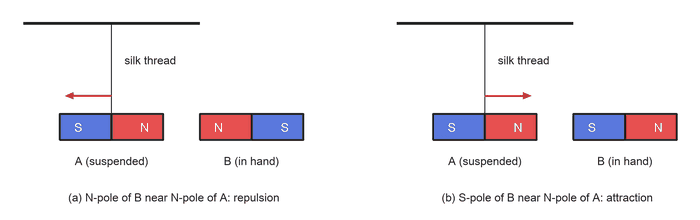
We need two bar magnets A and B with marked poles, a silk thread and a wooden stand.
Step 2 — Suspend magnet A.
Hang magnet A from the stand by the silk thread so that it can swing freely. It comes to rest in the north-south direction.
Step 3 — Bring like poles near each other.
Hold magnet B in the hand and bring its north pole near the north pole of the suspended magnet A, without touching it.
Step 4 — Bring unlike poles near each other.
Now bring the south pole of magnet B near the north pole of magnet A, again without touching it.
Step 5 — Note the observations.
In Step 3 the north pole of A moves away from B, so two north poles repel. In Step 4 the north pole of A moves towards B, so a south pole and a north pole attract. Repeating with the south pole of A gives the same result: two south poles repel.
Step 6 — Draw the conclusion.
The observations show the law of magnetism.
Therefore, like poles of two magnets repel each other while unlike poles attract each other.
- 613 marks
Question 61
Explain the meaning of the term, 'magnetic field'.
Solve with AIWritten solution
Solution:
Concept: A magnet affects a compass needle placed anywhere in the space around it, not only when the needle touches it.
Step 1 — Observe a compass alone.
Place a magnetic compass on a table, away from any magnet. Its needle rests in the north-south direction.
Step 2 — Bring a bar magnet near it.
Place a bar magnet near the compass. The needle turns and comes to rest in a different direction.
Step 3 — Move the compass around the magnet.
Place the compass at different points around the bar magnet. The direction in which the needle rests changes from point to point. This shows that the space around the magnet can act on a magnetic needle.
Step 4 — Define the magnetic field.
The space around a magnet in which a magnetic needle is influenced (deflected) is called the magnetic field of that magnet.
Step 5 — Add two facts about it.
The magnetic field is strongest near the poles and becomes weaker farther from the magnet. A wire carrying current also has a magnetic field around it, which is how an electromagnet works.
Therefore, the magnetic field of a magnet is the space around it in which a magnetic needle is deflected.
- 624 marks
Question 62
Draw a labelled diagram to make a soft iron bar as an electromagnet. Describe in steps the procedure.
Solve with AIWritten solution
Solution:
Concept: An electromagnet is a coil of insulated copper wire wound on a soft iron core. When current flows in the coil, the core becomes a strong magnet. When the current is switched off, the soft iron loses almost all its magnetism, so an electromagnet is a temporary magnet.
Step 1 — Take a soft iron bar.
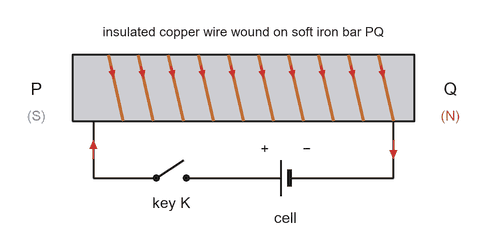
Take a soft iron bar PQ.
Step 2 — Wind the coil.
Wind thin insulated copper wire closely around the bar. The wire is insulated so that the current goes round every turn, instead of taking a short cut through turns that touch each other or through the bar.
Step 3 — Complete the circuit.
Join the two ends of the coil to a cell (or battery) and a key K, all in series, as in the diagram.
Step 4 — Close the key.
Close the key K. Current flows through the coil and the bar becomes a magnet. Bring a few iron pins near it: they cling to the bar.
Step 5 — Open the key.
Open the key K. The current stops and the bar loses its magnetism, so the pins drop off.
Step 6 — Find the poles.
Look at each end of the bar along its length. The end at which the current in the turns appears to flow anticlockwise becomes the north pole, and the end where it appears clockwise becomes the south pole (clock rule). With the current shown in the diagram, end Q becomes N and end P becomes S.
Watch out: If the current is reversed, the poles are reversed too.
Therefore, a soft iron bar wound with insulated copper wire becomes an electromagnet while current flows through the coil, and loses its magnetism when the current is switched off.
- 633 marks
Question 63
You are given a U shaped soft iron piece, insulated copper wire and a battery. Draw a circuit diagram to make a horse shoe electromagnet.
Solve with AIWritten solution
Solution:
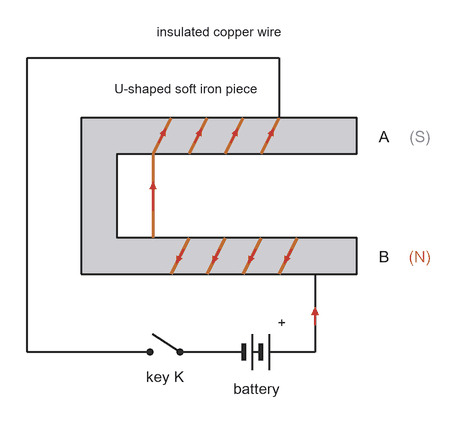
Concept: In a horse-shoe electromagnet the wire is wound on the two arms in opposite senses. Then one free end becomes a north pole and the other a south pole, and a strong field is produced in the gap between them.
Step 1 — Wind the first arm.
Wind the insulated copper wire closely on one arm (A) of the U-shaped soft iron piece.
Step 2 — Wind the second arm in the opposite sense.
Take the wire across the bend and wind it on the other arm (B) in the opposite sense, as seen from the free ends. If both arms were wound in the same sense, both free ends would become the same pole and the field in the gap would be weak.
Step 3 — Join the battery and key.
Join the two free ends of the wire to the battery through a key K, all in series.
Step 4 — Close the key.
When the key is closed, current flows in the coil. The U-shaped piece becomes a horse-shoe electromagnet. With the current shown, end A becomes S and end B becomes N.
Step 5 — Open the key.
When the key is opened, the current stops and the piece loses its magnetism.
Therefore, winding insulated copper wire on the two arms in opposite senses and passing current from a battery through it makes the U-shaped soft iron piece a horse-shoe electromagnet.
- 644 marks
Question 64
Draw a neat and labelled diagram of an electric bell and describe its working.
Solve with AIWritten solution
Solution:
Concept: An electric bell works on the magnetic effect of current. Its horse-shoe electromagnet pulls a soft iron armature, so the hammer fixed to the armature strikes the gong. The armature then breaks the circuit at the contact screw, and a spring brings it back, so the circuit is made and broken again and again.
Step 1 — Draw and label the diagram.
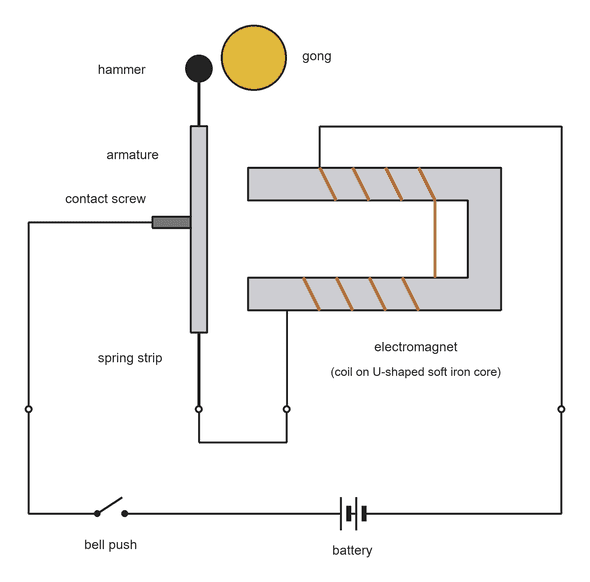
The diagram shows the parts of an electric bell joined in one series circuit.
Step 2 — Name the main parts.
An electric bell has a horse-shoe electromagnet, a soft iron armature fixed on a springy metal strip, a hammer at the top of the armature, a gong, a contact screw that touches the strip, a bell push and a battery. The battery, bell push, contact screw, springy strip and the coil of the electromagnet are all in series.
Step 3 — Press the bell push.
When the bell push is pressed, the circuit is complete. Current flows through the coil, so the electromagnet becomes a magnet and attracts the armature. The hammer strikes the gong and the bell rings.
Step 4 — See how the circuit breaks.
As the armature moves towards the electromagnet, the springy strip leaves the contact screw. The circuit breaks, the current stops and the electromagnet loses its magnetism.
Step 5 — See how the circuit is made again.
The springy strip brings the armature back. It touches the contact screw again and completes the circuit once more, so the electromagnet attracts the armature again and the hammer strikes the gong again.
Step 6 — Follow the repeat.
This making and breaking of the circuit happens many times a second. The bell keeps ringing as long as the bell push is pressed.
Therefore, an electric bell rings because its electromagnet repeatedly attracts the armature and its springy strip repeatedly breaks and remakes the circuit at the contact screw.
- 654 marks
Question 65
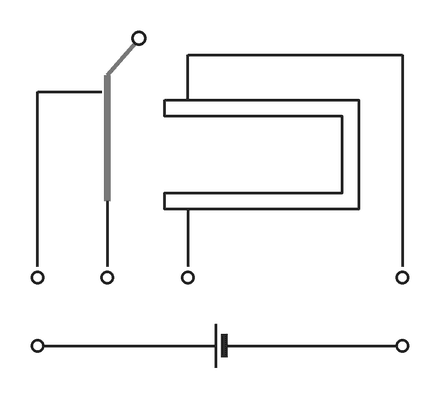
The incomplete diagram of an electric bell is given in Fig. 7.39. Complete the diagram and label its different parts.
 Solve with AI
Written solution
Solution:
Concept: In an electric bell the coil of the electromagnet, the springy strip, the contact screw, the bell push and the battery must all lie in one series path, and a gong must be placed where the hammer can strike it.
Step 1 — Add the coil.
Wind insulated copper wire on the two arms of the U-shaped soft iron core, in opposite senses, so that it becomes a horse-shoe electromagnet.
Step 2 — Add the gong.
Place a gong just beside the hammer at the top of the armature, on the side towards which the armature is pulled.
Step 3 — Join the strip to the coil.
Join the terminal of the springy strip to the terminal of one end of the coil with a wire.
Step 4 — Add the battery and bell push.
Join the battery and a bell push in series between the terminal of the contact screw and the terminal of the other end of the coil.
Step 5 — Draw the completed diagram.
The completed and labelled diagram is shown below.
Step 6 — Trace the current.
When the bell push is pressed, current flows round the series path: battery, bell push, contact screw, springy strip, coil of the electromagnet and back to the battery. The electromagnet attracts the armature, the hammer strikes the gong, the strip leaves the contact screw and the circuit breaks. The strip springs back and the whole process repeats.
Therefore, the completed bell has the coil on the U-shaped core, a gong beside the hammer, a wire from the springy strip to the coil, and the battery and bell push between the contact screw and the other end of the coil.
- 664 marks
Question 66
What is declination? Draw a diagram to show the angle between the declination and true direction of geographic north.
Solve with AIWritten solution
Solution:
Concept: A compass needle points to the magnetic north, which is not exactly the geographic (true) north.
Step 1 — Define declination.
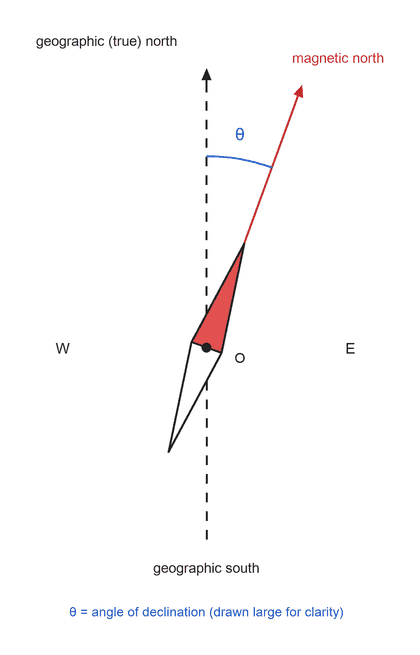
Magnetic declination at a place is the angle, in the horizontal plane, between the magnetic north (the direction in which a freely suspended magnet points) and the geographic or true north. It is shown by the symbol .
Step 2 — Draw the diagram.
In the diagram the dashed line is the geographic north-south line through the pivot O, and the red line is the direction of the compass needle. The angle between them is the angle of declination.
Step 3 — Give its sign.
Declination is called east (positive) when the magnetic north lies to the east of the true north, as in the diagram, and west (negative) when it lies to the west.
Step 4 — Note how it varies.
The declination is different at different places on the earth, and at any one place it slowly changes with time.
Watch out: In the diagram the angle is drawn large so that it is easy to see; in India the real angle is only a few degrees or less.
Therefore, declination is the angle between the magnetic north and the geographic (true) north at a place.
- 674 marks
Question 67
Describe an experiment to show that electricity flows only if the circuit is complete and it does not flow if the circuit is incomplete.
Solve with AIWritten solution
Solution:
Concept: An electric circuit is the path along which electricity flows from one terminal of a cell, through the connecting wires and components, to the other terminal. Electricity flows only when this path is complete (closed) and made entirely of conductors.
Step 1 — Collect the apparatus.
We need a cell, a torch bulb, about one metre of insulated metal wire, a blade and some cellotape.
Step 2 — Prepare the wires.
Cut the wire into two halves and remove the plastic covering from both ends of each wire with the blade, so that bare metal can touch the terminals.
Step 3 — Join the bulb to the cell.
With cellotape, fix one end of each wire to a terminal of the bulb. Fix the other ends of wire 1 and wire 2 to the two terminals of the cell, and observe the bulb.
Step 4 — Break the circuit.
Now remove wire 1 from the terminal of the cell, leaving a gap in the path, and observe the bulb again.

Step 5 — Note the observations.
With both wires joined, the bulb glows: electricity flows from one terminal of the cell through wire 1, the filament of the bulb and wire 2 to the other terminal, so the circuit is complete. With wire 1 removed, the bulb does not glow: there is a gap in the path, so the circuit is incomplete.
Therefore, electricity flows only if the circuit is complete; if the circuit is broken anywhere, electricity does not flow.
- 683 marks
Question 68
You are provided with a torch bulb, a cell and two plastic coated metal wires. Draw a diagram to show a complete circuit to light the bulb.
Solve with AIWritten solution
Solution:
Concept: Each terminal of the bulb must be joined by a conductor to a different terminal of the cell, so that there is a complete path through the filament.
Step 1 — Bare the wire ends.
Remove the plastic coating from both ends of each wire. Plastic is an insulator, so only bare metal ends can make contact with the terminals.
Step 2 — Join the first wire.
Join one terminal of the bulb to the positive terminal of the cell with wire 1.
Step 3 — Join the second wire.
Join the other terminal of the bulb to the negative terminal of the cell with wire 2.
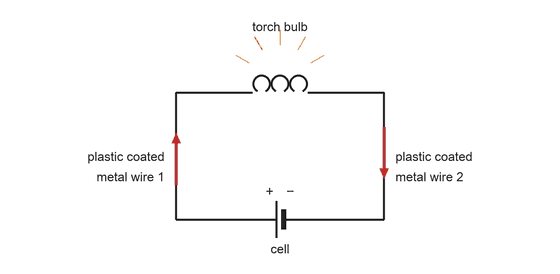
Step 4 — Check the path.
The path cell, wire 1, bulb, wire 2 and back to the cell is complete and made of conductors. So current flows and the bulb glows. The arrows show the direction of current, from the positive terminal round to the negative terminal.
Therefore, the bulb lights when its two terminals are joined by the two bared wires to the two different terminals of the cell.
- 693 marks
Question 69
In which of the following cases the bulb will glow:
(i) Only one terminal of a cell is joined with a metal wire to one terminal of the bulb.
(ii) Both terminals of the bulb are joined with two metal wires to one terminal of the cell.
(iii) One terminal of the cell is joined to one terminal of the bulb and other terminal of the cell to the other terminal of the bulb.
 Solve with AI
Written solution
Solution:
Concept: A bulb glows only if there is a complete path from one terminal of the cell, through the bulb, to the other terminal of the cell.
Step 1 — Check case (i).
Only one wire joins one terminal of the cell to one terminal of the bulb. There is no return path to the other terminal of the cell, so the circuit is incomplete and the bulb does not glow.
Step 2 — Check case (ii).
Both terminals of the bulb are joined to the same terminal of the cell. The other terminal of the cell is not connected at all, so no current flows through the bulb and it does not glow.
Step 3 — Check case (iii).
One terminal of the cell goes to one terminal of the bulb and the other terminal of the cell goes to the other terminal of the bulb. The path is complete, so current flows and the bulb glows.
Watch out: Joining wires to both terminals of the bulb is not enough; they must end on the two different terminals of the cell.
Therefore, the bulb will glow only in case (iii).
- 703 marks
Question 70
Distinguish between conductors and insulators of electricity. Give two examples of each.
Solve with AIWritten solution
Solution:
Concept: Substances that allow electricity to flow through them are conductors: all metals, the human body and impure (ordinary) water. Substances that do not allow electricity to flow are insulators: rubber, plastic, dry wood, glass, paper, cotton, silk, wool and pure (distilled) water.
Step 1 — Compare the two groups.
The table compares conductors and insulators point by point.
Conductors Insulators Substances that allow electricity to flow through them. Substances that do not allow electricity to flow through them. A bulb in a circuit glows when a conductor fills a gap in the circuit. A bulb in a circuit does not glow when an insulator fills the gap. Used for connecting wires and parts that carry current. Used to cover wires and to make switch covers and tool handles, to protect us from shocks. Examples: copper, silver (all metals), human body, impure water. Examples: rubber, plastic, dry wood, glass, cotton, pure (distilled) water. Step 2 — Pick two examples of each.
Two conductors are copper and silver. Two insulators are rubber and plastic.
Therefore, conductors (such as copper and silver) allow electricity to flow through them, while insulators (such as rubber and plastic) do not.
- 714 marks
Question 71
State the function of each of the following in an electric circuit and draw its symbolic representation : (i) Switch and (ii) Cell.
Solve with AIWritten solution
Solution:
Concept: Each component of a circuit has its own job and its own standard symbol.
Step 1 — Give the function of a switch.
A switch (or key) is used to put the circuit on and off. When it is closed, the circuit is complete and current flows (on). When it is open, the circuit is broken and the current stops (off).
Step 2 — Give the function of a cell.
A cell is the source of electricity in the circuit. A chemical reaction inside it changes chemical energy into electrical energy and keeps the current flowing.
Step 3 — Draw the symbols.
The symbols are drawn below. In the cell symbol, the long thin line is the positive (+) terminal and the short thick line is the negative (−) terminal.
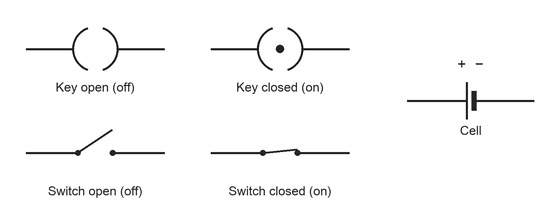
Therefore, a switch puts the circuit on and off, and a cell is the source of electricity in the circuit; their symbols are shown above.
- 723 marks
Question 72
Draw a circuit diagram for a bulb connected to a cell with a switch. Mark arrows in the diagram to indicate the direction of flow of current.
Solve with AIWritten solution
Solution:
Concept: In the symbol of a cell, the long thin line is the positive (+) terminal and the short thick line is the negative (−) terminal. The conventional current flows in the outer circuit from the positive terminal to the negative terminal.
Step 1 — Join the components.
Join the cell, the switch and the bulb one after another in a single loop with connecting wires, as shown.
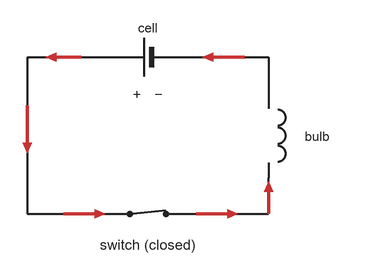
Step 2 — Close the switch.
When the switch is closed, the circuit is complete and current flows.
Step 3 — Mark the arrows.
The arrows start at the positive terminal (long line) of the cell, pass through the switch and the bulb, and come back to the negative terminal (short line) of the cell.
Watch out: The electrons move the opposite way, but the arrows show the conventional current, from + to −.
Therefore, the current arrows run from the positive terminal of the cell, through the switch and the bulb, back to the negative terminal.
- 732 marks
Question 73
Select conductors and insulators from the following:
Glass, silver, copper, wood, paper, pure water, impure water, aluminium, iron, leather, plastic, steel, human body and ebonite.
Solve with AIWritten solution
Solution:
Concept: Substances that allow electricity to flow through them are conductors: all metals, the human body and impure (ordinary) water. Substances that do not allow electricity to flow are insulators: rubber, plastic, dry wood, glass, paper, cotton, silk, wool and pure (distilled) water.
Step 1 — Sort the conductors.
Silver, copper, aluminium, iron and steel are metals, so they are conductors. Impure water and the human body also conduct electricity.
Step 2 — Sort the insulators.
Glass, wood, paper, leather, plastic and ebonite do not let electricity flow, so they are insulators. Pure (distilled) water is also an insulator, because it has almost no dissolved salts.
Conductors Insulators Silver Glass Copper Wood Impure water Paper Aluminium Pure water Iron Leather Steel Plastic Human body Ebonite Watch out: Pure water is a very poor conductor, but water with impurities, such as tap water, conducts; wet wood or leather also conducts.
Therefore, the conductors are silver, copper, impure water, aluminium, iron, steel and the human body; the insulators are glass, wood, paper, pure water, leather, plastic and ebonite.
- 743 marks
Question 74
The following diagram (Fig. 7.40) shows four circuits A, B, C and D. Each circuit has a cell and a torch bulb. Name the circuits in which the bulb will glow? Give reason to your answer.
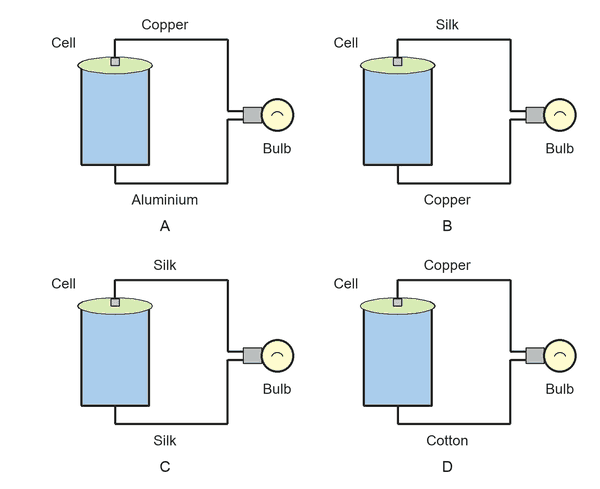 Solve with AI
Written solution
Solution:
Concept: A bulb glows only if every part of the circuit is made of conductors. One insulator anywhere in the path makes the circuit incomplete.
Step 1 — Check the wires of each circuit.
The table lists the two connecting wires in each circuit of Fig. 7.40 and whether both are conductors.
Circuit Wires Both conductors? Bulb A copper and aluminium yes glows B silk and copper no, silk is an insulator does not glow C silk and silk no, both are insulators does not glow D copper and cotton no, cotton is an insulator does not glow Step 2 — Give the reason.
In circuit A both wires, copper and aluminium, are metals and so are conductors. The circuit is complete and current flows through the bulb. In circuits B, C and D at least one wire is of silk or cotton, which are insulators, so the circuit is incomplete and no current flows.
Therefore, the bulb will glow only in circuit A, because only there both connecting wires are conductors.
- 752 marks
Question 75
The diagram given below (Fig. 7. 41) shows a bulb connected with a cell having terminals A and B. Mark the direction of current in the bulb.
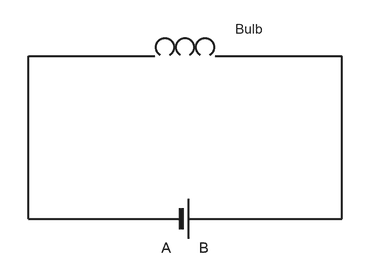 Solve with AI
Written solution
Solution:
Concept: In the symbol of a cell, the long thin line is the positive (+) terminal and the short thick line is the negative (−) terminal. Current flows in the outer circuit from the positive terminal to the negative terminal.
Step 1 — Find the positive terminal.
In Fig. 7.41 the line at B is the longer line, so B is the positive (+) terminal. The shorter, thicker line at A is the negative (−) terminal.
Step 2 — Trace the current.
Current leaves terminal B, goes up the right-hand wire, passes through the bulb from right to left, and comes down the left-hand wire to terminal A.

Therefore, in the bulb the current flows from right to left, from the side joined to B towards the side joined to A.
- 762 marks
Question 76
In which arrangement are the appliances connected in the electric circuit of our homes, Series or Parallel? Give one reason for your answer.
Solve with AIWritten solution
Solution:
Concept: In a parallel arrangement each appliance is joined directly across the supply, so each one works on its own.
Step 1 — State the arrangement.
The appliances in the electric circuit of our homes are connected in parallel.
Step 2 — Give the reason.
In a parallel circuit every appliance works independently. Each appliance can be switched on or off with its own switch without affecting the others, and if one goes out of order the rest keep working. For example, switching on a tube light does not affect the fan.
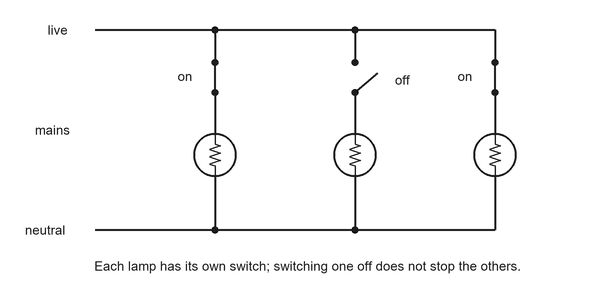
Step 3 — Compare with series.
In a series circuit all appliances would work only together: if one were switched off or went out of order, all the others would stop too. Each appliance in parallel also gets the full mains voltage (230 V).
Therefore, home appliances are connected in parallel, so that each one can be switched on and off and can work independently of the others.
What Class 7 Physics Ch 7 covers
The sections of the chapter, in the order the book takes them. Every question above comes from one of these.
- 01Law of Magnetism
- 02Magnetic Field
- 03Electromagnet
- 04Uses of Electromagnets
- 05Earth's Magnetic Declination
- 06Use of Electricity and Its Sources
More ways to study this chapter
The same chapter asked three other ways. Practise it, revise it, and see what the board has set on Ch 7 before.
Class 7 Physics Ch 7 questions students ask
How many questions are there in Class 7 Physics Ch 7?
76 questions. Every one is solved step by step on this page.
Are these Class 7 Physics solutions free?
Yes. Every question and its full working is free to read, with no account needed.
Can I download the Class 7 Physics Ch 7 solutions as a PDF?
There is no PDF to download. Every solution is on this page instead, which means it is searchable, always the current syllabus, and readable on a phone. Use your browser's print option if you want it on paper.